
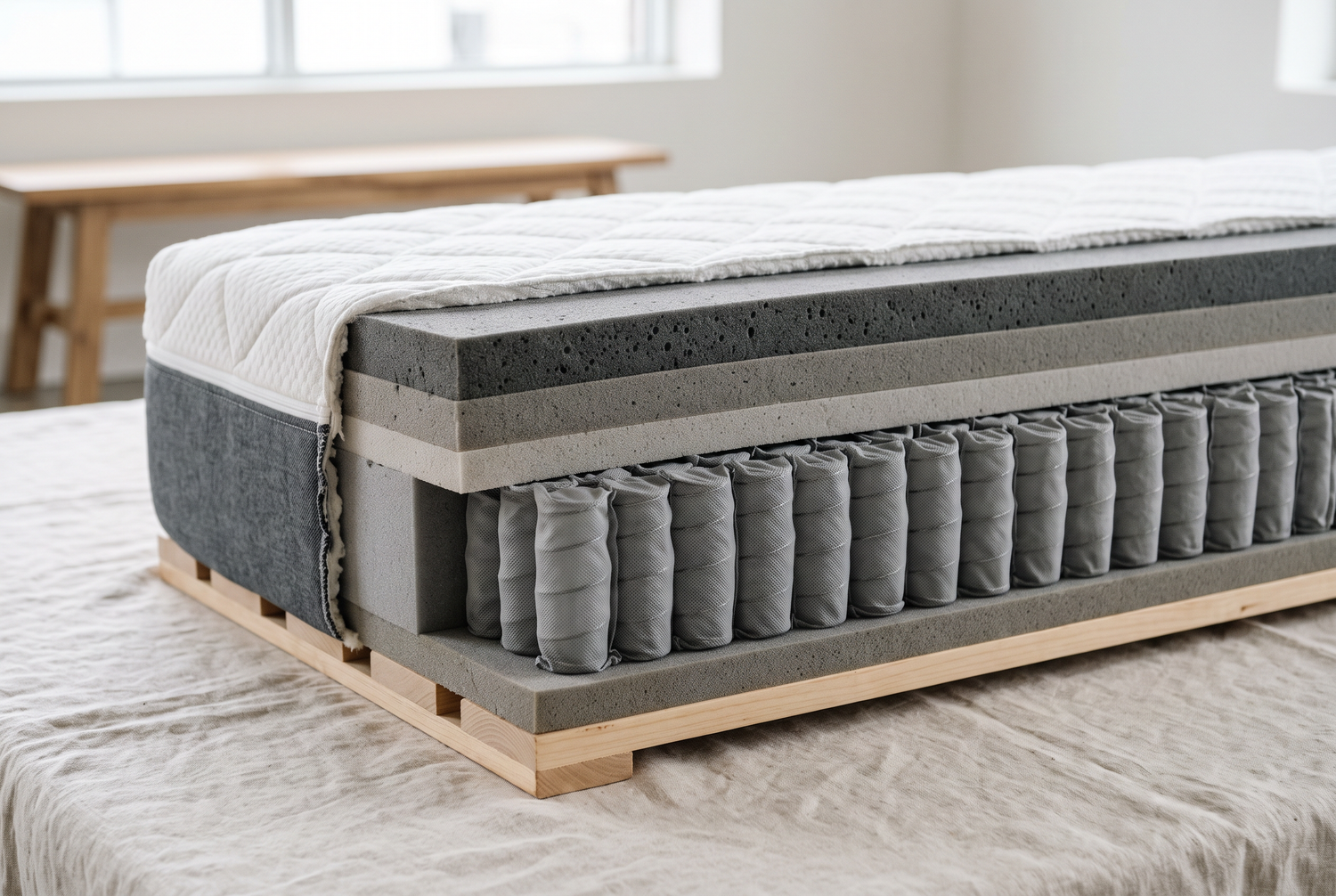
The idea behind the hybrid mattress sounds compelling: you take the spring core for support and air circulation, lay a foam layer on top for precise body contouring – and you have the best of both worlds. In recent years, this construction method has therefore grown significantly, especially in the mid and upper price segments. In practice, however, it turns out that "hybrid" is a very broad term. Some models consist of a high-quality pocket spring core with a 7 cm comfort layer, others of a simple spring core with a 2 cm foam topper – and both can call themselves hybrid mattresses. This article explains how a hybrid mattress is constructed, what the combination actually achieves, and how to distinguish a good one from a mediocre one.
The short answer: A hybrid mattress combines a pocket spring core as the supporting base with one or more foam layers on top – usually cold foam, visco or gel foam. The spring core provides support, edge stability, and good air circulation, while the foam ensures point elasticity and pressure distribution. The combination works well if both components are high-quality and the comfort layer is at least 5 cm thick. Disadvantages: high weight, often over 30 kg, higher price, and a more complex construction where individual layers can age at different rates.
- Hybrid = pocket spring core as base plus foam layers as comfort zone.
- The comfort layer should be at least 5 cm thick, otherwise the spring core dominates.
- Good ventilation, high edge stability, decent point elasticity.
- Weight often 30–45 kg for 160 x 200 cm – turning becomes a two-person job.
- The term "hybrid" is not legally protected – check layer thicknesses and density.
How a hybrid mattress is constructed
From bottom to top, a typical hybrid mattress consists of four layers. At the very bottom, there is often a base layer of firm foam, which decouples the spring core from the slatted frame and dampens noise. Above that is the actual support core: a pocket or barrel pocket spring core with typically 250 to 1000 springs per sleeping surface in 90 x 200 cm, usually 12 to 18 cm high. A foam frame is often used at the edge to increase edge stability – important so that you can sit on the edge of the bed without sinking in. On top of this lies the comfort layer of cold foam, visco foam or gel foam, usually 3 to 8 cm thick. The whole is completed by a quilted, usually removable and washable cover. The total height is therefore often 22 to 30 cm – significantly more than pure foam mattresses with 16 to 22 cm. This is relevant when buying fitted sheets: pay attention to sufficient depth, see the right fitted sheet.
What the combination actually achieves
The spring core takes on the load bearing. Because there is a lot of air space between the springs, moisture is well wicked away – relevant because an adult releases around 0.3 to 0.5 liters of fluid per night. The foam above takes care of the fine work: it distributes pressure on the shoulders and hips, where in a side position around 30 to 35 percent of body weight rests on a small area. This division of labor works – but only up to a certain point. If the comfort layer is too thin, the spring structure pushes through, and the point elasticity remains at the level of the spring core. As a rule of thumb: below 5 cm of comfort layer, the spring behavior dominates; from 6 to 8 cm, a real hybrid feeling develops. If, on the other hand, the layer is very thick, the spring core loses its influence and the climatic advantages diminish, because the air no longer circulates up to the body surface. The sweet spot for most constructions is between 5 and 8 cm. How the individual core types work on their own can be found under pocket spring mattress and cold foam mattress.

Advantages and disadvantages at a glance
| Aspect | Hybrid mattress | Pure foam mattress |
|---|---|---|
| Air circulation | Very good due to spring core | Good with open-cell foam |
| Edge stability | High (foam frame) | Medium to high |
| Point elasticity | Good from 5 cm comfort layer | Very good with adaptive foam |
| Weight (160 x 200 cm) | approx. 30–45 kg | approx. 18–30 kg |
| Total height | approx. 22–30 cm | approx. 16–22 cm |
| Handling when turning | Heavy, usually requires two people | Usually possible alone |
| Suitability for adjustable slatted frames | Limited | Good |
Common mistakes when buying a hybrid mattress
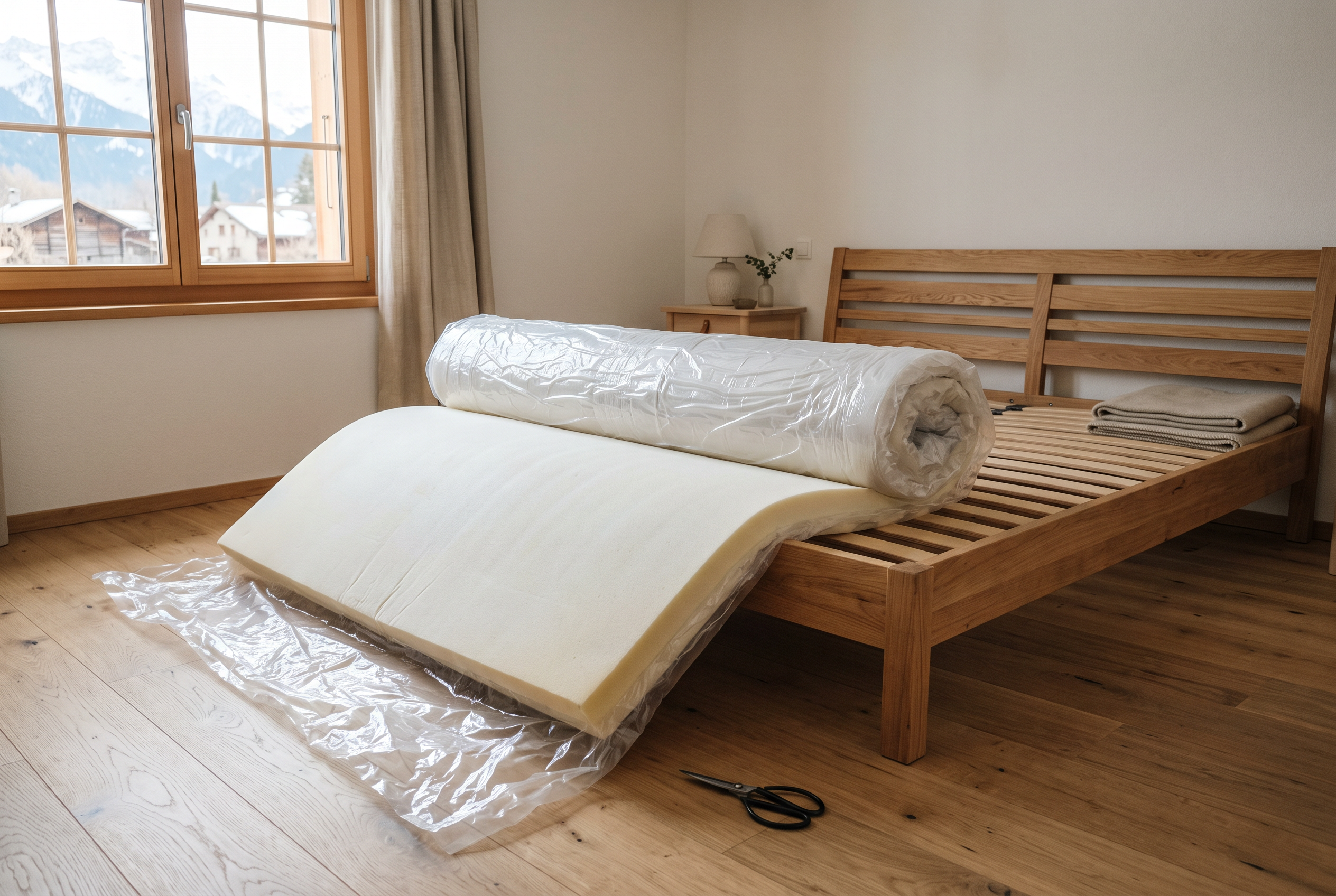
Only looking at the number of springs. 1000 springs sound impressive, but say nothing about wire gauge, spring height, or the quality of the comfort layer. Not asking about the thickness of the comfort layer. This is exactly where marketing separates from substance. If the information is not in the data sheet, ask – you should be skeptical if it's under 5 cm. Ignoring the foam density. Even with hybrid mattresses, at least 40 kg/m³ is recommended, better 50 or more, otherwise hollows will quickly form in the comfort layer while the spring core is still intact. Details under density explained. Underestimating the weight. A hybrid mattress in 160 x 200 cm often weighs 35 to 45 kilograms. Regular turning – recommended every three months, see turning or flipping – thus becomes a two-person task. Transport during a move and subsequent disposal are also more complex. Ignoring adjustable slatted frames. Spring cores can only be bent to a limited extent; for motorized frames, a pure foam mattress is usually the better choice.
How to test a hybrid mattress in practice
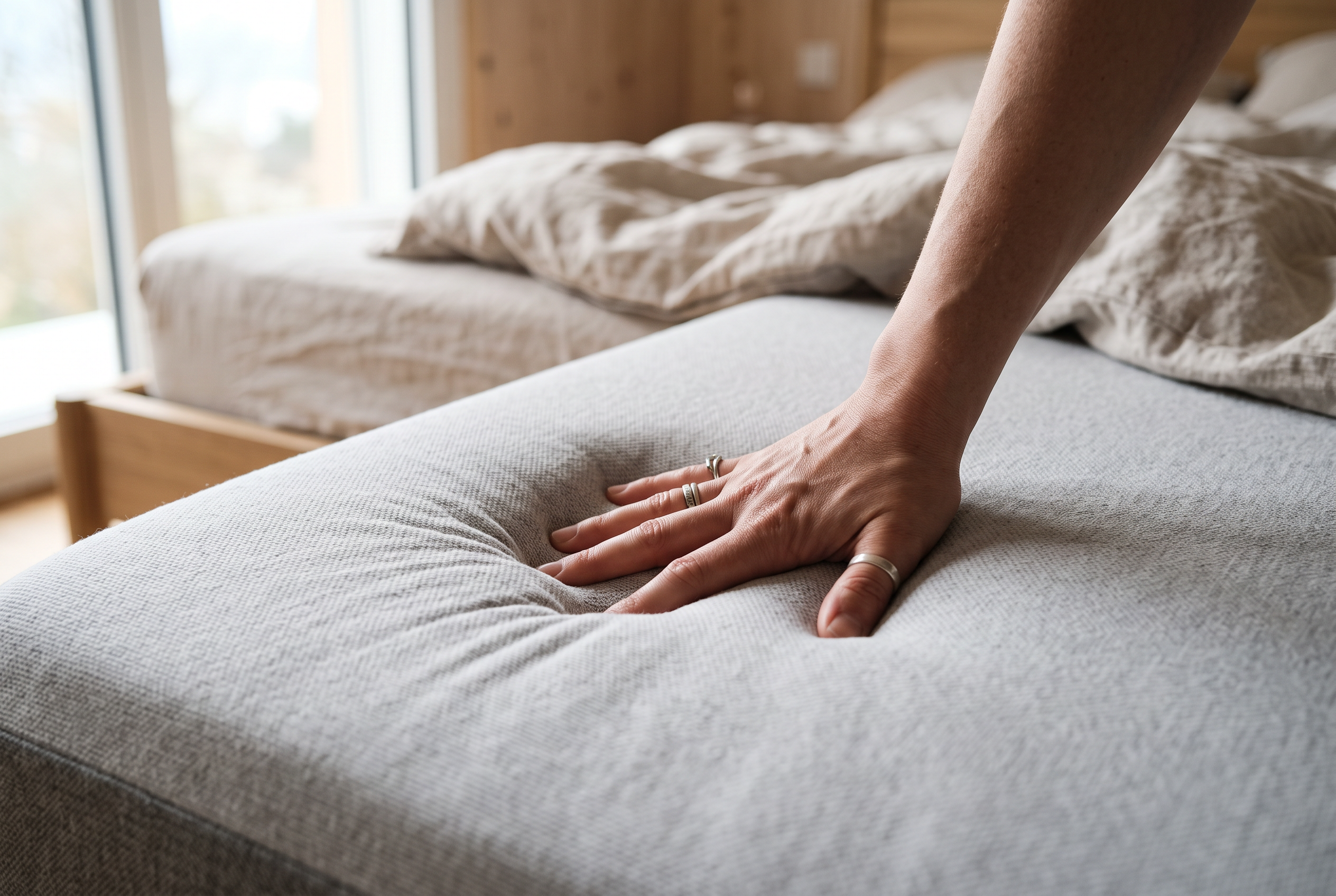
Step 1: Read the data sheet. Note the spring type, number of springs, core height of the spring core, material and thickness of each comfort layer, foam density, total height, and total weight. If more than two of these details are missing, caution is advised. Step 2: Test edge stability. Sit on the edge. If it sinks more than about 5 cm, a load-bearing edge frame is missing – relevant especially for older people and anyone who sits on the edge of the bed to get dressed. Step 3: Spinal test in side position. Have someone check from behind if your spine forms a straight line. If your hips sag, the comfort layer is too soft for your body type; if there's a gap between your waist and the mattress, the spring core is pushing through. Step 4: Check motion transfer. Place a glass of water on the mattress and move 50 cm next to it. With good constructions, the surface remains still – important for couples, see mattress for couples. Step 5: Test at home. Allow 14 to 30 nights of adjustment before making a judgment.
Who a hybrid mattress is suitable for
This construction is particularly useful for people who sweat a lot and still need good body adaptation – the spring core provides the climatic advantage here. It is also well suited for people with higher body weight, because a high-quality pocket spring core can absorb a lot of load without sagging. Anyone who appreciates a high, stable bed edge will also find a good solution in a hybrid construction with a foam frame. It is less suitable for adjustable slatted frames, in attics or rooms with narrow stairs where the weight becomes a problem, and for anyone who wants to turn their mattress regularly themselves. And those looking for maximum point elasticity are often better served with a high-quality adaptive foam: a foam is not tied to a spring grid and can deform continuously. An overview of all construction types is offered by our mattress type comparison; the differences within spring cores are explained by Bonell spring vs. pocket spring.

Get CHF 25 discount
Subscribe to newsletter and receive a one-time CHF 25 discount. ✓ 200 nights trial sleep ✓ 10 years warranty
Frequently asked questions about hybrid mattresses
What is a hybrid mattress?
A hybrid mattress combines a pocket spring core as a supporting base with one or more foam layers on top, usually made of cold foam, visco foam or gel foam. The spring core provides support and air circulation, while the foam ensures pressure distribution and body contouring.
How thick should the comfort layer be?
As a rule of thumb: at least 5 cm, ideally 6 to 8 cm. Below 5 cm, the spring core will be noticeably felt, and the point elasticity remains at the level of a pure spring mattress. Very thick layers over 10 cm negate the climatic advantages of the spring core.
How heavy is a hybrid mattress?
In the size 160 x 200 cm, hybrid mattresses often weigh 30 to 45 kilograms. This makes regular rotation, transport during a move, and later disposal more difficult. Plan for a second person to help with turning.
Is a hybrid mattress suitable for adjustable slatted frames?
Only to a limited extent. Spring cores are difficult to bend, which is why pure foam mattresses are generally better suited for motorized frames or adjustable slatted frames. In any case, check the manufacturer's approval.
Is a hybrid mattress better than a foam mattress?
Not necessarily. The hybrid construction excels in air circulation and edge stability, while high-quality adaptive foams achieve finer point elasticity and are significantly lighter. Which variant is better depends on sweating behavior, body weight, and sub-structure.
How long does a hybrid mattress last?
With good material quality, seven to ten years is realistic. It should be noted that the comfort layer usually ages faster than the spring core – so the mattress can feel worn out even though the core is still intact.








Leave a comment
This site is protected by hCaptcha and the hCaptcha Privacy Policy and Terms of Service apply.