
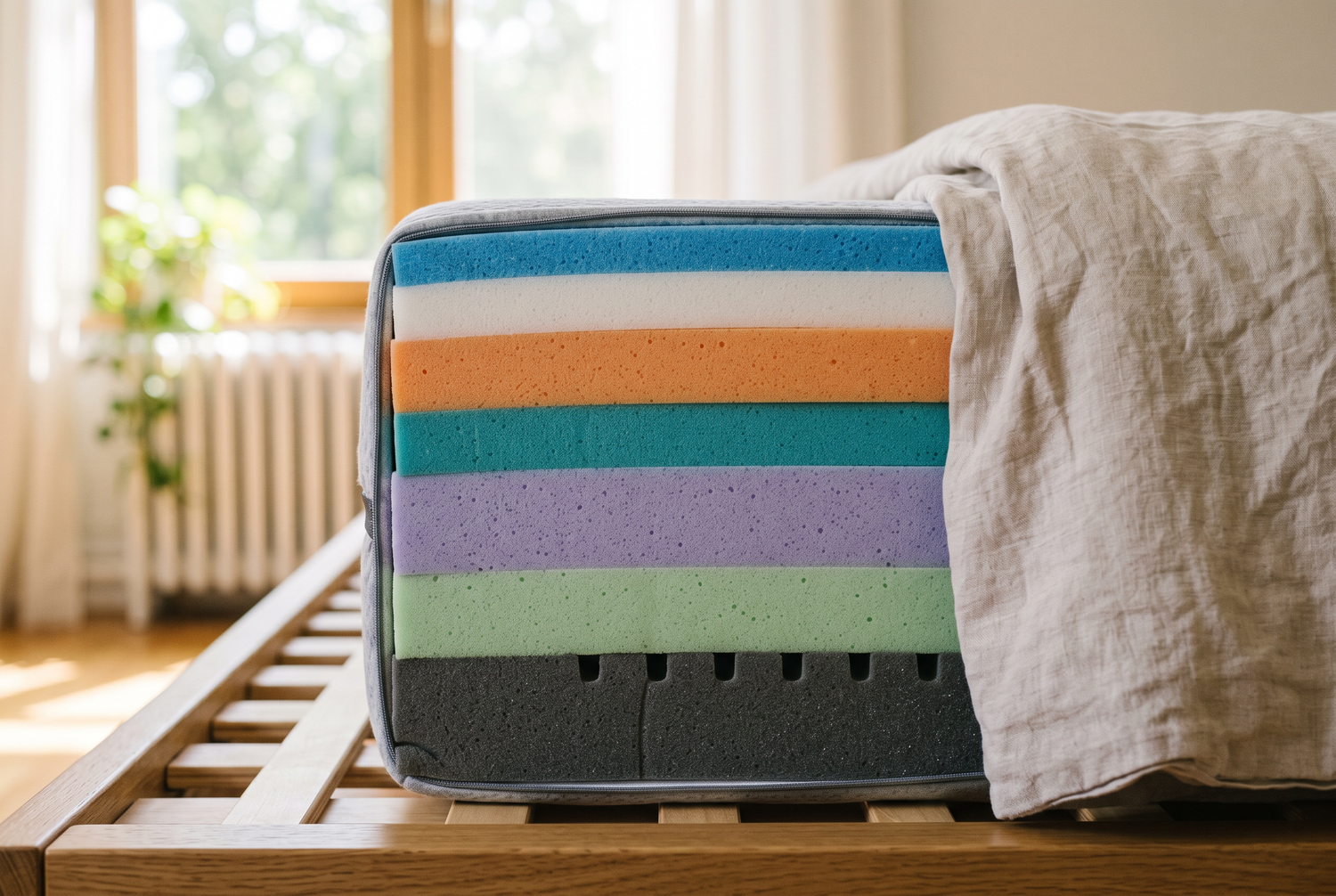
From the outside, mattresses look almost identical: a white cuboid with a fabric cover. What determines whether you sleep well on it for ten years or end up in a hollow after three years is hidden inside – in the construction of the mattress core. Modern mattresses are layered systems, where each layer fulfills a defined task: the base supports, the middle layer cushions and distributes, the comfort layer shapes the sleeping feel, and the cover regulates climate and hygiene. Understanding this construction allows you to read datasheets like a pro, distinguish marketing jargon from substance, and ask targeted questions when buying. This article dissects the mattress layer by layer: from the supporting core to climate layers, and addresses how many layers are actually useful – and how to recognize if true quality lies beneath the attractive cover.
The short answer: A high-quality mattress core typically consists of two to four functional layers: a supporting base layer (the actual core, at least 12 to 14 cm high), optionally a transitional support layer, and a 2 to 6 cm thick comfort layer for the sleeping feel – encased in a removable, washable cover with climate function. The decisive factor is not the number of layers, but their quality: density of the foams, clean adhesion, and an overall height of 18 to 25 cm are the more reliable quality indicators.
- The base layer accounts for 60 to 80 percent of the core height and determines durability and support – here, density decides the lifespan.
- The comfort layer (2–6 cm) forms the initial sleeping feel: softer foam, viscoelastic foam, latex, or adaptive premium foams.
- More layers do not mean more quality – five thin, cheap layers are worse than two high-quality ones.
- Overall heights of 18 to 25 cm are ideal for adults; under 16 cm, bottoming out and early fatigue are risks.
- The cover is part of the system: it should be removable, washable at 60 °C, and quilted with climate fibers.
The Base Layer: The Foundation of Every Mattress
At the very bottom is the base layer – a continuous block of cold foam or comfort foam in foam mattresses, the spring unit in innerspring models, and the vulcanized core in latex mattresses. It accounts for 60 to 80 percent of the core height and fulfills two tasks: it supports body weight and prevents the notorious "bottoming out" onto the slatted frame. Its quality determines the lifespan of the entire mattress: a base foam with a density under 35 kg/m³ will fatigue after a few years – no matter how luxurious the layers above it are. Good base layers are also profiled: incisions, cube, or wave cuts improve point elasticity and ventilation. Minimum values are 12 to 14 cm in height and RG 40; premium cores are at RG 50 and above. The article Understanding Indentation Hardness and Density explains what these metrics mean in detail.
Support and Transition Layers: The Mediators
Between the base and comfort layer, many mattresses feature one or two transition layers of 2 to 5 cm. Their task is to graduate the support: they mediate between the firm foundation and the soft surface, so the body doesn't abruptly "hit" a hard surface. In hybrid constructions, this role is often taken by a foam layer over the pocket spring core, which smooths the spring contour – the article on Hybrid Mattresses shows how this works in detail. High-quality adaptive foams sometimes make separate transition layers superfluous: their progressive characteristic curve – soft under light pressure, increasingly supportive under heavier loads – integrates the graduation directly into the material. This reduces adhesive surfaces, which has two advantages: fewer potential weak points (delamination, creaking) and better circulation. As a buyer, it's best to ask: What function does each individual layer have? If the provider cannot explain it, the layer may just be cosmetic for the datasheet.
The Comfort Layer: Where the Sleeping Feel is Created
The uppermost layer of the core determines how the mattress feels in the first few seconds. Typically, this is 2 to 6 cm of softer cold foam, viscoelastic foam (memory foam), gel foam, or latex. Viscoelastic foam reacts to body heat and slowly adapts – pressure-relieving but slow to respond to position changes (explained in detail in the article Viscoelastic Foam Explained). Latex springs dynamically and offers point elasticity. Modern adaptive foams like EvoPoreHRC combine both: pressure-relieving adaptation without the sinking-in sluggishness of classic memory foam. The relationship to the base is important: a comfort layer that is too thick and too soft (over 7 cm) causes the body to "sink into the layer" before the support engages – a common reason for morning back pain with seemingly comfortable mattresses. Conversely, at under 2 cm, the base is felt too directly. A good rule of thumb: 3 to 5 cm of high-quality comfort layer over a solid base.
| Layer | Typical Height | Function | Quality Feature |
|---|---|---|---|
| Cover with climate layer | 0.5–2 cm | Climate, hygiene, surface feel | Removable, washable at 60 °C |
| Comfort layer | 2–6 cm | Pressure relief, sleeping feel | High-quality material, appropriate thickness |
| Transition/Support layer | 2–5 cm | Graduation, weight distribution | Clearly explainable function |
| Base layer (core) | 12–18 cm | Load-bearing capacity, durability | RG 40+, profiling |

Cover and Climate Layers: The Underestimated Third
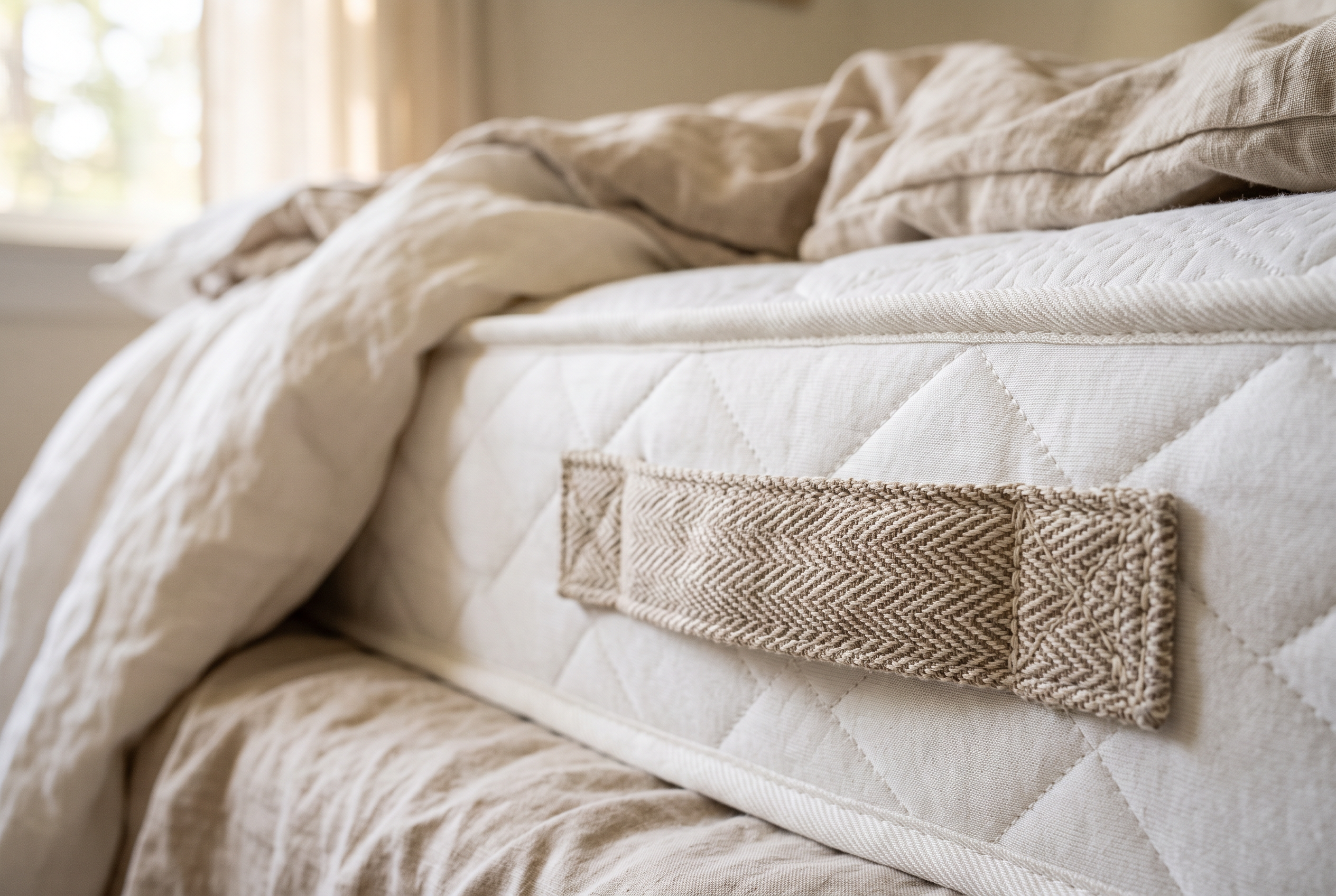
The cover is much more than just packaging. Every night, it absorbs a portion of the 0.3 to 0.5 liters of moisture the body releases, distributes it, and releases it again during the day. Good covers consist of double-knitted fabric with climate fibers (e.g., polyester hollow fiber or Lyocell) quilted in, are fully removable with a zipper – ideally divisible into two halves – and washable at 60 °C, the temperature that reliably removes mites and allergens. Side mesh climate bands further improve the core's cross-ventilation. Also check the workmanship: offset quilting seams, sturdy corner finishing, and handles for turning are signs of thoughtful construction. Washing instructions and care intervals are covered in the guide Washing a Mattress Cover. A detail with great impact: air should be able to circulate between the mattress and the slatted frame – closed bed base bottoms accumulate moisture and promote mold on the bottom of the core.
How many layers are useful? The Fact Check
Marketing likes to count: 5 layers, 7 layers, 9 zones. The truth is more sober. Functionally, a good mattress needs two to four layers – base, possibly transition, comfort, cover. Each additional layer means another adhesive surface, and adhesive surfaces are potential weak points: they can detach (delamination), develop noise, and hinder ventilation. Five thin 2-cm layers of cheap foam together result in less durability than a 16-cm mono-core with RG 50 plus a 4-cm comfort layer. Conversely, a single-layer cheap block without a differentiated characteristic curve supports less well than a well-designed two-layer system. The conclusion for buyers: don't ask "How many layers?", but "What does each layer do, and what is its density?". An overview of how core constructions – cold foam, pocket spring, latex, hybrid – fundamentally differ is provided by the comprehensive Mattress Type Comparison.
Common Mistakes in Assessing Mattress Construction
Mistake 1: Only evaluating the total height – 25 cm can consist of 20 cm of cheap foam. Mistake 2: Equating the number of layers with quality. Mistake 3: Ignoring the cover, even though it significantly determines climate and hygiene. Mistake 4: Considering "gel," "graphene," or "copper" additives as a reason to buy – for most of these admixtures, there is a lack of reliable evidence of efficacy. Mistake 5: Overlooking the interaction with the slatted frame: a fine multi-layer construction cannot work on a sagging frame; check slat spacing (maximum 4 cm) and condition. Mistake 6: Relying on renderings when buying online instead of declared data – reputable providers state materials, heights, and densities of each layer in writing. And Mistake 7: skipping the trial sleep. No layer diagram replaces the experience of several nights – which is why extensive trial sleeping remains the most reliable quality check.
Get CHF 25 Discount
Subscribe to our newsletter and receive a one-time CHF 25 discount. ✓ 200 nights trial sleep ✓ 10 years warranty

Frequently Asked Questions about Mattress Core Construction
How high should a good mattress be in total?
For adults, a total height of 18 to 25 cm is ideal, with at least 12 to 14 cm being the supporting core. Below 16 cm, the risk increases that heavier body parts will bottom out and the mattress will fatigue prematurely.
What is the most important layer of a mattress?
The base layer. It carries the body weight and, with its density, determines the lifespan of the entire mattress. A luxurious comfort layer over a cheap base core remains a short-lived construction.
Are mattresses with many layers better?
No. Functionally, two to four high-quality layers are sufficient. Each additional layer means another adhesive surface and thus a potential weak point. The material quality and clearly defined function of each layer are decisive, not their number.
How thick should the comfort layer be?
3 to 5 cm has proven effective. Below 2 cm, the base is felt too directly; above about 7 cm, the body sinks into the soft layer before the support engages – a common cause of morning back pain.
How do I recognize a high-quality mattress cover?
By an all-around zipper, divisibility into two halves, washability at 60 °C, and a quilted climate fiber. Side mesh bands additionally improve the ventilation of the core.
Can I assess the core construction when buying online?
Yes – reputable providers state the material, height, and density of each layer in writing. If this information is missing or remains vague, skepticism is appropriate. The final assessment, however, can only be made after an extended trial sleep at home.









Leave a comment
This site is protected by hCaptcha and the hCaptcha Privacy Policy and Terms of Service apply.