
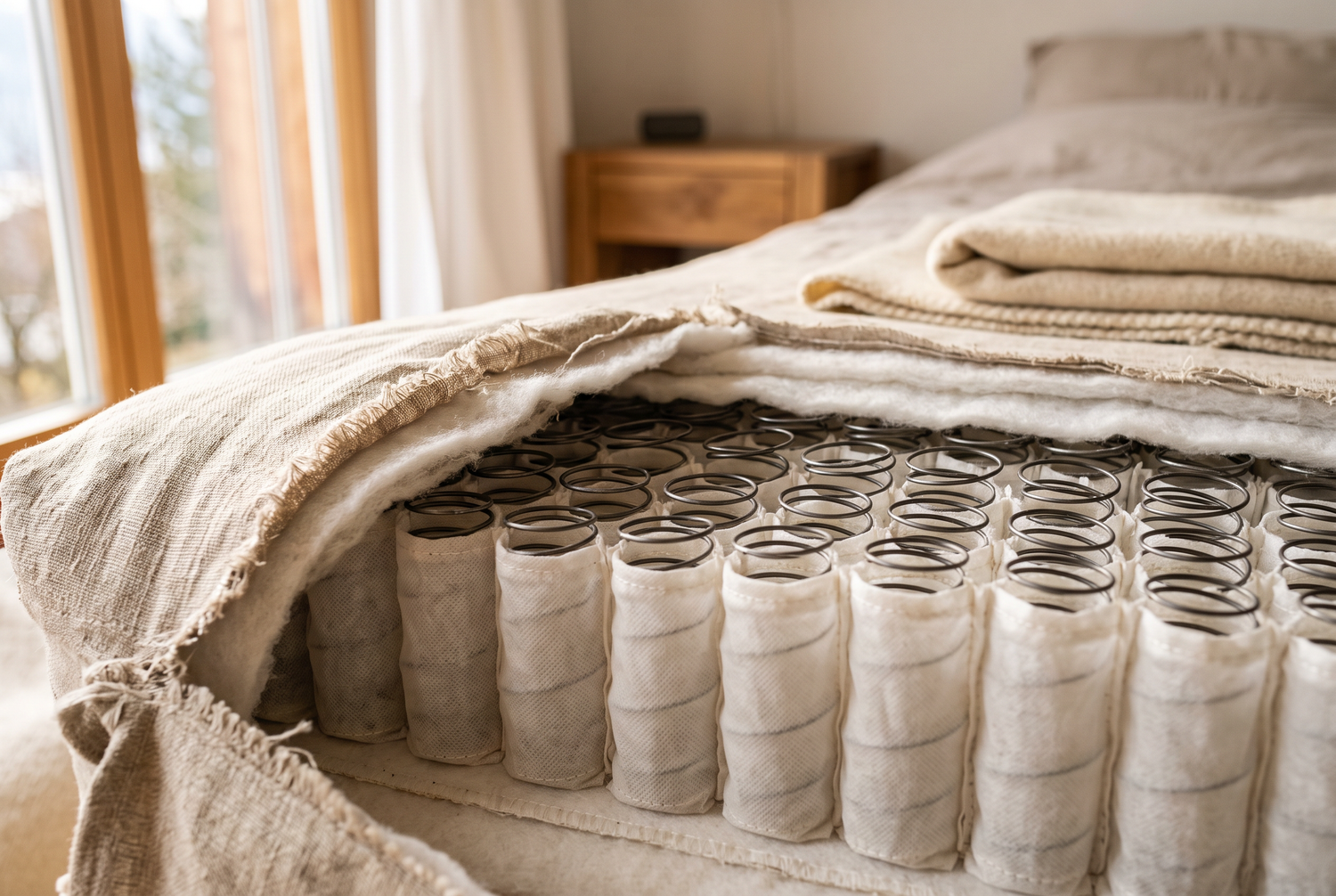
Anyone in Switzerland looking for a new mattress will almost inevitably come across the term pocket sprung mattress. It is considered a classic among spring core models and is often advertised in stores as being particularly precise and airy. At the same time, many remain unclear about what exactly is inside, what the difference is from a simple Bonnell spring core, and whether the often significant surcharge is justified. Added to this is a legitimate question: Is a spring core construction still up-to-date when modern foam systems actively adapt to the body and sleeping position? This guide explains the structure of a pocket sprung mattress, its real strengths and weaknesses, and for which sleep types it is actually suitable.
The short answer: A pocket sprung mattress consists of several hundred individual steel springs, each sewn into its own fabric pocket and thus springing independently of each other. This ensures good ventilation, a springy lying feeling, and relatively little motion transfer in a double bed. Its weakness lies in the details: springs react to pressure, but they don't really conform to the body's contour, and the weight makes turning cumbersome. Those who are primarily looking for precise adaptation to shoulders and pelvis are usually better off with a high-quality adaptive foam system.
- Each spring sits in its own fabric pocket and works independently – hence the name.
- Typical spring counts are between 250 and 1000 springs per square meter; more springs mean finer graduation, not automatically better sleep.
- Strengths: very good air circulation, cool sleeping climate, low motion transfer, high edge stability.
- Weaknesses: high weight (often 25–40 kg), limited contour adaptation, possible noise and sagging over the years.
How a pocket sprung mattress is constructed
The core is the spring unit. Unlike the Bonnell spring unit, where the springs are connected by wire spirals, with the pocket sprung unit each individual steel spring is sewn into its own non-woven or fabric pocket. These pockets are then glued or sewn together in rows. This allows each spring to yield independently without pulling the neighboring springs with it. Above the spring unit are upholstery layers – usually cold foam, memory foam, or fleece layers – which prevent you from feeling the springs and which shape the actual lying feeling on the surface. On the very outside is a removable, washable cover. A typical total height is 20 to 26 centimeters, with the spring unit itself making up about 12 to 16 centimeters. Interestingly: A large part of the comfort is not created in the spring unit, but in these upper upholstery layers.

Pocket spring, Bonnell spring, and barrel pocket spring in comparison
Spring cores are not all alike. The three common types differ significantly in price and behavior. The Bonnell spring core is the simplest and cheapest option, but it transfers movements strongly. The pocket spring core works more precisely. The barrel pocket spring core uses barrel-shaped springs that are wider in the middle, making them softer to compress and progressively harder under heavier loads. The following overview categorizes the types.
| Type | Springs per m² | Motion transfer | Typical price range |
|---|---|---|---|
| Bonnell spring | approx. 100–200 | high | CHF 150–400 |
| Pocket spring | approx. 250–500 | low | CHF 400–1200 |
| Barrel pocket spring | approx. 400–1000 | very low | CHF 700–2000 |
The number of springs is a popular selling point, but it tells less than you might think. Above about 500 springs per square meter, a further increase hardly offers any noticeable additional benefit in everyday use. More decisive are the quality of the spring steel, the workmanship of the pockets, and especially the upholstery layers above.
The advantages: ventilation, springing, and stability
The biggest and undisputed advantage is the climate. There is a lot of air between the springs, which is pumped through the mattress with every movement. Moisture – a person releases about half a liter per night – is reliably wicked away. For people who sweat a lot at night or sleep in warm bedrooms, this is a real plus. You can read more about this in the article on the ideal sleeping temperature. The second advantage is edge stability: a spring core can be well constructed with reinforced edge zones, which facilitates getting in and out of bed and is particularly relevant for older people. Thirdly, motion transfer in a double bed is low – if one person turns, the entire sleeping surface does not swing along.
The weaknesses rarely talked about
A steel spring can only do one thing: yield when pressure is applied and push back when it is released. It cannot form itself. This is precisely where the limit lies. At the shoulder or pelvis, where the body should sink in deeper, the spring core works more broadly than precisely – the fine work is done by the upholstery layers. Then there's the weight: 25 to 40 kilograms are not uncommon for a 160-model, which makes regularly rotating and flipping it a two-person task. After about seven to ten years, individual springs can become fatigued; visible sagging and quiet squeaking noises are then typical signs of age. And finally: spring core mattresses can hardly be vacuum-packed and are correspondingly complex to ship.
Who a pocket sprung mattress is suitable for – and who it isn't
It is well suited for people who like it cool, prefer a rather springy rather than sinking lying feeling, and appreciate a stable bed with a high entry. Even for very heavy people, a robustly built spring core can be useful because it provides a lot of counter pressure. This type of construction is less suitable for people with pronounced pressure points – such as shoulder pain when lying on their side – as well as for anyone who tends to feel cold in a cool bedroom. Those who regularly change their sleeping position benefit more from a material that follows this movement. An overview of all types can be found in the mattress type comparison.
What to look for when buying
First, check the total height: below 20 centimeters, the spring core is usually too shallow to work effectively. Second, the upholstery layer – this is where the actual lying feeling is decided, not in the core. Third, the cover: it should be removable and washable at at least 60 degrees. Fourth, the slatted frame: a spring core tolerates rigid foundations better than foam, but still needs ventilated support so that the climate advantages are not lost – details on this in the article on slatted frames and mattresses. And fifth, most importantly: test it at home for several weeks. Ten minutes in a store tells you practically nothing, because the body needs time to adjust.

Get CHF 25 discount
Subscribe to our newsletter and receive a one-time CHF 25 discount. ✓ 200 nights trial sleep ✓ 10 years warranty
Frequently asked questions about pocket sprung mattresses
How many springs should a good pocket sprung mattress have?
A solid lower limit is around 250 springs per square meter; good models have 400 to 500. Above about 500 springs, the noticeable additional benefit in everyday use is small, even if high numbers are often advertised. More important than the pure number are the quality of the spring steel and the upholstery layers above the core, as these define the actual lying feeling.
How long does a pocket sprung mattress last?
With good quality and regular care, seven to ten years is realistic. After that, individual springs may tire, sags can develop, and the support effect diminishes. A good indicator is not age, but how you feel when you wake up: if you wake up with tension for weeks or notice a visible indentation of more than two centimeters, you should consider replacing it.
Is a pocket sprung mattress suitable for allergy sufferers?
Yes, generally it is. Due to good ventilation, the mattress stays drier, which provides less breeding ground for dust mites. However, a cover washable at at least 60 degrees and regular ventilation of the bedroom are crucial. In case of diagnosed dust mite allergy, an encasing that completely encloses the mattress in a mite-proof way is also advisable.
Does a pocket sprung mattress need a special slatted frame?
A rigid, well-ventilated slatted frame with gaps of maximum four centimeters is sufficient in most cases. Pocket sprung mattresses tolerate rigid foundations better than foam mattresses because they provide their own springing. It is important that air can circulate from below – a closed bed base negates the biggest advantage of this construction and promotes moisture.
Pocket sprung or foam – which is better for back pain?
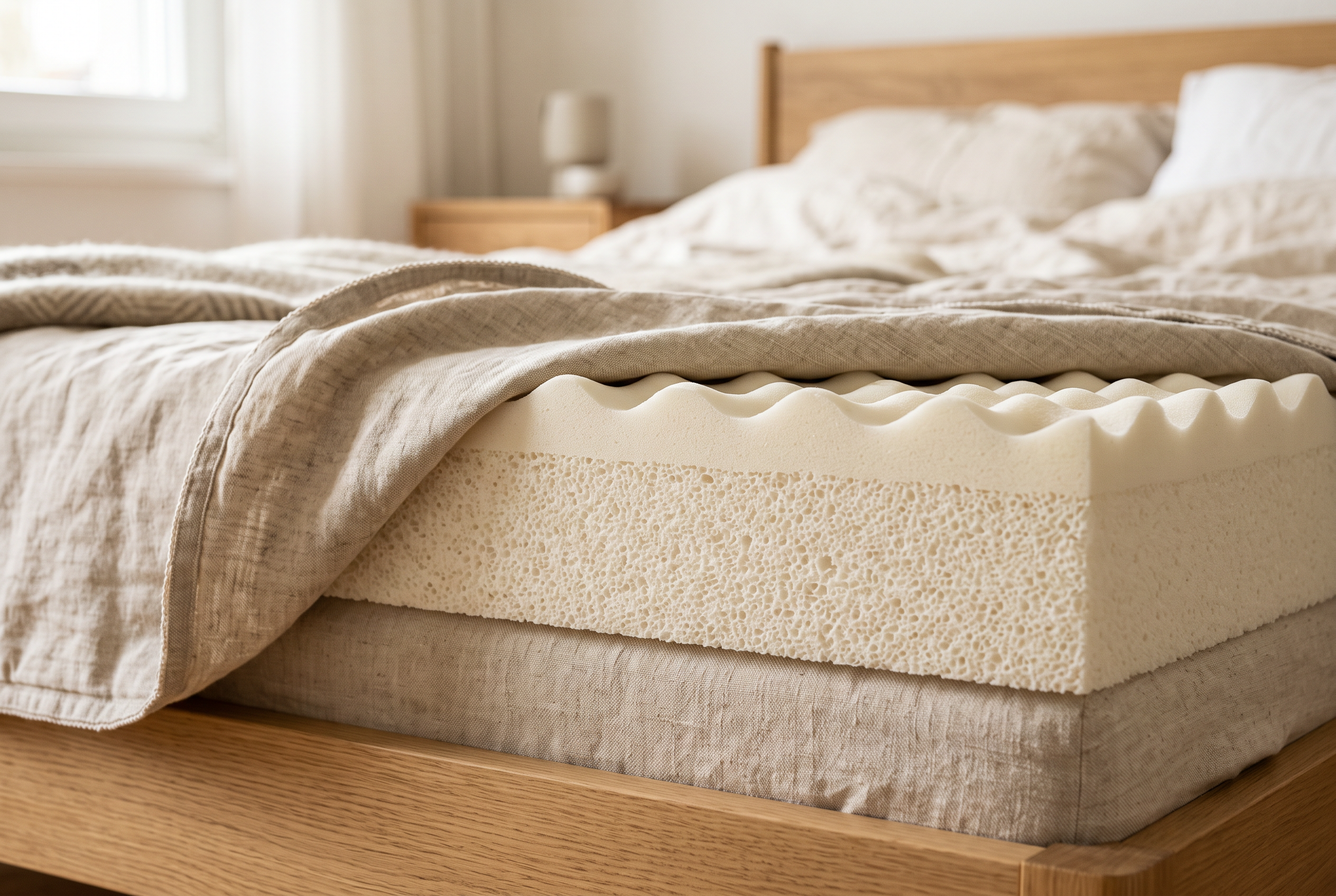
For back pain, it primarily matters whether the spine remains straight when lying down. Adaptive foam systems allow the shoulder and pelvis to sink in more precisely and support the lumbar spine more accurately than a spring core, which reacts more broadly. A spring core can still be suitable if you need a cool, springy lying feeling. For persistent complaints, medical or physiotherapeutic clarification is advisable.







Leave a comment
This site is protected by hCaptcha and the hCaptcha Privacy Policy and Terms of Service apply.