
Almost every mattress description in Switzerland begins with the same information: firmness level H2, H3, or H4. The number acts like a technical identifier, similar to shoe size or the diopter value of glasses. If you weigh 80 kilograms, you choose H3 – that's the common rule of thumb. The problem: this number is not legally defined anywhere. There is no DIN standard, no EN standard, and no ISO specification that determines when a mattress is H2 and when it is H3. Each manufacturer assigns the designation according to their own discretion, and that's precisely why two mattresses with the same label often feel noticeably different. This article explains why firmness levels are outdated as a purchasing criterion and which properties matter instead.
The short answer: The firmness level is a pure marketing construct with no legal or normative basis. An H3 from one manufacturer can be firmer than an H4 from another, because both use different measurement methods, foam densities, and cover constructions. In addition, the usual weight tables completely ignore body type, sleeping position, and pressure distribution. What matters is not how firm a mattress feels when you press on it with your hand, but how well it keeps the spine straight in side and back positions. Modern adaptive foams solve this problem without you even having to choose a firmness level.
- There is no standard for mattress firmness levels – H1 to H5 are manufacturer-specific designations.
- Weight tables ignore body shape, shoulder width, hip circumference, and sleeping position.
- More important than firmness are point elasticity, resilience, and pressure distribution at the shoulders and hips.
- Two people weighing 75 kg can have completely different requirements – depending on how the weight is distributed.
- Adaptive foams adjust automatically; there's no need to decide on a firmness level in advance.
Where firmness levels come from – and why they were never standardized
The classification into firmness levels dates back to a time when mattresses consisted almost exclusively of spring cores and simple polyurethane foams. Back then, the selection was small, the constructions were similar, and a rough scale from "soft" to "very firm" was sufficient for advice in a specialty store. Retailers adopted the designations to shorten consultations. What never happened: standardization. To this day, no regulation defines which indentation hardness in kilopascals should correspond to an H2 or H3. For comparison: for foams themselves, there are indeed measuring units such as indentation hardness according to DIN EN ISO 3386, but these values almost never appear on mattress labels. Instead, the derived marketing designation is communicated. The result is familiar to anyone who has ever compared two mattresses of the same firmness level: one sinks significantly when sat on, the other barely. Both can legally be called H3. Therefore, anyone who relies exclusively on this number when buying is essentially buying blind.
The miscalculation of weight tables
The classic recommendation is roughly: up to 60 kg H1, 60 to 80 kg H2, 80 to 100 kg H3, from 100 kg H4. This classification treats the body like a homogeneous block that presses evenly on the mattress. In reality, weight is distributed very unevenly. In a side position, about 30 to 35 percent of body weight rests on the shoulder and hips – on a contact area of a few hundred square centimeters. A person weighing 75 kg with broad shoulders and a narrow waist needs significantly more give there than a person of the same weight with a straight silhouette. Body height also plays a role: 75 kg at 160 cm creates a completely different surface pressure than 75 kg at 190 cm. And finally, the requirement changes with the sleeping position. Stomach sleepers need a surface that does not allow the pelvis to sink too deeply, side sleepers need the exact opposite. A single number cannot represent all of this. If you are interested in how the classic levels are intended in detail, you can find the system explained in our article on firmness levels H1 to H5.

What matters instead: Point elasticity and pressure distribution
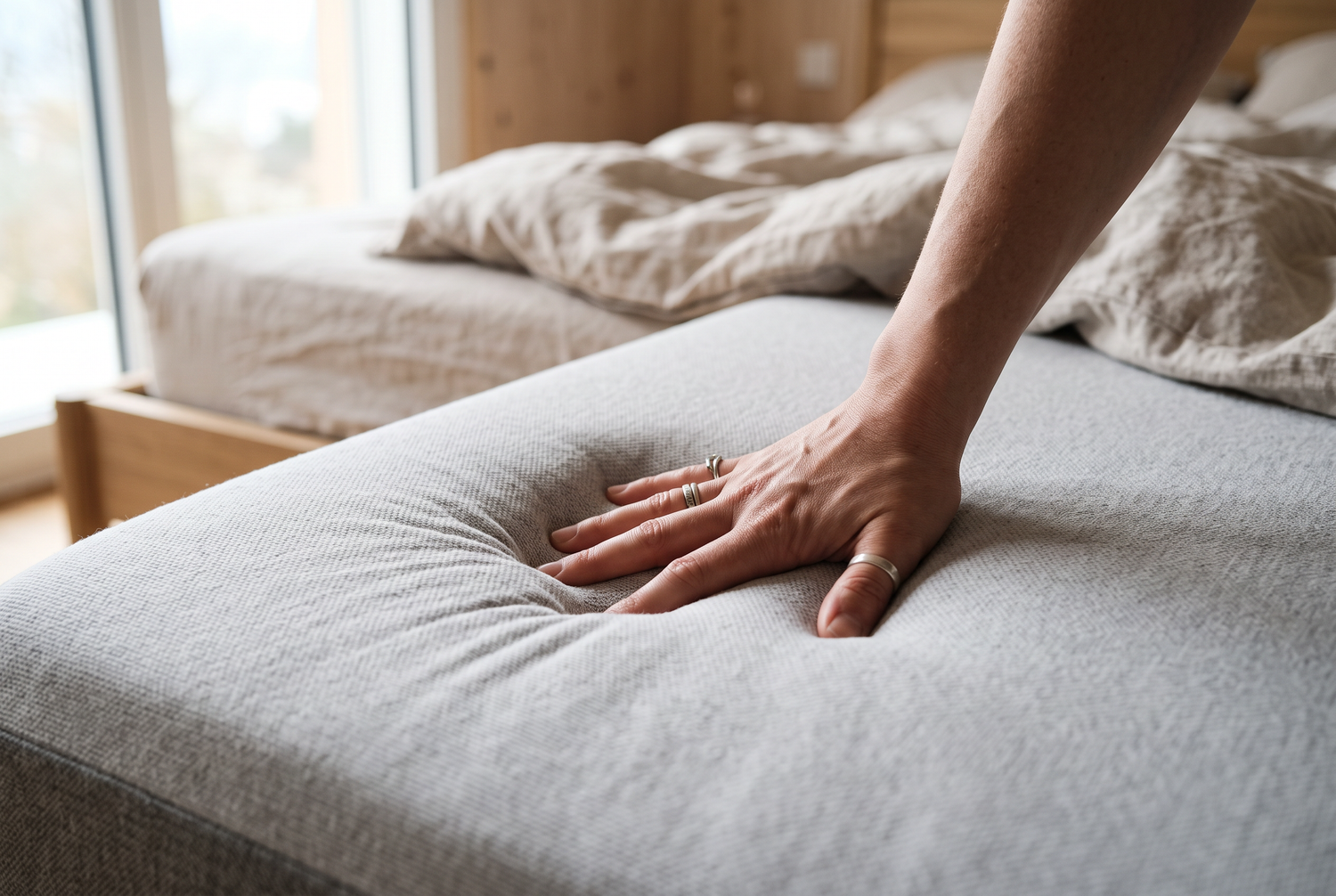
Point elasticity describes how precisely a material yields exactly where pressure is applied – without the surrounding area sinking in. If you press a finger into a point-elastic mattress, a small, clearly defined hollow forms. With a surface-elastic mattress, a large area deforms. This is crucial for the spine: only if the shoulders and pelvis can sink in precisely, while the waist and lumbar region continue to be supported, will the spine remain approximately straight in a side position. A second factor is resilience. A healthy adult changes position 20 to 60 times per night. If the material reacts too sluggishly, you sleep against the mattress; if it reacts too quickly and springily, there is a reverberation that disturbs your partner. The third factor is the pressure distribution itself: the larger the contact area, the lower the pressure per square centimeter and the less frequent the nocturnal repositioning due to numbness in the arm or shoulder.
Firmness level information in direct comparison
The following overview shows what information a firmness level actually provides – and what it does not.
| Criterion | Does firmness level indicate anything? | Why |
|---|---|---|
| Comparability between brands | No | No standard, each manufacturer defines their own |
| Shoulder indentation depth | No | Depends on zoning and cover, not the level |
| Support in the hip area | Only roughly | Core construction and material density are crucial |
| Durability | No | Determined by density and material quality |
| Suitability for your sleeping position | No | Position and body shape are not included in the level |
More meaningful are details such as density in kg/m³, core height in centimeters, and a description of the resilience. A look at our comparison of mattress types also helps more than any firmness level.
Fact-checking common myths
"A firm mattress is good for your back"
This statement persists but comes from a time when sagging mattresses were the main problem. Studies on back pain and mattress firmness tend to suggest that medium-firm, adaptable surfaces perform better than very firm ones. A too-firm surface creates pressure points on the shoulders and hips and forces the spine into a slight lateral curvature in a side position. However, the study situation is heterogeneous, and individual preferences play a significant role.
"Heavy automatically means firm"
Two people of identical weight can have completely different needs – depending on whether the weight is evenly distributed as muscle mass or concentrated in the torso. More on this in our articles for heavier and lighter individuals.
"For couples, you take the average value"
A compromise firmness level often leads to the mattress being unsuitable for both. Materials that adapt independently to two bodies are more sensible – see mattress for couples.
Common mistakes when buying based on firmness level
The first mistake is the quick test in the store. Two minutes of trying it out in a coat, in daylight, and with tense muscles tells you nothing about how the same mattress will feel after four hours of deep sleep. The body typically needs 14 to 30 nights for the muscles to accept a new surface – this adjustment period cannot be shortened. The second mistake is relying on the opinions of others: what is perfect for your neighbor may be too soft for you. The third mistake concerns the foundation. A sagging or too coarsely slatted base makes every mattress feel softer, a rigid board firmer – details can be found in the article slatted frame and mattress. Fourth mistake: confusing firmness and support. A mattress can feel soft and still reliably support the pelvic area if the core is constructed accordingly. And fifth, the topper is overlooked: a 5 cm thick topper changes the sleeping sensation so much that the firmness designation of the mattress underneath hardly matters anymore.
How to find the right sleeping surface in practice
Instead of focusing on a single level, proceed in four steps. First: Determine your dominant sleeping position. For a week, observe in which position you fall asleep and in which you wake up. Second: Do the spinal test. Lie on your side on the mattress and have someone check from behind if your spine forms a straight line. If your hips sag, the surface is too soft; if there is a visible gap between your waist and the mattress, it is too firm. Third: Check the pressure on your shoulders and hips after ten minutes of lying down. If you start to tingle or feel numb, the pressure distribution is insufficient. Fourth: Test at home for several weeks. Only in your own bedroom, at your own sleeping temperature and with your own pillow, can you get a realistic picture. A long trial sleep is therefore more valuable than any firmness rating in the data sheet.
The alternative: materials that adapt themselves
The actual consequence of all this is simple: If no number can represent individual anatomy, the material must take over the adaptation. Adaptive premium memory foams work exactly this way. They react to pressure and body heat, yielding specifically under the shoulders and hips and providing support where there is less load. If the sleeper changes position, the deformation changes with it – without needing a predefined zone. For the purchasing decision, this means a real simplification: the question of whether H2 or H3 is the right choice is eliminated, and with it the risk of making the wrong decision for years. This is particularly relevant for couples with different weights, for people who switch between side and back sleeping, and for everyone whose body weight changes over the years. A good mattress should be able to accommodate these changes instead of becoming unsuitable after two years. How long it can do this depends primarily on the material – see mattress lifespan.

Get CHF 25 discount
Subscribe to the newsletter and receive a one-time CHF 25 discount. ✓ 200 nights trial sleep ✓ 10-year warranty
Frequently asked questions about mattress firmness levels
Is there a legal standard for mattress firmness levels?
No. Neither in Switzerland nor in the EU is there a binding standard that specifies which measurements correspond to a firmness level H1 to H5. Each manufacturer assigns the designation themselves, which is why an H3 from one brand can be firmer than an H4 from another.
Which firmness level is suitable for 80 kg body weight?
This question cannot be answered reliably because body weight alone is insufficient. Shoulder width, hip circumference, body height, and preferred sleeping position strongly influence the necessary indentation depth. Two people weighing 80 kg can have very different requirements.
Is a firm mattress better for the back?
Not automatically. Very firm surfaces create pressure points on the shoulders and hips and can cause the spine to deviate from a straight line in the side position. Studies suggest that medium-firm, highly adaptable mattresses are more beneficial for most people. In cases of persistent discomfort, medical clarification is recommended.
How do I know if my mattress is too soft or too firm?
Lie on your side and have someone check if your spine forms a straight line. If your pelvis sags noticeably, the mattress is too soft. If there is a clear gap between your waist and the mattress, it is too firm. Morning tension can also be an indicator.
What is point elasticity and why is it more important than firmness level?
Point elasticity describes how precisely a material yields exactly where pressure is applied, without the surrounding area also sinking in. It determines whether your shoulders and hips can sink in while your waist remains supported – and thus the alignment of your spine.
How long does it take to assess a new mattress?
Allow about 14 to 30 nights. During this time, your muscles will adapt to the changed surface, and initial tension usually subsides. A judgment after two or three nights is therefore rarely conclusive.
This article is for general information purposes only and does not replace medical advice.








Leave a comment
This site is protected by hCaptcha and the hCaptcha Privacy Policy and Terms of Service apply.