
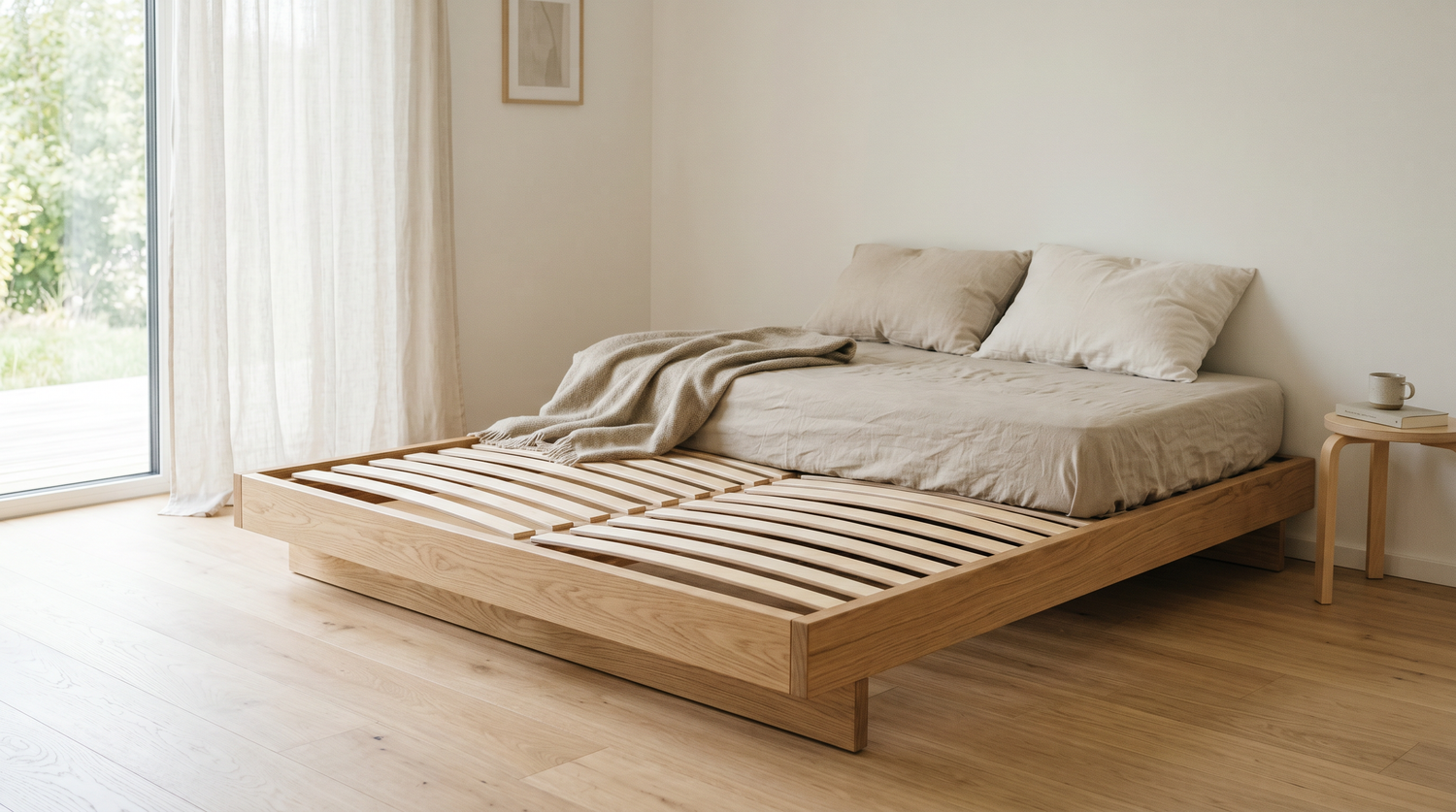
When buying a mattress, it receives full attention – the slatted frame is often forgotten. Yet, the base significantly influences how well a mattress supports, how well it is ventilated, and how long it lasts.
The short answer: The slatted frame should support the mattress evenly and stably, and ventilate it from below. A not too large slat spacing and an even surface are important. A high-quality, adaptable mattress does not need a highly complex slatted frame – but above all, a uniform, load-bearing base.
Key takeaways
- The slatted frame supports the mattress and provides ventilation from below.
- The slat spacing should not be too wide to prevent the mattress from sagging.
- An even, stable surface is more important than many adjustment functions.
- An adaptable mattress works on any even, load-bearing slatted frame.
What is the purpose of a slatted frame?
The slatted frame fulfills three functions: It supports the mattress, ventilates it from below (important against moisture and mold), and provides it with elastic resistance. A good slatted frame thus supports the ergonomic properties of the mattress instead of hindering them.
Overview of slatted frame types
| Type | Characteristics | Suitable for |
|---|---|---|
| Roll-up slatted frame | Inexpensive, simple, rigid | Guest rooms, budget solutions |
| Rigid slatted frame | Stable, even surface | Most mattresses |
| Adjustable slatted frame | Head/foot sections adjustable | Reading, health needs |
| Disc slatted frame | Point-elastic discs | Those seeking additional zoning |

Which slatted frame suits which mattress?
This is often overcomplicated. For a modern, adaptable foam mattress, a simple rule applies: it primarily needs a uniform, even, and load-bearing base. The mattress itself already provides precise body adaptation – a highly complex slatted frame with dozens of adjustable zones is not necessary for this.
The Ora Ultra Mattress with EvoPoreHRC Premium memory foam is built on the principle of "one mattress for all" and adapts automatically. It rests equally well on a solid, well-ventilated slatted frame as it does in a stable bed frame. If you're weighing bed systems, the article Box spring bed or mattress offers decision support.
Slat spacing and ventilation
The most important technical value is the slat spacing: If the slats are too far apart, the mattress can push through them – this promotes pressure points and premature wear. Therefore, pay attention to a narrow, even spacing. At the same time, the gap between the slats ensures air circulation, which removes moisture from the mattress – an important protection against mold.

Common mistakes
- Too wide slat spacing: The mattress sags and wears out faster.
- Defective or bent slats: Impair support – check regularly.
- Placing the mattress directly on the floor: Without ventilation from below, moisture can accumulate, leading to mold. Tips on this in the article Mattress care.
Get CHF 25 discount
Subscribe to newsletter and receive a one-time CHF 25 discount. ✓ 200 nights trial sleep ✓ 10 years warranty
A mattress that works on any good base
The Ora Ultra Mattress automatically adapts to your body – on an even slatted frame as well as in the bed frame. A sustainable option is the tested Ora Ultra Second Life.
Frequently asked questions about slatted frame and mattress
Which slatted frame is best for my mattress?
A stable, even slatted frame with narrow, even slat spacing. For an adaptable mattress, a highly complex slatted frame is not necessary – an important factor is a load-bearing, well-ventilated surface.
How wide can the slat spacing be?
The narrower, the better the slatted frame supports. Too wide gaps cause the mattress to sag and promote wear.
Can I place the mattress directly on the floor?
This is not advisable: Without ventilation from below, moisture accumulates, which encourages mold growth. A slatted frame or ventilated base is the better choice.










Leave a comment
This site is protected by hCaptcha and the hCaptcha Privacy Policy and Terms of Service apply.