
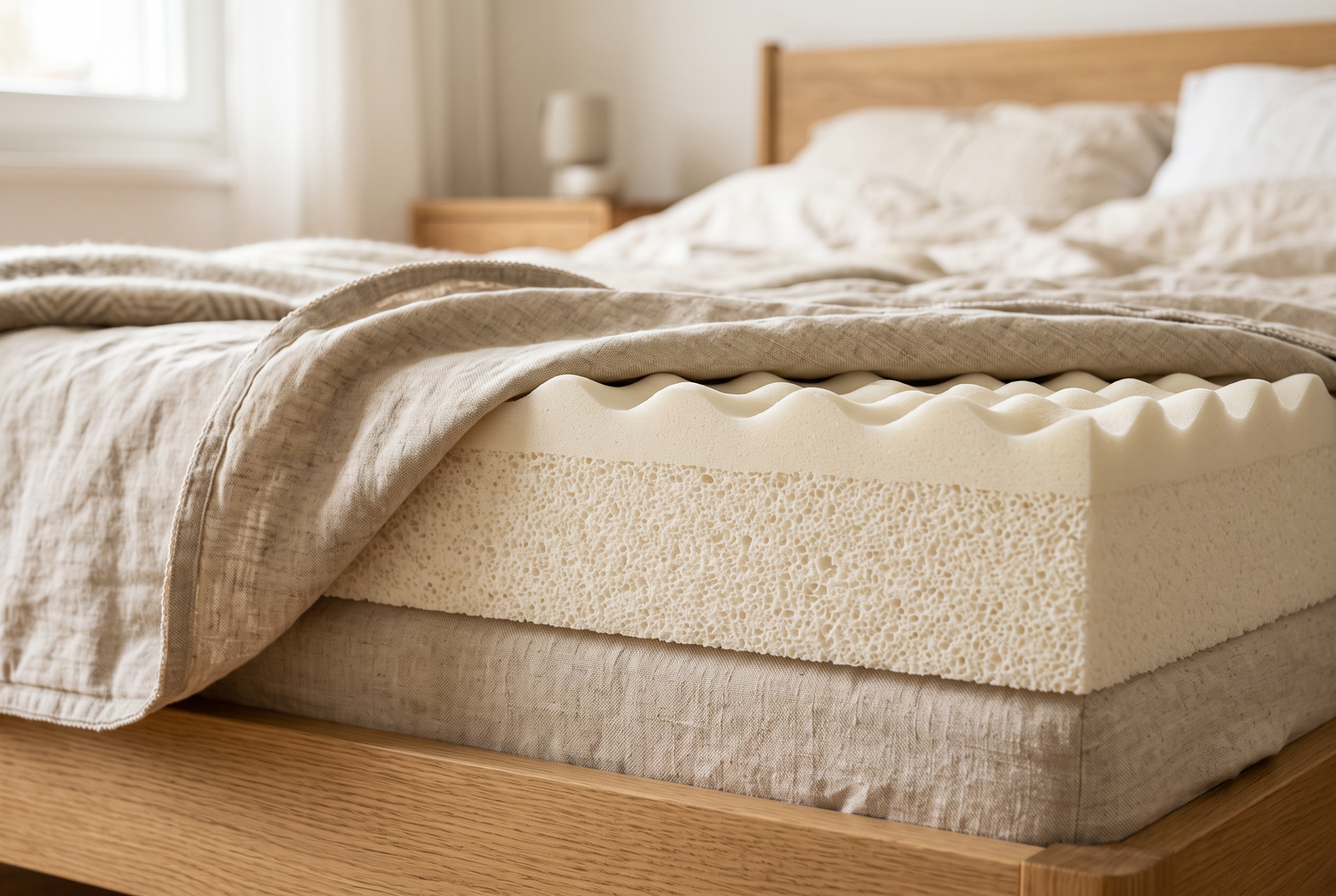
In Switzerland, cold foam mattresses are the best-selling type of mattress – and also the type with the greatest differences in quality. Two mattresses can both have "cold foam" on the label and yet differ by a factor of three in price and durability. Anyone who only pays attention to the term is buying blindly. This guide explains what cold foam actually is, which key figures really matter, and where this type of construction reaches its limits. By the end, you'll know what to look for when buying – and which sales arguments you can safely ignore.
The short answer: A cold foam mattress consists of foamed polyurethane that hardens without the application of heat, forming an open-pored cell structure. These open pores make the foam breathable, lightweight, and elastic. The density is crucial for quality: below 40 kg/m³, the mattress usually sags within a few years; from 50 kg/m³, it becomes durable. Cold foam reacts quickly and springs back swiftly – if you're looking for a softer, body-conforming adaptation, adaptive memory foam is a better choice.
- Cold foam hardens without heat, forming an open-pored, breathable cell structure.
- Density (RG) is the most important quality indicator: avoid anything below 40 kg/m³, 50 kg/m³ and above offers good durability.
- Strengths: lightweight (10–18 kg), good moisture management, good thermal insulation, low motion transfer.
- Weaknesses: reacts quickly rather than conforming, can quickly become soft and form hollows if of low quality.
What cold foam actually is
The name can be misleading. "Cold" doesn't refer to the sleeping sensation, but to the manufacturing process: the raw materials chemically react with each other and harden without external heat being applied. During foaming, some cell walls burst open, creating a network of open, interconnected pores. This open structure is precisely what distinguishes cold foam from older, closed-cell comfort foam. Air and moisture can pass through the material, which significantly improves the sleeping climate. In addition, the surface is usually profiled – with incisions, waves, or knobs – to specifically control elasticity and further increase ventilation. A typical core height is 14 to 20 centimeters.

Density: the only number that really matters
Density indicates how many kilograms of raw material are contained in one cubic meter of foam. It is not a measure of firmness, but of substance – and therefore the best available indicator of durability. A foam with RG 30 simply contains less material and will therefore lose its resilience more quickly. Unfortunately, the density is not always specified. If a provider does not mention the number, that in itself is information. The following classification helps with evaluation.
| Density | Classification | Realistic lifespan |
|---|---|---|
| RG 25–35 | Budget segment, promotional items | 2–4 years |
| RG 40–45 | Solid mid-range | 5–7 years |
| RG 50–60 | High quality | 8–12 years |
| above RG 60 | Premium, mostly specialized foams | 10–15 years |
In addition to density, indentation hardness, measured in kilopascals, is often mentioned. It describes the resistance when compressed – i.e., what is colloquially called firmness. Do not confuse the two values: a heavy foam can be soft and a light foam hard. Only one tells you something about durability.
Everyday advantages
Cold foam is lightweight. A 160-model often weighs only 12 to 18 kilograms, so it can be turned, transported, and carried up to a fourth-floor apartment alone. The material insulates heat better than a spring core, which is pleasant in cool bedrooms – those who get cold easily appreciate this. At the same time, the open cell structure effectively wicks away moisture, provided the slatted frame allows air from below. Motion transfer is very low, which is important in a double bed – see our article on mattresses for couples. And because cold foam can be shipped vacuum-packed, online purchasing is logistically straightforward.
Where cold foam reaches its limits
Cold foam is a fast-recovering material. If you press into it, it springs back almost immediately. This is practical when turning over, but it also means that the foam works against the body, rather than gently conforming to it. At sensitive pressure points – shoulders, hips, tailbone – some people feel this counter-pressure distinctly. This is the central difference to viscoelastic memory foam, which yields more slowly and traces the body's contours more precisely. Second limitation: Cheap cold foam quickly loses its elasticity. Indentations of more than two centimeters after two years are not uncommon with RG 30. Third limitation: New cold foam mattresses can smell initially. This is normal and usually dissipates within one to two weeks with good ventilation.
Cold foam, spring core, and latex in direct comparison
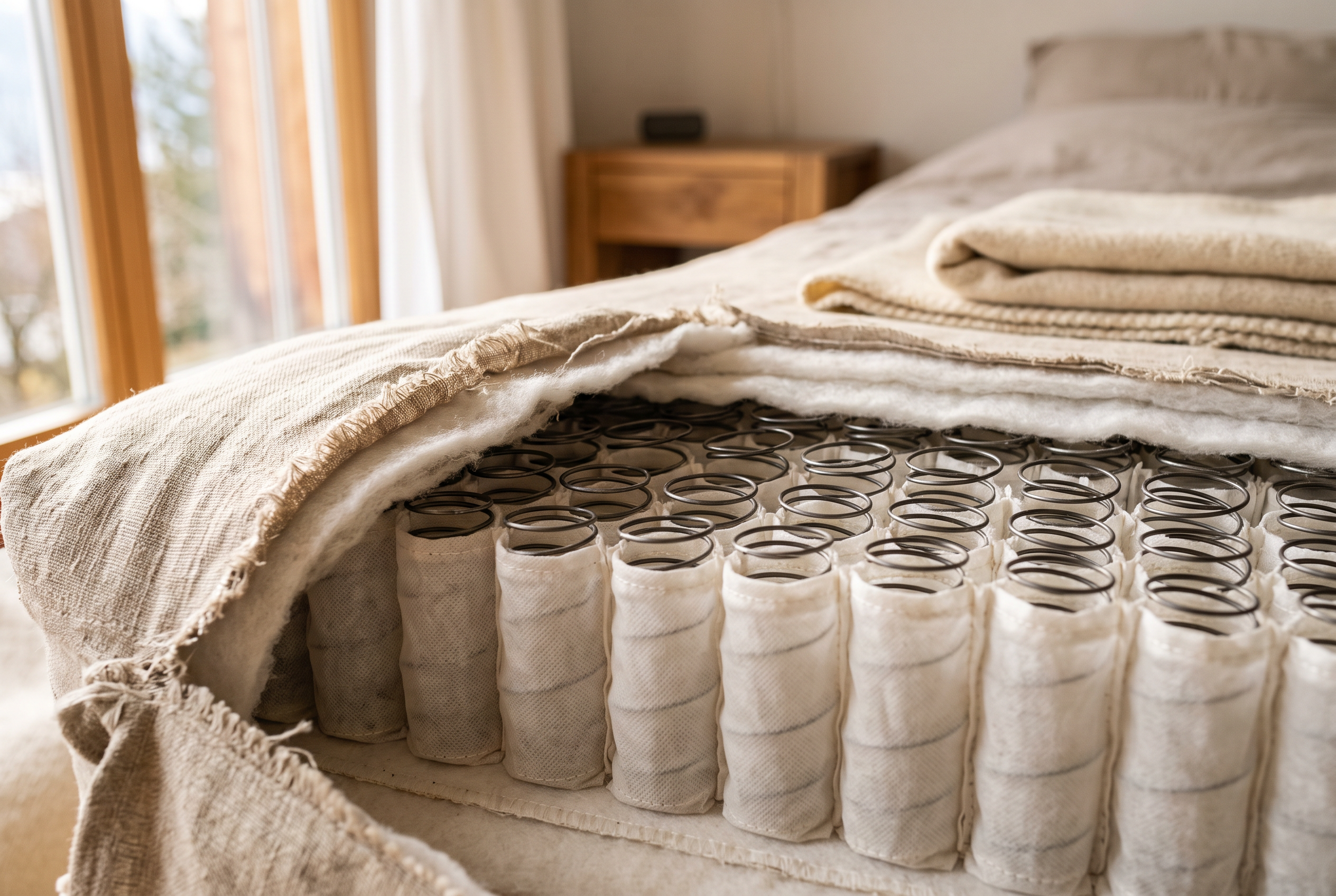
No design is inherently better – they differ in what they excel at. Spring core scores points for climate and edge stability, but is heavy and works over a larger area. Latex is very durable and point-elastic, but expensive and quite heavy at 30 to 45 kilograms. Cold foam lies in the middle: lightweight, good insulation, widely varied in price, but extremely different in quality. If you want to compare the designs systematically, you'll find that in the mattress type comparison. And if you want to know which price range is realistic, it's best to read what a good mattress costs.
Care and extending lifespan
Cold foam needs air. Never place the mattress directly on a closed bed base, but always on a slatted frame with a maximum slat spacing of four centimeters. Air out the bedroom for five to ten minutes each morning by opening windows on opposite sides, and pull back the duvet instead of making the bed immediately – this allows moisture absorbed overnight to escape. Rotate the mattress head to foot every three months to distribute the load. You should wash the cover two to three times a year at 60 degrees. The core itself should never be put in the washing machine or wet cleaned; stains should be treated locally with a small amount of water and mild detergent, and then thoroughly dried.

Get CHF 25 discount
Subscribe to our newsletter and receive a one-time CHF 25 discount. ✓ 200 nights trial sleep ✓ 10 years warranty
Frequently Asked Questions about Cold Foam Mattresses
What should be the minimum density of a cold foam mattress?
40 kg/m³ is considered the minimum for daily use. Below this, the foam usually loses noticeable resilience after just two to four years. If you want to use a mattress for eight years or more, you should aim for at least 50 kg/m³. For a guest bed, which is only used for a few nights a year, a lower density is sufficient.
Is a cold foam mattress too warm in summer?
Cold foam insulates heat more than a spring core, but it doesn't trap it as long as air can circulate. Crucial factors are an open slatted frame, a breathable cover, and a room temperature of 16 to 19 degrees Celsius. If you generally sweat a lot, combine the mattress with light cotton or linen bedding and avoid a thick, closed mattress protector.
Why does my new cold foam mattress smell?
The odor comes from residual volatile compounds from production and is particularly noticeable in vacuum-packed mattresses during the first few days. After unpacking, leave the mattress in a well-ventilated room without bedding for 24 to 72 hours. The odor usually dissipates completely within one to two weeks. An Oeko-Tex or comparable test seal provides additional safety regarding pollutant levels.
Can you flip a cold foam mattress?
That depends on the model. Mattresses with the same construction on both sides can be flipped. However, many modern models have a defined top and bottom side, sometimes with different profiling for summer and winter. These mattresses are only rotated head-to-foot. A look at the label or manufacturer's instructions will reliably clarify this.
Cold foam or memory foam – which is better?
Cold foam springs back quickly and feels more elastic, while memory foam yields more slowly and conforms more closely to the body's contours. For pronounced pressure points on the shoulder or hip, adaptive memory foam is usually superior because it distributes pressure over a larger area. Those who prefer a springy lying sensation and move a lot at night will get along well with high-quality cold foam.







Leave a comment
This site is protected by hCaptcha and the hCaptcha Privacy Policy and Terms of Service apply.