
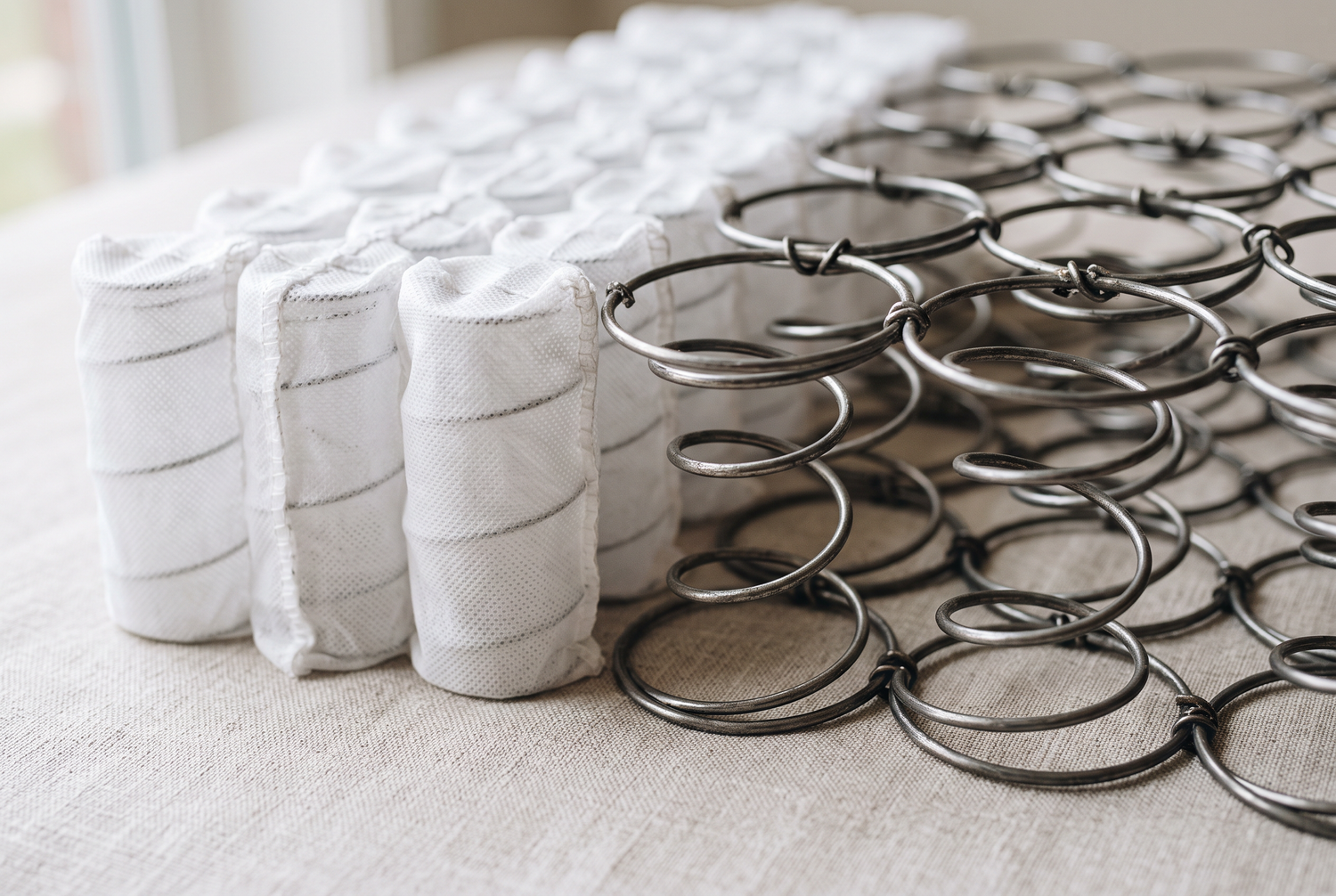
Both are called spring core, both consist of steel, both have been on the market for decades - and yet Bonnell spring and pocket spring mattresses are worlds apart. The difference is not cosmetic, but structural: in one design, all springs are connected to each other, in the other, each spring works independently. Practically everything else follows from this - how precisely the mattress yields, how strongly a partner's movements are transferred, and how well the spine is supported when lying on your side. If you only read "spring core" when buying, you can easily overlook this difference. This article explains both designs in detail, shows advantages and disadvantages, and categorizes for whom which variant is still an option.
The short answer: In a Bonnell spring core, hourglass-shaped steel springs are firmly connected by spiral wires - the mattress reacts with surface elasticity, meaning it yields over a large area. In a pocket spring core, each spring is individually encased in a fabric pocket and works independently of its neighbors, which provides significantly more point elasticity. For spinal alignment and for couples, the pocket spring is clearly superior. The Bonnell spring scores with good air exchange, high robustness, and a low price - but is mainly still suitable for occasional use, for example in a guest room.
- Bonnell spring core: connected springs, surface-elastic, inexpensive, very well ventilated.
- Pocket spring core: individually pocketed springs, point-elastic, significantly better body adaptation.
- Number of springs per sleeping surface: Bonnell approx. 100–250, pocket spring typically 250–1000.
- For couples, the pocket spring is clearly advantageous – less motion transfer.
- Both designs require a load-bearing base and are poorly suited for floor storage.
Structure of the Bonnell spring core
The Bonnell spring core is the older of the two designs and dates back to the 19th century. It consists of hourglass-shaped steel springs - wide at the top and bottom, constricted in the middle - which are connected by spiral wires to form a continuous grid. A circumferential frame wire stabilizes the edge. Typically, there are 100 to 250 springs per sleeping surface in the 90 x 200 cm size. Because all springs are mechanically coupled, the mattress yields over a large area when a point is loaded: if you sit on the edge, a wide area sinks in. This is called surface elasticity. This is unfavorable for the spine because the shoulder and pelvis cannot sink independently of each other. The big advantage of this construction lies in its ventilation: there is a lot of air space between the springs, and moisture is quickly wicked away. In addition, the design is very robust, durable in terms of material fatigue, and inexpensive to manufacture. However, due to the high steel content, Bonnell mattresses are heavy - often 25 to 35 kilograms in 140 x 200 cm.
Structure of the pocket spring core
In a pocket spring core, each cylindrical spring is individually encased in a sewn fabric pocket. The pockets are glued or welded together at the sides, but the springs themselves are not connected. As a result, each spring reacts only to the pressure directly applied to it. The result is a significantly more precise adaptation: the shoulder can sink in, while two centimeters away, the support force is maintained. The number of springs is typically 250 to 1000 per sleeping surface in the 90 x 200 cm size; a barrel pocket spring is a variant with barrel-shaped instead of cylindrical springs, which reacts even more finely and allows for higher spring counts. Important to know: More springs do not automatically mean more quality. The wire thickness, number of turns, and the quality of the top layers above the core are crucial. A mattress with 500 well-dimensioned springs and a high-quality comfort layer often feels better than one with 1000 thin springs and meager padding. More about the different core constructions in the article Pocket spring mattress.

The direct comparison
| Criterion | Bonnell Spring Core | Pocket Spring Core |
|---|---|---|
| Springs connected | Yes, via spiral wires | No, individually pocketed |
| Elasticity | Surface elastic | Point elastic |
| Springs per 90 x 200 cm | approx. 100–250 | approx. 250–1000 |
| Motion transfer | High | Low |
| Ventilation | Very good | Good |
| Noise development over the years | Possible (squeaking) | Rare |
| Price level | Low | Medium to high |
| Typical use | Guest room, holiday apartment | Permanent use |
Why point elasticity determines sleeping comfort
When lying on your side, approximately 30 to 35 percent of your body weight rests on your shoulder and pelvis - distributed over a relatively small area. For the spine to remain straight, precisely these two areas must be able to sink in, while the waist maintains contact with the surface and remains supported. A surface-elastic Bonnell spring core cannot achieve this in principle: if the shoulder sinks in, the entire upper body area sinks with it, and the spine curves laterally. Over years, this can lead to morning tension in the shoulder and neck area - more on this in the article Shoulder pain in side sleeping. The second practical effect concerns couples: because all springs in a Bonnell spring core are coupled, every change in position of one partner is transferred to the other's sleeping surface. With 20 to 60 position changes per person per night, this adds up to considerable potential for disturbance. The pocket spring core significantly dampens this transfer, and adaptive foams even more so - see Mattress for couples.
Common mistakes and misunderstandings
"More springs = better." The number of springs is a popular selling point, but it means little on its own. Wire thickness, spring height, number of coils, and especially the comfort layer above determine the sleeping experience at least as strongly. "Spring core is always hard." The opposite can be true: a Bonnell spring core with thin padding feels hard, a pocket spring core with a thick foam topper feels very soft. The construction alone does not determine the firmness – why firmness ratings are problematic anyway is explained in Why firmness ratings are outdated. "You can put a spring core on the floor." Better not. Without a ventilated base, moisture condenses on the underside, and mold formation is likely. "Spring core doesn't need to be turned." Yes, it does – spring core mattresses also benefit from regular rotation, see Turning or flipping a mattress. "Squeaking is normal." It's a sign of aging: springs usually rub against broken connecting wires – an indication that the core is losing its stability.
For whom which design is useful
A Bonnell spring core is still acceptable if the mattress is used infrequently and price is the main criterion: guest rooms, holiday apartments, second homes. In very humid rooms, good ventilation can also be an argument. However, for regular use over years, it is hardly up-to-date anymore. A pocket spring core is the significantly better choice for daily use, for couples, and for people who tend to sweat but still need good body adaptation. It combines decent ventilation with useful point elasticity. However, those seeking maximum adaptation will end up with modern foams: adaptive memory foams react more finely than any mechanical spring because they are not tied to a grid but are continuously deformable. Motion transfer is also lowest there. An overview of all types of construction - spring core, cold foam, latex, visco foam - can be found in the article Comparison of mattress types. And if your existing spring core mattress already shows indentations or is older than eight years, it's worth looking at the lifespan of mattresses.

Get CHF 25 discount
Subscribe to newsletter and receive a one-time CHF 25 discount. ✓ 200 nights trial sleep ✓ 10 years warranty
Frequently asked questions about Bonnell spring and pocket spring cores
What is the main difference between Bonnell spring and pocket spring cores?
In a Bonnell spring core, all springs are firmly connected by spiral wires, causing the mattress to react with surface elasticity. In a pocket spring core, each spring is individually encased in a fabric pocket and works independently, allowing for precise body adaptation.
How many springs should a good pocket spring mattress have?
Typically, 250 to 1000 springs per sleeping surface in a 90 x 200 cm size. However, a high number of springs alone doesn't say much – wire thickness, spring height, and the quality of the comfort layer above the core influence the sleeping sensation at least as much.
Is a Bonnell spring core suitable for couples?
Only to a limited extent. Because all springs are connected, a partner's movements are significantly transferred to one's own sleeping surface. With 20 to 60 position changes per person per night, this can noticeably disturb sleep.
Is a spring core better ventilated than foam?
Spring cores have a lot of air space between the springs due to their construction and wick away moisture well. However, modern open-cell foams also achieve good moisture regulation. The cover and a ventilated base are also crucial.
Why does my spring core mattress squeak?
Squeaking usually occurs when connecting wires are broken and springs rub against each other. This is a sign of material fatigue and indicates that the core has lost stability. Occasionally, the noise also comes from the bed frame.
Can I place a spring core mattress directly on the floor?
It is not recommended. Without a ventilated base, moisture collects on the underside, which promotes mold growth. A slatted frame or another air-permeable base is necessary for both types of spring cores.







Leave a comment
This site is protected by hCaptcha and the hCaptcha Privacy Policy and Terms of Service apply.