
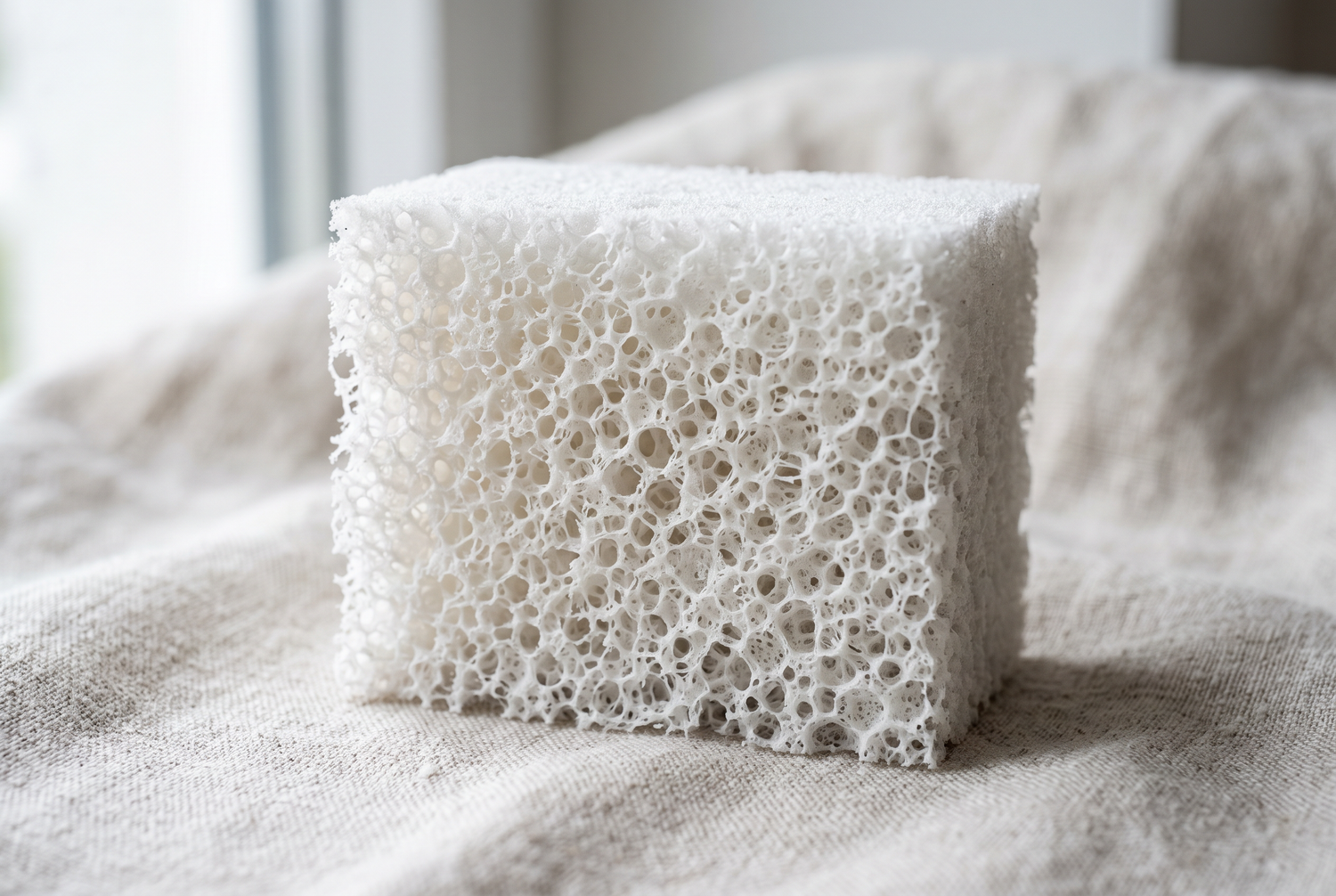
If a mattress description contains only one hard number that actually says something about quality, it's the density. While firmness levels are not standardized and spring counts reveal little about sleeping comfort, density is a physically defined quantity: It indicates how many kilograms of raw material are in one cubic meter of foam. It is usually given as RG 35 or RG 50, occasionally as density in kg/m³. The catch: Many providers conceal the value, and where it is stated, it is often confused with firmness. However, the two have nothing to do with each other. This article explains what density measures, which values are useful for which applications, and how to interpret it correctly when buying.
The short answer: Density describes the material density of a foam in kilograms per cubic meter and is the best available indicator of durability. The higher the value, the more material is used and the slower indentations form. For daily use over many years, you should aim for at least RG 40, preferably RG 50 or more. Values below RG 30 are only suitable for occasional beds. Important: Density and firmness are independent of each other – a foam with RG 50 can be set to be soft or firm, depending on the formulation.
- Density = kilograms of foam material per cubic meter, indicated as an RG value.
- It measures material density and thus durability – not firmness or support.
- From RG 40 for regular use, from RG 50 for high long-term stability.
- Indentation hardness in kilopascals describes firmness – a completely different quantity.
- If the RG specification is missing completely, that's a warning sign.
What density physically describes
Foam consists largely of air. When foamed, millions of small cells are created; the raw material only forms the webs and walls in between. The density indicates how much of this web material is actually present. A foam with RG 30 contains 30 kilograms of substance per cubic meter, a foam with RG 60 has twice as much. More material means thicker cell webs, and thicker webs can withstand more deformation cycles before they permanently give way. This is exactly why density correlates so closely with durability. Calculate it yourself: A mattress measuring 90 x 200 cm with a core height of 16 cm has a core volume of 0.288 cubic meters. At RG 30, this core weighs around 8.6 kilograms, and at RG 50, about 14.4 kilograms. The weight difference is clearly noticeable when lifting – a practical hint if no RG specification is available. Very light foam mattresses are almost always low-density. You can find basic information on the material in the article Cold foam mattress.
Density is not firmness – the most common misconception
The firmness of a foam is described by its indentation hardness, measured in kilopascals and determined according to standardized procedures such as DIN EN ISO 3386. Typical values for mattress cores are between approximately 3 and 6 kPa. This value is independent of density: Soft foams with high density can be produced, as can firm foams with low density, through chemical formulation. In practice, this means that a mattress with RG 50 can feel very soft and yet remain dimensionally stable for years. Conversely, a cheap foam with RG 25 can initially feel pleasantly firm and show visible indentations after 18 months. Those who only pay attention to the feel in the store when buying cannot recognize this difference – it only becomes apparent after months. Therefore, both values should be considered together: Density indicates how long the mattress retains its properties; indentation hardness and constructive design indicate what those properties are. Why the usual firmness levels are of little help in this regard can be read under Firmness levels are outdated.

Which RG value for which purpose
| Density | Classification | Suitable for | Expected lifespan |
|---|---|---|---|
| under RG 30 | Low density | Occasional bed, camping | 1–3 years with daily use |
| RG 30–40 | Medium | Guest room, children's bed | approx. 4–6 years |
| RG 40–50 | Good | Daily use | approx. 7–10 years |
| above RG 50 | High quality | Permanent use, higher body weight | 10 years and more |
The information on service life is a guideline and also depends on body weight, foundation, care, and room climate. Details can be found under Lifespan of a mattress.
How to estimate density yourself
If the information is missing, a simple calculation helps. Determine the core volume: Length x Width x Core Height in meters. For 90 x 200 cm and a 14 cm core, this results in 0.9 x 2.0 x 0.14 = 0.252 cubic meters. Then weigh the mattress without the cover – or subtract about 2 to 4 kilograms from the total weight for the cover and quilting. Divide the core weight by the volume, and you have a usable estimate. Example: 12 kilograms of core weight divided by 0.252 results in about RG 48. If the same mattress weighs only 7 kilograms, you end up with about RG 28 – a clear warning sign for daily use. This rough calculation is not laboratory-precise, because top layers and core construction can vary, but it reliably distinguishes between "substantial" and "airy." A second practical test: Press firmly on the surface with your thumb for 5 seconds and release. A dense foam will fully recover within a few seconds without a visible indentation remaining.
Common mistakes when dealing with RG specifications
Confusing the RG specification of the top layer with the core. Some providers state the highest value of all layers used. A 2 cm thick visco layer with RG 60 over a core with RG 28 does not result in a high-quality mattress. Ask for the RG of the support core. Reading density as a firmness specification. As described: RG says nothing about soft or firm. Only paying attention to RG and ignoring the core height. A high-quality foam with only a 10 cm core can sag with higher body weight. 14 to 20 cm core height is sensible for adults. Drawing comparisons between material types. Latex naturally has significantly higher densities of 60 to 90 kg/m³ – a direct numerical comparison with cold foam is misleading, see Latex mattress. Ignoring the foundation. A poor slatted frame will cause even a high-density foam to wear out prematurely because the load is introduced pointwise instead of over an area – see Slatted frame and mattress.
What else matters besides density
Density is a good filter, but not a complete quality judgment. Three other factors are important. First, cell structure: Open-cell foams wick away moisture, while closed-cell foams trap heat. An adult releases about 0.3 to 0.5 liters of fluid per night – this volume must be able to be transported away. Second, rebound behavior: How quickly does the foam regain its shape after a change in position? With 20 to 60 position changes per night, this determines whether you sleep against the mattress. Third, point elasticity: Does only the loaded point sink in, or a large area? Only point-elastic materials can allow the shoulder and pelvis to sink in independently while the waist remains supported. A high-density foam with poor point elasticity will last a long time but will not provide good support. Conversely, the best adaptation is of little use if the core gives way after two years. The combination makes the difference – and that is precisely why it is worth looking at both specifications. For more in-depth information, see our comparison of mattress types and the article on viscoelastic foam and memory foam.

Get a CHF 25 discount
Subscribe to the newsletter and receive a one-time CHF 25 discount. ✓ 200 nights trial sleep ✓ 10-year warranty
Frequently asked questions about cold foam density
What does RG mean for a mattress?
RG stands for "Raumgewicht" (density) and indicates how many kilograms of foam material are contained in one cubic meter. RG 40 therefore means 40 kg/m³. The value describes the material density and is the best available indicator of expected durability.
What density should a good cold foam mattress have?
For daily use, you should aim for at least RG 40, preferably RG 50 or more. Values between RG 30 and 40 are suitable for guest rooms or children's beds. Below RG 30, long-term use is not recommended, as indentations quickly form.
Does a high density indicate firmness?
No. Density and firmness are independent quantities. Firmness is described by indentation hardness in kilopascals, typically 3 to 6 kPa for mattress cores. A foam with RG 50 can be soft or firm, depending on the formulation.
How can I estimate density without manufacturer specifications?
Calculate the core volume from length x width x core height in meters and divide the core weight by it. Subtract about 2 to 4 kilograms from the total weight for the cover. Very light foam mattresses are almost always low-density.
Why does latex have a much higher density than cold foam?
Latex is inherently denser; typical values are 60 to 90 kg/m³. A direct numerical comparison between latex and cold foam is therefore not useful – the values can only be compared within the same material type.
What to do if the manufacturer does not specify the density?
Specifically ask for the density of the support core, not just the top layers. If no information is provided, that is a warning sign. As a makeshift solution, the total weight of the mattress helps: A very light model indicates low material density.









Leave a comment
This site is protected by hCaptcha and the hCaptcha Privacy Policy and Terms of Service apply.