
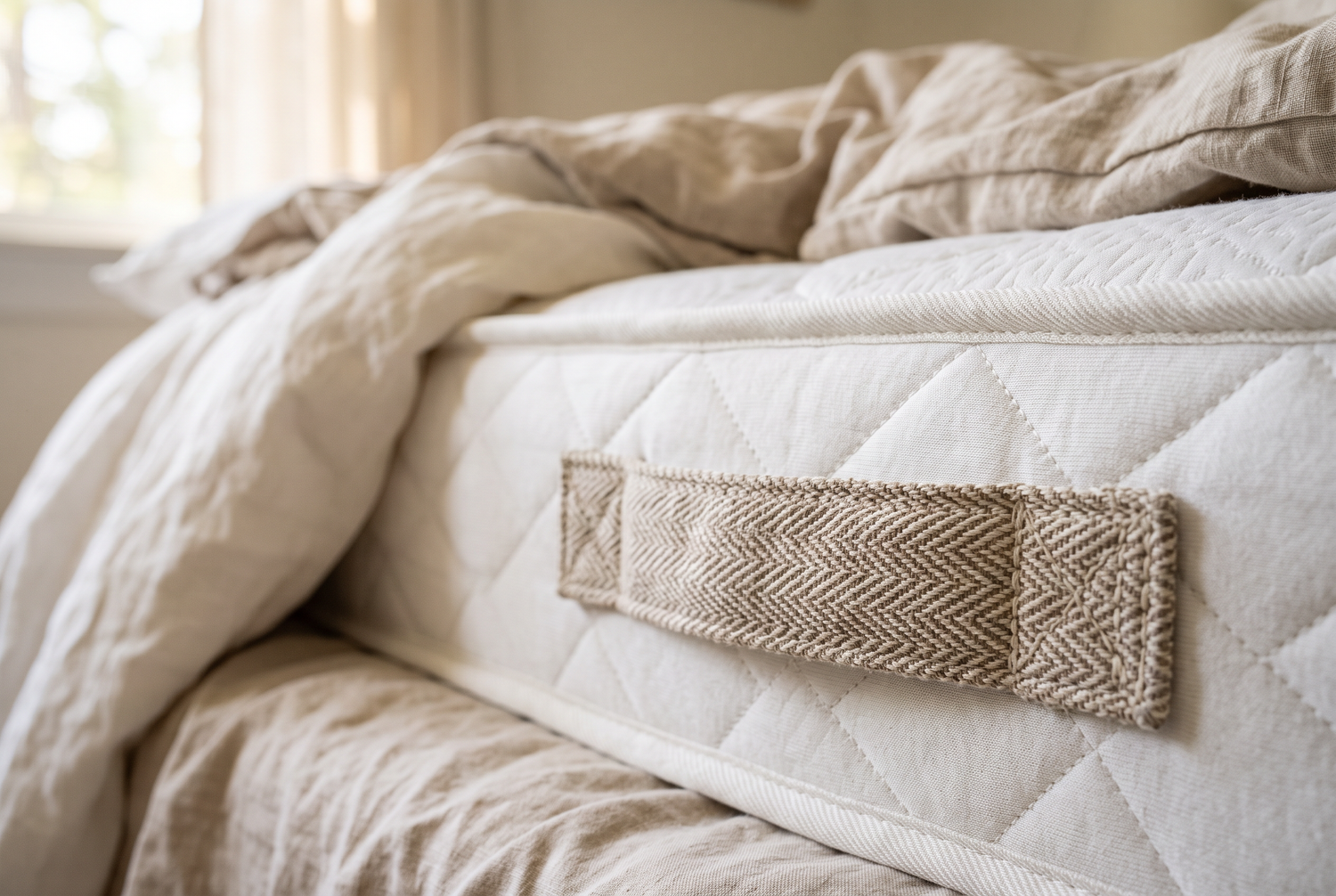
Four inconspicuous fabric loops on the sides – and yet, turning handles regularly raise questions when buying a mattress: Do you really need them? Can they hold the weight? And why do some manufacturers deliberately omit them? In fact, turning handles are more than just decoration: For mattresses weighing 15 to 40 kg, they determine whether regular turning and flipping is a two-minute job or a sweaty struggle that damages discs and fingernails. At the same time, misunderstandings surround these handles: They are intended for positioning, not for carrying – if you drag the mattress through the stairwell by them, they will tear out sooner or later. This article explains what turning handles do, what designs are available, how to turn and flip correctly – and why modern single-sided mattresses sometimes make flipping unnecessary.
The short answer: Turning handles are loops or recessed grips sewn into the sides that facilitate turning (180 degrees horizontally) and flipping (top to bottom) the mattress. They are designed for tension during positioning – typically 10 to 25 kg per handle – and not for freely carrying the entire mattress. Turning is recommended every 1 to 3 months; flipping is only done if both sides are designed as sleeping surfaces. For heavy mattresses weighing around 25 kg or more, it's worth flipping them with two people – using technique instead of brute force.
- Turning (head to foot) evens out wear and is advisable for almost all mattresses every 1–3 months; flipping (swapping top/bottom) only for double-sided sleeping surfaces.
- Turning handles are positioning aids: Depending on their construction, they can withstand 10–25 kg of tensile load – freely carrying the entire mattress by them overstrains the seams.
- Four vertical handles (one per side/corner) are the practical standard; sewn-in recessed grips are more stable than attached loops.
- Mattresses weigh between 15–40 kg (90×200 to 180×200 cm) depending on the material – for mattresses weighing around 25 kg or more, it is recommended to flip them with two people.
- Missing handles are not a sign of poor quality: Many modern single-sided mattresses with washable covers deliberately omit them because only turning is necessary.
What are turning handles for – and what are they not for?
The purpose of the handles is clearly defined: They provide a specific grip point for your hands when the mattress is being turned, flipped, adjusted, or propped up for airing on the slatted frame. Without handles, you are left with either gripping the mattress from underneath or holding onto the cover fabric – both are unergonomic and detrimental to both the cover and your back. Equally important is what handles are not: carrying handles for transport. The loops are sewn to the cover, not to the core – if the full weight of the mattress hangs freely from them, each seam quickly experiences 10 to 20 kg of constant tension plus peak loads during lifting. Torn-out handles are one of the most common cover damages and usually not covered by warranty, as they are considered improper use. Therefore, for moving: pack the mattress in a protective cover, lift from underneath, or use carrying straps – the best techniques are shown in the article Moving a Mattress.
Turning or Flipping: What does your mattress really need?
The terms are often confused but mean different things. Turning means: The mattress stays with the same side up and is rotated 180 degrees, swapping the head and foot ends. This distributes the pressure – the heavy pelvic area alternately rests on different core zones – and prevents one-sided indentations. Recommended: every 1 to 3 months; for new mattresses, rather monthly during the first six months. Flipping means: Swapping the top and bottom sides. This only makes sense if both sides are designed as full sleeping surfaces – which is the case for classic double-sided cores, but not for modern layered mattresses with a defined bottom side (recognizable by anti-slip fabric or manufacturer label). Such single-sided mattresses should only be turned; incorrect flipping places the soft comfort layer at the bottom and the support layer at the top – uncomfortable and damaging to the material. The articles Turning or Flipping a Mattress and Identifying a Sagging Mattress delve into which intervals apply to which mattress type and how to recognize initial indentations.
Designs and Quality: How to recognize good handles
Not all handles are created equal. The simplest form are attached fabric loops, sewn only to the cover fabric – functional, but with limited load-bearing capacity. Higher quality handles are integrated into the border seam or reinforced with fabric backing: they distribute the tension over a larger area and can hold 20 to 25 kg instead of 10 to 15 kg. A third variant are recessed grips – stiffened pockets embedded in the border, into which the hand grips from above; they are particularly tear-resistant, but more complex to manufacture. Regarding the number: Four handles are common, two on each long side – this allows for any turning and flipping movement. Six or eight handles offer real added value for large double mattresses 160 cm wide or more. You can check the quality with a simple test: pull firmly but evenly on the handle – if you hear seams crackle or see the fabric ripple, the anchoring is weak. For washable covers, the handles should also be placed so that the zipper runs freely – details can be found in the guide Washing a Mattress Cover.
| Handle Type | Load Capacity (Guideline) | Strengths | Weaknesses |
|---|---|---|---|
| Attached fabric loop | approx. 10–15 kg | Inexpensive, widely used | Seam can tear under tension |
| Handle integrated into seam | approx. 15–25 kg | Tension distributed over border | Slightly more expensive to manufacture |
| Recessed grip in border | approx. 20–25 kg | Very tear-resistant, ergonomic grip | Rare, elaborate |
| Without handles (single-sided mattress) | – | No tear-out risk, smooth border | Turning requires a bit more gripping technique |

Step by step: Turning and flipping a mattress to protect your back
With the right technique, a strenuous task becomes a routine exercise. To turn (180 degrees horizontally): Remove bedding and toppers, pull the mattress 20 to 30 cm towards the foot end using the handles, then grip one corner and rotate the mattress like a clock hand across the diagonal – the slatted frame acts as a turntable, the weight remains distributed. To flip (swap sides): First, pull the mattress across to the middle of the bed, then stand it on its long edge – bend your knees and keep your back straight, using your leg muscles for power. Then carefully tip it onto the other side and reposition it. Important: pull instead of lift whenever possible – the handles are made precisely for this. For mattresses weighing around 25 kg or more (many 160×200s, almost all latex models), it's significantly safer to work with two people: one person per long side, communicate commands, tip simultaneously. Use the opportunity for a double benefit: vacuum the slatted frame, check the underside of the mattress for mildew stains, and let the mattress air out upright for half an hour – the article on Mattress Ventilation explains why this is worthwhile.
Common mistakes regarding turning handles
Mistake 1: Carrying the mattress by the handles through the stairwell – the classic scenario that tears seams and jeopardizes warranty claims. Mistake 2: Flipping single-sided mattresses because "that's what you do" – always check the label beforehand; if the support layer is on top, sleep comfort and material suffer. Mistake 3: Jerking on a single handle instead of distributing the tension between two handles. Mistake 4: Lifting from a standing position with a rounded back – for mattresses weighing 25 to 40 kg, this is an invitation for a slipped disc; bend your knees, keep your back straight, keep the load close to your body. Mistake 5: Neglecting to turn the mattress for years – one-sided continuous pressure is the quickest way to develop an indentation, especially for couples with fixed sleeping sides. Mistake 6: Continuing to use damaged handles; a torn handle will completely rip out under load and often damage the cover in the process. Small repairs are worth doing early. You can read how long a well-maintained mattress generally lasts in the article on the Lifespan of a Mattress.
Turning handles as a buying criterion: How important are they really?
To be honest: Turning handles are a comfort feature, not proof of quality – and their absence is not a disqualifying factor. The overall construction is crucial: a single-sided mattress with a high-quality, dimensionally stable core only needs to be turned – a process that can be done well even without handles using the diagonal technique, especially as modern covers offer good grip. Heavy, double-sided mattresses (latex, high-pocket springs), on the other hand, benefit noticeably from four sturdy handles. When buying, prioritize as follows: first core quality, support behavior, and climate properties, then cover and washability – and only then features like handles. Ultimately, you won't recognize a well-thought-out overall package by its border, but by how you sleep: over weeks, in your own bed. That's precisely why extensive trial periods exist – the guide Buying a Mattress Online and Trial Sleeping shows what to look for.
Get CHF 25 discount
Subscribe to our newsletter and receive a one-time CHF 25 discount. ✓ 200 nights trial sleep ✓ 10 years warranty

Frequently Asked Questions about Turning Handles
What are the handles on the mattress for?
They make it easier to turn, flip, adjust, and prop up the mattress in bed. The loops provide a secure grip for your hands, so neither the cover nor your back is overstrained. They are not intended for carrying the entire mattress.
How much weight can turning handles hold?
Depending on the manufacturing, 10 to 25 kg of tensile load per handle. Attached loops are at the lower end, while handles integrated into the border seam and recessed grips are at the upper end. If the full mattress weight hangs freely from the handles, the seams can tear out.
How often should you turn or flip your mattress?
Turn (swap head and foot ends) every 1 to 3 months, for new mattresses monthly at first. Flip (swap top and bottom sides) only if both sides are designed as sleeping surfaces – this is indicated on the manufacturer's label.
Can every mattress be flipped?
No. Many modern mattresses are designed to be single-sided: a support layer at the bottom, a comfort layer at the top. They should only be turned, not flipped. The defined underside can be recognized by anti-slip fabric or corresponding labeling.
Are mattresses without handles worse?
No. Missing handles are not a sign of poor quality – many high-quality single-sided mattresses deliberately omit them because only turning is necessary, and this can be done well without handles using the diagonal technique. More important are core quality, cover, and support behavior.
How do you flip a heavy mattress by yourself?
First pull it sideways, then stand it upright on its long edge and carefully tip it over – with bent knees, a straight back, and pulling instead of lifting. For mattresses weighing around 25 kg or more (large double and latex mattresses), working with two people is significantly safer.









Leave a comment
This site is protected by hCaptcha and the hCaptcha Privacy Policy and Terms of Service apply.