

Anyone who shares a bed knows it: one person turns over, the other wakes up. Additionally, two people are rarely built the same way or sleep the same way. A good couple's mattress must therefore do two things – dampen disturbances and satisfy both.
The short answer: Important are low motion transfer (so that a partner's movements are not transferred) and a mattress that adapts to different body types. Instead of settling for a compromise firmness level, an adaptable mattress is the more elegant solution – plus ample lying surface.
Key takeaways
- Keep motion transfer low – so your partner isn't disturbed.
- The mattress should adapt to two different bodies.
- Choose sufficient width (at least 160 cm, better 180 cm).
- If you have different temperature preferences: two separate duvets.
The three challenges of sleeping as a couple
Sleeping as a couple brings with it three typical sticking points: motion transfer, different needs (weight, sleeping position, warmth), and space. Resolving all three significantly improves sleep.
Motion transfer: the most important factor
Motion transfer describes how much one person's movement is transferred to the other side. The lower it is, the less you notice when your partner turns over or gets up. Adaptive memory foam is particularly effective here because it absorbs and dampens movements at specific points, rather than transmitting them like a continuous spring system.

Different needs – without a compromise firmness level
The biggest concern for many couples: "He needs it firm, she needs it soft – so what firmness level?" The honest answer: a single firm firmness level rarely suits both. The solution lies not in compromise, but in adaptability.
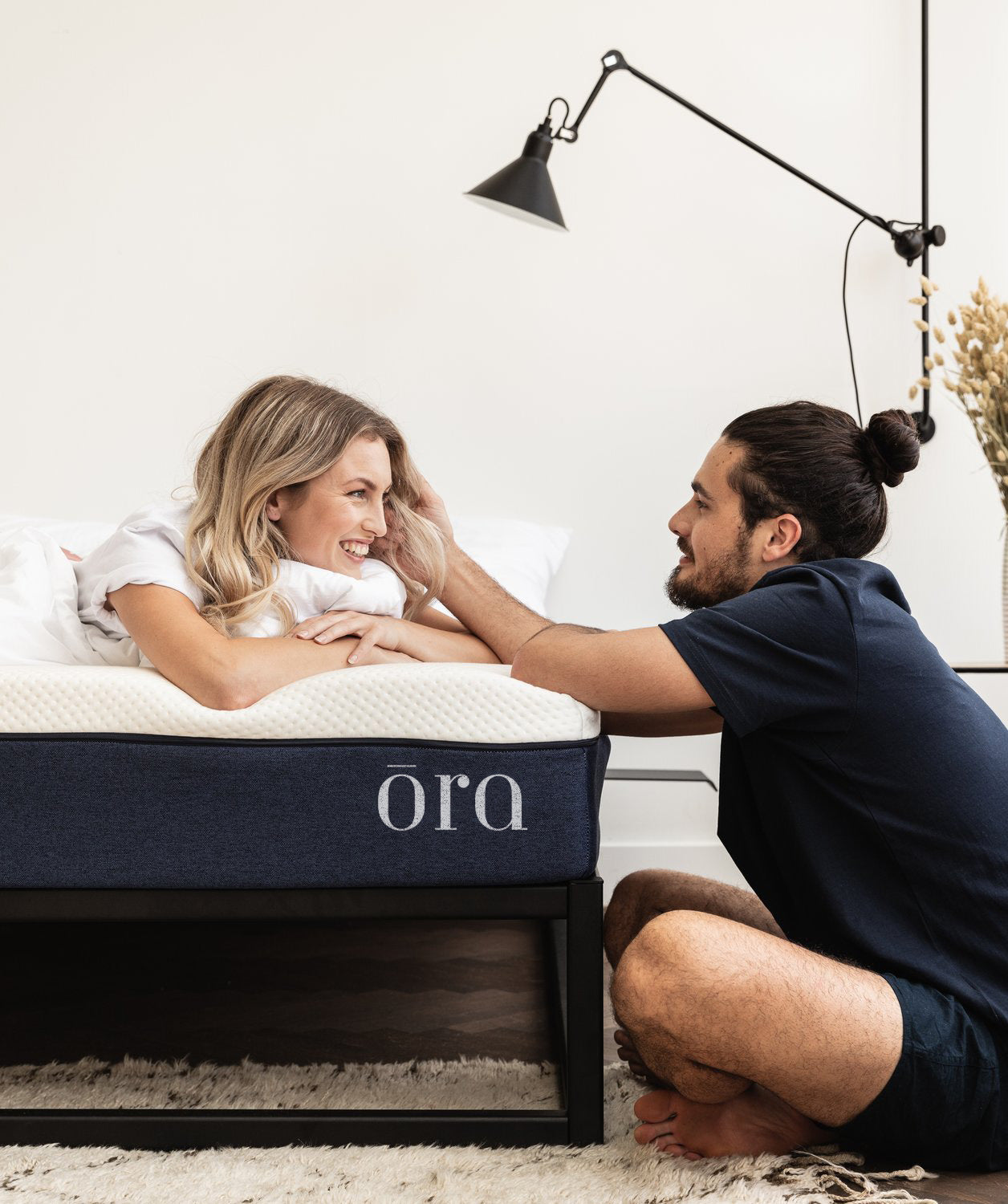
The Ora Ultra mattress is built on the principle of "one mattress for all": the EvoPoreHRC premium memory foam reacts individually to each body – the lighter person sinks in differently than the heavier person, and both are ergonomically supported. This way, you don't have to agree on a firmness level. Guides for side sleepers and back and stomach sleepers show how different sleeping positions are supported.
The right size for couples
| Width | Space per person | Suitable for |
|---|---|---|
| 140 x 200 cm | 70 cm | Tight – only for minimal space requirements |
| 160 x 200 cm | 80 cm | Comfortable minimum for couples |
| 180 x 200 cm | 90 cm | Plenty of freedom of movement, recommended |
As a rule of thumb: the more width, the less you disturb each other. More about dimensions can be found in the article Mattress sizes Switzerland.

Practical tips for sleeping as a couple
- Use two separate duvets – this solves duvet-hogging and different temperature preferences. See Duvets for summer and winter.
- Pay attention to low motion transfer, especially for light sleepers.
- It's better to choose a wider size – space is the most underestimated comfort factor.
Get CHF 25 discount
Subscribe to the newsletter and receive a one-time CHF 25 discount. ✓ 200 nights trial sleep ✓ 10-year warranty
A mattress that suits both
The Ora Ultra mattress dampens movement and adapts to both bodies with EvoPoreHRC premium memory foam – without any compromise on firmness. A sustainable option is the tested Ora Ultra Second Life.
Frequently asked questions
Which mattress is best for couples?
A mattress with low motion transfer that adapts to both bodies. Adaptive memory foam is ideal because it dampens movement and reacts individually to each person.
What firmness level if both are different?
Instead of a compromise firmness level, an adaptable mattress is the better choice – it reacts differently to each person, so both are ergonomically supported.
What mattress size for two people?
At least 160 x 200 cm, 180 x 200 cm is more comfortable. More width means more freedom of movement and less mutual disturbance.







Leave a comment
This site is protected by hCaptcha and the hCaptcha Privacy Policy and Terms of Service apply.