When you delve into the world of mattresses, you will sooner or later come across the term "point elasticity" – usually without a clear explanation. Yet, it is precisely this property that determines whether your shoulder can gently sink in when lying on your side or if the entire sleeping surface yields like a trampoline. A mattress with high point elasticity only gives way where pressure is applied, while simultaneously supporting the surrounding areas. This may sound technical, but it has very practical consequences: fewer tensions, a straight spine, and quieter sleep for two. In this guide, we explain the difference between point- and surface-elastic mattresses, compare common materials, and show you how to test point elasticity yourself. This way, your purchasing decision will be based on facts, not advertising claims.
The short answer: Point elasticity is a mattress's ability to yield only at the loaded point, while the rest of the surface remains stable. For ergonomic lying, it is clearly superior to surface elasticity because the shoulder and pelvis can sink in, while the waist and lumbar region are supported. The most point-elastic materials are high-quality memory foams and latex, followed by pocket springs; Bonnell springs, in contrast, are typically surface-elastic. If you experience tension or pressure points at night, you should specifically look for high point elasticity when buying your next mattress.
- Point-elastic mattresses only yield where pressure is applied – the spine remains straight in every sleeping position.
- Surface-elastic mattresses (e.g., Bonnell spring) yield over a large area and form a hollow around the entire body.
- Memory foam and latex achieve the highest point elasticity; pocket springs are in the good midfield.
- High point elasticity significantly reduces pressure peaks and decreases nightly tossing and turning.
- You can test the principle yourself: press your palm into the mattress and observe how much the surrounding area sinks in.
What exactly does point elasticity mean?
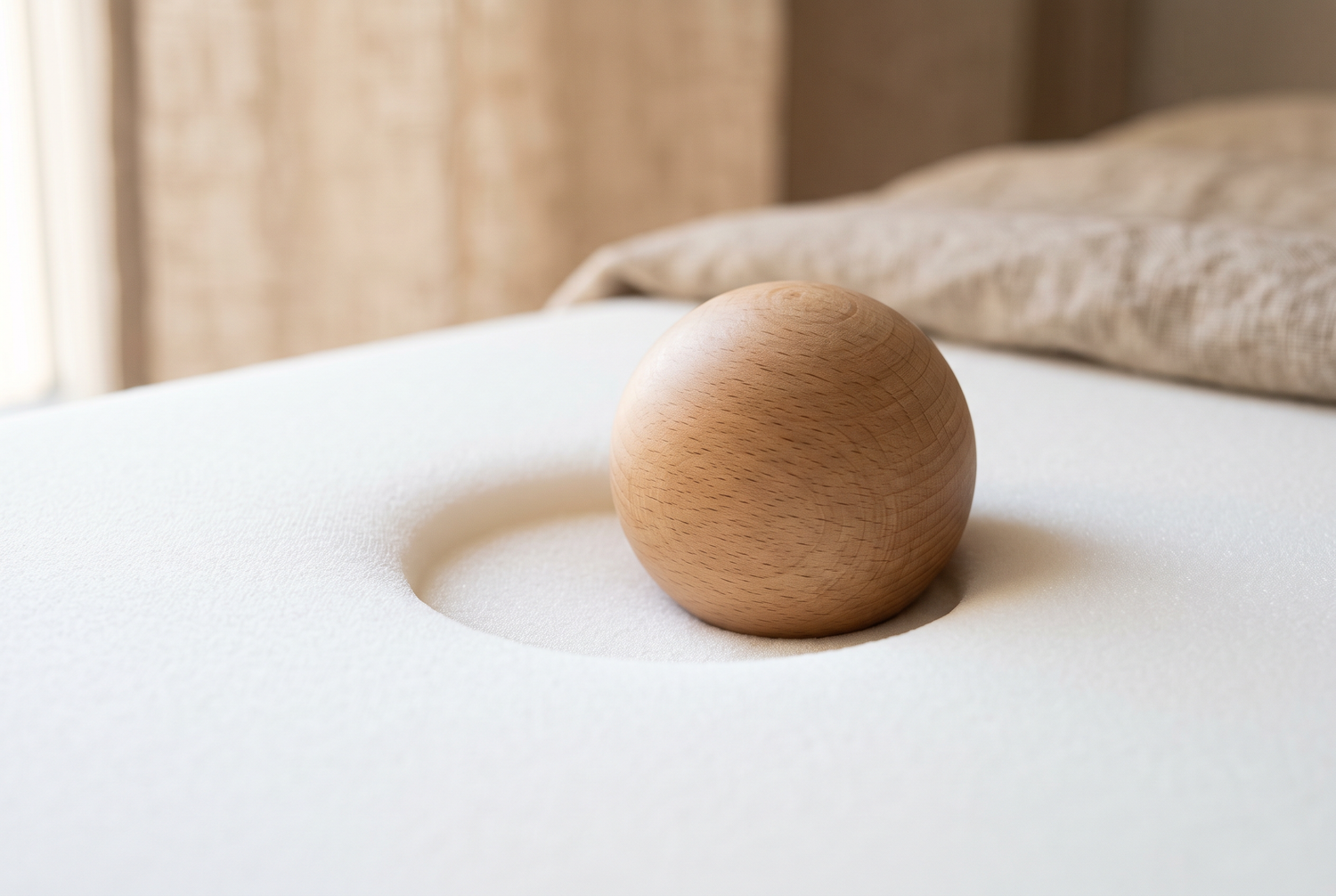
Point elasticity describes how precisely a mattress reacts to local pressure. If you place a ball about 10 cm in diameter on a high-quality point-elastic surface, a sharply defined hollow of perhaps 12 to 15 cm will form – the rest of the surface remains flat. With a surface-elastic mattress, however, an area of 40 cm or more sinks in. In sleep, this means: your shoulder, when lying on your side, weighs only a fraction of your body weight, but needs significantly more sinking depth than your waist. Only a point-elastic mattress can achieve both simultaneously. Physically, point elasticity depends on how strongly adjacent material areas are mechanically coupled. Open-cell foams with high density and springs individually sewn into fabric pockets react largely independently of each other. Continuous spiral connections or very firm, closed foams, however, transfer pressure over the surface. Our article on mattress core construction explains in detail how the individual layers of a mattress interact.
Surface elasticity: the counter-principle explained simply
Surface-elastic mattresses behave like a stretched membrane: if you press at one point, a large area yields together. The classic example is the Bonnell spring core, where hour-glass shaped steel springs are connected by spiral wires to form a continuous unit. If the hip presses down on the middle of the mattress, the connected springs pull the surrounding area down with it – creating a wide hammock-like hollow. This is unfavorable for the back: the lumbar spine sags, while the shoulder and pelvis are not specifically relieved. Sleep quality for two also suffers, as every movement of one person is noticeably transferred to the other side of the bed. Historically, surface elasticity was simply cheaper to produce, which is why Bonnell spring cores dominated hotel rooms and guest beds for decades. Today, high surface elasticity is a disqualifying criterion for a bed used regularly; for occasionally used guest solutions, it may be acceptable. You can find a broader overview of the types of construction in our mattress type comparison.
Why point elasticity is crucial for the spine
The spine is not a straight line, but a double S-curve. When lying down, it should maintain its natural shape: on the side, the shoulder must sink 4 to 7 cm deep depending on body shape, the pelvis 3 to 5 cm, while the waist must be supported. On the back, the buttocks need space, while the lumbar lordosis needs contact and support. A point-elastic mattress meets these conflicting demands centimeter by centimeter, because each body area gets its own sinking depth. Studies on pressure distribution show that point-elastic surfaces can significantly reduce peak pressures on the shoulder and hip – less pressure means better circulation, less tingling, and fewer position changes. Those who regularly wake up with numb arms or hip pain often lie on a mattress that is too surface-elastic or too firm. Read more about the connection between lying properties and discomfort in the guide Mattress and Back Pain.

Materials compared: Who is ahead?
Point elasticity primarily depends on the material of the mattress core. Modern memory foams with high density react most precisely because they adapt exactly to the body's contours under warmth and pressure. Natural latex follows closely behind, thanks to its millions of cell structures. Pocket springs achieve good values because each spring is individually sewn in – however, the fabric pockets slightly couple the springs. Cold foam is in the mid-range depending on its quality, while simple comfort foam and Bonnell springs bring up the rear.
| Material | Point Elasticity | Special Feature |
|---|---|---|
| Premium Memory Foam (e.g., EvoPoreHRC) | Very High | Automatically adapts to body and position |
| Natural Latex | Very High | High intrinsic weight, very durable |
| Pocket Spring | Good | Individually sewn springs, good ventilation |
| Cold Foam (RG 40+) | Medium to Good | Quality highly dependent on density |
| Bonnell Spring | Low (surface-elastic) | Connected springs yield over a large area |
How to test point elasticity yourself: A 4-step guide
You don't need a laboratory to roughly assess a mattress's point elasticity. First: the palm test. Press the heel of your hand about 5 cm deep into the sleeping surface and observe the edge of the indentation. If the depression remains limited to a circumference of about 10 cm, the mattress is point-elastic; if a palm-sized area sinks in much further, surface elasticity dominates. Second: the bottle test. Place a filled 1.5-liter bottle on the mattress and press firmly about 20 cm next to it – if the bottle tips over, the material transfers movement across the surface. Third: the side-lying check during a trial lie-down. Lie on your side and have a second person check whether your spine forms a straight line. Fourth: the partner test. If the person next to you turns over, you should ideally feel as little as possible. The most conclusive test, however, remains sleeping for several weeks – our article on trial sleeping when buying online explains how to do this risk-free.
Common mistakes regarding elasticity and firmness
The most common mistake: confusing point elasticity with firmness. A mattress can be firm and yet point-elastic – or soft and surface-elastic. These two properties describe completely different things: firmness indicates how much force is needed to sink in; point elasticity indicates how localized the sinking remains. Second mistake: relying on firmness ratings like H3. This scale is not standardized; each manufacturer defines it differently – our article Why firmness ratings are outdated shows why this concept is obsolete. Third mistake: ignoring the slatted frame. A worn out or incorrectly adjusted slatted frame can impede even the best point-elastic mattress. Fourth mistake: seeing thin toppers as a miracle cure – a topper changes the surface feel, but cannot replace the core's support structure. And finally: only a few minutes of trial lying in a store. The body needs several nights to get used to a new sleeping sensation.
Point elasticity and sleeping position: Who benefits most?
Side sleepers benefit most from high point elasticity, as they have the greatest height differences between their body parts and the mattress: the shoulder is often 10 to 15 cm wider than the waist. If it cannot sink in specifically, the cervical spine will bend and the arm will go numb. Back sleepers primarily need precise adaptation in the pelvic and lumbar regions so that the buttocks sink in without the lower back sagging. Stomach sleepers, in turn, need a surface that does not allow the pelvis to sink too deeply – here too, point elasticity helps because it specifically supports where the main load lies. Those who change position frequently at night benefit most from an adaptive, point-elastic mattress: it reacts anew with each change without waking you up. Couples with different body types also sleep better on point-elastic mattresses – read more about this in the guide Mattress for Couples.
The role of slatted frame and topper
Point elasticity results from the interaction of the entire bed system. A slatted frame with 26 to 42 flexible slats supports local adaptation because each slat can yield individually. Rigid bases such as boards or very simple frames with 10 to 14 wide slats, however, make the surface harder and more uniform – although with high-quality, sufficiently thick mattresses of about 20 cm core height, the effect is less than often claimed. The most important thing is that the slatted frame has no hollows or broken slats. A topper made of point-elastic foam can noticeably refine the sleeping sensation of a too-firm mattress and improve pressure distribution on the shoulders and hips; however, it cannot compensate for a worn-out mattress. As a rule of thumb: the core determines the support function, the topper the sleeping comfort of the top 4 to 8 cm. The article Slatted frame and mattress shows how a frame and mattress optimally fit together.

Get CHF 25 discount
Subscribe to our newsletter and receive a one-time CHF 25 discount. ✓ 200 nights trial sleep ✓ 10-year warranty
Frequently Asked Questions about Point Elasticity
What is the difference between point elasticity and surface elasticity?
Point-elastic mattresses only yield at the loaded point, while the rest of the surface remains stable. Surface-elastic mattresses sink over a large area and form a hollow around the entire body, which can distort the spine from its natural shape.
Is a point-elastic mattress automatically soft?
No, point elasticity and firmness are independent properties. A mattress can be firm and still highly point-elastic – the crucial thing is that the sinking remains localized and the entire surface does not swing along.
Which material is the most point-elastic?
High-quality memory foams and natural latex achieve the highest point elasticity. Pocket springs are in the good mid-range, while Bonnell springs typically react as surface-elastic and are not recommended for beds used long-term.
How do I test a mattress's point elasticity?
Press the heel of your hand about 5 cm deep into the sleeping surface: if the indentation remains confined to about a 10 cm radius, the mattress is point-elastic. Additionally, the bottle test helps – if a bottle placed next to it tips over when you press down, the mattress is more surface-elastic.
Is point elasticity also important for stomach sleepers?
Yes, because stomach sleepers also need targeted support in the pelvic area so that the lumbar spine does not sag into a hollow back. A point-elastic mattress supports where the main load lies, while simultaneously relieving the chest and knees.
Does a topper help if my mattress is too surface-elastic?
A point-elastic topper improves pressure distribution on the surface and makes the sleeping sensation more comfortable. However, it cannot replace the support function of a surface-elastic or worn-out core – in that case, a mattress replacement is the better solution.







Leave a comment
This site is protected by hCaptcha and the hCaptcha Privacy Policy and Terms of Service apply.