
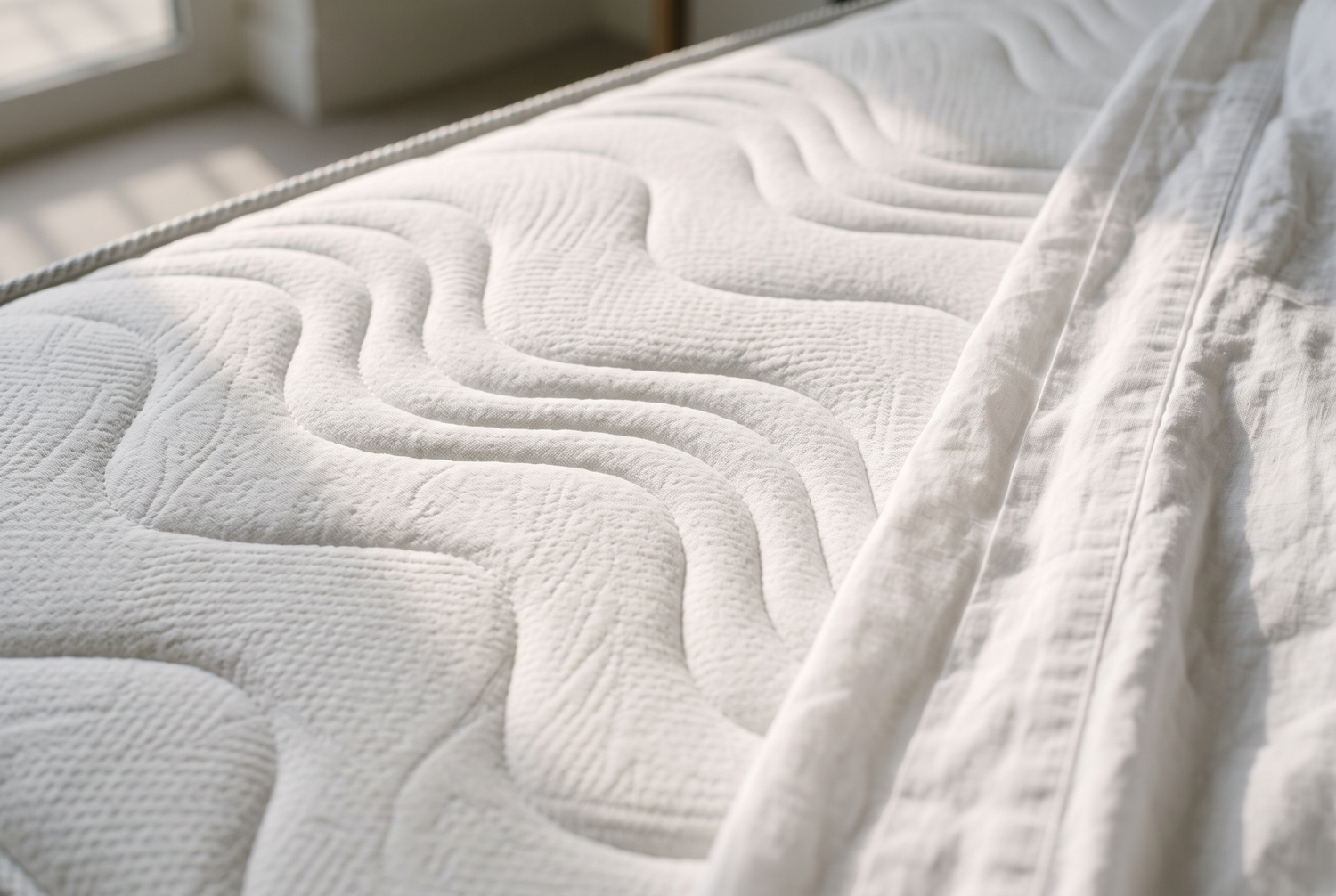
Hardly any mattress data sheet can do without them: comfort zones. Sometimes there are 3, sometimes 5, mostly 7, occasionally even 9 – and advertising suggests that more zones automatically mean better sleep. But what do mattress comfort zones actually do? The basic idea is ergonomically sound: different body regions have different weights and require different levels of give so that the spine remains straight in both side and supine positions. However, the implementation using fixed cut-in zones has pitfalls that are rarely discussed: rigid zones only fit if body size matches the zone division – and the concept becomes flawed when a couple has a 20 cm height difference. This article explains how comfort zones are constructed, what they can do, where their limits lie, and why modern adaptive materials are increasingly leaving the age of zones behind.
The short answer: Comfort zones are areas of varying firmness in the mattress core: softer at the shoulders and pelvis, more supportive at the waist and lower back. The goal is a straight spine in every sleeping position. More than 7 zones offer no demonstrable additional benefit, and rigid zones only work if the shoulders and pelvis are actually on the intended areas – which is often not the case depending on body size. Point-elastic, adaptive materials achieve the same effect continuously and for every body size, without having to lie in a specific spot.
- Comfort zones are designed to allow the shoulders and pelvis to sink deeper and support the body's center – for a straight spine in side and supine positions.
- From an ergonomic perspective, only 3 functional areas are relevant: shoulder, pelvis, and the support in between. 7 zones are primarily for symmetry (head and foot ends are interchangeable).
- Rigid zones are designed for a standard height of approximately 165 to 185 cm – those significantly shorter or taller quickly find themselves outside the zones.
- More important than the number of zones are point elasticity and material quality: A high-quality adaptive foam provides continuous support everywhere.
- 9 or more zones are marketing – no serious ergonomic standard requires more than the classic functional areas.
What are comfort zones – and why do they exist?
The human body is not a uniform load: the pelvic area carries about 40 to 50 percent of body weight, the shoulder area is the narrowest and most pressure-sensitive support surface for side sleepers, and the waist needs support so that it doesn't sag. Comfort zones try to meet these requirements by using areas of different firmness in the mattress core: incisions, cut-outs, or different material densities make the shoulder zone more yielding and the lumbar zone more supportive. The goal is always the same: in the side position, the spine forms a straight line parallel to the mattress, and in the supine position, it maintains its natural double-S shape. If this is not achieved – for example, if the pelvis sags or the shoulder is pushed up – tension and, in the long term, back problems can result. The article Mattress and back pain shows how closely mattresses and back health are related.
3, 5, 7 or 9 zones: What's behind the numbers?
The number of zones follows a simple logic. A 3-zone mattress differentiates between the shoulder, middle, and pelvis. The 5-zone variant adds the head and foot areas. The common 7-zone mattress divides the body into head, shoulder, lumbar, pelvis, thigh, calf, and foot – with the zones arranged symmetrically so that the mattress can be rotated (the foot area then corresponds to the head area). Functionally, only three of these are relevant: the softer shoulder zone, the supportive lumbar zone, and the load-bearing pelvic zone – the head and calves do not pose significant ergonomic demands. Anything beyond 7 zones is product differentiation without proven benefit: no scientific standard exists that ergonomically justifies 9 zones. A detailed classification of when the zone concept is useful and when it's marketing is provided in the article 7-zone mattress: useful or marketing?.
The weakness of rigid zones: humans are not the norm
The biggest problem with fixed comfort zones is their geometry. The zone division is designed for an average person of about 165 to 185 cm: for example, the shoulder zone then begins 25 cm below the top of the mattress and is 30 cm long. Someone who is 195 cm tall will have their shoulder partly on the firmer head zone; someone who is 155 cm tall and sleeps further down in the bed will miss the zones completely. Sleeping habits also disrupt the concept: many people slide up or down at night, sleep diagonally, or change positions 20 to 40 times. And for a couple, two bodies of different sizes share the same zone geometry – it can only fit one at best. In addition: the zone effect depends heavily on body weight. For light people under 60 kg, cut-in zones are barely activated, while for heavy people over 100 kg, soft shoulder zones can yield too much. Rigid zones are therefore a compromise for the average – similar in generality to the concept of fixed firmness levels, whose weaknesses we highlight in the article Why firmness levels are outdated.
| Zone Concept | Operating Principle | Strength | Weakness |
|---|---|---|---|
| 3 Zones | Shoulder/Middle/Pelvis | Covers the relevant areas | Coarse division, size-dependent |
| 7 Zones | Symmetric fine division | Reversible, more differentiated | Only works with appropriate body size |
| 9+ Zones | Further subdivision | – | No proven additional benefit |
| Adaptive foam (zoneless) | Continuous adjustment via point elasticity | Works for any size, position and location in bed | Quality of foam is crucial |

Point elasticity: the real key to good support
What comfort zones try to solve through geometry, a good material solves through physics: point elasticity. A point-elastic material yields exactly where pressure is applied – regardless of where on the mattress that happens. The heavy hips sink deeper, the lighter waist continues to be supported, and this applies equally to a body height of 155 cm as to 195 cm, in the middle of the bed as at the edge. Area-elastic materials (such as Bonnell spring cores), on the other hand, yield over a large area and form hollows. Modern adaptive high-performance foams like EvoPoreHRC combine high point elasticity with progressive support: they react softly to light pressure (shoulder) and increasingly firmly to high pressure (pelvis) – the "zones" thus automatically emerge where the body needs them, not where the manufacturer has cut them in. This is precisely the principle behind the approach one mattress for all: Instead of standard zones for standard bodies, the material adapts individually to each body.
Zones and sleeping position: What matters depending on your position
Side sleepers benefit most from yielding shoulder areas: the shoulder must be able to sink 4 to 7 cm so that the cervical spine remains straight – mattresses that are too firm push the shoulder up and cause tension. Further details can be found in the guide Mattress for side sleepers. Back sleepers primarily need a supported lumbar region: if the pelvis sinks too deep, it creates a hollow back pull; if it remains too high, the lower back sags. Stomach sleepers are best on generally more supportive surfaces, because a deeply sinking pelvis overextends the lower back. It is important to understand: all these requirements concern the interaction of immersion depth and support force – not the number of stamped zones. A mattress with excellent point elasticity fulfills them in every position, while the best 7-zone geometry fails if the shoulder and pelvis are outside the intended areas. During nocturnal position changes – on average 20 to 40 times per night – the speed at which the material springs back also matters.
Common myths about comfort zones in a fact check
Myth 1: "The more zones, the better." False – beyond the three functional areas of shoulder, lumbar, and pelvis, there is no proven ergonomic additional benefit; 9 zones are simply cosmetic for a catalog. Myth 2: "Comfort zones are clearly noticeable." Mostly no – well-made zone transitions are fluid; if you feel hard edges, you're lying on poor craftsmanship. Myth 3: "No ergonomics without zones." False – high-quality point-elastic materials provide continuous correct support, without any cuts. Myth 4: "Zones replace material quality." On the contrary: an inferior foam with 7 zones will still wear out after a few years, while a dense quality foam maintains its support for over a decade. Myth 5: "The zones must match the firmness level." Both concepts originate from the same standardization mindset – what matters is how the mattress reacts to your individual body, not what label it bears. An overview of other advertising promises can be found in the article Mattress myths checked.
Get a CHF 25 discount
Subscribe to the newsletter and receive a one-time CHF 25 discount. ✓ 200 nights trial sleep ✓ 10-year warranty

Frequently Asked Questions about Comfort Zones
How many comfort zones should a mattress have?
Three functional areas are ergonomically relevant: a yielding shoulder zone, a supportive lumbar zone, and a load-bearing pelvic zone. 7 zones are the widespread standard, but offer little added value compared to 5 zones. More important than the number of zones are point elasticity and material quality.
Can you feel comfort zones when trying out a mattress?
Well-made zones are barely noticeable because the transitions are fluid. Clearly palpable edges or abruptly changing firmness are more likely a sign of poor quality. Instead, assess whether the spine lies straight in the side position and whether the shoulder and pelvis sink in comfortably.
Do comfort zones work for every body size?
No. Rigid zones are designed for body sizes of approximately 165 to 185 cm. Significantly smaller or taller individuals may have their shoulders and pelvis partly outside the intended areas, which negates the zone effect. Continuously adaptive materials bypass this problem.
Are more than 7 zones useful?
No. There is no scientifically proven additional benefit for 9 or more zones. The division primarily serves product differentiation in marketing. Crucial for ergonomics are the immersion depth, support force, and point elasticity of the material.
What is more important: comfort zones or firmness level?
Both are simplifications from the normative way of thinking. Neither the number of zones nor the firmness level label guarantees that the mattress will suit your body. What is crucial is how the material reacts to your individual weight and sleeping position – you can most reliably test this by trying it out at home for an extended period.
Do couples need different zones?
In rigid zone systems, the geometry rarely fits both partners, especially with significant differences in height and weight. Point-elastic, adaptive mattresses react individually to each body on either side of the bed, solving the problem without zone compromises.









Leave a comment
This site is protected by hCaptcha and the hCaptcha Privacy Policy and Terms of Service apply.