
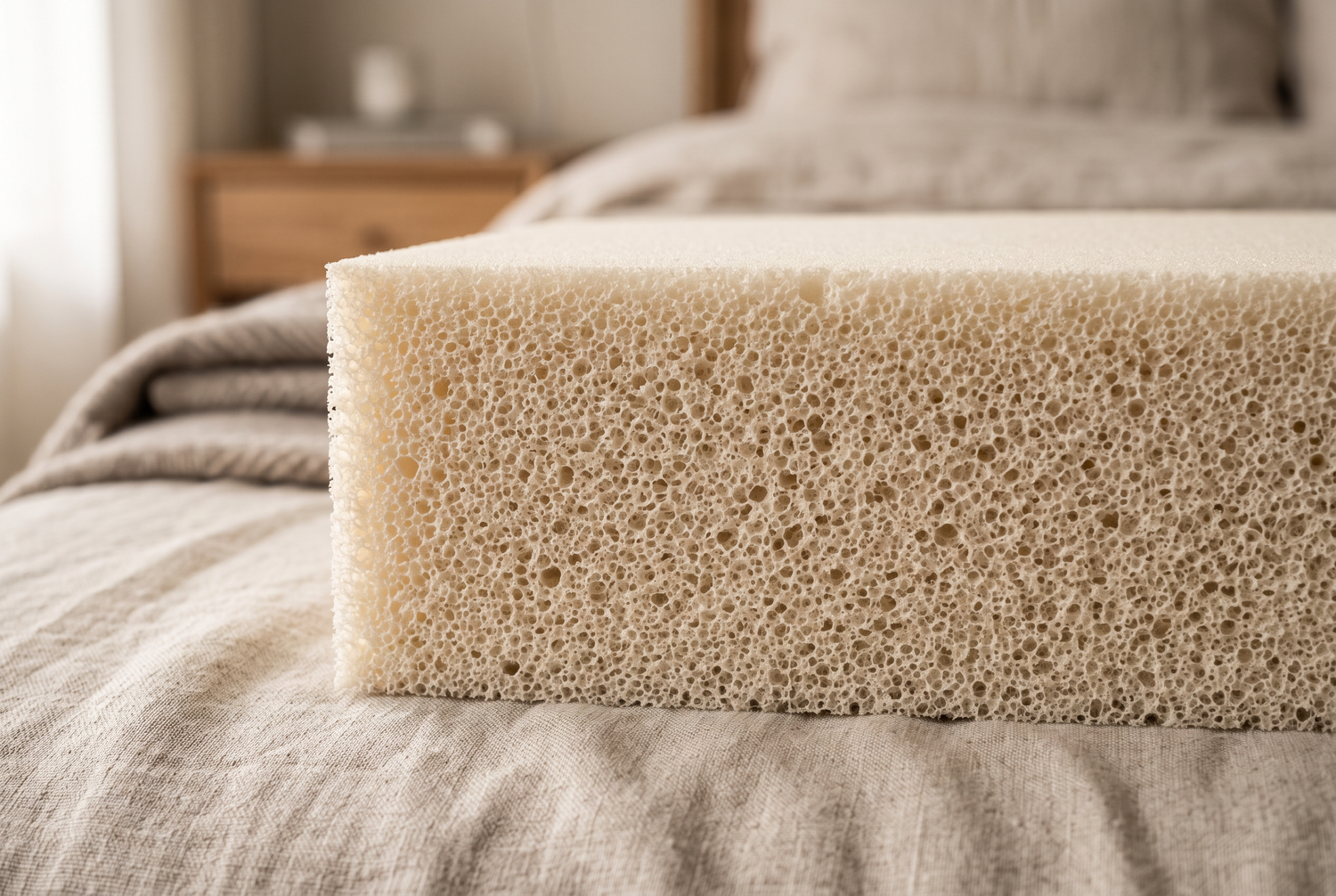
Anyone studying mattress data sheets will encounter two technical metrics that reveal more about actual quality than any advertising promise: indentation hardness and density. While firmness labels like H2 or H3 are not standardized and are assigned differently by each manufacturer, indentation hardness and density are physically measurable quantities: one describes how much force is needed to compress a foam, and the other, how much material is actually in it. Together, they determine how a mattress feels – and, most importantly, how long it lasts. Nevertheless, both values are often concealed or confused in sales. This article explains both metrics clearly, provides concrete benchmarks for good quality, shows the limitations of the numbers – and thereby makes you a more informed buyer.
The short answer: The density (RG, in kg/m³) indicates how much raw material is contained in one cubic meter of foam – it is the most important metric for durability: below RG 35, early sagging is a risk; from RG 40, good quality begins; from RG 50, it is premium. Indentation hardness (in kPa) describes how firm the foam feels: typical values are 25 to 45 kPa. Both values are independent of each other – a firm foam can be cheap and short-lived, while a soft one can be high-quality and durable. For purchasing, the rule is: check the density, and personally test the lying sensation.
- Density = amount of material per cubic meter: RG 35 is the lower limit, RG 40–50 is solid, RG 50+ is durable premium quality with 8–10+ years lifespan.
- Indentation hardness = firmness sensation in kilopascals (kPa): measures the force required to compress the foam by 40 percent; typical values are 25–45 kPa.
- The two values are independent: High indentation hardness does NOT mean high quality – even a cheap foam can be firm.
- Missing RG specification is a warning sign: Reputable manufacturers declare the density, budget providers hide it.
- Numbers do not replace trying it out: How sinking and support feel is decided by your own body – ideally over several weeks in your own bed.
What is density – and why is it so important?
Density (RG) quantifies how many kilograms of raw material are contained in one cubic meter of foamed material. A foam with RG 40 contains 40 kg of material per m³, one with RG 25 only 25 kg – the rest is air. Why this matters: During foaming, cell walls are formed, which must be compressed and rebound with every load. The more material these cell walls form, the more stably they withstand approximately 2,500 hours of use per year. An RG-25 foam often loses its resilience after just 2 to 4 years – visible as a hollow, noticeable as a sagging mid-body. An RG-50 foam, on the other hand, lasts 8 to 10 years and more. Density also explains a large part of the price differences: more raw material costs more – which is why a 300-franc mattress with "premium foam" almost certainly has a low RG. The article Identifying a Sagging Mattress shows how to recognize sagging early.
What is indentation hardness – and how is it measured?
Indentation hardness describes a foam's resistance to compression. It is measured according to a standard (ISO 3386): A test plate compresses the foam by 40 percent of its height, and the force required for this is given in kilopascals (kPa). A foam with an indentation hardness of 30 kPa feels medium-firm, one with 45 kPa feels significantly firmer, and below 25 kPa it is soft. What is important is the interaction with the characteristic curve: Good foams behave progressively – they give way slightly at first (comfortable sinking of the shoulder and hips) and build up increasing counter-pressure with deeper compression (support for the mid-body). It is precisely this progression that distinguishes high-quality adaptive foams from simple block foams that yield linearly. Indentation hardness, by the way, is what firmness labels should actually represent – except that H1 to H5 do not follow a binding measurement standard. You can read why the entire firmness system is therefore of little use in the article Why Firmness Grades are Obsolete.
The crucial point: Both values are independent
The most common misconception when buying a mattress: confusing firmness with quality. In reality, density and indentation hardness can be largely adjusted independently during production. There are firm, cheap foams (RG 25, 40 kPa) that feel "robust" when tried out and are sagged after three years. And there are soft, premium foams (RG 55, 25 kPa) that feel conforming and last a decade. So, firmness says something about how the mattress feels today, while density says something about how it will feel in five years. For the purchase decision, this means: evaluate firmness with your own body (preferably over several weeks), but check durability using the declared density. If the RG specification is missing from the data sheet, ask – and interpret evasiveness as what it usually is: an indication of material savings. The article What does a good mattress cost? clarifies what good quality should cost.
| Density | Quality Level | Expected Lifespan | Typical Use |
|---|---|---|---|
| RG 20–30 | Low | 2–4 years | Guest mattresses, budget goods |
| RG 35 | Lower Mid-range | 4–6 years | Entry-level models |
| RG 40–45 | Solid Quality | 6–8 years | Good everyday mattresses |
| RG 50–60 | Premium | 8–10+ years | High-quality brand cores |
| RG 65+ | Top Class | 10–12 years | Visco foam and latex top products |

Practical benchmarks: Which numbers for whom?
For the vast majority of adults, a core with RG 40 to 55 is a sensible basis – it combines durability with an affordable price. People with higher body weight, starting at around 90 kg, particularly benefit from RG 50+, because the cell structure fatigues faster under higher load; here, the surcharge is doubly worthwhile. For indentation hardness, there is no "correct" value in the data sheet: whether 28 or 38 kPa feels better depends on body type, weight distribution, and sleeping position – and can only be determined by lying on it. Additionally, pay attention to the core height: a high-quality foam core should measure at least 14 cm, and the total height of the mattress 18 to 25 cm – cores that are too thin will sag in heavier areas. For multi-layer mattresses: the specifications must be available per layer; a thin premium topper over an RG-25 base foam remains a short-lived construction. The article Cold Foam Density Explained elaborates on how these metrics interact specifically with cold foam.
Common mistakes when dealing with the metrics
Mistake 1: Interpreting firmness as proof of quality – "nice and firm" says nothing about durability. Mistake 2: Confusing RG specifications of the cover and the core; some providers advertise the density of a thin comfort layer, while the supportive core is cheap. Mistake 3: Falling for "up to" formulations ("RG up to 50" can mean RG 35 on average). Mistake 4: Comparing indentation hardness values across material types – 30 kPa feels different in cold foam, visco foam, and latex because resilience and temperature dependency vary. Mistake 5: Buying based solely on numbers and skipping the trial sleep – no data sheet replaces two weeks of real nights. Mistake 6: Ignoring the interaction with the slatted frame; a sagging slatted frame makes even the best RG-55 core look bad. More on typical pitfalls can be found in the article The most common mistakes when buying a mattress.
Why modern foams are changing the discussion
The classic logic – soft comfort foam here, firm support foam there – stems from a time when foams reacted largely linearly. Modern high-performance foams like EvoPoreHRC work differently: their cell structure is designed to react flexibly under low pressure and progressively build up counter-pressure under higher loads. The result: shoulders and pelvis sink comfortably, while the mid-body remains supported – for both light and heavy individuals, without requiring different firmness variations. High densities ensure longevity, while the adaptive characteristic curve handles what used to be solved by firmness grade selection. For buyers, this simplifies things: instead of puzzling over H2 and H3, you check the declared material specifications – and simply test the adaptive behavior in your own bed. The article Adaptive Mattresses: The Future of Sleep provides an overview of this concept.
Get CHF 25 discount
Subscribe to our newsletter and receive a one-time CHF 25 discount. ✓ 200 nights trial sleep ✓ 10 years warranty

Frequently Asked Questions about Indentation Hardness and Density
What density should a good mattress have?
As a rule of thumb: at least RG 40 for daily use, RG 50 and more for premium demands and individuals weighing approximately 90 kg or more. Below RG 35, early sagging within a few years is to be expected.
What does indentation hardness in kPa mean?
Indentation hardness indicates how much pressure is needed to compress the foam by 40 percent of its height. Typical values range between 25 kPa (soft) and 45 kPa (firm). It describes the feeling of firmness but says nothing about quality or durability.
Is higher indentation hardness better for the back?
No, not generally. What's crucial is that the shoulders and pelvis can sink in while the mid-body remains supported – this depends on the interplay between body shape and material characteristics. Mattresses that are too firm cause as many problems as those that are too soft.
How can I identify inferior foam?
By missing or evasive density specifications, very low prices with grand quality promises, a low core height under 14 cm, and spongy rebound: if a handprint remains visible for an extended period, even though it's not memory foam, it indicates fatigued or cheap material.
Are density and firmness grade the same thing?
No. Density measures material density and thus durability, while firmness grade is intended to describe firmness – but it is not standardized and varies from manufacturer to manufacturer. Indentation hardness in kPa would be the measurable firmness specification.
Do the RG guidelines also apply to latex and visco foam?
The logic yes, the numbers no: Latex, due to its production process, works with significantly higher densities of 65 to 95 kg/m³, while high-quality visco foam uses 50 to 85 kg/m³. Therefore, always compare RG values only within the same material category.









Leave a comment
This site is protected by hCaptcha and the hCaptcha Privacy Policy and Terms of Service apply.