
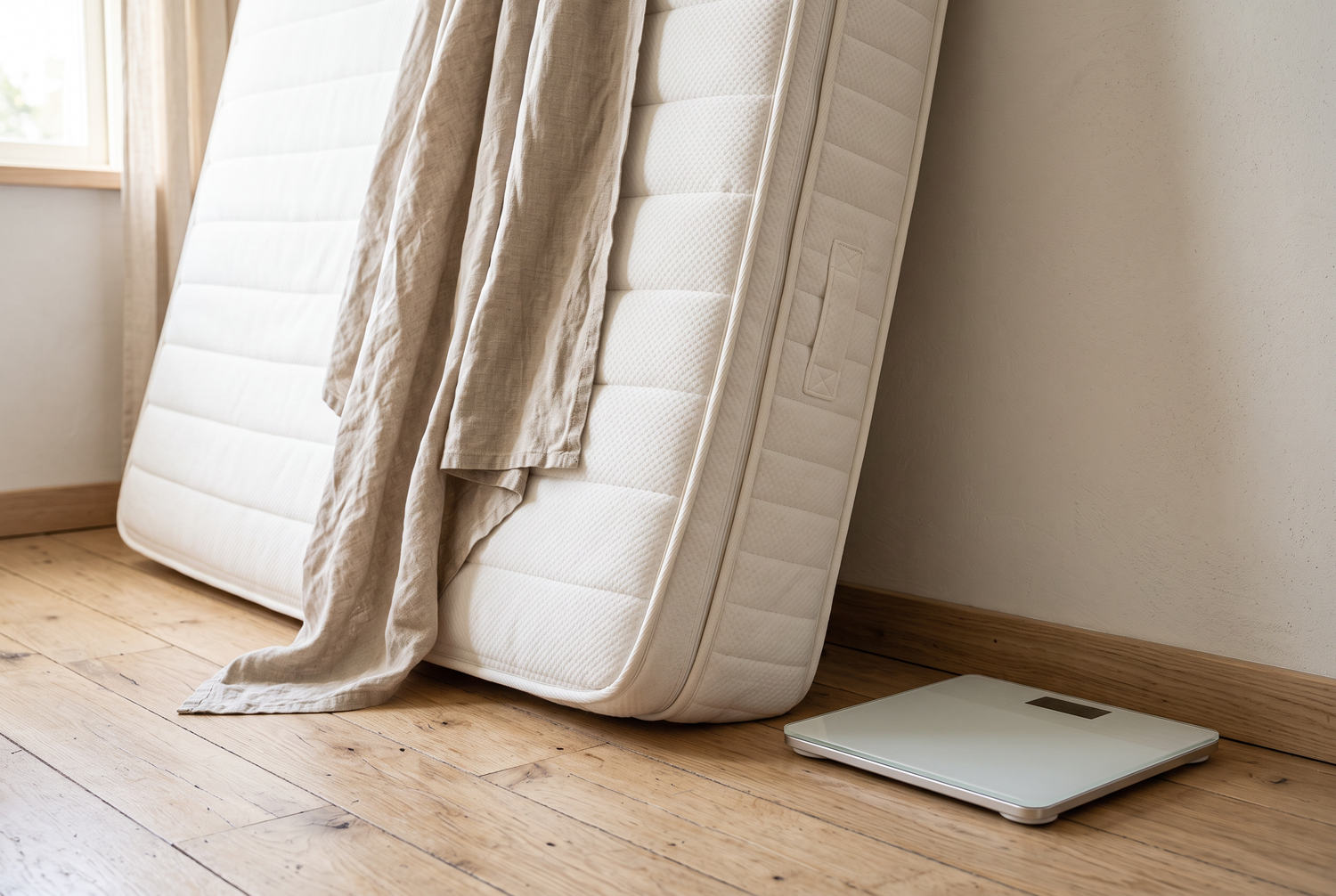
When buying a mattress, most people focus on feel, size, and price – the weight of the mattress is rarely on the checklist. Yet, this very number reveals an astonishing amount: about the material quality, durability, and how strenuous making the bed will be in the future. A 160x200 cm mattress can weigh between 15 and over 60 kg, depending on its construction – a difference you'll notice at the latest when you first turn it. At the same time, a very light foam core simply contains little material and often loses its supportive power more quickly. In this guide, we show how much mattresses typically weigh, what the weight has to do with density, and what you should pay attention to regarding bed frames, transport, and care. This way, you can correctly interpret the weight specification in the data sheet.
The short answer: The weight of a mattress depends on material, size, and height: simple foam mattresses in 90x200 cm often weigh only 10 to 15 kg, high-quality memory foam and latex mattresses 20 to 30 kg, large innerspring or latex models in 180x200 cm up to over 60 kg. For foam mattresses, a higher weight is usually a good sign because it indicates a high density and thus durable, dimensionally stable material. However, it's not just the weight that matters, but the relationship between material, supportive power, and everyday handling.
- Typical weights in 90x200 cm: simple foam mattress 10–15 kg, cold foam 15–20 kg, memory foam 18–25 kg, pocket spring 20–30 kg, latex 25–35 kg.
- For foams, weight is an indirect quality indicator: more kilos per cubic meter (density) means more material and a longer lifespan.
- Very light mattresses under 12 kg (90x200) usually consist of foam with low density and sag faster.
- For turning, making the bed, and moving, handling counts: turning handles, a second pair of hands, and the right lifting technique protect your back.
- Bed frame and slatted base must support the mattress plus body weight – quickly 250 kg and more for two people.
How much does a mattress weigh? Figures by type and size
The weight of a mattress results from three factors: the material, the sleeping surface, and the core height. A simple comfort foam mattress with a height of 14 cm in 90x200 cm often weighs only 10 to 13 kg. A high-quality cold foam core with a height of 20 cm and a density of 40 already weighs 16 to 20 kg in the same format, a premium memory foam mattress 18 to 25 kg. Pocket spring mattresses weigh 20 to 30 kg due to the steel springs, while latex mattresses are the heavyweights among standard formats at 25 to 35 kg. If you double the width to 180x200 cm, the weight also roughly doubles: large latex or box spring top mattresses can reach 50 to over 60 kg. If you want to understand the differences between the types of construction in more detail, you can find a comprehensive comparison in the mattress type comparison. Important for practical use: manufacturer specifications usually refer to the mattress without packaging – vacuum-packed roll goods often seem heavier when unpacked because they are compact and difficult to grip.
Why weight is a quality indicator: density
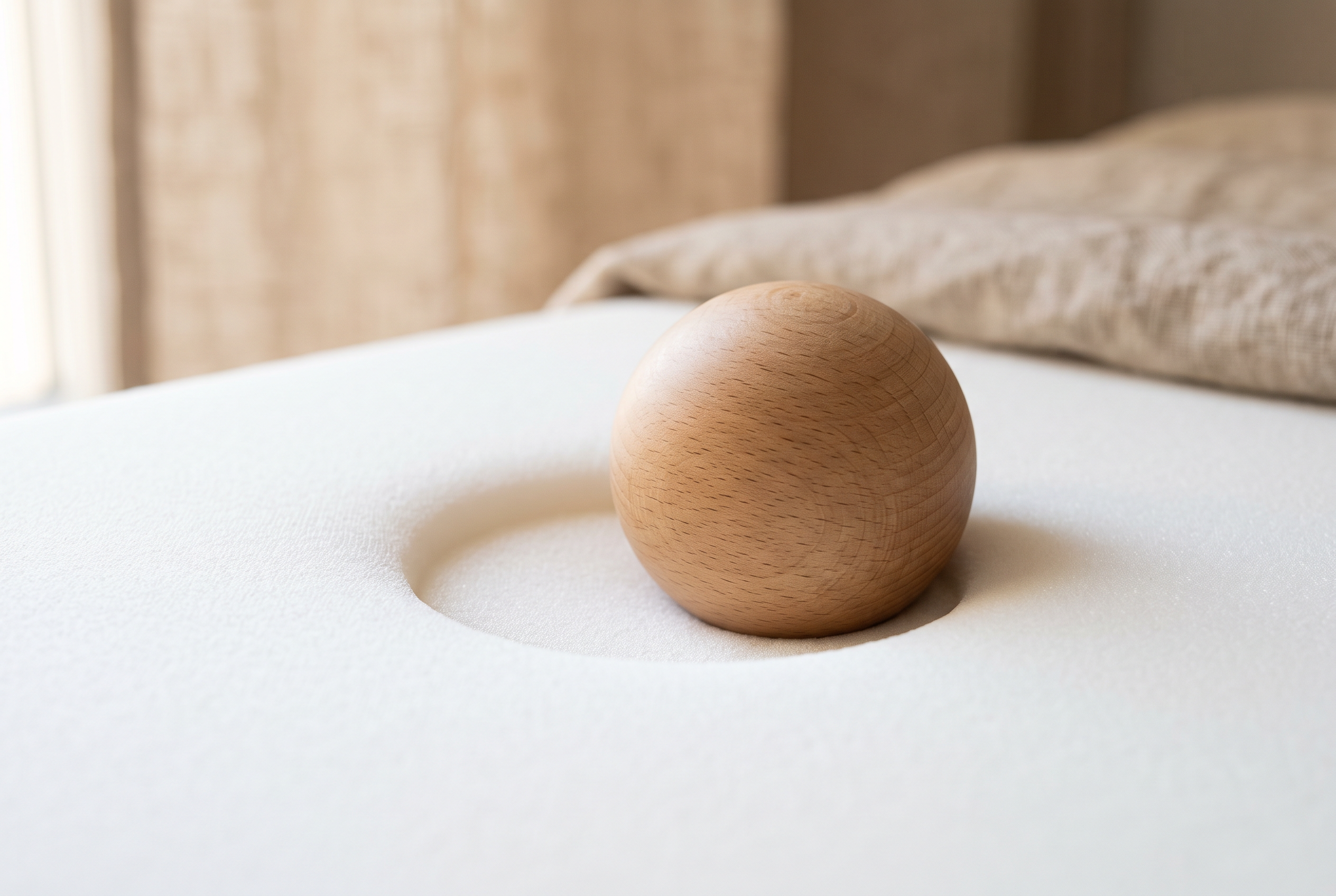
For foam mattresses, weight is directly related to density (RG) – the material density in kilograms per cubic meter. A core with RG 30 contains 30 kg of foam per cubic meter, a core with RG 50 corresponds to 50 kg. More material means more cell walls that absorb stress: foams from RG 40 are considered durable and dimensionally stable, while foams below RG 30 often form indentations after just two to four years. Let's do the math: A 90x200 cm, 20 cm high mattress has a core volume of 0.36 cubic meters. With RG 30, the core weighs around 11 kg, with RG 50 around 18 kg – so the weight on the data sheet indirectly reveals the material quality. That's why it's worth looking at the kilogram specification, especially for cheap offers: if a 160x200 mattress weighing less than 20 kg seems suspiciously light, it almost certainly contains little material. We explain the details of density and indentation hardness in the articles Cold Foam Density and Indentation Hardness and Density.

Weight overview: Mattress types compared
The following table shows typical weight ranges for common mattress types in two common Swiss sizes. The values apply to core heights of 18 to 25 cm and serve as an orientation – individual models may vary.
| Mattress Type | Weight 90x200 cm | Weight 160x200 cm | Classification |
|---|---|---|---|
| Comfort Foam (simple) | 10–15 kg | 18–25 kg | Light, but often short-lived |
| Cold Foam (RG 40+) | 15–20 kg | 27–35 kg | Good balance of weight and durability |
| Premium Memory Foam | 18–25 kg | 32–45 kg | High material usage, very dimensionally stable |
| Pocket Spring | 20–30 kg | 35–50 kg | Steel springs significantly increase weight |
| Latex | 25–35 kg | 45–60 kg | Very heavy, but extremely durable |
Weight in everyday life: turning, changing sheets, and transport
In everyday life, mattress weight becomes relevant whenever you need to move the mattress: when putting on a fitted sheet, turning or rotating it, airing it by an open window, and definitely when moving house. As a rule of thumb: a mattress weighing up to about 20 kg can be handled by one person; above that, it becomes difficult alone, and from 35 kg, two people should always help. Many manufacturers today no longer produce classic reversible mattresses, opting for single-sided sleeping surfaces instead – in this case, it's sufficient to rotate the mattress 180 degrees every one to three months, which is manageable even for heavier models. Side handles are practical: the article Mattress with turning handles explains why these are more for carrying than for turning. For moving, never fold mattresses; transport them flat or slightly bent and protect them from moisture – the best tips can be found under Transporting a mattress when moving.
Mattress weight, bed frame and slatted base
The weight of the mattress is only part of the load your bed has to bear. Consider this: a 40 kg double mattress plus two adults each weighing 75 to 90 kg quickly adds up to 200 to 250 kg of continuous load – movements at night create even higher short-term point loads. Stable bed frames made of solid wood or metal can easily support this; for very inexpensive frames and delicate central beams, it's worth checking the manufacturer's specification for maximum load. The slatted base must also match the weight: simple roll-up slatted bases with thin slats are often only designed for up to 100 to 120 kg per sleeping surface, while high-quality sprung slatted frames can support up to 150 kg and more. For heavy latex or innerspring mattresses, a central support beam with support legs is also recommended in a double bed to prevent sagging. The guide Choosing a Bed Frame shows what you should pay attention to when it comes to frames and foundations. Incidentally, a sagging foundation also noticeably shortens the lifespan of even the best mattress.
Common mistakes and myths about mattress weight
Myth one: "The heavier, the better." This is only true within the same material class. A heavy Bonnell spring mattress, despite many kilos of steel, is not a good choice, while a modern premium foam with a sophisticated cell structure achieves top values in support and durability at a moderate weight. Myth two: "Light mattresses are always bad." For the guest bed or as a temporary solution, a light mattress can be perfectly sufficient – but as a permanent solution for every night, it is usually the wrong choice. Myth three: "The weight says something about the firmness." Weight and feel are two different things; a heavy latex core can feel soft, a light foam firm. The most common practical mistake: the mattress is never rotated for years because it seems too heavy – then one-sided indentations form. Schedule rotating it with two people, for example, when changing bedding seasonally. You can read how to identify wear and tear early on under Identifying a Sagging Mattress.
Practical advice: handling heavy mattresses to protect your back
With the right technique, even a 40 kg mattress can be manageable. First: work with gravity. First, pull the mattress to the edge of the bed, tilt it upright, and move it on its narrow side – this way, you never carry the full weight. Second: lift with your legs, not your back, and keep the mattress close to your body. Third: use the handles only for positioning, not for full lifting – they are usually only sewn for partial loads. Fourth: when making the bed, it helps to slightly lift the mattress corner by corner instead of lifting it completely; elastic fitted sheets with a high bridge make the job even easier. Fifth: for stairwells, a sturdy mattress cover with carrying handles that also protects against dirt is suitable. And finally: only unpack vacuum-packed new mattresses at their destination – rolled and packed, they are much more compact to carry than unfolded.

Get CHF 25 discount
Subscribe to our newsletter and receive a one-time CHF 25 discount. ✓ 200 nights trial sleep ✓ 10 years warranty
Frequently Asked Questions about Mattress Weight
How much does a normal 90x200 cm mattress weigh?
Depending on the material, a 90x200 cm mattress weighs between 10 and 35 kg: simple foam mattresses are 10 to 15 kg, high-quality memory foam models 18 to 25 kg, pocket springs 20 to 30 kg, and latex 25 to 35 kg.
Is a heavy mattress automatically better?
Within the same material class, more weight indicates more material and longer durability. However, the comparison is not meaningful between different construction types – density, point elasticity, and workmanship are decisive, not just the number of kilos.
What does weight tell about density?
For foam mattresses, the density can be roughly estimated from weight and core volume: A 90x200 cm, 20 cm high mattress with a core weight of around 18 kg corresponds to approximately RG 50. If a mattress seems very light for its size, the density is usually low.
How much weight must a slatted base withstand?
The slatted base must permanently support the mattress plus body weight – quickly 100 to 150 kg per sleeping surface. Simple roll-up slatted bases are often only designed for up to about 120 kg, while high-quality sprung slatted frames and sturdy system bases can support 150 kg and more.
Can I turn a heavy mattress alone?
Up to about 20 kg, this is easily manageable alone; above that, help is recommended. Use the upright technique: pull the mattress to the edge of the bed, tip it upright, and turn it on its narrow side – this way, you never have to lift the full weight.
Why are latex mattresses so heavy?
Latex has a very high material density, often over 60 kg per cubic meter, significantly more than most foams. This makes latex mattresses durable and dimensionally stable, but also among the heaviest mattresses overall – in 160x200 cm, 45 to 60 kg is common.








Leave a comment
This site is protected by hCaptcha and the hCaptcha Privacy Policy and Terms of Service apply.