
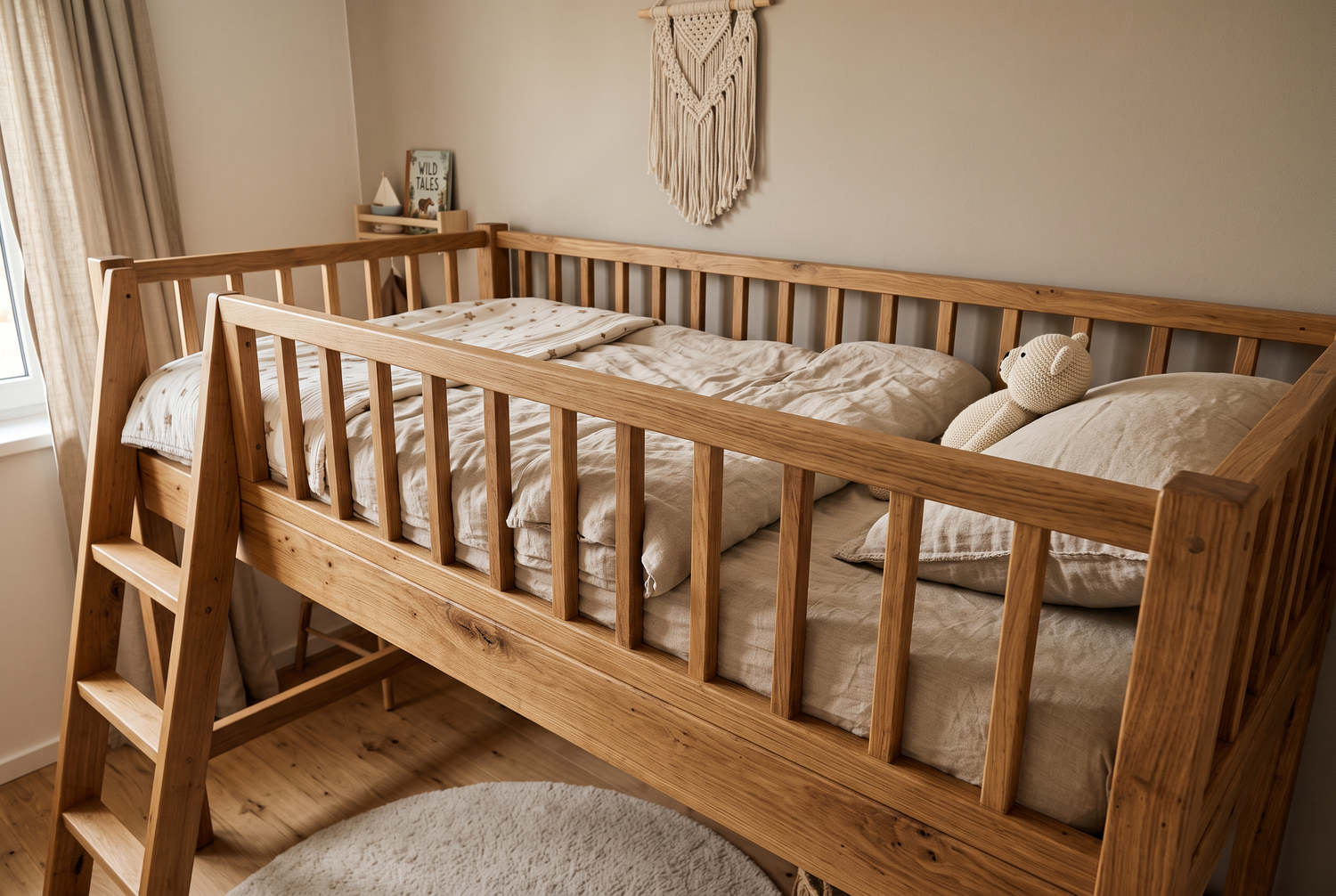
Loft beds and bunk beds are space-savers in children's rooms: they create space for siblings, play areas, or a desk – and exert a magical attraction on children. However, it is precisely when choosing the mattress that most mistakes are made, and these can be serious: a mattress that is too high renders the fall protection ineffective, one that is too soft becomes a climbing trap on the upper bed, and an incorrectly sized one can get stuck or leave dangerous gaps. Unlike a regular bed, mattress selection for a bunk bed is not just a matter of comfort, but of safety. In this guide, we explain the maximum permissible height for the mattress in the upper bed, the age at which children should sleep there, what matters for ventilation and fit – and how to furnish the bunk bed to be both safe and cozy.
The short answer: For the upper bed: The fall protection must extend at least 16 cm above the mattress surface – with typical rail heights, this means a maximum mattress height of 16 to 18 cm; most manufacturers mark the maximum line on the frame. For the upper bed, choose a rather flat, dimensionally stable mattress with precise dimensions (maximum 2–3 cm gap to the frame) and a density of at least RG 35, so it remains stable even when sitting and climbing. According to standards and expert recommendations, children should only sleep on the upper bed from the age of 6. For the lower bed, mattresses can be higher and more comfortable – good ventilation is particularly important there.
- Safety rule number 1: at least 16 cm rail height above the mattress surface – this determines the maximum mattress height (usually 16–18 cm).
- Children under 6 years old do not belong in the upper bed – neither for sleeping nor for playing.
- The mattress must fit perfectly: a maximum gap of 2–3 cm to the frame, otherwise there is a risk of entrapment.
- The top needs a dimensionally stable, rather firm mattress (from RG 35), while the bottom can be more comfortable.
- Don't forget ventilation: a roll-up slatted frame instead of a wooden board and regular airing prevent moisture.
Why mattress height in a loft bed is safety-relevant
The European standard EN 747 for loft and bunk beds stipulates that the fall protection must extend at least 16 cm above the top edge of the mattress. The reason is simple: a sleeping child will roll over any edge that is lower than their center of gravity when lying down. If the mattress height increases, the effective railing height decreases – a 25 cm thick comfort mattress in a bed with a 35 cm railing only leaves 10 cm of protection and effectively renders the safety device useless. Therefore, reputable manufacturers mark the maximum mattress height with a line on the frame; if it is missing, measure yourself: railing top edge minus 16 cm results in the permissible mattress height. Also consider toppers or thick overlays – they count towards the total height. In addition, the standard requires that openings in the railing are dimensioned so that no child's head can get trapped, and that the entry point is clearly defined. When buying: Only choose beds with an EN 747 label and follow the assembly instructions exactly – self-constructed extensions or omitted struts undermine the safety concept.
The right mattress for the upper bed
Four criteria apply to the upper level. First, height: 12 to 16 cm is ideal, up to 18 cm is permissible depending on the railing – check the marking on the bed. Second, fit: The mattress must fill the internal dimensions of the bed as completely as possible; gaps of more than 2–3 cm between the mattress and the frame are entrapment hazards for arms and legs. Common sizes are 90x200 cm, or 90x190 cm for compact children's beds – measure rather than guess. Third, firmness: The upper bed is not just for sleeping, but also for sitting, climbing, and playing. A dimensionally stable mattress with a density of at least RG 35 retains its edge and does not dangerously give way when kneeling on the edge; very soft or deeply sinking mattresses also make it difficult for small children to turn over in their sleep. Fourth, weight: For making the bed at a height, a light mattress weighing 8 to 12 kg is invaluable – you will appreciate it every time you change the bedding. What generally makes a good children's mattress – from being free of harmful substances to having a stable edge – is covered in detail in the children's mattress guide.

Upper and lower bed in comparison
While safety dominates for the upper bed, comfort can take precedence for the lower bed – this is often where an older child, a teenager, or even an adult guest sleeps. The following overview summarizes the recommendations:
| Criterion | Upper Bed | Lower Bed |
|---|---|---|
| Mattress height | 12–16 cm (observe max. marking) | 16–25 cm freely selectable |
| Firmness | Dimensionally stable, stable edge | According to lying sensation and body type |
| Weight | Light (8–12 kg) for making the bed | Not critical |
| Ventilation | Good (open environment) | More critical – slatted frame instead of board, ventilate regularly |
| User age | From 6 years | Any age |
Safety rules by age
The most important rule first: children under 6 years of age do not belong in the upper bed – this corresponds to standard EN 747 and the recommendations of accident prevention agencies. Younger children cannot yet assess height and risk motorically and cognitively; most bunk bed accidents do not happen during sleep, but during play and climbing. Basic rules also apply to older children: the ladder must be securely mounted, non-slip, and easily accessible with good lighting – a night light at the entrance helps with nocturnal toilet visits. Romping, jumping, and trampoline games on the upper level are taboo, as are cords, strings, or fairy lights on the railing, which a child could strangle themselves on. Check all screw connections every six months – bunk beds work harder under the double load of two children than normal beds. Under and next to the bed, the floor should be free of hard, sharp objects; a carpet provides cushioning in case of a fall. For the youngest ones, the same principle applies in a different form – the article Baby Mattress and Safety explains what safe sleeping environments for babies look like.
Ventilation and sleeping climate in a bunk bed
Bunk beds place special demands on the climate – in both directions. It is warmer upstairs: warm air rises, and directly under the ceiling it can be 2 to 4 degrees warmer in summer than at floor level. Therefore, choose breathable mattresses and light duvets for the upper bed, and ventilate the room thoroughly in the evening – the ideal sleeping temperature for children is 16 to 19 degrees. Downstairs, the opposite problem lurks: the lower bed is in the shadow of the upper level, air circulates less, and if the upper sleeping surface is a closed board, moisture from the lower mattress cannot easily escape upwards. Therefore, use open slatted frames on both levels, turn back the duvets in the morning, and do not additionally fill the lower bed with bed box drawers. A hygrometer in the children's room helps to keep the humidity in the target range of 40 to 60 percent. General information on air circulation under the mattress can be found in the article Mattress Ventilation; tips against too much morning light in the children's room are provided in the guide Darkening the Children's Room.
Common mistakes with loft and bunk beds
Mistake one: putting the old, thick adult mattress on top. This shrinks the effective railing height below a safe level – the most common and dangerous deviation of all. Mistake two: buying the wrong size mattress. Even a 5 cm gap to the frame is an entrapment point; measure the internal dimensions of the bed before buying. Mistake three: placing a thick topper on the upper bed – it counts towards the mattress height and renders the fall protection ineffective in the same way. Mistake four: placing the bed freely in the room. At least one long side belongs against the wall, and above the upper sleeping surface, there must be 75 to 90 cm of headroom to the ceiling so that no one bumps their head when sitting up. Mistake five: installing ceiling lamps or fans within reach of the upper level. Mistake six: using the ladder as a towel rail or clothes rack – blocked rungs are tripping hazards at night. Mistake seven: ignoring parts left over after converting the bed (e.g., from a bunk to a single bed) – missing struts weaken the construction. And mistake eight: rushing the age. Even if the younger sibling is eager – before their 6th birthday, the upper bunk remains off-limits.
Practical tips: setting up a bunk bed safely in 6 steps
Step 1: Measure the internal dimensions of both levels (length, width, maximum mattress height according to the marking) and note them down. Step 2: Buy suitable mattresses – flat, dimensionally stable, and light for the top; according to comfort preferences for the bottom; pay attention to pollutant testing according to OEKO-TEX Standard 100. Step 3: Assemble the bed according to the instructions, tighten all screws carefully, and place the bed with one long side against the wall. Step 4: Safety check: Measure the railing overhang above the mattress (at least 16 cm), check for gaps all around, and check the ladder for a secure fit. Step 5: Add accessories – night light at the entrance, carpet as fall protection, no cords or fairy lights on the railing, child-friendly bedding. Step 6: Agree on and demonstrate rules: the top is for sleeping and reading, not jumping; the ladder remains clear at night. Repeat the screw check every six months and the railing check with every mattress or topper change. For narrow children's rooms, you can find more space-saving ideas in the article Making the most of a small bedroom.

Secure a CHF 25 discount
Subscribe to the newsletter and receive a one-time CHF 25 discount. ✓ 200 nights trial sleep ✓ 10-year warranty
Frequently asked questions about bunk bed mattresses
What is the maximum permissible mattress height in a bunk bed?
The fall protection must extend at least 16 cm above the mattress surface – with typical rail heights, this results in a maximum mattress height of 16 to 18 cm. Many beds have a marking line on the frame that you should not exceed.
At what age can children sleep in the upper bunk bed?
According to standard EN 747 and recommendations from accident prevention agencies, no earlier than 6 years of age. Younger children cannot yet assess height and risk – this also applies to playing on the upper level.
Which mattress is suitable for the upper bed?
A flat (12–16 cm), dimensionally stable, and light mattress with a density of at least RG 35 and precise dimensions. It must remain stable even when sitting and climbing on the edge and may leave a maximum gap of 2 to 3 cm to the frame.
Can I put a topper on a bunk bed mattress?
Only if the mattress plus topper combined remain below the marked maximum height – the topper counts towards the total height. When in doubt: do without the topper on the upper bed and address comfort through the mattress itself.
How much weight can a bunk bed hold on the top?
This is specified by the manufacturer – typical approvals are 70 to 100 kg for children's and youth beds, higher for adult bunk beds. Check the information in the instructions and include the mattress and bedding.
What to do about heat in the upper bunk bed?
Ventilate crosswise in the evening, use light summer duvets and breathable mattresses, and keep the blinds down during the day – it is often 2 to 4 degrees warmer under the ceiling than on the floor. A fan should be out of reach of the bed.








Leave a comment
This site is protected by hCaptcha and the hCaptcha Privacy Policy and Terms of Service apply.