
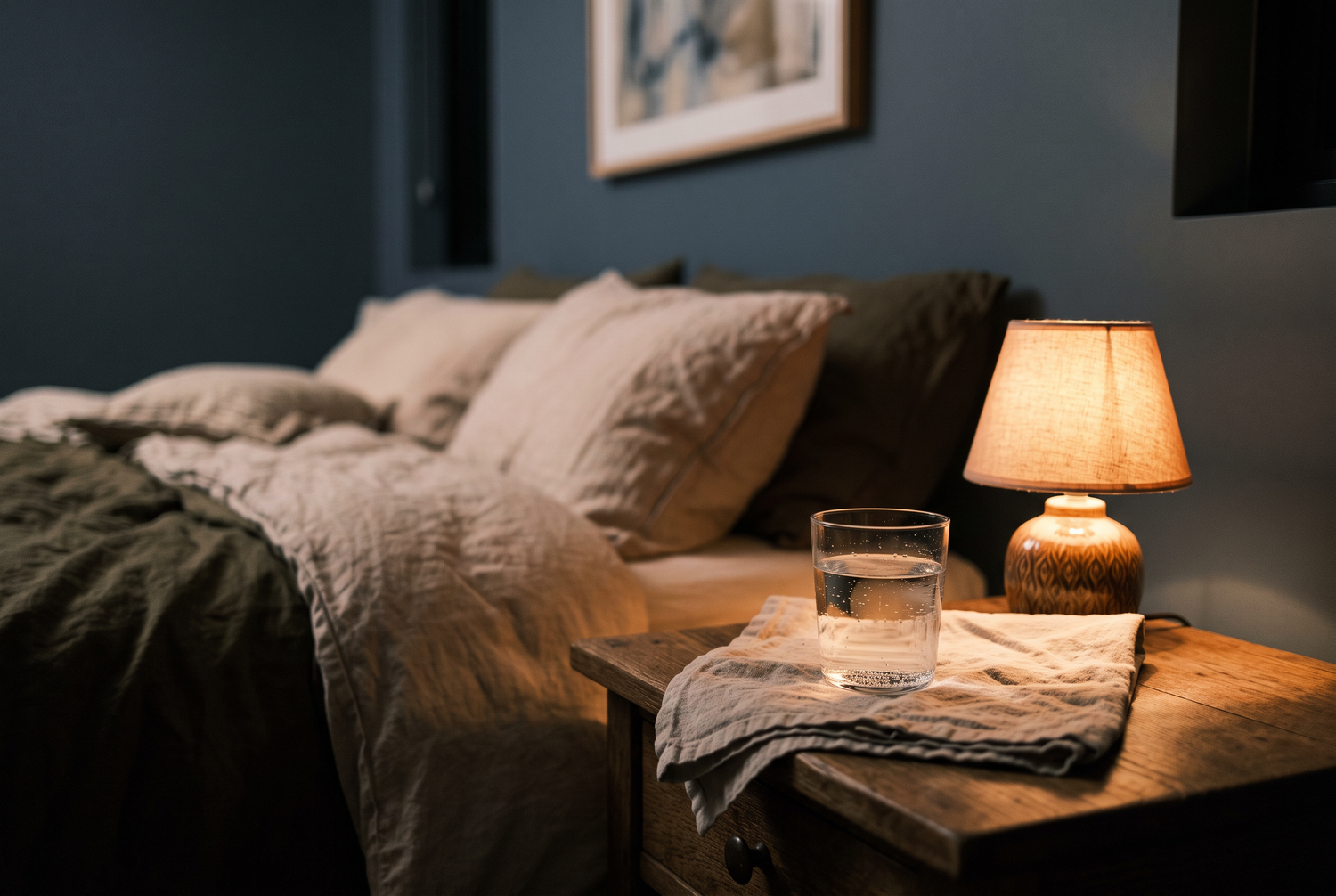
A night-time panic attack is one of the most unsettling experiences sleep can hold: you jolt awake for no apparent reason, your heart is racing, your chest feels tight, your hands tingle, and the thought "I'm dying" or "I'm going crazy" forcefully takes over. Within a few minutes, the fear reaches its peak, often leaving behind exhaustion that makes it impossible to fall back asleep. Approximately 18 to 45 percent of people with panic disorder experience such nocturnal attacks, and even people without a diagnosis know isolated episodes during periods of high stress. The good news: nocturnal panic attacks are physically harmless, well-understood, and highly treatable. This guide explains what happens in your body and brain, how to get through an attack at night, how to make falling back asleep easier, what prevents them in the long term, and when professional help is the right step.
The short answer: Night-time panic attacks usually arise from light sleep or during the transition to deep sleep, when the brain interprets physical changes such as a breathing cessation or a heartbeat as a danger and triggers an alarm reaction. They are not dangerous and subside within 10 to 30 minutes. In the acute phase, slow exhalation, a firm connection to your surroundings, and the knowledge that it is a panic attack help. In the long term, cognitive behavioral therapy, regular sleep, and stress reduction are effective. If attacks become frequent, a medical or psychotherapeutic evaluation should be sought.
- Night-time panic attacks usually occur within the first three hours of sleep, during the transition from light to deep sleep – not during a dream.
- They peak within 10 minutes and subside in 10 to 30 minutes but are physically harmless.
- Acute help: don't fight against it, exhale slowly, turn on the light, name the room, drink a glass of water.
- Sleep deprivation, caffeine, alcohol, and irregular sleep times significantly increase the likelihood.
- Cognitive behavioral therapy is the most effective treatment; if attacks recur, it's worth seeking professional help.
What happens in the body during a night-time panic attack
A panic attack is an alarm reaction of the body without real danger. The amygdala, the fear center in the brain, sounds the alarm, the sympathetic nervous system releases adrenaline and noradrenaline, and within seconds the entire body reacts: the pulse rises to 100 to 140 beats per minute, breathing becomes rapid and shallow, muscles tense up, the skin becomes cold and damp because blood is redirected to the large muscles. Rapid breathing lowers the carbon dioxide content in the blood, causing tingling in the hands and lips, dizziness, and lightheadedness – symptoms that further intensify the fear. This cascade reaches its maximum within 10 minutes and then subsides as stress hormones are broken down.
At night, there's a special factor: the attack begins during sleep, usually in the first three hours, during the transition from sleep stage 2 to deep sleep. You don't wake up because of a nightmare; instead, the panic is already in full swing when you come to. This makes it particularly unsettling because no trigger is apparent. Researchers suspect that during this transition, the brain incorrectly interprets physical signals – a change in breathing, heart rate, or CO2 levels – as a threat. People with panic disorder often have increased sensitivity to precisely these body signals. Our basic article explains how sleep phases are structured and where this transition lies.
Night-time panic attack or something else? The distinction
Not every nocturnal awakening is a panic attack. A night terror (Pavor nocturnus) also occurs in deep sleep, but the person is not fully awake, barely responsive, and does not remember in the morning – during a panic attack, you are wide awake and remember everything clearly. A nightmare occurs in REM sleep, i.e., in the second half of the night, and has a dream content that you remember. Sleep paralysis is accompanied by immobility, which is absent during panic. And finally, physical causes can trigger similar symptoms: sleep apnea, where breathing cessations lead to a feeling of suffocation and racing heart, reflux, an overactive thyroid, hypoglycemia, or cardiac arrhythmias.
Therefore, with recurrent nocturnal attacks, a medical evaluation is advisable before the diagnosis of "panic" is established: ECG, thyroid values, and if snoring or daytime sleepiness occurs, a sleep apnea screening. If you wake up at night with a racing heart and also experience chest pain, shortness of breath, pain radiating into the arm, or dizziness leading to fainting, you should call emergency services instead of waiting – when in doubt, clarification is always the right step. You can read more about the distinction in the article Racing heart when falling asleep.
| Event | Time of night | Consciousness | Memory |
|---|---|---|---|
| Panic attack | First 3 hours, light/deep sleep | Wide awake, oriented | Complete |
| Night terror | First hours, deep sleep | Unresponsive | None |
| Nightmare | Second half of night, REM | Awake after dream | Dream content |
| Sleep paralysis | Falling asleep/waking up, REM | Awake, unable to move | Complete |
| Sleep apnea awakening | Anytime | Awake, shortness of breath | Often incomplete |

Immediate help: What you can do during the attack
The most important principle is: don't fight against it. Trying to suppress panic amplifies it because it signals to the brain that something dangerous is actually happening. Instead, a sequence of five steps helps, which you should ideally memorize during the day. First, name it: "This is a panic attack. It's unpleasant, but not dangerous. It will pass in a few minutes." Second, light: turn on the bedside lamp, sit up, feet on the floor. Darkness intensifies the feeling of disorientation. Third, breathe – but correctly: don't inhale deeply, this intensifies hyperventilation, but exhale slowly. Inhale for four seconds, exhale for six to eight seconds, ten times. The prolonged exhalation activates the vagus nerve and slows the pulse.
Fourth, ground yourself: Name five things you see, four you hear, three you feel – the duvet, the floor under your feet, the glass in your hand. This shifts attention away from bodily signals. Fifth, wait it out: A sip of water, a few steps around the room, and the attack subsides on its own, usually within 10 to 30 minutes. Some people find it helpful to run cold water over their wrists or wet their face, which slows the heart rate via the diving reflex. It is important that all these measures are not about "preventing" the attack, but about getting through it – the attack is allowed to be there, it will pass anyway.
Falling back asleep after the attack
After a night-time panic attack, the body is flooded with stress hormones, and falling back asleep often takes 30 to 60 minutes. Don't force it. If you're still wide awake in bed after 20 minutes, you should get up and go to another room – dim light, no screens, a quiet activity like reading or soft music, a cup of herbal tea. Only go back to bed when you feel sleepy. This prevents the bed itself from becoming a trigger for anxiety, a mechanism that sleep medicine knows as conditioning and treats with stimulus control.
In bed, a relaxation technique that systematically calms the body then helps: progressive muscle relaxation, where muscle groups are tensed for 5 seconds and released for 20 seconds, or a body scan, which slowly moves attention from the head to the feet. Both distract from the fear of the next attack and reduce muscle tension. A warm blanket, a cool room of 17 to 19 °C, and a familiar sleep environment also help. And: Don't look at the clock. Calculating how much sleep is left is one of the most reliable ways to stay awake. We have extensively described which techniques are suitable for falling asleep faster.
Prevention: what lowers the likelihood
Night-time panic attacks often occur when the nervous system is already overstimulated. Four adjustments have proven particularly effective. First, sleep regularity: going to bed and waking up at the same time, even on weekends, stabilizes sleep architecture and reduces the unstable transitions from which attacks arise. Sleep deprivation is one of the strongest triggers. Second, substances: avoid caffeine from early afternoon, as it increases excitability for up to 8 hours; avoid alcohol in the evening, as its breakdown triggers a rebound activation of the nervous system in the second half of the night; nicotine as well. Third, exercise: 30 minutes of moderate activity a day measurably reduces anxiety levels, but not in the last two hours before sleep.
Fourth, an evening routine that lowers stress levels before falling asleep: 30 to 60 minutes without work, news, and screens, with a fixed ritual – stretching, breathing exercises, journaling where worries for the next day are noted and thus "parked." Those prone to rumination benefit from a fixed worry time in the early evening. We describe what generally needs to be considered for sleep and anxiety disorders in a separate article. And an often overlooked point: the bedroom should be a place where you feel safe – tidy, comfortably temperate, with a night light within reach and without disturbances.
When professional help is useful
A single night-time panic attack during a stressful period of life is no cause for concern. However, if the attacks recur, if the fear of the next attack dominates your daily life or bedtime, if you delay going to sleep out of fear, or if daytime fatigue and exhaustion increase, then consulting a professional is the right step. Cognitive behavioral therapy is the best-proven treatment for panic disorder: it explains how the attack arises, reduces the fear of physical symptoms, and teaches how to deal with them – with significant improvement in around 70 to 80 percent of those affected within 12 to 20 sessions. In some cases, medication, decided exclusively by a doctor, supplements the treatment.
The first point of contact is your GP, who will rule out physical causes and refer you to psychotherapy or psychiatry. In Switzerland, basic insurance covers psychotherapeutic treatment on medical prescription. If you are in an acute crisis and cannot reach anyone, "Die Dargebotene Hand" (The Offered Hand) offers support 24/7 at number 143. Night-time panic attacks are distressing, but they are not a sign of weakness or an incurable trait – they are a treatable pattern of the nervous system that can be changed with the right support.

Get CHF 25 discount
Subscribe to the newsletter and receive a one-time CHF 25 discount. ✓ 200 nights trial sleep ✓ 10 years warranty
Frequently asked questions about night-time panic attacks
Why do I get panic attacks in my sleep without dreaming?
Night-time panic attacks usually arise during the transition from light to deep sleep in the first three hours, not during dream sleep. The brain interprets physical signals such as breathing or heart rate as a danger and triggers the alarm reaction before you are fully awake.
Is a night-time panic attack dangerous?
No, it is physically harmless and subsides in 10 to 30 minutes. However, if you experience chest pain, shortness of breath, radiating pain, or fainting, you should call emergency services to rule out a physical cause.
What helps immediately during a night-time panic attack?
Name the attack, turn on the light and sit up, exhale slowly (4 seconds in, 6 to 8 seconds out), perceive your surroundings with your senses, and drink a glass of water. Don't fight against it, but wait it out.
How do I fall back asleep after a panic attack?
After 20 minutes of lying awake, get up, go to another room, engage in a quiet activity with dim light, no screens, no clock. Only go back to bed when you feel noticeably tired, then use a relaxation technique like a body scan or muscle relaxation.
What increases the risk of night-time panic attacks?
Sleep deprivation, irregular sleep times, caffeine in the afternoon, alcohol and nicotine in the evening, and prolonged stress. Regular sleep and a relaxing evening routine significantly reduce the likelihood.
When should I seek help for night-time panic attacks?
If the attacks recur, if the fear of the next attack dominates your daily life, or if you delay going to bed out of fear. Your GP can rule out physical causes, and cognitive behavioral therapy is the most effective treatment.
This article is for general information purposes only and does not replace medical advice.








Leave a comment
This site is protected by hCaptcha and the hCaptcha Privacy Policy and Terms of Service apply.