
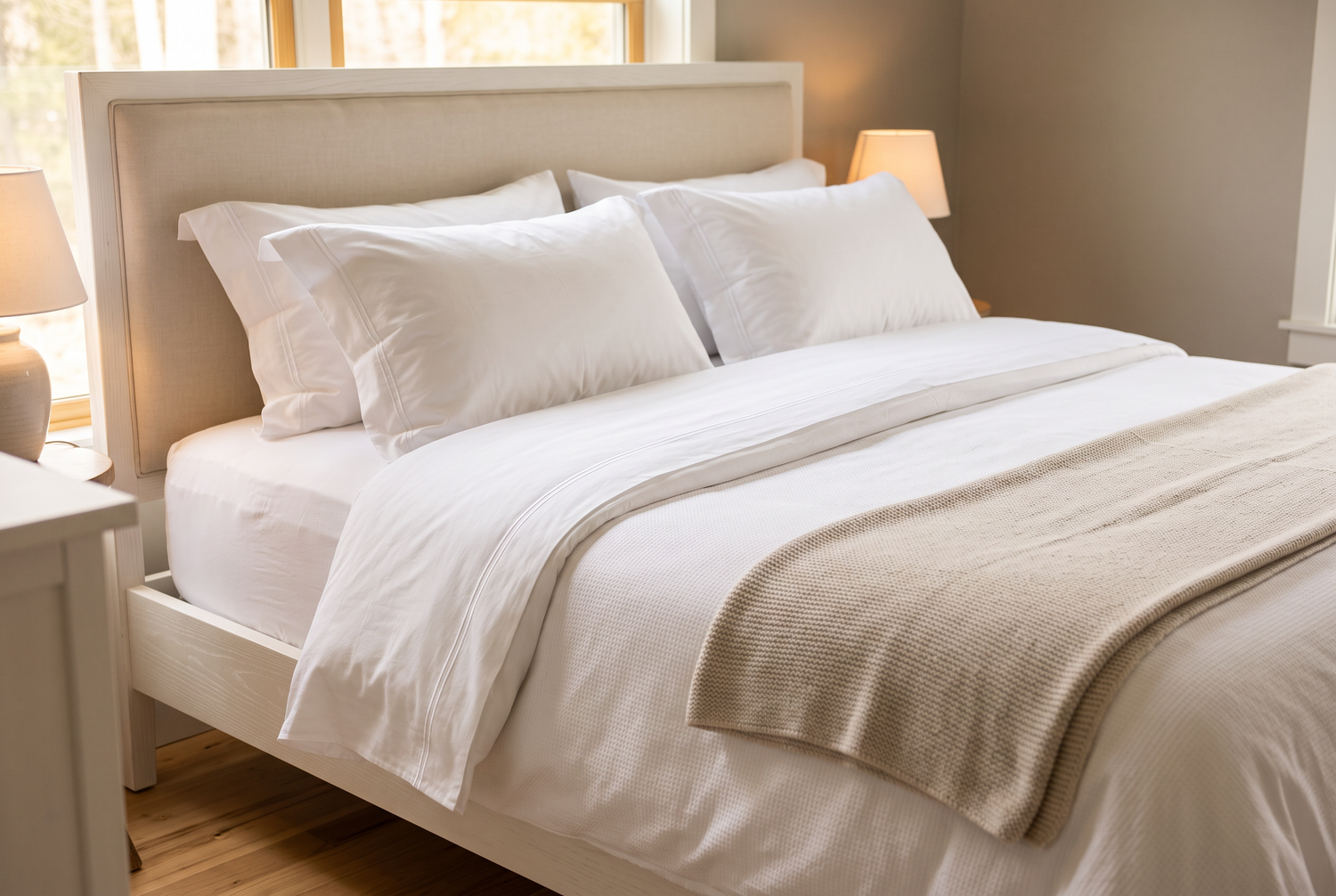
You're probably familiar with it: the hotel room is lovely, the bed is freshly made – and yet you're wide awake at two in the morning. Poor sleep on the first night in a hotel is so common that sleep research has its own term for it: the "First-Night Effect." Studies involving brainwave measurements show that in an unfamiliar environment, one half of the brain sleeps more lightly and remains responsive – an evolutionary alert system that once protected against danger and now robs us of sleep before important appointments. Added to this are unfamiliar noises, unaccustomed pillows, dry air conditioning, and often overly warm rooms. The good news: there are effective measures against almost every one of these factors. This article shows how you can fall asleep faster and sleep better through the night in a hotel – and what you can learn from hotel sleep for your own bedroom.
The short answer: Better sleep in a hotel is achieved with three levers: creating familiarity (your own pillow or at least your usual pillowcase, a familiar evening routine), eliminating disturbances (earplugs, sleep mask, adjusting room temperature to 16 to 19 °C), and supporting the body (no late alcohol, light dinner, 30 minutes screen break before turning off the lights). The First-Night Effect usually diminishes significantly by the second night – those staying only one night benefit most from routine and shielding.
- The First-Night Effect is real: In an unfamiliar environment, one half of the brain sleeps more lightly – usually only on the first night.
- Earplugs and a sleep mask are the most effective immediate measures against hotel noise and light sources.
- Actively set the room temperature to 16 to 19 °C – many hotel rooms are pre-heated to 22 to 24 °C.
- A piece of home helps: your own pillowcase, familiar scent, and your usual evening routine signal security.
- If you sleep better in a hotel than at home, it's a warning sign for your own mattress.
Why we sleep worse in hotels: the First-Night Effect
Researchers at Brown University showed in 2016 with brain scans that on the first night in an unfamiliar environment, the left hemisphere of the brain remains more awake during deep sleep phases than the right – it reacts more strongly to sounds and wakes us up faster. This asymmetrical sleep is known in dolphins and migratory birds; in humans, it is a relic of a time when unfamiliar sleeping places posed real dangers. Practically, this means: longer time to fall asleep, less deep sleep, more frequent awakenings – even in the best bed. The effect is strongest on night one and rapidly subsides thereafter. Adaptation can be accelerated by familiarity signals: familiar smells, familiar bedtime rituals, the same sleeping position as at home. Frequent travelers benefit doubly from a stable evening routine – the article on the perfect evening routine shows how to build one.
Setting up your hotel room for better sleep – in five minutes
Immediately after checking in, a quick optimization round is worthwhile. First, the temperature: Set the air conditioning or heating to 17 to 19 °C – many rooms are set significantly warmer, and overheating is one of the most common sleep killers; the guide on ideal sleep temperature explains the background. Second, the light: Close the blackout curtains completely and check for disturbing lights – standby LEDs on the TV and air conditioning can be covered with a piece of clothing or some tape. Third, the noise: Identify noise sources (minibar compressor, hallway side, street) and, if necessary, ask for a quieter room – higher floors and rooms facing the courtyard are usually quieter. Fourth, the air: Ventilate vigorously once, as air conditioning often dries out the air to below 30 percent humidity, which irritates mucous membranes. Fifth, the bed: Remove superfluous decorative pillows, place the duvet on your usual side – small actions, big impact.

The travel pharmacy for good sleep: what to pack
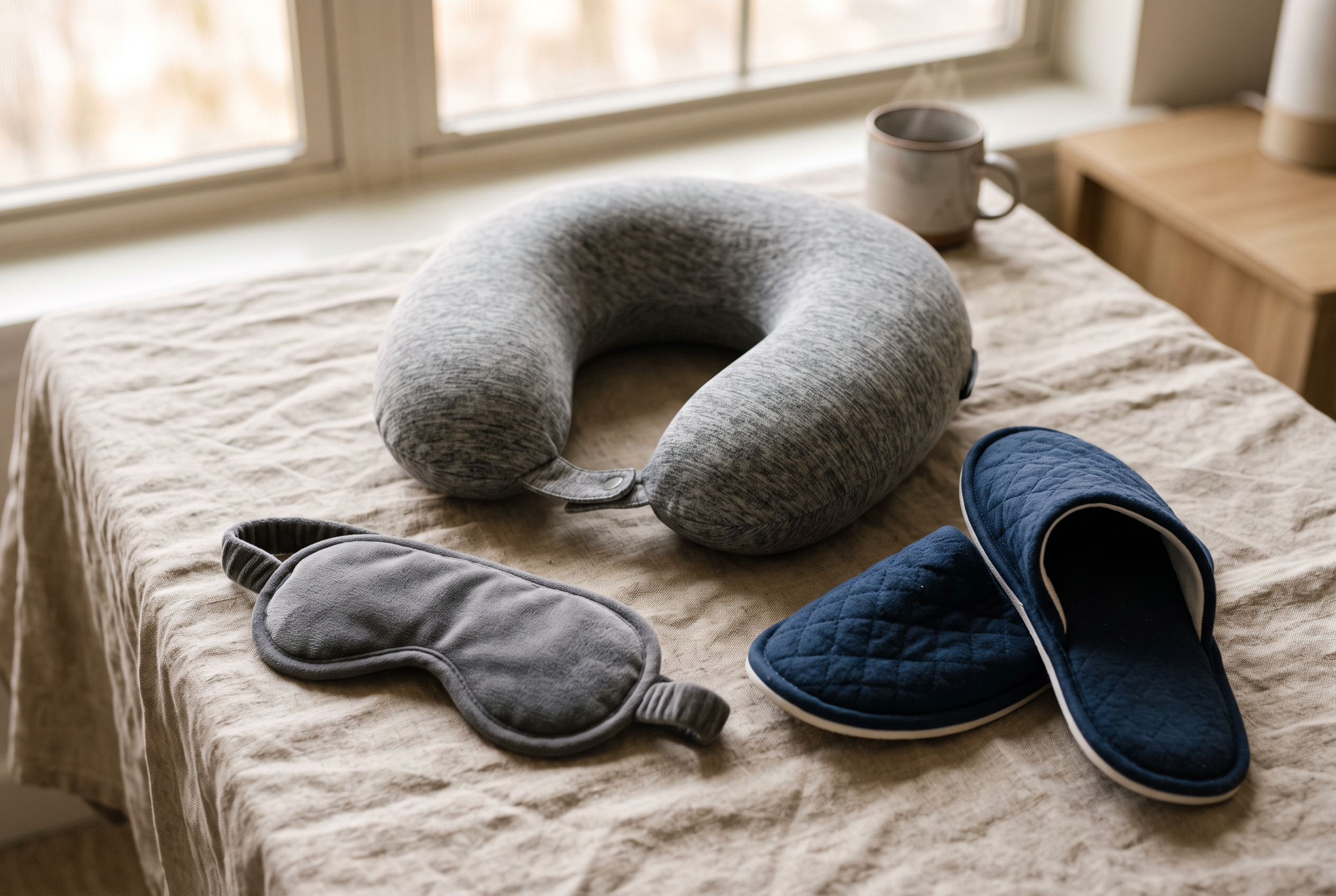
A small sleep kit weighs less than 200 grams and can save nights. Foam earplugs dampen 25 to 33 decibels – enough to push hallway noise and street sounds below the waking threshold; for those who don't like them, white noise apps offer an alternative that covers disturbing noises, as explained in the article on white noise for falling asleep. A contoured sleep mask blocks residual light without pressing on the eyes. Your own pillowcase from home brings a familiar scent – an underestimated signal for the brain's sense of security; if you have space, take your own pillow, as hotel selections rarely match individual neck height, as the pillow guide shows. Also: a small lavender roll-on or your usual shower gel as a scent anchor, and possibly nasal spray for dry air conditioning. However, you should avoid sleeping pills as a standard travel solution – they alter sleep architecture and often leave you feeling groggy the next day.
Behavior on arrival day: the underestimated factors
Travel days often sabotage sleep even before bedtime. Late, heavy restaurant meals shift digestion into the night – plan dinner at least 3 hours before sleep and keep it light. Alcohol, while making you feel sleepy, fragments the second half of the night and suppresses REM sleep; that glass of wine at the hotel bar is more expensive for sleep quality than it seems – details in the article Alcohol and Sleep Quality. Caffeine has a half-life of 5 to 6 hours: an espresso at 4 PM still has half its effect at 10 PM. And working on a laptop in bed associates the hotel room with tension rather than relaxation – a 30-minute screen break before turning off the lights gives melatonin levels time to rise. If you're still restless after arriving: a short evening stroll around the block is proven to reduce travel stress better than room service and television.
Sleep techniques for an unfamiliar environment
If you're still awake despite everything, structured techniques are better than brooding. The 4-7-8 breathing technique – inhale for 4 seconds, hold for 7, exhale for 8, four to eight repetitions – activates the parasympathetic nervous system and measurably lowers pulse and tension. Progressive muscle relaxation works through all muscle groups from foot to jaw: tense for 5 seconds each, release for 10 seconds; instructions can be found in the article on progressive muscle relaxation. Also proven: the body scan, where you slowly let your attention wander through your body without changing anything. The 20-minute rule is important: if you're awake for longer, get up briefly, sit in a chair in dim light, and read a few pages – this prevents the brain from associating "hotel bed" with "lying awake." And checking the clock is taboo: controlling the time demonstrably increases sleep-onset stress.
What hotels do right – and what you can learn from them
Interestingly, some people report the opposite of the First-Night Effect: they sleep better in a hotel than at home. This is a diagnostically valuable signal – it shows that something is wrong at home. Good hotels systematically do many things right that private households neglect. The table shows the most important hotel standards and how they translate to your own bedroom:
| Hotel Standard | Effect | Implement at home |
|---|---|---|
| New, high-quality mattresses (replaced every 5–7 years) | no hollows, full support | replace your own mattress after 8–10 years |
| Complete blackout | stable melatonin level | install blackout curtains |
| Freshly washed, ironed bedding | hygienic feeling of freshness | change bedding every 1–2 weeks |
| Multiple pillow options | appropriate neck support | choose pillows according to sleep position |
| Quiet, tidy rooms | less overstimulation | declutter bedroom, banish work |
Get CHF 25 discount
Subscribe to the newsletter and receive a one-time CHF 25 discount. ✓ 200 nights trial sleep ✓ 10 years warranty
Common mistakes when sleeping in a hotel
Mistake one: taking the room as it is – those who don't adjust the temperature, curtains, and standby lights miss out on the easiest improvements. Mistake two: planning a nightcap at the bar as a sleep aid; sleep becomes measurably shallower as a result. Mistake three: working on a laptop until midnight and immediately turning off the light – the brain needs a transition zone. Mistake four: writing off the second night in advance out of frustration over the first bad night; the First-Night Effect subsides on its own, anxiety of expectation keeps it artificially alive. Mistake five: late, heavy meals directly before bedtime – digestion keeps you awake, and for reflux sufferers, lying on your back in an unfamiliar bed exacerbates the problem. And mistake six: compensating for lost sleep in the morning with four espressos, thereby burdening the next night as well – better: get daylight and take a short nap of no more than 20 minutes early in the day.

Frequent questions about sleeping in a hotel
Why do I sleep so poorly on the first night in a hotel?
Because of the First-Night Effect: in an unfamiliar environment, one half of the brain remains more awake during deep sleep phases and reacts more strongly to noises. The effect is evolutionarily determined and usually significantly diminishes from the second night.
What helps most quickly against noise in a hotel?
Foam earplugs with 25 to 33 decibels of damping. Alternatively, white noise from an app covers disturbing individual noises. Additionally, asking for a room facing the courtyard or on a higher floor is worthwhile.
What temperature should a hotel room be for sleeping?
16 to 19 °C. Many hotel rooms are set to 22 to 24 °C – adjust the air conditioning or heating immediately after check-in so the room can cool down by bedtime.
Should I take my own pillow to the hotel?
If there's enough space, yes – your own pillow provides the accustomed neck support and a familiar scent, which signals security to the brain. The space-saving alternative is your own pillowcase.
Does alcohol help with falling asleep in a hotel?
No. While alcohol shortens the time to fall asleep, it fragments the second half of the night, suppresses REM sleep, and increases snoring. For restful hotel sleep, abstinence from late afternoon onwards is the better choice.
What does it mean if I sleep better in a hotel than at home?
It indicates problems in your own bedroom – often a worn-out or unsuitable mattress, too much light, or an overly warm room. Systematically check your mattress, blackout capabilities, and temperature.
This article is for general information purposes only and does not replace medical advice.








Leave a comment
This site is protected by hCaptcha and the hCaptcha Privacy Policy and Terms of Service apply.