

Those who lie awake for hours in the evening often look for the cause in the night itself – yet good sleep is usually decided in the hours leading up to it. A well-thought-out evening routine reliably signals to the body and brain: The resting phase is now beginning. Studies on sleep hygiene show that regular rituals before bedtime can shorten the time it takes to fall asleep and measurably improve sleep quality.
The short answer: The perfect evening routine begins about 60 minutes before bedtime and follows three principles: dim the lights and put away screens, actively relax the body (e.g., with reading, tea, or breathing exercises), and go to bed at a similar time each evening. Consistency, not perfection, is key – the brain learns the sequence and automatically switches to sleep mode.
- A consistent evening routine shortens the time it takes to fall asleep because the brain associates recurring signals with sleep.
- The last 60 minutes before bedtime should be spent with dimmed lights, quiet, and screen-free time.
- Caffeine, alcohol, and heavy meals in the evening disrupt natural melatonin secretion.
- Consistent sleep times – even on weekends – are the most effective way to stabilize the internal clock.
Why an evening routine is so effective
Our body loves predictability. The internal clock – the circadian rhythm – controls when fatigue hormones like melatonin are released. If the same actions are repeated in the same sequence in the evening, a conditioned stimulus is created: the ritual itself makes you tired. Conversely, if every evening is different – sometimes on the laptop until midnight, sometimes early in bed with a book – the internal clock becomes confused. You can find out more about the biological basics in our article on sleep phases.
Light management is particularly important. Bright, blue light in the evening suppresses melatonin production for hours. You can read why this is the case and how to counteract it in the article on blue light and screens in the evening.
The perfect evening routine: the 60-minute plan
60 minutes before: Create a transition
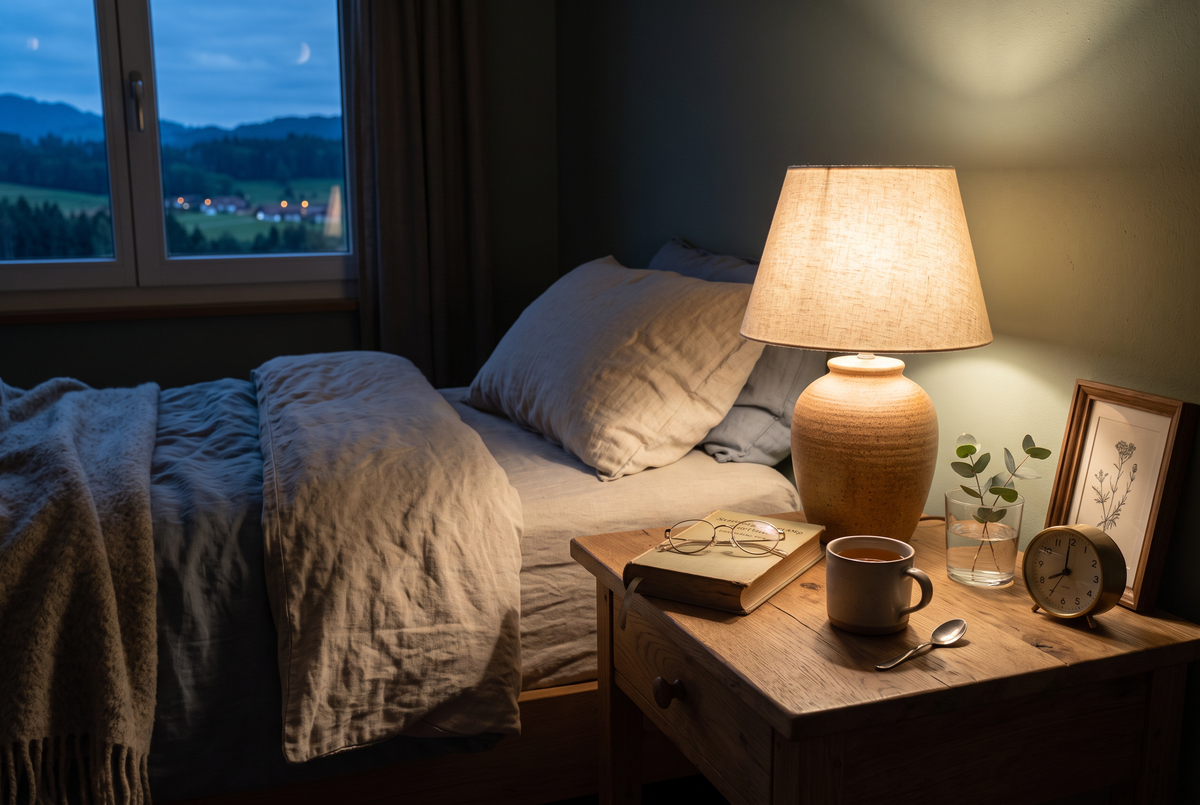
Actively end the day: write down your to-do list for tomorrow, tidy up the kitchen, switch off screens. If you write down open tasks, you won't take them to bed with you – the racing thoughts will be significantly reduced. Now dim the lights in your home and use warm light sources instead of overhead lighting.
45 minutes before: Relax your body
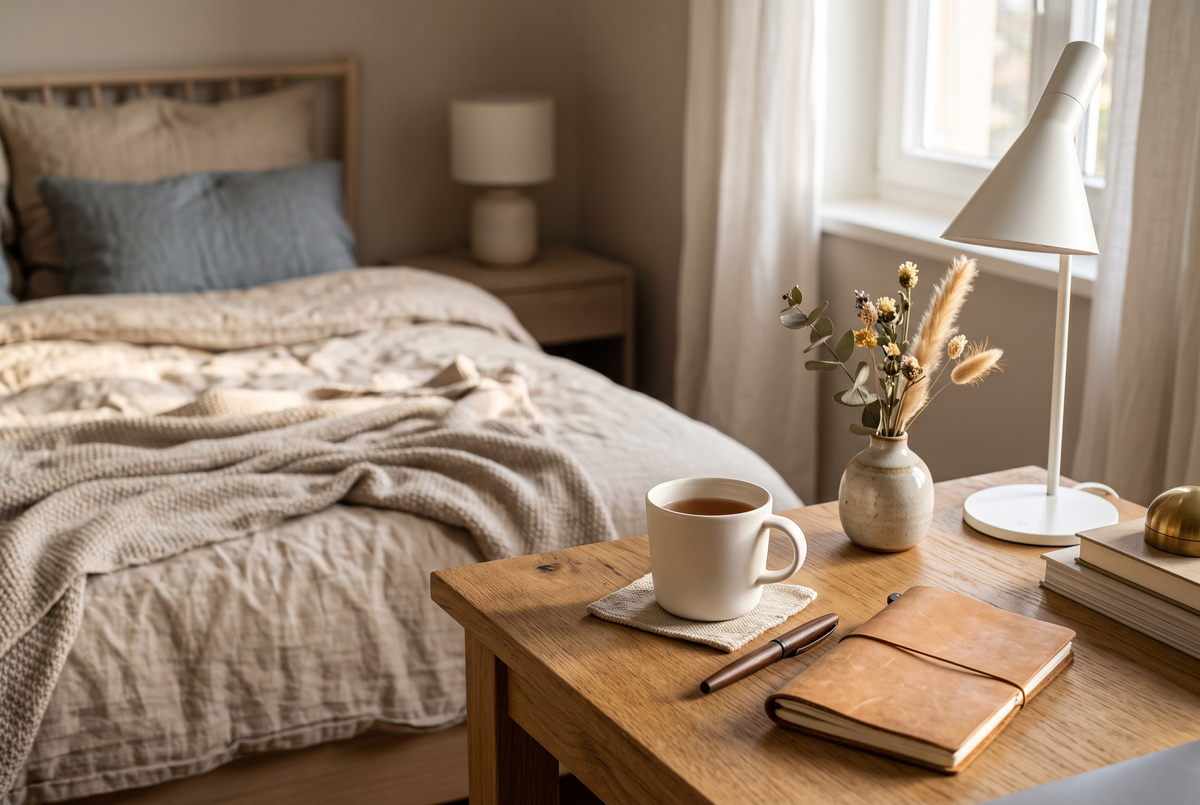
A warm shower or a short foot bath has a dual effect: the subsequent cooling of the core body temperature is one of the strongest sleep signals there is. Herbal tea (caffeine-free), gentle stretching, or calm music also belong in this phase. Our guide Caffeine and Sleep explains what caffeine in the evening can do.

30 minutes before: Calm your mind
Now is the time for quiet activities without a screen: read a few pages (ideally nothing upsetting), write in a journal, or do a short relaxation exercise. Breathing techniques like the 4-7-8 method activate the parasympathetic nervous system – the body's calming nerve. If you often struggle with racing thoughts, you'll find more techniques in our guide Fall asleep faster.
15 minutes before: Prepare the bedroom
Briefly air out the room and set the room temperature to about 16 to 19 degrees – more on this in the article on the ideal sleep temperature. Darken the room, put your smartphone out of reach, and only go to bed when you are truly tired.
Evening routine at a glance: What helps, what hinders
| Habit | Effect on sleep | Recommendation |
|---|---|---|
| Dimmed, warm light | Promotes melatonin secretion | 1–2 hours before sleep |
| Smartphone in bed | Suppresses melatonin, activates the brain | Put away at least 30–60 minutes before |
| Warm shower | Subsequently lowers core body temperature | 60–90 minutes before bedtime |
| Alcohol as a "nightcap" | Accelerates falling asleep, but destroys deep sleep | Avoid, especially late at night |
| Heavy meals | Burden digestion and sleep quality | Last large meal 2–3 hours before |
| Consistent bedtime | Stabilizes the internal clock | Daily, even on weekends (±30 min.) |
The sleep environment: the foundation of every routine
Even the best evening routine will fizzle out if the bed itself becomes a disruptive factor. A cool, dark, quiet bedroom and a surface that correctly supports the body are the basis. Many people rack their brains over the right firmness level – but this is not standardized at all: what one manufacturer sells as H3 feels completely different from the next. Modern materials make this classification superfluous. The Ora Ultra mattress relies on EvoPoreHRC Premium memory foam, which automatically adapts to body weight and sleeping position – an adaptive mattress for everyone, without the guesswork of firmness levels. You can read why the classic firmness level system is obsolete in the article Mattress firmness level.

Common mistakes in the evening routine
We always see three pitfalls: First, starting the routine too late – if you want to sleep at 11 PM, you shouldn't be checking emails at 10:55 PM. Second, changing too much at once: Start with a single ritual and build up the routine over several weeks. Third, using the bed as a multifunctional zone – working, eating, and watching TV do not belong on the mattress, otherwise the brain will associate the bed with being awake instead of sleeping. You can find more basic rules in the comprehensive guide to sleep hygiene.
Secure CHF 25 discount
Subscribe to newsletter and receive a one-time CHF 25 discount. ✓ 200 nights trial sleep ✓ 10 years warranty
The perfect basis for your evening routine
The Ora Ultra mattress automatically adapts to body and sleeping position thanks to EvoPoreHRC Premium memory foam – no firmness level selection, for all sleeper types. If you want to upgrade your existing mattress, the Ora Ultra Topper is a clever addition; price-conscious sleepers can opt for the Ora Ultra Second Life.
✓ 200 nights trial sleep ✓ 10 years warranty
Frequently asked questions about evening routines
How long should an evening routine last?
Ideally, 30 to 60 minutes. More important than the length is regularity: even 20 minutes with the same rituals in the same order will have a noticeable effect after a few weeks, because the brain associates the sequence with sleep.
What is the 10-3-2-1 rule?
A simple mnemonic: no caffeine 10 hours before sleep, no large meals and no alcohol 3 hours before, no work 2 hours before, no screens 1 hour before. It doesn't have to be followed dogmatically, but it provides good guidance.
Does reading in bed help you fall asleep?
Yes, quiet reading is one of the most effective sleep rituals – ideally with warm, dimmed light and a printed book instead of a tablet. Avoid exciting thrillers or disturbing news right before bed.
How long does it take for a new evening routine to work?
Expect two to four weeks of consistent repetition. The internal clock needs time to adjust to new signals. Stay at it even if the first few nights don't show any improvement.
What to do if I can't fall asleep despite a routine?
Don't lie awake in bed for more than 20 minutes. Get up, go to another room, read in dim light, and only return when you're tired. If problems persist for several weeks, it's worth getting a medical check-up.
This article is for general information only and does not replace medical advice.








Leave a comment
This site is protected by hCaptcha and the hCaptcha Privacy Policy and Terms of Service apply.