
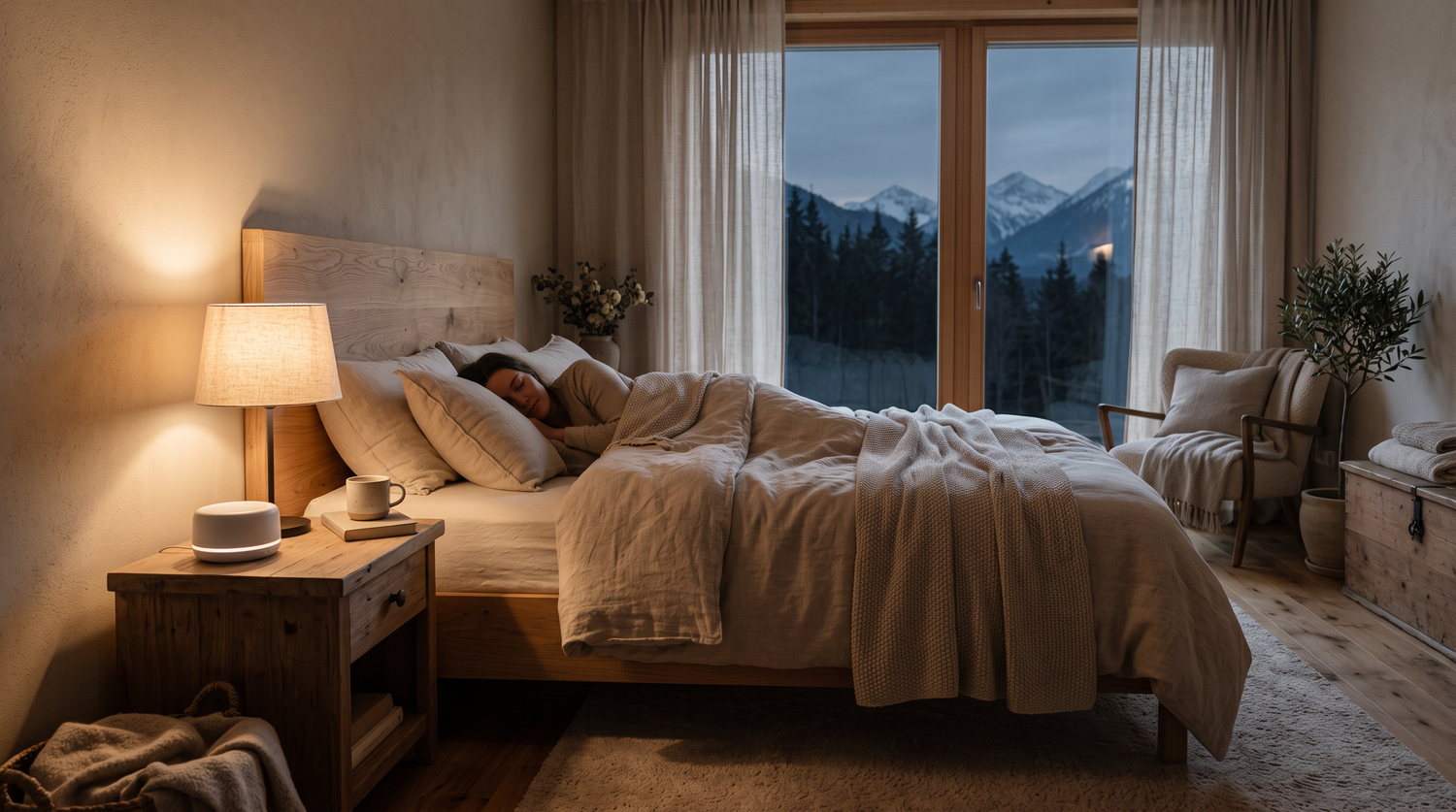
City traffic, a snoring partner, thin walls: Many people lie awake at night because their brain reacts to every noise. Instead of enforcing absolute silence, more and more sleepers are turning to the opposite – a steady background hum. But what exactly is white noise, how does it differ from pink or brown noise, and does it actually help you fall asleep?
The short answer: White noise is a steady sound that contains all audible frequencies with equal intensity. It masks sudden disturbing noises like slamming doors or traffic noise, making them less "alarming" for the brain. Studies show: especially people in noisy environments fall asleep faster and wake up less often with constant noise. Important are a moderate volume (under 50 decibels), a distance from the ear and ideally a timer.
- White noise masks disturbing noises and smooths out the soundscape – the brain reacts less to sudden stimuli.
- Pink and brown noise sound deeper and are perceived by many as more pleasant than pure white noise.
- The volume should remain below 50 dB – about as loud as light rain; the device should not be directly next to the ear.
- Sleep sounds work best as part of a calm evening routine with good sleep hygiene and a suitable sleep environment.
What is white noise – and why does it help you sleep?
The term comes from acoustics: similar to white light, which contains all colors, white noise encompasses all frequencies of the audible spectrum with equal intensity. It sounds like a TV without a signal or a fan turned up high. The trick behind it is called sound masking: Our brain remains vigilant for acoustic changes even during sleep – a slamming car door doesn't wake us up because of its absolute volume, but because of the sudden contrast to silence. A constant noise raises the noise level evenly, so that disturbing noises stand out less.
For people with sleep maintenance insomnia in noisy environments, this can make all the difference: Fewer micro-awakenings mean more stable sleep stages and more restorative deep sleep.

White, pink or brown noise: the differences
Not all noise sounds the same – the "color" describes how the energy is distributed across the frequencies:
| Noise color | Sound character | Sounds like | Well suited for |
|---|---|---|---|
| White noise | All frequencies equally strong, rather bright and sharper | TV static, hissing | Masking of high-frequency noise |
| Pink noise | Emphasizes low frequencies, more balanced | Steady rain, waterfall | Falling asleep, perceived as more pleasant |
| Brown noise | Even stronger bass emphasis, dark and soft | Distant ocean surf, deep hum | Relaxation, sensitive ears |
| Nature sounds | Irregular, but familiar | Rain, waves, forest | Winding down in the evening, rituals |
Research does not give any noise color a clear victory – what matters is what you find pleasant. Many adults prefer pink or brown noise because the higher frequencies of white noise can be perceived as sharp over time.
How to use sleep sounds correctly
Volume: less is more
As a rule of thumb, a maximum of 45–50 decibels applies – comparable to light rain. Continuous exposure significantly above this can strain the ears and disturb sleep rather than promote it. Place the source at least one to two meters away from your head.
Timer or continuous operation?
For pure sleep aid, a timer of 30–60 minutes is sufficient. Those who frequently wake up at night due to noise benefit more from continuous operation – because the abrupt silencing of the noise can itself become an awakening stimulus.
Caution with headphones
Wearing in-ear headphones all night can cause pressure points and irritate the ear canal. Better: a small speaker in the room. For babies and toddlers, special restraint applies – devices do not belong directly in the crib and not at high volume. More on the topic in the guide Helping Children Sleep Better.
As part of the evening routine
Sounds work best embedded in a fixed ritual: same bedtime, dimmed lights, no screens – you can find the basics in our articles on sleep hygiene and falling asleep faster. Waking up can also be made gentler – for example, with a light alarm clock.

When noise is not the solution
Sleep sounds mask noise – but they don't solve the root cause of sleep problems. If you sleep poorly despite a quiet environment, you should check other factors: caffeine in the afternoon, stress, irregular sleep times – or a sleeping surface that doesn't suit your body. If your partner is the source of the noise, targeted measures to reduce snoring are often more helpful than any masking.
A frequently overlooked disturbing factor for couples: motion transfer. Every turn of your partner not only creates noise, but also noticeable vibrations. Classic mattresses try to solve this problem with firmness levels – an outdated concept that is not standardized and reaches its limits anyway with two people of different weights. The adaptive EvoPoreHRC Premium memory foam of the Ora mattress, on the other hand, automatically adapts to the body and sleeping position of both partners and absorbs movements precisely – quieter nights completely without background noise. More on this in the guide Mattress for Couples.
Get CHF 25 discount
Subscribe to newsletter and receive a one-time CHF 25 discount. ✓ 200 nights trial sleep ✓ 10 years warranty
Quiet nights begin with the right foundation
The Ora Ultra Mattress dampens movements and automatically adapts to every body and sleeping position – without firmness compromises. For a quick comfort boost on an existing mattress, the Ora Ultra Topper is suitable, budget-conscious sleepers choose the Ora Ultra Second Life Mattress. With 200 nights of trial sleep and a 10-year warranty.
Frequently Asked Questions about White Noise and Sleep Sounds
Is it harmful to sleep with white noise every night?
At moderate volume below 50 decibels and with some distance from the ear, nightly noise is considered harmless. It only becomes problematic with continuously high volume or if in-ear headphones are worn all night.
Which is better for falling asleep: white or pink noise?
Both effectively mask disturbing noises. Pink noise emphasizes deeper frequencies, sounds like steady rain, and is perceived as more pleasant by most people. Ultimately, personal preference is decisive – try both variants for a few nights.
Can you get used to sleep sounds and not be able to sleep without them?
A certain amount of habituation is possible: Anyone who sleeps with noise every night will initially find silence unfamiliar. However, a real dependency does not develop – after a few nights without noise, sleep in a quiet environment normalizes again.
Does white noise also help with tinnitus?
Many sufferers find a low background hum helpful because it makes the ringing in their ears seem less dominant. However, with persistent tinnitus, the application should be discussed with an ENT specialist.
This article is for general information only and does not replace medical advice.








Leave a comment
This site is protected by hCaptcha and the hCaptcha Privacy Policy and Terms of Service apply.