
Tense shoulders, a stiff neck, restless legs – often it's the body that keeps us from falling asleep, not the mind. Progressive Muscle Relaxation (PMR) according to Edmund Jacobson addresses exactly this: through targeted tensing and conscious releasing of individual muscle groups, the body learns to perceive tension in the first place – and then to release it. The method has been proven since the 1920s, is well-researched scientifically, and is recommended by health insurance companies and sleep specialists alike.
The short answer: In progressive muscle relaxation, you actively tense individual muscle groups one after another for about 5 to 7 seconds and then consciously release them for 30 seconds – from your hands, arms, face, shoulders, and abdomen to your legs. The contrast between tension and relaxation lowers muscle tone, pulse, and blood pressure. Applied directly in bed, PMR is one of the most effective sleep aids without any tools.
- PMR works with contrast: tense strongly, then consciously release for twice as long.
- The method demonstrably lowers muscle tone, heart rate, and perceived stress.
- A short version with 4–7 muscle groups takes only 10–15 minutes and is perfect for bed.
- Regular practice over 2–4 weeks makes the relaxation response increasingly automatic.
How progressive muscle relaxation works
Stress manifests physically: the sympathetic nervous system imperceptibly increases the basic tension of the muscles – jaw, neck, and shoulders are typical candidates. This continuous tension, in turn, sends alarm signals to the brain: no all-clear, no sleep. PMR breaks this cycle with a simple physiological trick: after a strong contraction, a muscle automatically enters a deeper state of relaxation than before. Systematically applying this effect throughout the body significantly lowers overall tension – and with it, pulse, blood pressure, and breathing rate. The brain registers: the body is safe, sleep is allowed. How sleep then organizes itself into cycles is shown in our article on sleep stages.

Step-by-step guide for bed
Preparation
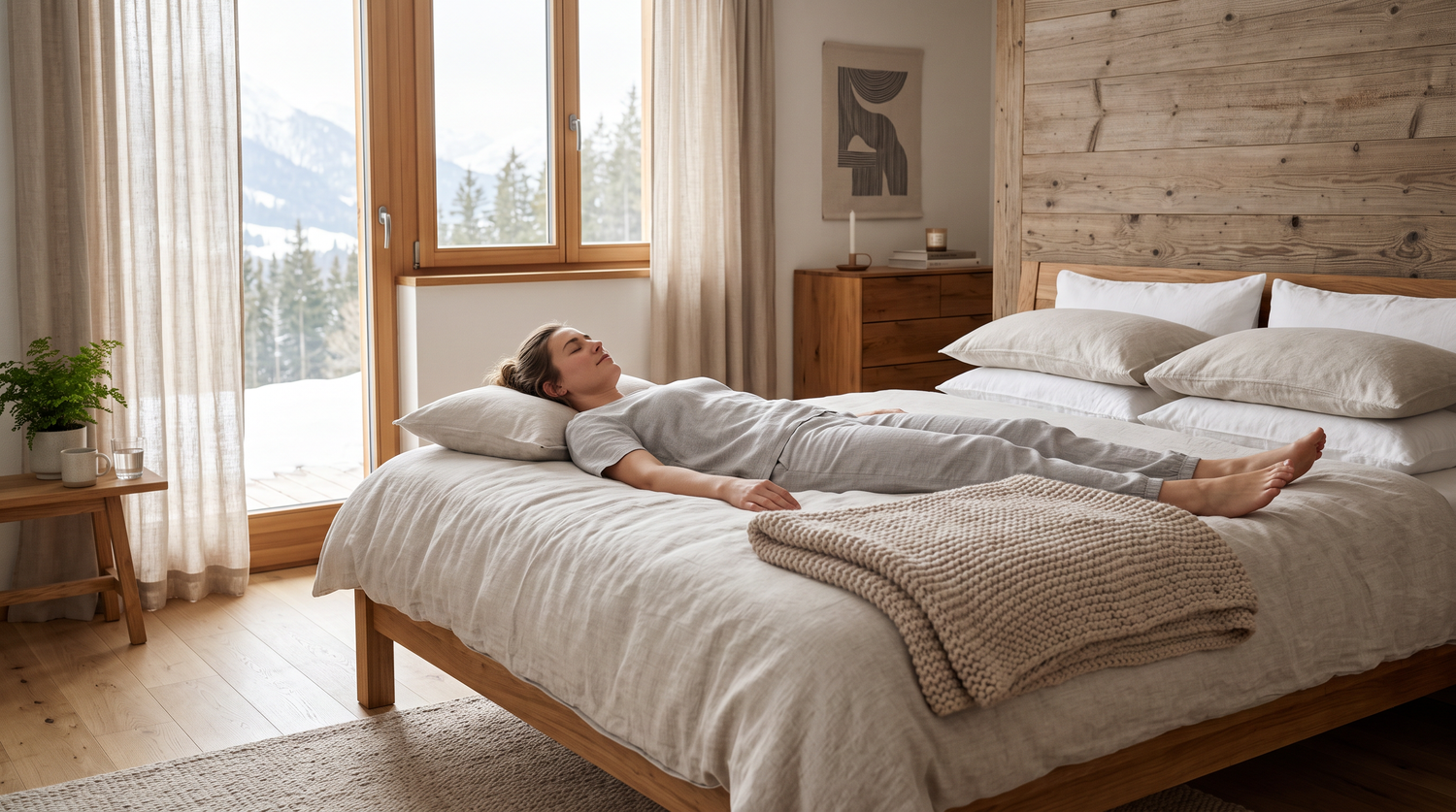
Lie comfortably on your back, arms beside your body, legs slightly open. The room should be dark, quiet, and pleasantly cool – you can find guidelines in the guide to the ideal sleep temperature. Take two to three deep breaths before you begin.
The process: 7 muscle groups
Tense each group strongly (but not cramped) for about 5–7 seconds, breathing calmly throughout. Then, as you exhale, release abruptly and feel the sensation for 30 seconds:
| Step | Muscle Group | How to tense |
|---|---|---|
| 1 | Hands & Forearms | Clench both fists tightly |
| 2 | Upper Arms | Bend arms, tense biceps |
| 3 | Face | Frown, squint eyes, clench jaw slightly |
| 4 | Neck & Shoulders | Pull shoulders towards ears |
| 5 | Abdomen | Tense abdominal wall firmly |
| 6 | Glutes & Thighs | Squeeze glutes, straighten legs |
| 7 | Calves & Feet | Pull toes towards body |
Finally, become aware of your entire body: heavy, warm, relaxed. Many people fall asleep during the last steps – this is expressly allowed.
The short version for tired evenings
If 15 minutes is too long: limit yourself to four groups (hands/arms, face, torso, legs). With a little practice, simply mentally going through the muscle groups will be enough later on – the body will have learned the relaxation response by then.
Who is PMR particularly suitable for?
PMR is ideal for people who find quiet meditation difficult: the active tension gives the restless mind a concrete task. People with stress-related tension, nocturnal teeth grinding, or inner restlessness particularly benefit. The technique also helps with sleep maintenance insomnia to fall back asleep. Those who prefer to work without tension phases will find gentler alternatives in meditation for falling asleep or breathing exercises – everything can be combined anyway.

Relaxed muscles need a supportive surface
Even the best relaxation technique has its limits if the mattress creates new tension: a mattress that is too firm presses against the shoulders and hips, while a sagging one causes the spine to slump – the muscles then have to counteract this all night long. The common answer "then you need a different firmness level" falls short, because firmness levels are not standardized and vary completely from manufacturer to manufacturer. The Ora Ultra solves the problem more fundamentally: its EvoPoreHRC premium memory foam automatically adapts to your body and sleeping position – an adaptive mattress for everyone that relieves pressure points without sacrificing support. More on this in the article Mattress firmness: an outdated concept and in the guide Mattress for back pain.
Get CHF 25 discount
Subscribe to our newsletter and receive a one-time CHF 25 discount. ✓ 200 nights trial sleep ✓ 10 years warranty
Release your muscles – on the right mattress
The Ora Ultra mattress relieves shoulders, back, and hips by automatically adapting to your body and sleeping position – no firmness selection needed. The Ora Ultra topper significantly upgrades existing mattresses; for the budget-conscious, the Ora Ultra Second Life offers a great night's sleep.
✓ 200 nights trial sleep ✓ 10 years warranty
Frequently asked questions about progressive muscle relaxation
How often should I practice progressive muscle relaxation?
Ideally once a day, preferably in bed in the evening. After two to four weeks of regular practice, the relaxation response will set in more quickly – then often the short version with four muscle groups is sufficient.
How strongly should I tense my muscles?
Approximately 60 to 70 percent of maximum strength – clearly noticeable, but without pain or cramping. The tension is merely a means to an end: it makes the subsequent release more intensely perceptible.
Is PMR also suitable for pain or injuries?
Generally yes; affected body regions are simply omitted or only minimally tensed. In case of acute injuries, severe tension, or chronic pain, discuss the exercise with your doctor or physiotherapist beforehand.
What is the difference between PMR and meditation?
PMR works actively through the body: tense, release, feel. Meditation works passively through attention. Many find PMR an easier entry point because it gives the mind a concrete physical task. Both methods can be excellently combined.
Can I use PMR to fall back asleep at night?
Yes, PMR is very well suited for waking up at night. Start directly with the short version and avoid light and checking the time – both would unnecessarily activate the body.
This article is for general information purposes only and does not replace medical advice.









Leave a comment
This site is protected by hCaptcha and the hCaptcha Privacy Policy and Terms of Service apply.