
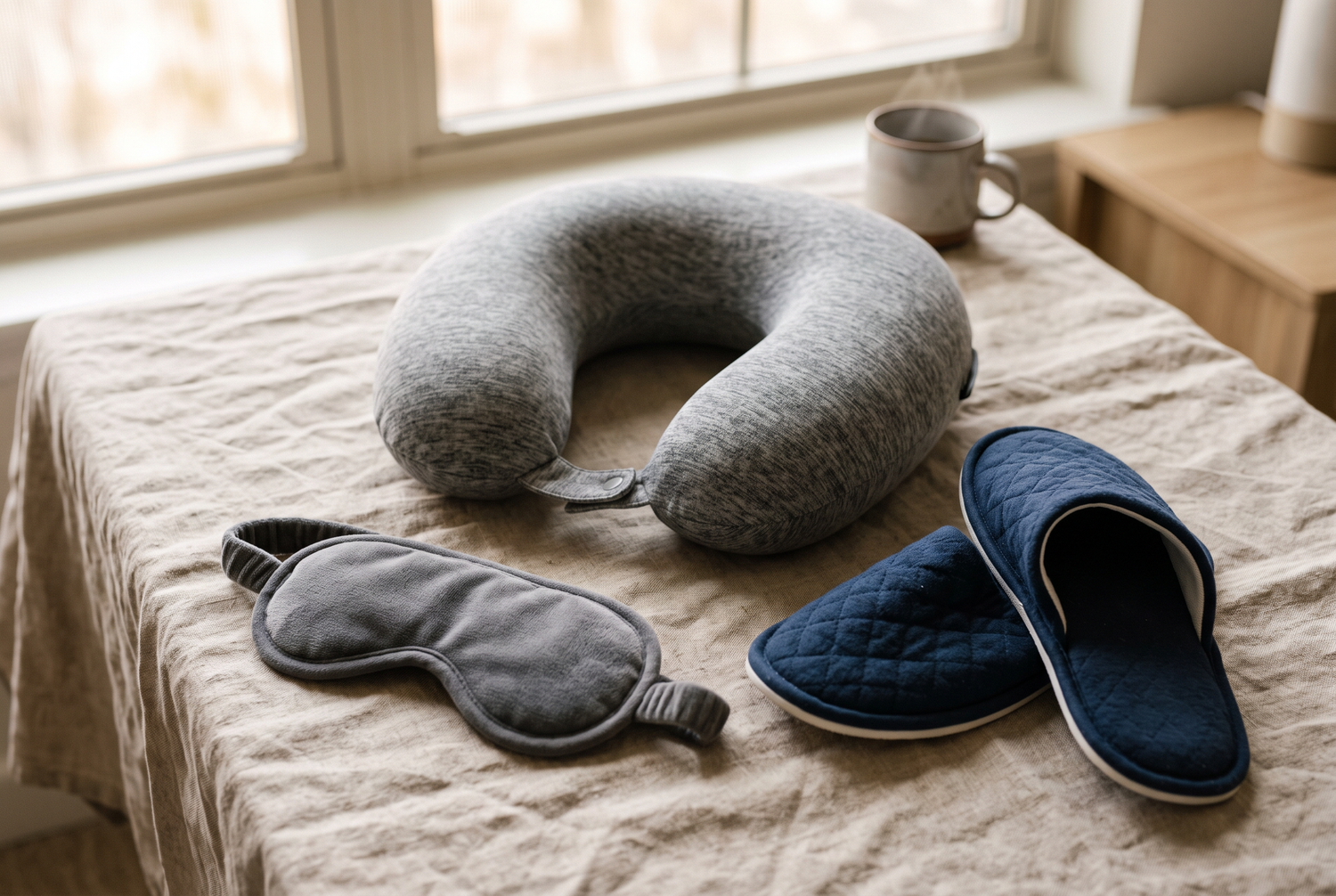
Eleven hours of flying, and then the first appointment or holiday straight away – those who can't sleep on a plane pay for it with one to two lost days. The cabin is particularly sleep-unfriendly: seats with 76 to 81 cm pitch in Economy, constant noise of 75 to 85 decibels, humidity below 20 percent, and cabin pressure equivalent to being at an altitude of 2400 meters. Nevertheless, sleeping on a plane is not a gamble but largely plannable: with the right seat choice, suitable equipment, clever timing, and a few techniques that make it easier for the body to fall asleep sitting up. This guide summarizes what demonstrably helps on long-haul flights – from booking to landing.
The short answer: Sleeping on a plane is best achieved with a window seat near the wing on the left side, a supportive neck pillow, a sleep mask, and earplugs or noise-canceling headphones – and with timing: Adjust to the destination time during boarding and only sleep when it's night at the destination. Avoid alcohol and late caffeine, recline your seat, secure your head to the side, and use breathing techniques instead of sleeping pills. This way, 3 to 5 hours of useful sleep are realistic even in Economy.
- Choose a window seat: headrest against the wall, nobody climbs over you – by far the best sleeping position in Economy.
- The right equipment makes all the difference: neck pillow, sleep mask, earplugs, and warm socks weigh less than 500g combined.
- Sleep according to destination time, not departure time – this halves the subsequent jet lag.
- Alcohol and cabin altitude amplify each other: even two glasses feel like three and fragment sleep.
- Sleeping pills are risky on a plane – immobility increases the risk of thrombosis.
Seat selection: half the battle is decided at booking
The best sleeping spot in Economy is a window seat: you can lean your head against the cabin wall, control the window shade, and won't be woken up when fellow passengers need to use the restroom. If you usually sleep on your left side (at home or on the plane), choose a left-hand seat – the familiar side makes it easier to fall asleep. Being near the wing is doubly beneficial: turbulence is least felt there because the area is close to the aircraft's center of gravity. Avoid rows near galleys and lavatories (light, noise, foot traffic) as well as the last row, whose seats often don't recline. Exit rows offer legroom but often have rigid armrests and colder drafts near the door. For night flights, an additional tip: a flight departing late in the evening fits better with your biorhythm than an afternoon flight, where you're expected to sleep while your body is programmed for daytime.
The right equipment: small, light, effective
Four things contribute to flight sleep. First, the neck pillow: good memory foam models support the chin and prevent the notorious head-lolling that repeatedly wakes you up – wearing it in reverse (opening to the back) often provides better chin support. Second, the sleep mask: screens flicker and reading lights stay on throughout the night in the cabin; a contoured mask creates true darkness that your melatonin levels need. Third, noise protection: foam earplugs attenuate 25 to 33 decibels, while noise-canceling headphones additionally eliminate the low-frequency engine hum – the combination of both is unbeatable on long-haul flights. Fourth, warmth: cabin temperature drops to 18 to 20 °C at night, often colder by the window; warm socks and a light extra layer replace the thin airline blanket. Additionally useful: lip balm and nasal spray against the extremely dry cabin air, as well as a large water bottle, refilled after security.

Timing: sleep according to destination time, not by feeling
The most common strategic mistake: falling asleep as soon as the meal is cleared – regardless of the time at the destination. Better: Mentally (or actually) set your watch to the destination time during boarding and act accordingly from then on. If it's night at your destination, sleep as early and as long as possible; if it's daytime, stay awake – with light, movement in the aisle, and light activity – and only sleep during the destination's nighttime. This pre-adjustment of your rhythm measurably reduces jet lag, as the internal clock only shifts by about 1 to 1.5 hours per day; every hour slept "correctly" on the flight is an advantage. Even 2 to 3 days before departure, it helps to shift your bedtime daily by 30 to 60 minutes towards the destination time. The article on the internal clock and circadian rhythm explains exactly how the internal clock works and why light is its strongest pacemaker; strategies after landing can be found under avoiding and overcoming jet lag.
Eating, drinking, and substances on board
Cabin altitude changes the effect of substances. Alcohol is noticeably stronger at a cabin pressure equivalent to 2400 meters altitude – and it further fragments the already fragile seated sleep, suppresses REM sleep, and dehydrates you twice as much in the dry cabin air. Therefore, gin and tonic as a sleep aid is counterproductive, as the article Alcohol and Sleep Quality also shows. Avoid caffeine from 6 hours before your planned sleep phase – its half-life of 5 to 6 hours tends to be even longer under flight conditions. When it comes to food, choose the lighter option and skip the late second meal if it's nighttime at your destination – your digestive system also has an internal clock that interprets meals as time signals. Instead, consistently drink water: 200 to 250 ml per flight hour compensates for evaporation through breathing and skin and prevents pressure headaches after landing.
Sleeping position in the seat: making the most of 30 degrees
We sleep worse when sitting because muscle tone has to support the head and deep sleep phases are rarely reached – but the position can be optimized. Recline the seat fully (the few degrees make a measurable difference for venous return and neck angle). Secure your head sideways: against the wall by the window with a pillow or folded jacket, otherwise with a supportive neck pillow. Do not cross your legs – this puts pressure on veins and promotes numb feet; better to place both feet flat on the floor or on the footrest. The seatbelt should be visibly fastened over the blanket so that the crew doesn't have to wake you up during turbulence. And plan for movement: get up every 2 to 3 hours, stretch your calves, walk a few steps – this prevents thrombosis and improves circulation for the next round of sleep. Experts advise against sleeping pills on board: they increase immobility and thus the risk of thrombosis.
The comparison: What does each measure achieve?
| Measure | Effect on flight sleep | Effort/Cost |
|---|---|---|
| Window seat near the wing | High – stable leaning position, no disturbances | 0–50 CHF reservation |
| Neck pillow + mask + earplugs | High – dampens the three biggest disruptors | 30–80 CHF one-time |
| Noise-canceling headphones | Medium to high – eliminates engine hum | 100–400 CHF |
| Sleeping according to destination time | High – perceptibly halves jet lag | Only discipline |
| Avoiding alcohol | Medium – deeper, calmer sleep | Free |
| Premium Economy / Business | Very high – more recline to lie-flat | Significant surcharge |
Get CHF 25 discount
Subscribe to our newsletter and receive a one-time CHF 25 discount. ✓ 200 nights trial sleep ✓ 10 years warranty
Common mistakes when sleeping on a plane
Mistake one: trying to sleep immediately after takeoff, even though it's bright afternoon at the destination – this sleep amplifies jet lag instead of mitigating it. Mistake two: extending the movie marathon deep into the "destination night"; screen light and stimulation delay the onset of sleep by hours. Mistake three: using alcohol as a sleep aid – doubly counterproductive at cabin altitude. Mistake four: leaving equipment at home because "it'll probably be fine"; without a mask and earplugs, announcements, light, and neighbors reliably wake you up every 30 to 45 minutes. Mistake five: sleeping for 3 hours in the afternoon on arrival day after a sleepless flight night – this solidifies the old rhythm. Better: stay awake until the local bedtime, if necessary with a power nap of a maximum of 20 minutes, as described in the article How to do a power nap correctly, get plenty of daylight, and go to bed early.

Frequent Questions about Sleeping on a Plane
Which seat is best for sleeping on a plane?
A window seat near the wing: The cabin wall serves as a headrest, nobody wakes you up when going to the restroom, and turbulence is least noticeable over the wings. Avoid proximity to galleys, lavatories, and the last row.
When should I sleep on the plane?
Always according to the destination time: Only sleep when it's night there, and stay awake when it's day there. This shifts your internal clock during the flight and significantly reduces jet lag.
Do sleeping pills help on long-haul flights?
It is not recommended. Sleeping pills increase immobility in the seat and thus the risk of thrombosis. In addition, they can make you groggy after landing. Breathing techniques and good equipment are the safer choice.
Why does alcohol have a stronger effect on a plane?
Cabin pressure is equivalent to approximately 2400 meters altitude, which means less oxygen reaches the blood, and alcohol has a noticeably stronger effect. At the same time, it fragments sleep and causes additional dehydration in the dry cabin air.
How much should I drink on a long-haul flight?
About 200 to 250 ml of water per flight hour. The humidity in the cabin is below 20 percent, which means the body loses significantly more fluid through breathing and skin than on the ground.
What should I do on arrival day after a sleepless flight night?
Stay awake until local bedtime, get plenty of daylight, and go to bed early. If necessary, a power nap of a maximum of 20 minutes in the early afternoon can help – longer naps delay adaptation to the new time zone.
This article is for general information purposes only and does not replace medical advice.








Leave a comment
This site is protected by hCaptcha and the hCaptcha Privacy Policy and Terms of Service apply.