
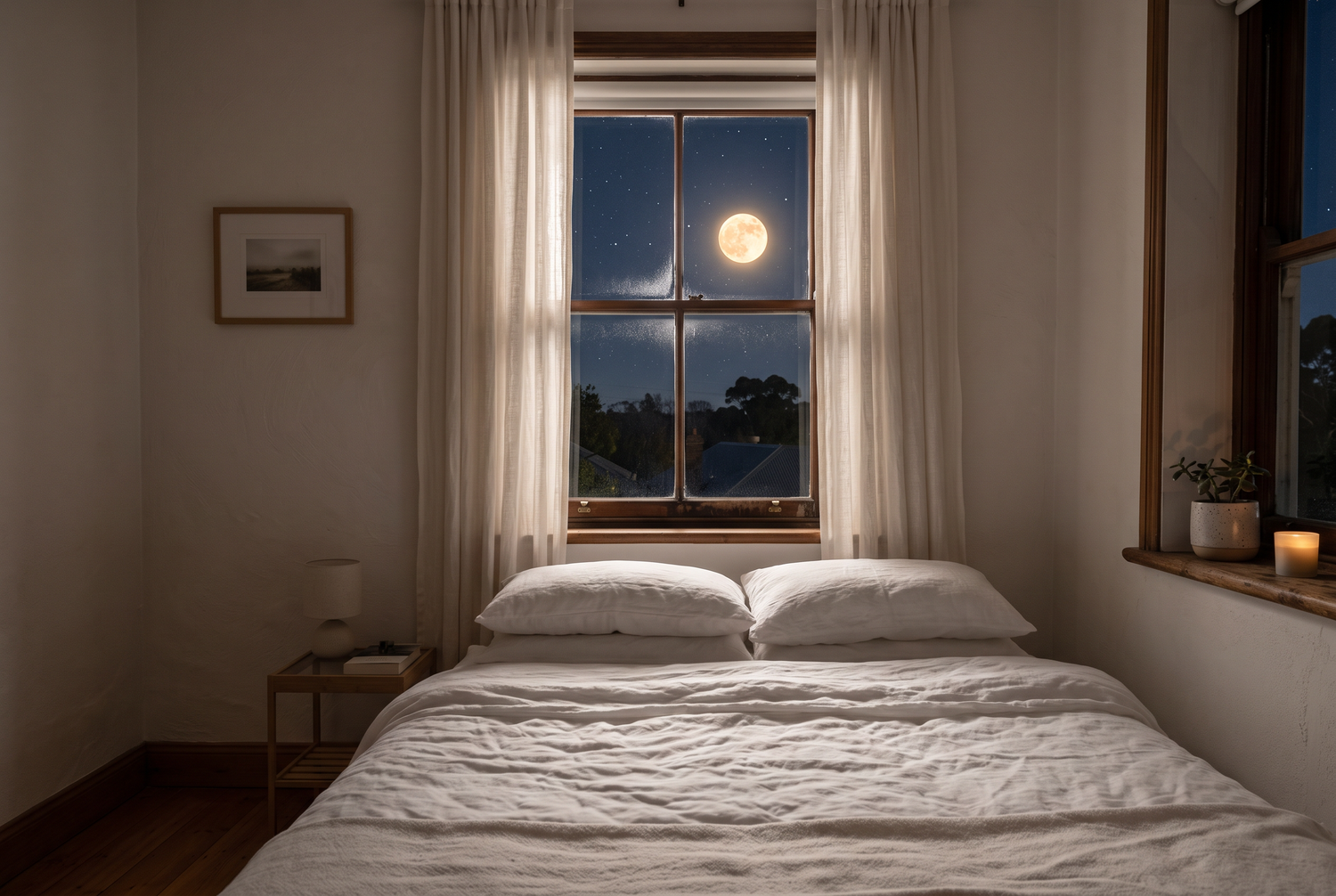
“No wonder I slept poorly – it was a full moon.” Few sleep myths are as firmly entrenched as this one: Surveys show that depending on the country, 30 to 50 percent of people report that the moon affects their sleep. At the same time, many experts dismiss this, pointing to imagination and selective memory. Who is right? The honest answer is more interesting than either side believes: Research has indeed found measurable effects – but smaller than the myth claims, and with explanations that have less to do with lunar forces than with light and expectation. This article sorts through the study situation, explains the plausible mechanisms, and shows what you can concretely do if bright nights disturb your sleep – with or without a full moon.
The short answer: A small effect is scientifically plausible, a large one is not. Individual studies found an average of about 15 to 20 minutes less sleep around the full moon, 30 percent less deep sleep, and about 5 minutes longer to fall asleep – other studies could not confirm this. The most likely explanations are sobering: brighter nighttime light before and during a full moon, expectation effects, and random fluctuations. For those who sleep poorly during a full moon, one thing reliably helps above all else: consistent darkening.
- The 2013 Basel study found about 20 minutes less sleep and 30 percent less deep sleep around the full moon – larger follow-up studies often could not replicate this effect.
- Full moon light only reaches about 0.1 to 0.3 lux – too little to strongly suppress melatonin, but the brighter evenings before a full moon can delay falling asleep.
- The expectation effect is real: those who expect poor sleep sleep measurably worse – and selectively remember bad full moon nights.
- A “moon cycle gene” or gravitational effects on humans are not scientifically proven.
- Practically effective: darkening, a cool room, and consistent routines – in every moon phase.
What research has actually found
The best-known finding comes from Basel: In 2013, a team led by Christian Cajochen analyzed sleep laboratory data from 33 people and found an approximately 5-minute longer sleep onset latency, about 20 minutes less total sleep, 30 percent less deep sleep (measured by delta activity in the EEG), and lower melatonin levels around the full moon – even though the subjects were in a windowless laboratory and did not know the moon phase. What was special: The data had originally been collected for other purposes, so an expectation effect seemed ruled out. The study made headlines worldwide – but science demands replication: Several larger follow-up studies with sometimes over a thousand participants found no or only a minimal correlation between moon phase and sleep quality. A much-discussed 2021 study using activity monitors, in turn, showed that people – from indigenous communities in Argentina to students in Seattle – fell asleep later and slept less in the nights before a full moon, most strongly where there was no electric light. Conclusion of the research: A small effect may exist, but it is significantly weaker and less consistent than popular belief.
Mechanism 1: Light – the most plausible explanation
The moon has no known “radiation” that affects sleep – but it does have light. A full moon night brings about 0.1 to 0.3 lux; for comparison: normal room lighting is 100 to 300 lux, a smartphone display close to the face is also significantly higher. Thus, moonlight is too weak for strong melatonin suppression. More relevant is the timing: In the evenings before a full moon, the bright moon is already high in the sky early – precisely in the hours when the body actually wants to darken. In environments without artificial light, this demonstrably shifts the sleep onset back; the 2021 activity monitor study found up to 30 minutes later sleep onset there. In brightly lit everyday Swiss life, however, this effect is largely lost in the artificial light – the floor lamp outshines the moon by a hundredfold. Anyone who already darkens their bedroom well completely neutralizes the light channel; the article Darkening the bedroom shows how this can be achieved. Why evening light is generally the strongest sleep disruptor is explained in the article on Blue light and screens.

Mechanism 2: Expectation and selective memory
The second channel runs through the mind – and is well-documented. Sleep is extremely sensitive to expectation: those who are convinced they will sleep poorly tonight go to bed more tense, monitor their own wakefulness, and actually sleep worse as a result – a mechanism that also plays a central role in insomnia. Those who know the calendar ("today is a full moon") have a self-fulfilling prophecy delivered free of charge. In addition, there is the confirmation bias: a bad night during a full moon is remembered and recounted ("typical full moon!"), while twenty bad nights without a full moon and good full moon nights are overlooked. This can create a subjectively overwhelming connection where statistically there is hardly any. This also explains why the belief remains so stable, even though measurement data only weakly support it. The constructive way to deal with it: don't dramatize the night. A single short night – whether due to the moon or stress – is easily compensated for by the body; it is only the anxious preoccupation with sleep that becomes problematic, as the article Stress and brooding with sleep problems shows.
What is not proven: gravity, lunar cycles in the body, sleepwalking
Some popular explanations do not stand up to scrutiny. While the moon's gravity affects the oceans, its tidal force on the human body with its few liters of fluid is vanishingly small and just as strong at new moon as at full moon; as an explanation for pure full moon effects, it is illogical. An internal human "moon cycle" analogous to the circadian rhythm has been postulated repeatedly but is not proven. Even for the classics of popular belief – more sleepwalking, more births, more emergencies during a full moon – large analyses of clinic and birth registries show no reliable correlations. By the way, sleepwalking occurs in deep sleep and has nothing to do with moonlight; more on this in the article Sleepwalking: Causes. It remains to be seen: Where full moon effects have been measured, they are most parsimoniously explained by light and expectation – without any mystical forces.
Moon phases and sleep: an overview of the study situation
| Claim | Study situation | Classification |
|---|---|---|
| Less deep sleep during full moon | Basel study: -30% Delta activity; replications inconsistent | possible, but small and uncertain |
| Later falling asleep before full moon | Confirmed with actimetry in 2021, strongest effect without artificial light | plausible due to evening moonlight |
| More sleepwalking during full moon | no reliable evidence | Myth |
| Gravity disturbs sleep | physically negligible, equally strong at new moon | Myth |
| Perceived worse full moon nights | Expectation effect and selective memory well documented | real, but psychologically explainable |
Secure CHF 25 discount
Subscribe to newsletter and receive a one-time CHF 25 discount. ✓ 200 nights trial sleep ✓ 10 years warranty
Practice: How to sleep better on bright nights
Whether the disturbance is a full moon, a streetlamp, or early summer sun – the remedies are the same. First, darkening: blackout curtains or blinds reduce the brightness in the room to below 0.1 lux and negate any effect of moonlight; a cheaper alternative is a sleep mask. Second, light discipline in the evening: dimmed, warm light 1 to 2 hours before bedtime strengthens the melatonin signal far more than the moon could weaken it. Third, routine: fixed bedtimes and a cool room of 16 to 19 °C stabilize sleep against small disturbances of all kinds – the basics are summarized in the guide Sleep Hygiene. Fourth, serenity: Skip checking the full moon calendar in the evening – what you don't expect can sabotage you less. And if you do lie awake at night: don't look at the clock, but find your way back to relaxation with a calm breathing technique, such as the 4-7-8 method from the article Falling asleep faster.

Frequently Asked Questions about Full Moon and Sleep
Do you really sleep worse during a full moon?
Possibly a little: individual studies found around 15 to 20 minutes less sleep and less deep sleep around the full moon, while others found no effect. If there is an influence, it is small – significantly smaller than popular belief suggests.
How bright is full moon light actually?
Only about 0.1 to 0.3 lux – room lighting is 100 to 300 lux. This is too little for strong melatonin suppression, but in dark environments, the bright evening moon can slightly delay falling asleep.
Why does my sleep still feel worse during a full moon?
Mostly due to expectation and selective memory: those who expect poor sleep sleep more tensely, and bad full moon nights are remembered more strongly than unremarkable ones. Both together create a perceived connection.
Does the moon's gravity affect our body?
No, not measurably. While tidal forces affect oceans, they are negligible for the human body – and are just as strong at new moon as at full moon, so they couldn't logically explain pure full moon effects anyway.
What specifically helps against poor sleep during full moon nights?
Blackout curtains or a sleep mask, dimmed light in the evening, a cool room of 16 to 19 °C, and consistent bedtimes. Those who also avoid checking the full moon calendar remove the basis for the expectation effect.
Are there people who are more sensitive to the moon?
This is not specifically proven for the moon. However, some people are generally more sensitive to light and expectation stress – for them, bright nights and the belief in the full moon have a stronger effect. Darkening and serenity help both groups.
This article is for general information purposes only and does not replace medical advice.








Leave a comment
This site is protected by hCaptcha and the hCaptcha Privacy Policy and Terms of Service apply.