

Anyone who carries more body weight knows the problem: many mattresses sag too much at the shoulders and pelvis, the back sinks in, and in the morning, the lower back complains. Online, recommendations like "choose firmness level H4 or H5" quickly circulate. But this rule of thumb falls short – and it is based on a concept that isn't even standardized. In this guide, we clarify what really matters when choosing a mattress for heavier individuals.
The short answer: Heavier sleepers don't need the "hardest" possible mattress, but one that precisely supports the extra weight while simultaneously relieving pressure on the shoulders and hips. The decisive factors are support, point elasticity, and a stable, high-quality core – not an arbitrary firmness level number. An adaptive mattress, which automatically adjusts to body weight and sleeping position, solves this problem more reliably than traditional firmness level thinking.
- The goal is not "hard," but the right combination of support and pressure relief.
- Firmness levels (H1–H5) are not standardized – the same designation feels different for every manufacturer.
- Important factors are material quality, resilience, and a durable core that maintains its shape even under higher weight.
- An adaptive mattress adjusts automatically – eliminating the guesswork of finding the "right" firmness level.
Why heavier individuals have different requirements
More weight means more pressure on the sleeping surface. If the mattress sinks too deeply in the heaviest body zones – i.e., pelvis and shoulders – the spine loses its natural alignment. The result is tension, back pain, and restless sleep. A too-soft surface virtually "swallows" the body; a too-hard one, however, creates localized pressure and leads to numbness in the arms and legs.
The goal, therefore, is balance: the mattress must provide enough counter-pressure to support the heavier zones, while remaining flexible enough to relieve pressure on sensitive areas. This precise interplay is what makes a good mattress for heavier individuals – and it cannot be reduced to a single firmness number. Those who generally wonder what makes a good mattress will find the same quality criteria here, just under a higher load.

The Firmness Level Myth: Why "H5" is no guarantee
The common recommendation is: the heavier the person, the higher the firmness level. Sounds logical, but it has a crucial flaw – firmness levels H1 to H5 are not bindingly defined by any standard. Each manufacturer decides for themselves what they call "H4". An "H4" mattress from one brand can feel softer than an "H3" from another. This makes comparison practically worthless and leads to incorrect purchases.
Furthermore, firmness says nothing about the actual support performance. A mattress can feel firm and still sag under high point pressure if the material lacks sufficient resilience. Conversely, a mattress can feel pleasantly yielding yet provide excellent support. We have dedicated a separate detailed guide to firmness levels to this topic – the core message: Don't rely on the number, but on the material and its adaptive behavior.
What really matters: Support, Point Elasticity, Core Quality
Three properties determine the sleeping comfort of heavier individuals. Support describes how well the mattress bears the weight without sagging. Point elasticity refers to the ability to yield only where pressure is applied – good foam reacts locally, not broadly. And core quality determines how dimensionally stable and durable the mattress remains even under continuous higher load. Cheap foams quickly lose their shape (indentation), while high-quality materials last for years.
Comparison: Concepts at a Glance
| Approach | How it works | Suitability for heavy individuals |
|---|---|---|
| High firmness level (H4/H5) | Very firm, less yielding surface | Provides support, but often presses on shoulders and hips – not standardized |
| Very soft mattress | Deep sinking over the entire surface | Spine sags, back pain likely |
| Pocket spring, firm | Supports with steel springs | Point elasticity often limited, noise and heat build-up possible |
| Adaptive premium foam | Automatically adjusts to weight and position | Supports heavy zones, relieves sensitive ones – regardless of weight |
If you want to understand the different constructions in principle, you will find a broader overview of foam, pocket spring, and latex in the comparison of mattress types.
The Adaptive Alternative: A Mattress for Everyone
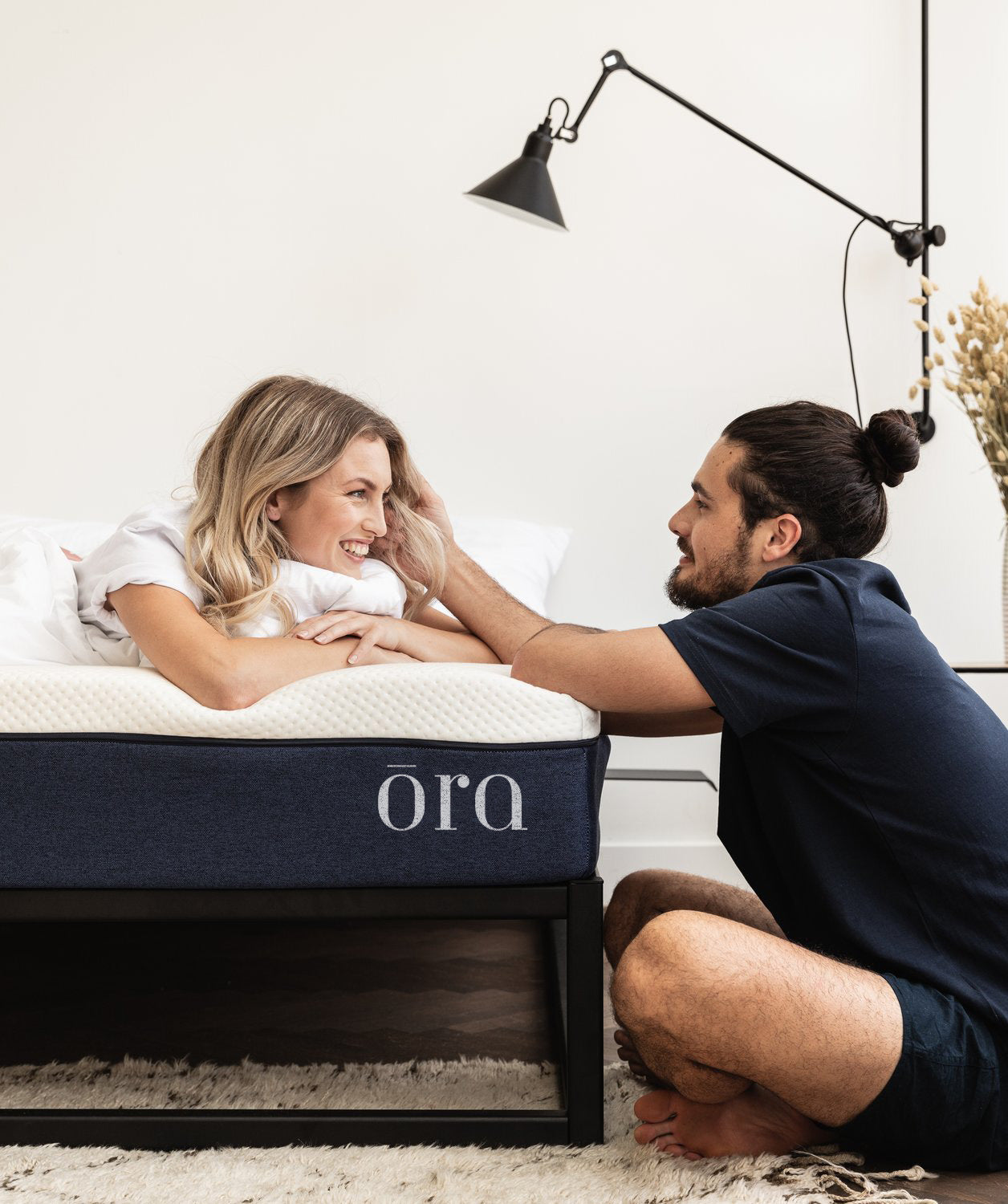
Instead of categorizing sleepers into weight classes and firmness levels, Ora takes a different approach: a single adaptive mattress that automatically adjusts to the body and sleeping position. This is made possible by their in-house EvoPoreHRC premium memory foam. It reacts to pressure and temperature, yielding selectively in heavy zones and providing counter-pressure where support is needed. A lighter and a heavier person can use the same mattress – it reacts individually to each body.
This is particularly advantageous for heavier individuals: they don't have to hope that a certain firmness level happens to fit, but instead get a surface that adapts to them – not the other way around. This principle also solves a long-standing problem for couples with different weights, as both sides are supported appropriately.

What else to look out for when buying
In addition to the mattress itself, a few factors play a role that are particularly important for higher weights. A stable, closely slatted slatted frame prevents the mattress from sagging despite good quality – too large slat spacing undermines any support. The right sleeping temperature and consistent sleep hygiene also contribute to more restful nights. Side sleepers with more weight also benefit from the tips in our guide to the best mattress for side sleepers, as shoulder relief is particularly important here.
If you are unsure, you should rely on one thing above all: a sufficiently long trial sleep period. The first few nights are often deceptive; the body needs time to adjust. How risk-free this can be today is shown in our article on buying a mattress online with a trial sleep.
Get a CHF 25 discount
Subscribe to our newsletter and receive a one-time CHF 25 discount. ✓ 200 nights trial sleep ✓ 10-year warranty
A mattress for every body – the Ora Ultra
The Ora Ultra mattress with EvoPoreHRC premium foam automatically adapts to weight and sleeping position – without any firmness level guesswork. If you want to specifically upgrade an existing mattress, the Ora Ultra Topper provides additional pressure relief. And those who want to sleep sustainably will find a tested, resource-saving option in the Ora Ultra Second Life. All come with 200 nights of trial sleep and a 10-year warranty.
Frequently Asked Questions about Mattresses for Heavier Individuals
Which firmness level is best for heavier individuals?
No blanket number. Firmness levels are not standardized and say little about actual support. Support, point elasticity, and core quality are more important. An adaptive mattress that automatically adjusts to weight is a more reliable choice than an arbitrarily high firmness level.
Does an adaptive foam mattress sag with higher weight?
High-quality premium foam like EvoPoreHRC has high resilience and remains dimensionally stable even under continuous higher load. Material quality is crucial: cheap foams form indentations, while durable foams fully return to their shape.
Do I need a special slatted frame as a heavier person?
Yes, a stable slatted frame with narrow slat spacing is important so that the mattress does not sag. Too large spacing can overwhelm even a good mattress. A continuously firm, flat base also works.
Does a mattress last shorter with higher weight?
Only if the material is inferior. A mattress with a high-quality, durable core has a comparable lifespan even for heavier sleepers. Regular rotation and a suitable slatted frame also extend durability.
Is a firm mattress automatically better for the back?
No. Too firm means localized pressure and insufficient relief for the shoulders and hips. Optimal is a mattress that supports while simultaneously relieving sensitive areas – i.e., reacts adaptively instead of just being firm.
This post is for general information and does not replace medical advice.









Leave a comment
This site is protected by hCaptcha and the hCaptcha Privacy Policy and Terms of Service apply.