
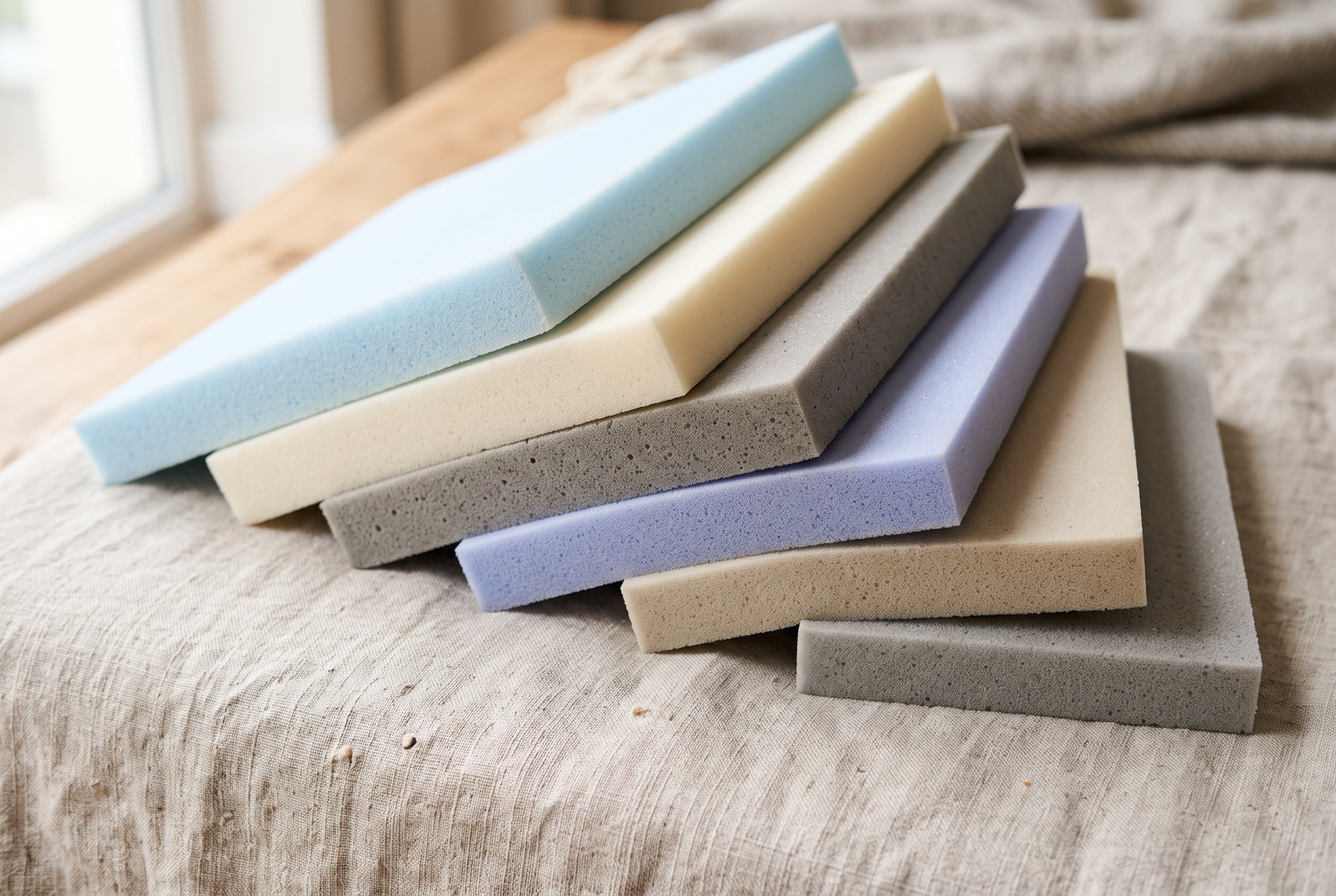
Almost every mattress description includes a firmness level between H1 and H5, often accompanied by seemingly precise weight recommendations. This seems helpful – finally, a clear number in a confusing purchasing decision. But if you put two mattresses from different manufacturers with the same firmness level side-by-side, you'll immediately feel the difference. The reason is simple: there is no binding standard for firmness levels. Each manufacturer sets its own scale. This article explains what the individual levels usually mean, why the information is still only of limited help – and what criteria really matter.
The short answer: H1 to H5 describes how much resistance a mattress offers to body weight – from very soft (H1) to very firm (H5). The catch: this classification is not standardized. An H3 from one provider can feel like an H2 from another, and the usual kg limits are purely arbitrary. They completely ignore body shape, sleeping position, and weight distribution. What's crucial is not the firmness level, but whether your spine remains straight when lying down – and you can only check that at home over several weeks.
- H1 to H5 is purely a manufacturer's specification – there is no legal or DIN standard for it.
- The common kg limits are rough guidelines, not measurements: Two people weighing 75 kg need completely different things depending on their body shape.
- H4 and H5 are often sold as "especially supportive" – but too firm means pressure points on the shoulder and hip.
- More meaningful are point elasticity, density (RG), and how the mattress behaves during position changes.
Firmness level H1 to H5: the usual classification
Even if no standard exists, an approximate convention has become established in the trade. The following table shows it – with the explicit note that weight specifications can differ by 15 to 20 kilograms between providers.
| Level | Feel | Often cited weight range | Market prevalence |
|---|---|---|---|
| H1 | very soft | up to approx. 60 kg | rare |
| H2 | soft to medium | approx. 60–80 kg | frequent |
| H3 | medium-firm | approx. 80–100 kg | most frequent |
| H4 | firm | approx. 100–130 kg | frequent |
| H5 | very firm | from approx. 130 kg | niche product |
The distribution is striking: H3 is by far the most commonly sold – not because it's ideal for most people, but because it's the safe middle ground where providers risk the fewest returns.

Why the scale doesn't work
There are three structural problems. First, the lack of standardization: Unlike shoe or clothing sizes, there is no reference that manufacturers must adhere to. A provider with a soft range calls its firmest mattress H4, while another would classify the same product as H2. Second, the reduction to body weight: Two people weighing 75 kilograms each can have completely different builds – broad shoulders and a narrow pelvis require different pliability than a balanced or pear-shaped body. Third, sleeping position: Side sleepers need more sink depth at the shoulder and hip than stomach sleepers, regardless of weight. A single number cannot represent these three dimensions. We have discussed this in more detail in the article on mattress firmness levels.
The most expensive misconception: “firmer is more supportive”
Many people with back pain instinctively opt for H4 or H5, because "hard" sounds like "supportive." The opposite is often true. On a surface that's too firm, the shoulder can't sink in when lying on your side; the spine bends upwards, and weight is distributed to only a few pressure points – shoulder, hip, rib cage. The result is pressure sores, frequent tossing and turning, and morning tension. Conversely, however, a mattress that is too soft causes the pelvis to sag, arching the lumbar spine. The ideal state lies in between – and it's not called "medium," but "adapted to your contour." You can read more about how this affects discomfort in the article on mattresses and back pain.
What you should check instead
Instead of looking for a firmness level, pay attention to four things. First, point elasticity: Does the material yield only where pressure is applied, or does the entire surface sink? Second, the density (RG) of foam – below 40 kg/m³, even the nicest firmness level is useless, because it won't hold up after two years. Third, behavior when changing position: A good mattress adjusts its support when you turn from your back to your side. Fourth – and this is the real test – the spinal alignment: Have a second person photograph you from behind while you are lying on your side. The spine should form a straight, horizontal line, without sagging in the pelvis or kinking at the shoulder.
The practical test at home
Ten minutes in a specialty store tells you little. The body needs three to four weeks to adjust to a new surface – during this adjustment phase, even temporary minor tension can occur, even if the mattress is suitable. Therefore, only evaluate after four weeks. Three specific questions help: Do you wake up in the morning without new stiffness? Do you toss and turn less often at night than before? And has falling asleep become easier? If two out of three questions are answered with yes, the mattress fits. That's why a long, genuine trial sleep period is more important than any number on the label – read more about it under buying a mattress online and trial sleeping.

Get CHF 25 discount
Subscribe to our newsletter and receive a one-time CHF 25 discount. ✓ 200 nights trial sleep ✓ 10-year warranty
Frequently Asked Questions about Firmness Levels
Is there a standard for mattress firmness levels?
No. There is no legal requirement and no DIN or EN standard that defines what H1 to H5 mean. Each manufacturer defines the scale themselves, usually in relation to their own product range. Therefore, the same designation from two providers can refer to noticeably different mattresses. Measurable data such as indentation force in kilopascals or density are more reliable.
What firmness level do I need for 70 kg?
This question cannot be answered reliably with a single number. Body weight is only one of several factors; body shape, shoulder width, hip circumference, and preferred sleeping position are at least as important. Two people weighing 70 kilograms may need different types of support. It is more sensible to check the spinal alignment while lying down and to test the mattress for several weeks.
Is a firm mattress better for your back?
No, this is one of the most common misconceptions. A mattress that is too firm prevents the shoulders and hips from sinking in, leading to pressure points and tension. One that is too soft causes the pelvis to sag. A good mattress keeps the spine in a neutral alignment. If back pain persists, medical or physical therapy consultation is advisable.
What does H5 mean and who is it for?
H5 indicates the firmest level in a manufacturer's range and is usually advertised for people weighing approximately 130 kilograms or more. In practice, it is a niche product. More important than the firmness level for heavier body weights is the material quality: a high density (RG), sufficient core height, and a sturdy slatted frame will prevent premature sagging more reliably than a firmness designation.
Can I compensate for a mattress that is too firm with a topper?
Partially, yes. A topper of five to eight centimeters can make the surface noticeably softer and relieve pressure points on the shoulders and hips. However, it does not change the fundamental support of the mattress core. If the mattress is significantly too firm or already sagging, a topper merely shifts the problem instead of solving it.









Leave a comment
This site is protected by hCaptcha and the hCaptcha Privacy Policy and Terms of Service apply.