
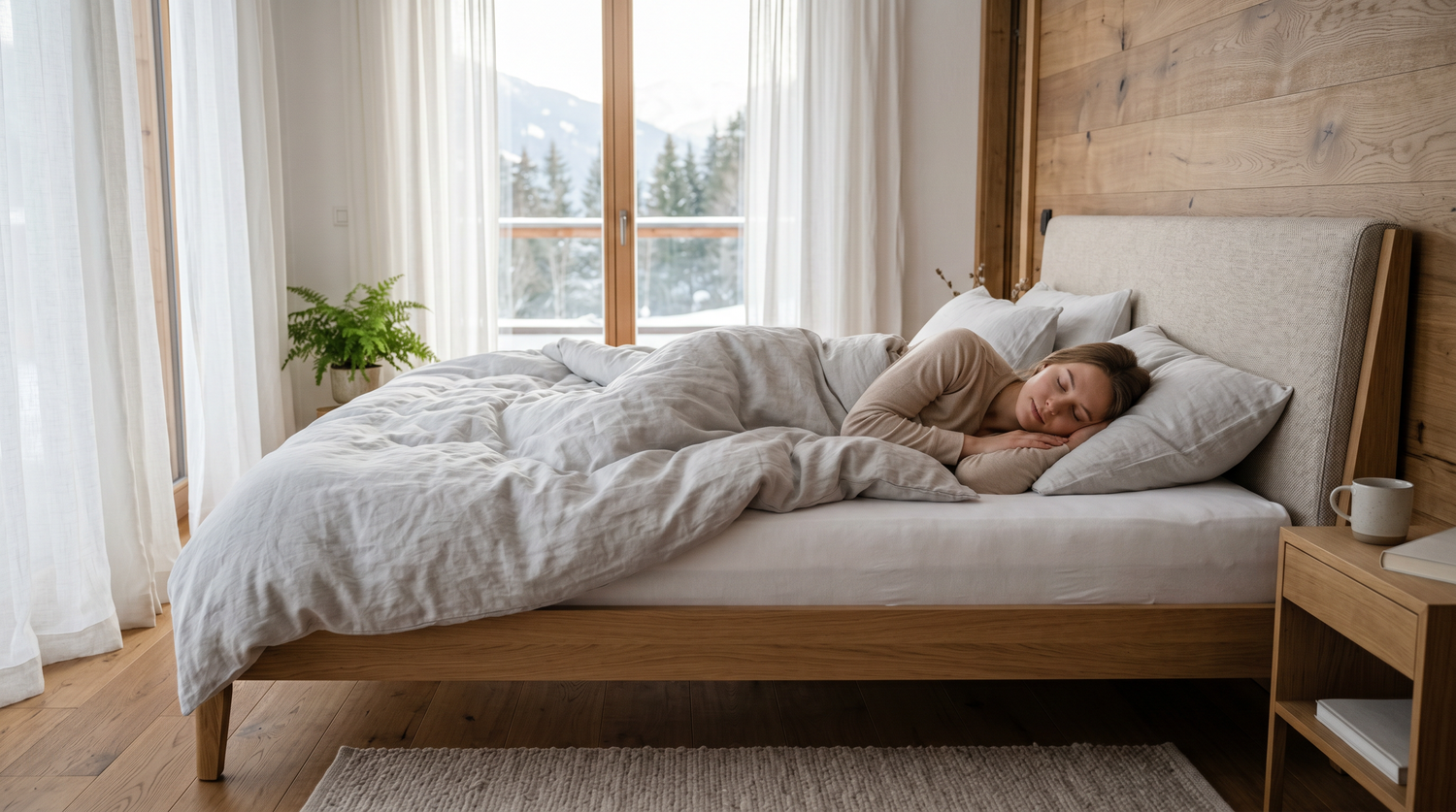
Those who weigh less than 60 kilograms often know the problem without being able to name it: The mattress feels comfortable in the store, but after a few nights, their shoulder or hip hurts, their arm falls asleep, and in the morning, their body feels worn out – even though the mattress is new. The reason is simple: most mattresses are designed for an average weight of 70 to 90 kilograms. Lighter individuals simply don't activate the comfort zones of such mattresses and therefore lie on rather than in the mattress.
The short answer: Lighter individuals don't need an extra soft mattress or a special firmness level, but rather a mattress that yields precisely even with low body weight. The key is an adaptive foam that reacts to minimal pressure and allows shoulders and pelvis to sink in, while the rest of the body remains supported – keeping the spine straight in any sleeping position.
- Individuals under approx. 60 kg often find standard mattresses too firm: shoulders and hips don't sink in, leading to pressure points and tension.
- Firmness levels like H1 or H2 are not standardized – each manufacturer defines them differently. Choosing a "soft" mattress is therefore a gamble.
- The adaptability of the material is crucial: premium memory foam like EvoPoreHRC reacts even to low pressure and provides precise relief.
- For lighter side sleepers in particular, shoulder relief is vital – this determines whether the spine lies straight.
Why light individuals often find most mattresses too firm
A mattress only functions ergonomically if the body exerts enough pressure to deform the material. This is precisely where the problem lies: spring and simple cold foam mattresses require a certain minimum weight for their zones to respond at all. For a person weighing 50 to 55 kilograms, this hardly happens. The result: the contact surface remains small, and the entire body weight is distributed over a few contact points – especially the shoulder, hip, and heel. High localized pressure develops there, disrupting blood circulation and leading to frequent tossing and turning at night.
Additionally, there's the posture of the spine: if the shoulder doesn't sink in when sleeping on one's side, the cervical spine bends. Many light individuals unconsciously compensate for this with a pillow that is too high – which shifts the problem but doesn't solve it. More on this in the Pillow Guide and in the article for Side Sleepers.
The firmness level fallacy: why "H1 for light individuals" is not a solution
The classic advice is: light individuals = soft firmness level (H1 or H2). This sounds logical, but it has two drawbacks. Firstly, firmness levels are not standardized – one manufacturer's H2 corresponds to another's H3. Secondly, a universally soft mattress only solves half the problem: it allows the shoulder to sink in, but it also yields where support would be needed – for example, in the waist and lower back. The result is a sagging lying position that, in the long run, leads to tension just like a surface that is too firm.
Modern adaptive materials make this choice superfluous. Premium memory foam like EvoPoreHRC reacts to pressure and body heat: it yields where little weight needs a lot of relief, and supports where the body needs hold. Such a mattress automatically adapts to the body and sleeping position – the outdated concept of firmness level is simply no longer needed.

What light individuals should really look for when buying a mattress
1. Responsiveness to low pressure
The central question is: Does the material react to even a small amount of weight? New-generation memory foam does this because it responds not only to pressure but also to body heat. This creates a large, even support surface even for someone weighing 50 kilograms.
2. Point elasticity instead of surface elasticity
Point-elastic materials only yield where pressure is applied. For light individuals, this means: the shoulder sinks in, the waist remains supported. Surface-elastic systems (such as simple spring cores) deform over a large area – hardly at all with low weight.
3. Consider sleeping position
Light side sleepers need maximum shoulder relief, while light back and stomach sleepers tend to need even support for the pelvis. An adaptive mattress covers both, as it adapts to the position – important for anyone who moves a lot at night.
Body weight and lying sensation at a glance
| Body Weight | Typical Problem on Standard Mattresses | What matters |
|---|---|---|
| under 60 kg | Lying too hard, pressure points on shoulder and hip, bent spine | Material that yields precisely even with low pressure |
| 60–90 kg | Mostly unproblematic, but firmness level choice remains a gamble | Balanced pressure relief and support |
| over 90 kg | Sinking too deep, hammock effect, faster material fatigue | High compression hardness and dimensional stability – see Mattress for heavy individuals |
The table shows: The requirements differ – the solution doesn't have to. A high-quality adaptive foam covers the entire spectrum because it adapts its behavior to the applied pressure, instead of specifying a fixed firmness.
Light person, heavy partner: the uneven couple
The firmness level fallacy becomes particularly clear in a double bed: if one person weighs 55 and the other 95 kilograms, there is no common firmness level that suits both. Two separate mattresses create the unwelcome "visitor's ditch," while a compromise mattress leaves one person sleeping poorly. An adaptive mattress elegantly solves this: it reacts individually to the respective body weight on each side of the bed. More on this in the article Mattress for Couples. If you want to continue using an existing, too-firm mattress for now, you can also make the sleeping surface noticeably more pressure-relieving with a high-quality topper.

Get CHF 25 Discount
Subscribe to our newsletter and receive a one-time CHF 25 discount. ✓ 200 nights trial sleep ✓ 10 years warranty
A mattress that adapts to you – not the other way around.
The Ora Ultra Mattress with EvoPoreHRC premium memory foam automatically adapts to body weight and sleeping position – ideal even for light individuals, without any firmness level guesswork. Price-conscious individuals can opt for the tested Ora Ultra Second Life, and if you want to make your existing mattress softer, the Ora Ultra Topper offers a quick solution. With 200 nights of trial sleep, you can test both risk-free at home – more on this under Buy mattress online & trial sleep.
Frequently Asked Questions about Mattresses for Light Individuals
Which firmness level is right for light individuals?
None – at least not a general one. Firmness levels are not standardized and vary greatly between manufacturers. Instead of opting for H1 or H2, light individuals should look for adaptive, point-elastic material that yields even with low pressure and automatically adapts to the body.
Why do light individuals often wake up with shoulder or hip pain?
Because their body weight is too low to deform standard mattresses. The contact surface remains small, pressure concentrates on the shoulder and hip, and blood circulation is disrupted. The body reacts with frequent tossing and turning and morning tension.
Is a very soft mattress automatically better for light individuals?
No. A universally soft mattress also yields where the body needs support, such as in the waist. Ideal is a mattress that reacts softly where relief is needed and supports where stability is required – precisely what adaptive premium memory foam provides.
What should I do if my partner is significantly heavier than me?
With large weight differences, any firmness level logic fails. An adaptive mattress reacts individually to the respective weight on each side of the bed – both lie ergonomically correctly, without compromise and without a "visitor's ditch."
From what weight is one considered a light individual?
There is no fixed limit, but a rule of thumb is about 60 kilograms. However, the interaction of weight, height, and build is crucial: a tall, slender person distributes their weight differently than a small, compact one – which makes material that adapts individually even more important.









Leave a comment
This site is protected by hCaptcha and the hCaptcha Privacy Policy and Terms of Service apply.