
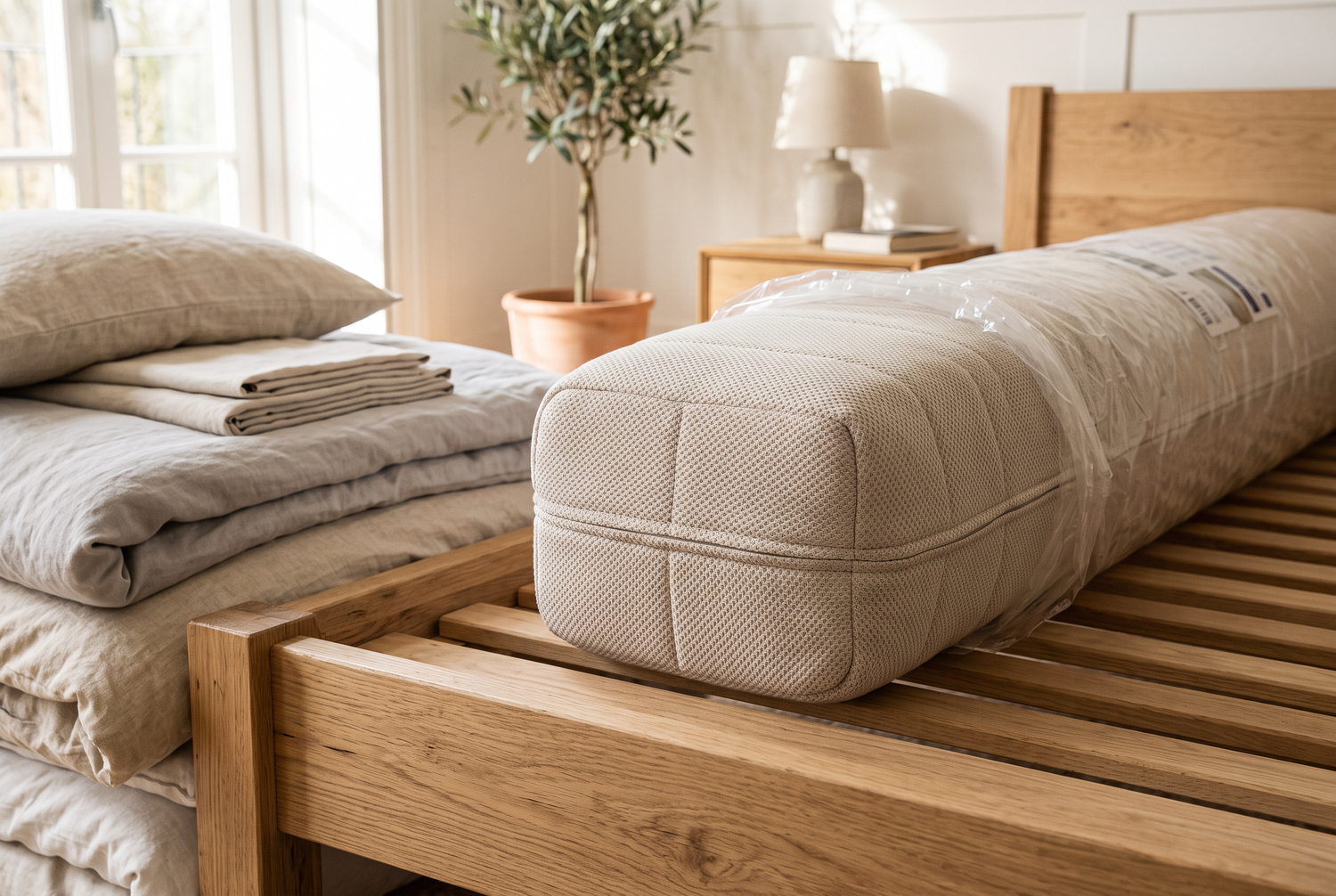
Ten minutes of trying out a mattress in a specialty store, in street clothes, under neon lights, and with a saleswoman standing by – from this, a decision is supposed to emerge that will accompany you for the next ten years. Once you've noticed this contradiction, you'll understand why testing a mattress at home is a much more reliable method. Your body needs time to get used to a new sleeping surface, and the first few nights are almost never representative. That's precisely why Ora offers 200 nights for testing. This article shows how to make the most of this time, what to look for each week, and when you can form a clear judgment.
The short answer: Use the first two to four weeks purely as an adjustment phase and do not make a judgment during this time. Your body needs to adapt to a changed support behavior, and slight tension in the first few nights is normal. From about week four onwards, systematically evaluate: How do you wake up, how often do you turn, are there pressure points? After eight to twelve weeks, you will have a reliable picture. The 200 nights also give you the opportunity to experience a change of seasons.
- The first 2–4 weeks are for adjustment – do not evaluate during this time.
- Test on the final base, not temporarily on the floor.
- Briefly note each week how you wake up – memory is deceiving.
- 200 nights also cover temperature changes throughout the seasons.
Why trying a mattress in a store is not very indicative
When trying out a mattress in a store, you are primarily measuring your first impression – and that is systematically distorted. A mattress that feels particularly soft and cuddly in the first few minutes is often perceived as too yielding after eight hours. Conversely, a well-supporting surface often feels uncomfortably firm at first. Added to this are practical distortions: you lie dressed instead of in pajamas, usually on your back instead of in your actual sleeping position, with a strange pillow and no duvet. And you are not actually sleeping – your muscles are awake and actively resisting. Only in real sleep do they fully relax, and only then does it become clear whether your shoulder and hip sink in correctly. The mattress type comparison shows how the different constructions fundamentally differ.
The adjustment: what happens in the first few weeks
Your body has adapted to your old mattress over the years – often one with hollows that your muscles and ligaments have grown accustomed to. A new, uniformly supportive surface brings the spine into a changed position, and the same muscles that previously compensated now have to readjust. Slight tension or an unusual feeling in the first few nights are therefore normal and not a sign of a wrong choice. The material itself also changes: memory foam only reaches its final behavior after several weeks of regular use. Read more about this in the article on mattress adjustment.

Your test plan for the 200 nights
Structure helps because memory of individual nights is deceiving. The following division has proven effective.
| Period | What to look for | Evaluation |
|---|---|---|
| Weeks 1–2 | Setup, airing, check base | Do not evaluate yet |
| Weeks 3–4 | First adjustment, adjust pillow | Note tendency |
| Weeks 5–8 | Wake-up feeling, pressure points, frequency of turning | First reliable assessment |
| Weeks 9–12 | Back comfort throughout the day | Clear judgment possible |
| Up to night 200 | Temperature behavior over the seasons | Final decision |
Four things you should do right when testing
1. The base must be right
A mattress on a sagging slatted frame or directly on the floor behaves differently. Test it from the beginning on the base you intend to use permanently, and check if the slats are intact and the distance is not too great.
2. Consider the pillow
If your shoulder sinks deeper into the new mattress than before, your old pillow is often too high. Neck pain after changing is more often due to the pillow than the mattress – the pillow guide helps with adjustment.
3. Don't immediately jump between options
If you switch after ten nights, you start the adjustment process all over again and end up comparing two incomplete impressions. Give a configuration at least four weeks.
4. Document briefly
Three keywords per week are enough: How did you wake up, were there any pressure points, how often did you wake up during the night? After two months, you will see a trend that you would never have been able to discern so clearly from memory alone.
When a mattress really doesn't fit
There are clear signals that persist even after the adjustment period. These include morning lower back pain that improves within an hour of getting up, numb arms or shoulders when lying on your side, visibly frequent turning during the night, and a hollow back feeling when lying on your back. If these symptoms persist for six to eight weeks, it is no longer due to habituation. Conversely, an initially unfamiliar feeling that diminishes from week to week suggests a good choice. For persistent or severe pain, you should consult a doctor, regardless of the mattress, to rule out any other underlying cause.

Get a CHF 25 discount
Subscribe to the newsletter and receive a one-time CHF 25 discount. ✓ 200 nights trial sleep ✓ 10 years warranty
Frequent questions about trial sleeping
How long does it take to get used to a new mattress?
For most people, two to four weeks. During this time, the muscles adjust to the changed support behavior, and the foam reaches its final properties. You should not make a judgment before four to six weeks at the earliest.
Is trying a mattress in a store pointless?
Not pointless, but not very meaningful. Ten minutes in street clothes, mostly on your back and with awake muscles, only show the first impression. How a mattress performs over eight hours of real sleep cannot be deduced from this.
What if I get back pain in the first few nights?
Slight tension is normal during the adjustment phase, as muscles and ligaments adapt to a new position. If the symptoms improve from week to week, that's a good sign. If they persist for six to eight weeks or are severe, have them medically checked.
Can I use the mattress normally during the trial sleep period?
Yes, that's the whole point. Cover it with a fitted sheet, sleep on it as usual, and use it completely normally. Only then will you get a realistic picture.
Why 200 nights and not 30 days?
Because 30 days, with an adjustment period of two to four weeks, barely extend beyond the transition phase. Over 200 nights, you also experience a change of seasons and can assess the temperature behavior.









Leave a comment
This site is protected by hCaptcha and the hCaptcha Privacy Policy and Terms of Service apply.