
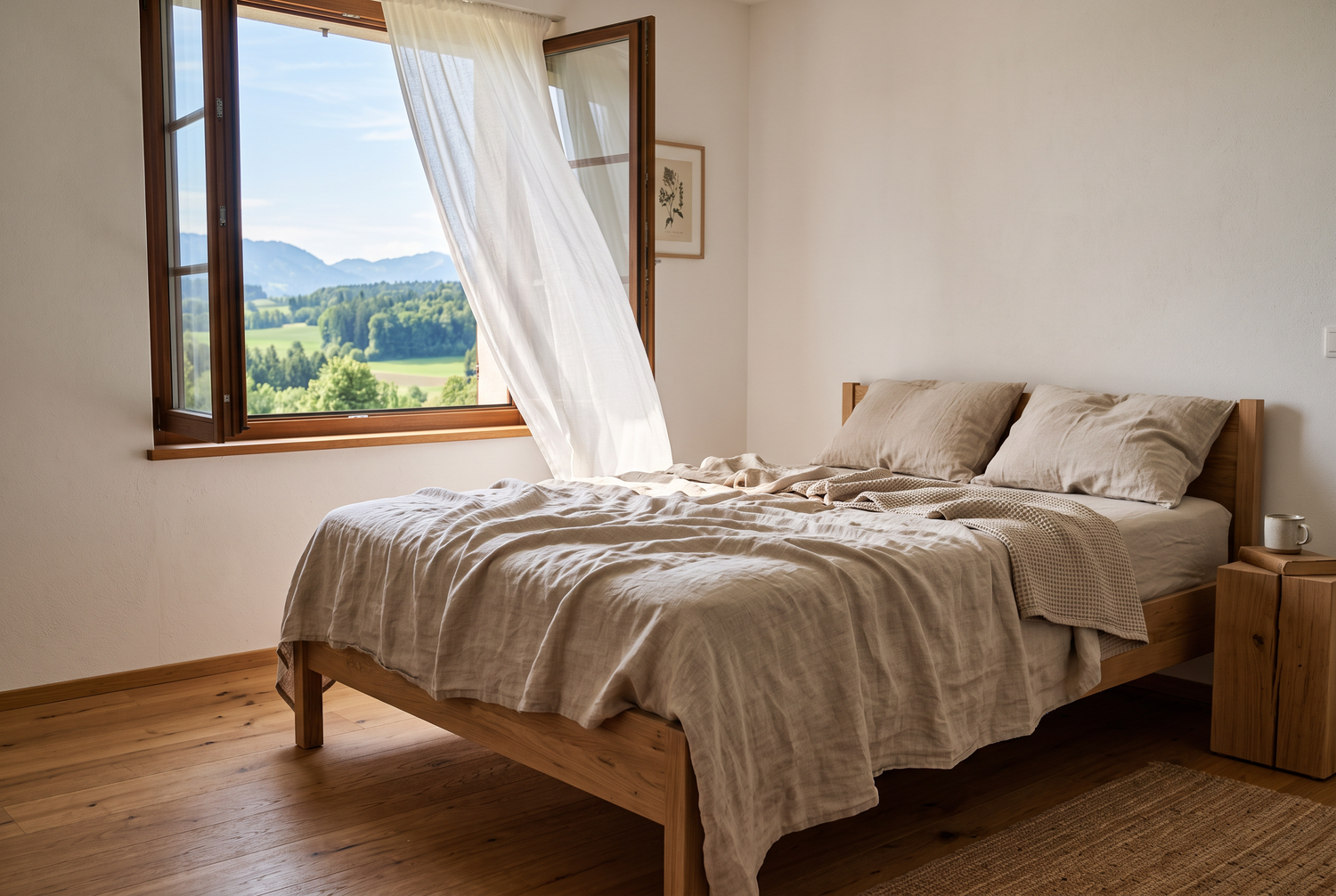
When the thermometer in the bedroom still reads 27 degrees Celsius at midnight, falling asleep becomes a test of patience. You toss and turn, kick off the duvet, pull it back on, get up, drink water, lie down – and remain wide awake. This isn't your imagination: to fall asleep, the body needs to lower its core temperature by about 0.5 to 1 degree Celsius, and this is almost impossible in an overheated room. Swiss summers now regularly bring tropical nights where the outside temperature doesn't drop below 20 degrees, especially in urban areas with a lot of buildings. The good news: sleeping in the heat can be significantly improved with relatively simple measures – if you adjust the right settings.
The short answer: The decisive factor is not just the air temperature, but whether your body can release heat. Keep the room consistently shaded and closed during the day, and only ventilate at night and early in the morning when the outside air is cooler than the inside air. Use light natural fibers instead of synthetic fibers, a thin summer duvet instead of no blanket at all, and specifically cool your hands and feet – that's where the heat-releasing vascular networks are located. An ideal room temperature is 16 to 19 degrees; during heatwaves, 23 to 25 degrees is often realistic, which is still manageable for sleeping with the right measures.
- To fall asleep, the body lowers its core temperature by 0.5 to 1 degree – heat precisely blocks this.
- Keep windows and blinds closed during the day, only cross-ventilate at night.
- Cooling hands and feet works faster than cooling the torso.
- Linen and cotton wick moisture better than polyester.
- Ice-cold showers are counterproductive – lukewarm is more effective.
Why heat reliably disrupts sleep
Human sleep is closely linked to body temperature. In the evening, the body begins to release heat through the skin, especially through the hands and feet. This release lowers the core temperature, and this drop is one of the most important signals for falling asleep. If the ambient air is warmer than about 24 degrees Celsius, heat dissipation works less effectively because the temperature gradient between skin and air becomes too small. The body responds by sweating – which cools, but only as long as the sweat can evaporate. With high humidity above 60 percent, even that becomes difficult. The result is longer sleep onset latency, more nocturnal awakenings, and especially less deep sleep. Studies on sleep in warm nights consistently indicate a shortening of deep sleep phases, while light sleep increases. Waking up exhausted in the morning, despite having been in bed for a long time, is exactly this effect. Our article on sleep phases explains how the phases are related.
The daily plan: Don't let the heat in at all
The most effective measure costs nothing and begins at seven in the morning. As soon as the outside temperature rises above the inside temperature – usually between 8 and 9 AM in Switzerland – close windows, roller shutters, and curtains. External shading is many times more effective than internal shading: shutters or awnings block solar energy before it enters through the window. Internal curtains only stop a portion of the radiation that has already penetrated. Secondly: reduce heat sources in the room. A running computer emits 50 to 150 watts, a TV similarly, and an incandescent bulb almost all of its power as heat. Over eight hours, this adds up noticeably. Thirdly: Only ventilate when the outside air is cooler than the inside air – during heatwaves, often not until 10 or 11 PM, most effectively between 4 and 7 AM. But then do it properly: cross-ventilation with opposite windows completely exchanges the room air in 5 to 10 minutes. Details can be found in the article Proper ventilation for a good sleeping climate.

Body cooling: what works quickly and what only helps short-term
Arteriovenous anastomoses – special vascular connections through which the body efficiently releases heat – are located in the hands, feet, face, and ears. Targeted cooling works best precisely there. A foot bath with water at about 20 to 25 degrees Celsius for 5 to 10 minutes before bedtime measurably lowers the core temperature. A damp, cool cloth over the wrists works similarly. What often disappoints, however, is an ice-cold shower. It feels refreshing at the moment but triggers a counter-reaction – the skin blood vessels constrict, heat dissipation decreases, and a few minutes later you feel warmer than before. A lukewarm shower, at about 30 to 33 degrees, is more effective because the blood vessels remain open and residual moisture on the skin evaporates. Fluid intake also plays a role: in hot nights, one can easily lose 0.5 to 1 liter of fluid overnight. Two to three deciliters of water before sleeping is sensible; large amounts lead to nocturnal toilet visits. Alcohol has a doubly unfavorable effect – it dilates blood vessels but massively disturbs the second half of the night, as our article on alcohol and sleep quality shows.
Comparison of the effectiveness of measures
| Measure | Effect | Effort |
|---|---|---|
| External shading during the day | Very high – up to 3–5 degrees cooler | Low, but daily |
| Cross-ventilation at night | High – complete air exchange | Low |
| Lukewarm foot bath | Medium to high, works quickly | 5–10 minutes |
| Linen instead of synthetic fiber | Medium – better moisture wicking | One-time purchase |
| Oscillating fan | Medium – promotes evaporation | Low, possibly noise |
| Ice-cold shower | Low – counter-reaction possible | Low |
Bedding and mattress: Moisture is more important than "cool"
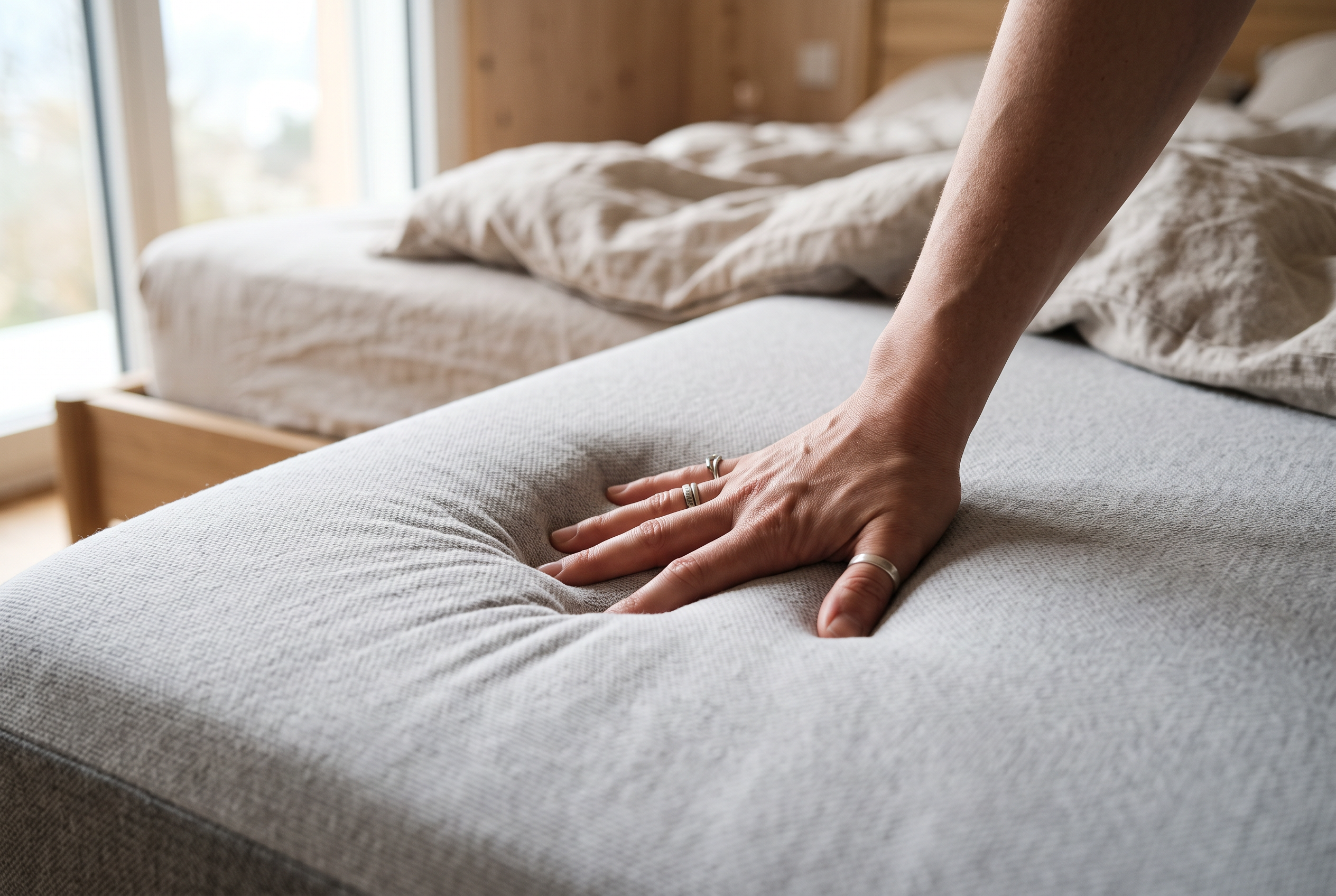
A common misconception: people look for something that feels cold. In fact, moisture regulation determines whether a night is bearable. Linen absorbs up to 20 percent of its weight in moisture before feeling damp and releases it quickly. Cotton is around 8 to 10 percent, polyester under 1 percent – which is why synthetic bedding sticks in hot nights. A comparison of materials can be found in the article Bedding materials. For duvets: going without is usually worse than a very light summer duvet, because the body cools down in the early morning hours and triggers waking up. The mattress also plays a role: open-pored foams and a washable, breathable cover wick away moisture, while closed-pored materials trap heat. A topper made of dense material can be counterproductive on hot nights – check if it's more pleasant without one. Further ideas can be found in the article cool mattresses.
Common mistakes on hot nights
Leaving windows open all day. This actively brings heat into the house. A room that is 22 degrees in the morning can heat up to 29 degrees by evening if warm air continuously flows in. Directing a fan directly at the body. The constant airflow dries out mucous membranes and can promote neck tension. Better: oscillating mode, medium setting, distance at least two meters. Hanging a wet cloth over the fan. This cools briefly but increases humidity – and that's precisely what makes heat truly unbearable. Late, heavy dinner. Digestion generates additional metabolic heat; light food two to three hours before sleeping is more favorable. Abandoning your rhythm. Anyone who goes to bed differently every evening because of the heat disrupts their internal clock and worsens the problem over several days. Keep your bedtime and wake-up time as consistent as possible, even if you had a bad night.
A practical evening routine for tropical nights
This sequence has proven effective and takes about 30 minutes in total. From 9 PM: Switch off all unnecessary devices in the bedroom, including standby. Reduce lighting to a warm, subdued level. 9:30 PM: Take a lukewarm shower, about 30 to 33 degrees Celsius, then do not rub completely dry – the residual moisture on the skin cools as it evaporates. 9:45 PM: Foot bath with lukewarm water or alternatively a cool cloth over wrists and neck for five minutes. 10:00 PM: Check if the outside temperature is below the inside temperature – if so, cross-ventilate for 10 minutes, then leave windows tilted, if noise and insects allow. 10:15 PM: Prepare the bed with a light linen cover and a thin summer duvet, have a glass of water ready. 10:30 PM: Lie down. If sleep doesn't come after 20 to 25 minutes, get up, do something quiet in another room with dimmed light, and only return when you feel sleepy. Further elements can be found in our article on evening routines and under cooling the bedroom in summer.

Get CHF 25 discount
Subscribe to our newsletter and receive a one-time CHF 25 discount. ✓ 200 nights trial sleep ✓ 10 years warranty
Frequently Asked Questions About Sleeping in Heat
What is the ideal room temperature for sleeping?
Approximately 16 to 19 degrees Celsius is considered optimal. During heatwaves, such temperatures are hardly achievable without air conditioning; 23 to 25 degrees are usually still sleepable with good shading, light natural fibers, and targeted body cooling.
Is it better to sleep without a duvet?
Usually not. Completely without a blanket, the body cools down in the early morning hours when the core temperature reaches its lowest point – this often leads to waking up. A very light summer duvet or a simple linen sheet is a better solution.
Does a cold shower before bed help?
An ice-cold shower only works briefly. The skin blood vessels constrict, heat dissipation decreases, and soon after, one often feels warmer than before. A lukewarm shower at about 30 to 33 degrees is more effective because the blood vessels remain dilated.
When should I ventilate in summer?
Only when the outside air is cooler than the inside air – in heat periods usually from 10 or 11 PM and especially effective between 4 and 7 AM. During the day, windows, blinds, and curtains should remain closed.
Is a fan healthy all night?
A fan is unproblematic if the airflow is not directed directly at the body. Constant drafts can dry out mucous membranes and promote tension. Oscillating mode, medium setting, and at least two meters distance are advisable.
Which bedding is best suited for heat?
Linen is particularly suitable in summer because it can absorb up to 20 percent of its own weight in moisture without feeling clammy. Cotton is a good alternative. Polyester hardly stores any moisture and quickly feels sticky on hot nights.
This article serves general information purposes and does not replace medical advice.




Leave a comment
This site is protected by hCaptcha and the hCaptcha Privacy Policy and Terms of Service apply.