
App stores are full of them: sleep trackers that turn every night into colorful graphs, sleep aids with rain sounds and spoken narratives, smart alarms that promise the perfect wake-up moment, and digital therapy programs for insomnia. It's estimated that about one in three smartphone users in Europe occasionally uses a sleep app, and the market is growing by double digits. The question is whether this benefits sleep. The answer varies greatly depending on the app type: digital behavioral therapy programs are among the most well-proven sleep aids available, while pure trackers demonstrably worsen sleep for some people. This guide categorizes the apps, explains what sensors can and cannot measure, describes the phenomenon of orthosomnia, and provides a checklist to help you choose an app that actually helps you.
The short answer: Sleep apps help when they change behavior, not just when they measure. Digital CBT-I programs, which structure sleep restriction, stimulus control, and cognitive techniques, are the most well-supported; studies show they achieve effects comparable to in-person therapy. Sleep aids with sounds or guided relaxations are a useful addition for many people. Sleep trackers provide useful bedtimes and trends but not reliable sleep phase analysis, and they can cause anxious users to fixate on numbers, which worsens sleep. If you sleep poorly, you should ban your phone from the bedroom at night and, if anything, choose an app that is evaluated in the morning and provides concrete behavioral recommendations.
- Three app types with very different benefits: trackers (measure), sleep aids (calm), digital CBT-I (change behavior). Only the third type is proven as a treatment.
- Trackers detect sleep vs. wake at about 80–90%, but sleep stages only roughly; quiet wakefulness is often counted as sleep.
- Orthosomnia: Fixation on sleep metrics can exacerbate sleep anxiety and insomnia. Those who already sleep poorly are particularly at risk.
- A phone by the bed means light, notifications, and easy accessibility; all three disrupt sleep. Airplane mode and distance are the minimum.
- Good apps: evaluate in the morning, provide behavioral tips, clearly regulate data protection, do not promise diagnoses.
The three types of sleep apps
Sleep trackers
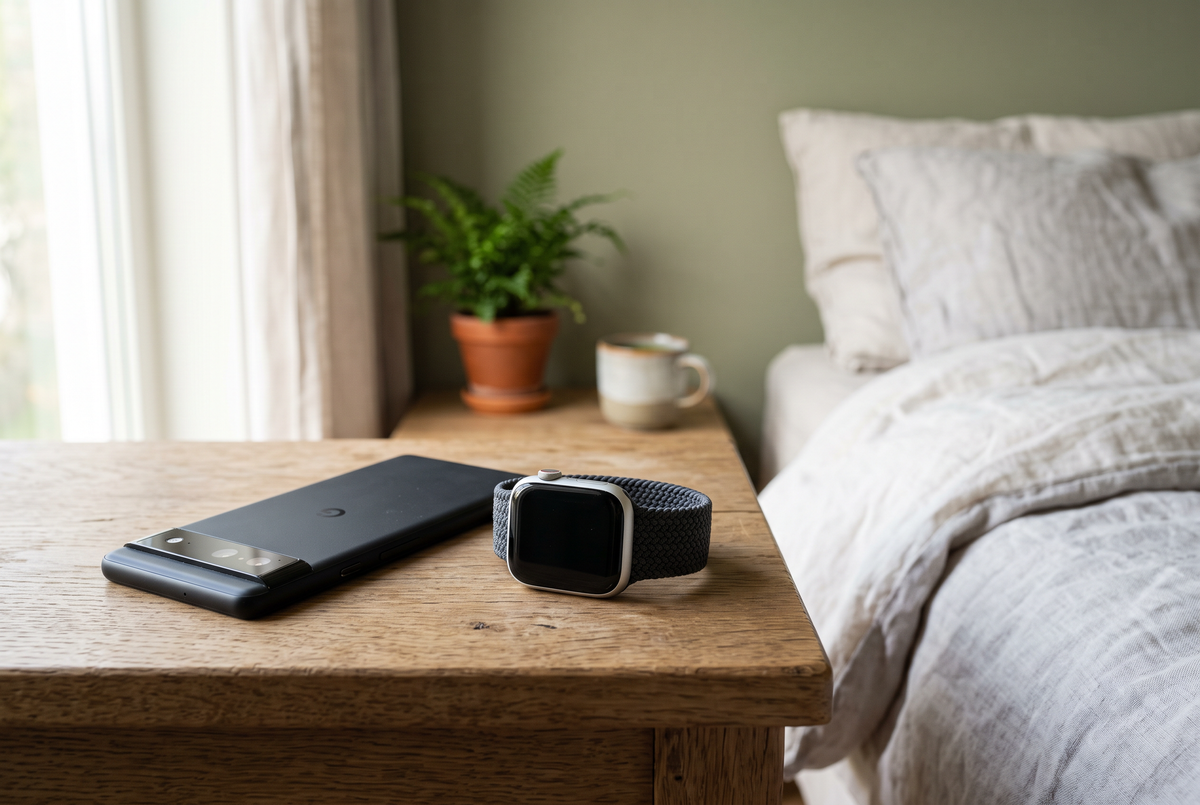
They record movement, sounds, heart rate, and sometimes blood oxygen and skin temperature using the phone's microphone and accelerometer or wearables (watch, ring, band). From this, they estimate bedtime, sleep onset latency, wake phases, and sleep stages, often outputting a "sleep score." Many offer a smart alarm that aims to wake you during a light sleep phase.
Sleep aids
Soundscapes (rain, ocean, white or pink noise), guided meditations, body scans, breathing exercises, bedtime stories, quiet music. They aim for relaxation and distraction from rumination. Our article on white noise for falling asleep describes what soundscapes can achieve.
Digital CBT-I programs
Structured programs over six to eight weeks that digitally implement cognitive behavioral therapy for insomnia: sleep diary, calculation of sleep window, sleep restriction, stimulus control, managing sleep-related thoughts, relaxation. In Germany, some programs are approved as digital health applications and are reimbursed by health insurance companies; in Switzerland, some supplementary insurances cover the costs, and sleep medicine centers are increasingly using them as a complementary tool. Our article on CBT-I explains what the method involves.
What sleep trackers can and cannot measure
The gold standard for sleep measurement is polysomnography in a sleep laboratory: brain waves (EEG), eye movements, muscle tension, breathing, oxygen. Only an EEG can truly determine sleep stages. Consumer devices do not have an EEG. They infer the state from movement (actigraphy) and heart rate variability. This works quite well for the rough distinction between sleep and wake: validation studies show that current wearables have an agreement of about 80 to 90% with the sleep laboratory in detecting sleep. The problem is the opposite direction: if someone lies quietly in bed but is awake, most devices classify them as sleeping. The specificity for wake phases is often only 40 to 60%. Especially in cases of insomnia, where prolonged quiet wakefulness is the core problem, trackers systematically underestimate wake time.
When it comes to sleep stages, the data is thinner. The classification into light, deep, and REM sleep in good wearables matches the lab in about 50 to 65% of epochs; this is better than random, but far from a diagnosis. The statement "You only had 45 minutes of deep sleep today" is an estimate with considerable uncertainty. Phone apps without a wearable, which only use the microphone and mattress movement, are even less accurate, especially if two people are in bed. The smart alarm also relies on this uncertain phase detection. What these devices reliably provide: bedtime, wake-up time, rough total sleep time, regularity over weeks, resting heart rate, and in some models, indications of sleep apnea via oxygen saturation. Trends over weeks are more informative than individual nights. You can read about how sleep stages actually work in our article on sleep stages.

App types compared
| Type | What it does | Study situation | Useful for whom | Risk |
|---|---|---|---|---|
| Sleep Tracker (phone) | Movement/sounds, sleep score, smart alarm | Low accuracy, no proof of better sleep | Curious healthy sleepers | Phone by bed, orthosomnia |
| Wearable Tracker | Heart rate, movement, partially SpO2, trends | Sleep/wake good, phases rough; trends useful | Rhythm observation, sports recovery | Number fixation, misinterpretation |
| Sleep aids (sounds, meditation) | Relaxation, distraction from rumination | Moderate evidence for relaxation techniques; sounds individual | Overthinkers, people with sleep onset problems | Dependence on ritual, screen in bed |
| Digital CBT-I | Structured 6–8 week therapy | High evidence, several randomized studies, guideline recommendation | Chronic insomnia | Perseverance needed, costs |
| Sleep diary apps | Morning self-report, key metrics | Standard instrument in sleep medicine | Anyone with sleep problems | Low, if filled out in the morning |
Orthosomnia: when the app worsens sleep
In 2017, sleep doctors at Rush University in Chicago coined the term orthosomnia for a new phenomenon in their clinics: patients who came in with tracker data and were convinced they were sleeping poorly, even though sleep lab results showed normal values. Their fixation on the perfect sleep score had created the very tension that sustains insomnia. A low score in the morning led to worry, which in turn led to a worse next night, completing the cycle. Some extended their time in bed to "collect" more sleep, which further diluted their sleep.
This phenomenon highlights a central point: sleep is sensitive to observation pressure. If you let a number tell you how you should feel in the morning, you lose trust in your own body's sensations. Studies also show that a fake "bad" sleep score in the morning measurably lowers daytime performance and mood, regardless of actual sleep. People with existing sleep anxiety, perfectionists, and those who intensely optimize their health are particularly vulnerable. For them, discontinuing the tracker can be one of the most effective measures. If you wish to continue tracking, you should view the data as a trend at most weekly, never evaluate the score of a single night, and turn off app notifications. Our article Sleep and Anxiety describes the basics of how anxiety and sleep are related.
The phone in the bedroom: the actual disruptor
Regardless of the app itself, a smartphone by the bed presents three problems. First, light: even in night mode, the display emits a few lux directly in front of the eyes; this is enough to suppress melatonin production if you're scrolling in the evening. Second, notifications and vibrations, which are registered even in semi-sleep and trigger micro-wake responses. Third, accessibility: if you wake up at night and have your phone within reach, in many cases you'll grab it, check the time, or read messages, both of which significantly prolong the wake phase.
Anyone who wants to use a phone-based sleep app should therefore follow minimum rules: activate airplane mode or "do not disturb," place the display face down or the device out of arm's reach, disable all notifications for the night, and view the app in the morning, not at night. Even better is a wearable that works without a phone by the bed, or simply foregoing tracking altogether. Sleep aids with audio can be set to automatically end after 20 to 45 minutes, with the display remaining dark. To understand why phones generally don't belong in the bedroom and how to make the switch, read our article Ban Your Phone from the Bedroom. If you want to reduce evening screen time, you'll find background information in the article on blue light and screens in the evening.
Checklist: How to choose a helpful sleep app
First: What should the app do? If you sleep poorly, you need behavioral change, not measurement. Look for programs based on CBT-I and developed by sleep doctors or psychologists. If you sleep well and are curious, a tracker is unproblematic as long as you treat it as a gimmick. Second: How is it evaluated? A good app asks about subjective feelings in the morning, offers a sleep diary, and provides concrete recommendations, such as regarding bedtime or caffeine cessation. An app that only shows a score changes nothing.
Third: Data protection. Sleep data is health data. Check where the data is stored, whether it is shared with third parties, and whether the app can be used without an account. Providers based in Switzerland or the EU are subject to stricter regulations. Fourth: Promises. Apps that diagnose sleep apnea, detect diseases, or "guarantee" better sleep are disreputable. Indications of breathing pauses may warrant a doctor's visit but do not replace a diagnosis. Fifth: Operation without a screen in bed. Audio with a timer, wearable instead of a phone, evaluation in the morning. Sixth: Cost and duration. Digital CBT-I programs typically cost between 100 and 300 Swiss francs for eight weeks; ask your supplementary insurance about reimbursement. Seventh: Your own feeling. If the app makes you more anxious, it's the wrong one, no matter how good the reviews are. And finally: No app replaces the basics. Regular wake-up times, a cool, dark bedroom around 18°C, a caffeine stop in the early afternoon, and a mattress that prevents you from waking up due to pressure points or heat, do more than any score. Our article on sleep hygiene summarizes the basics.

Get CHF 25 discount
Subscribe to our newsletter and receive a one-time CHF 25 discount. ✓ 200 nights trial sleep ✓ 10 years warranty
Frequent questions about sleep apps
Do sleep apps really help with sleep?
It depends on the type. Digital CBT-I programs that change behavior are well-supported by science. Sleep aids with relaxation exercises help many people. Pure trackers only measure and do not improve sleep on their own.
How accurate are sleep trackers?
Current wearables distinguish sleep/wake with about 80 to 90% accuracy, though quiet wakefulness is often counted as sleep. The classification into sleep stages only matches the sleep lab in about 50 to 65% of cases and should be understood as a rough estimate.
What is orthosomnia?
An unhealthy fixation on sleep data from trackers. A poor score creates anxiety, and that anxiety worsens the next night. Affected individuals feel bad even though their sleep is objectively normal. For sleep anxiety, discontinuing the tracker can be the most effective measure.
Is it bad to have your phone next to the bed at night?
Yes, generally. Display light, notifications, and accessibility when waking up at night disturb sleep. At a minimum, use airplane mode, face the display down, and keep it at a distance; it's better to use an alarm clock instead of a phone and keep the device in another room.
Which sleep app is best for insomnia?
For chronic insomnia, a digital CBT-I program that teaches sleep diary, sleep restriction, stimulus control, and cognitive techniques over six to eight weeks. Look for scientific basis, data privacy, and morning rather than nighttime use.
Do smart alarms that wake you in a light sleep phase work?
Only to a limited extent. They are based on the uncertain phase detection of trackers. Some users find waking up gentler, but a reliable effect is not proven. A fixed wake-up time and natural light in the morning are more reliable.
This article is for general information and does not replace medical advice.



Leave a comment
This site is protected by hCaptcha and the hCaptcha Privacy Policy and Terms of Service apply.