

Pedometer, heart rate monitor – and now a sleep coach too: Wearables promise to measure our nights and optimize our sleep. Millions of people check their sleep score first thing in the morning. But how accurate is the data from the wrist really? And does nocturnal measurement actually lead to better sleep – or does it ultimately just create new pressure? A sober look at whether sleep trackers are useful.
The short answer: Sleep trackers are useful for making trends and patterns visible – such as too short sleep times, irregular rhythms, or the influence of alcohol and late exercise. However, as a measurement tool for individual sleep phases, they are inaccurate, and a poor sleep score should not be overestimated. Those who deal with the data in a relaxed way benefit; those who let it stress them out sleep worse with a tracker than without.
- Wearables measure movement, pulse, and heart rate variability – from these, they estimate sleep phases only indirectly, with a significant error rate compared to the sleep lab.
- Their strength lies in long-term trends: sleep duration, regularity, and the effect of habits become clearly visible.
- Taking sleep data too seriously risks "orthosomnia": The pressure to optimize itself becomes a sleep problem.
- No tracker improves sleep on its own – sleep hygiene, rhythm, and a suitable sleep environment remain crucial.
What do sleep trackers measure anyway?
Whether it's a watch, bracelet, ring, or sensor mat under the sheet: no consumer device measures sleep directly. The gold standard – polysomnography in a sleep lab – records brain waves, eye movements, and muscle tension. Wearables, on the other hand, work with surrogate signals: motion sensors register how still you are lying; optical sensors measure pulse and heart rate variability; some devices also record breathing rate, skin temperature, or sounds. From these signals, an algorithm estimates whether you are awake, lightly sleeping, deeply sleeping, or dreaming. What actually happens in these phases is explained in our basic article on sleep phases.
How accurate is the data?
Studies show a consistent picture: good devices accurately recognize total sleep time – whether you are sleeping or lying awake is correct in about 85 to 90 percent of cases. However, the hit rate for distinguishing individual sleep phases drops significantly, often to 50 to 70 percent. Especially awake phases in bed are often counted as sleep, and deep sleep data fluctuates greatly. The consequence: the individual night's value should be treated with caution – the data only becomes meaningful in a weekly and monthly comparison.
Comparison of tracker types
| Tracker Type | Strengths | Weaknesses |
|---|---|---|
| Smartwatch / Fitness Tracker | Many measured values (pulse, HRV, movement), suitable for everyday use | Comfort at night, daily charging, inaccurate phases |
| Smart Ring | Hardly noticeable, good pulse and temperature measurement | Higher price, partly subscription models |
| Sensor mat / Bed sensor | Nothing on the body, measures automatically every night | Susceptible to interference with two people in bed |
| Smartphone app (microphone/sensors) | Free or inexpensive, easy to get started | Most inaccurate, phone in bed – risk of distraction |

What sleep trackers are really useful for
Recognizing patterns instead of grading nights
The greatest benefit of sleep tracking lies not in the nightly score, but in the mirror it holds up to one's own behavior. Many users only discover through the data that they systematically sleep too little during the week – how much it should be is shown in the article How much sleep do I need?. Others see in black and white that sleep after alcohol is more restless, that late exercise delays falling asleep, or that irregular bedtimes disrupt the internal clock. Such insights motivate concrete behavioral changes – and that is exactly where the actual sleep gain occurs.
Useful application scenarios
Sleep trackers are particularly worthwhile if you want to realistically assess your sleep duration (subjective estimates are often wrong), if you want to check the effect of new habits – such as better sleep hygiene or less screen time in the evening – or if you want to better plan shift work and travel. Many devices are also useful as gentle alarm clocks: they wake you up in a light sleep phase within a time window, which can make getting up easier.
Where the limits lie
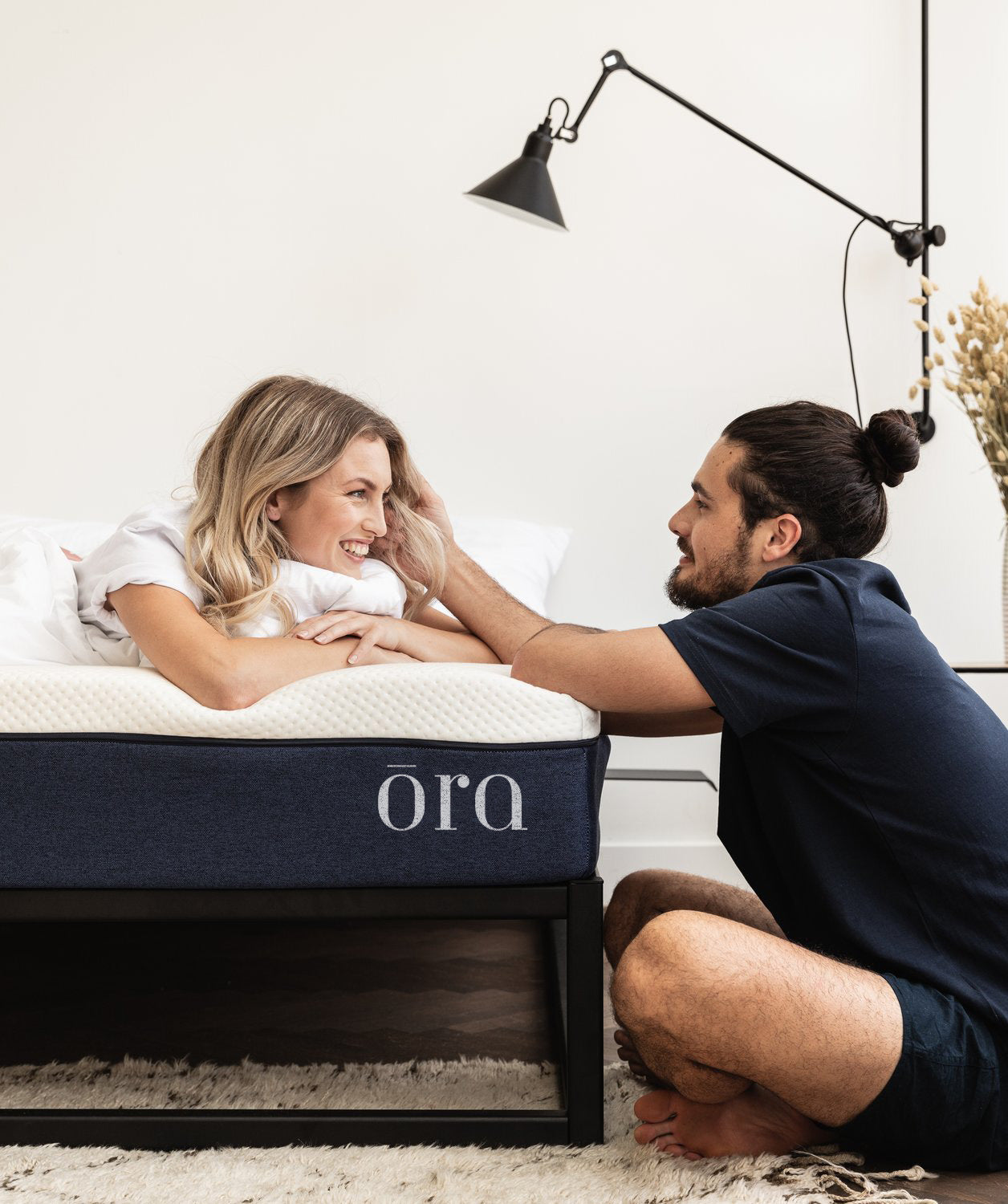
However, it is also clear that a tracker does not diagnose a sleep disorder. Anyone who persistently wakes up exhausted despite enough time in bed, snores loudly, or suspects breathing interruptions needs a medical examination – not a software update. And: no algorithm changes the basics. If the data shows restless sleep night after night, the cause is often not in the analysis, but in the bedroom itself: too warm, too bright – or a mattress that does not suit the body. This is where the Ora philosophy comes in: Instead of guessing at unstandardized firmness levels when buying a mattress, the Ora Ultra with its EvoPoreHRC Premium memory foam automatically adapts to the body and sleeping position – an adaptive mattress for everyone, whose effect you can wonderfully check with a tracker trend.
Caution Orthosomnia: When tracking becomes a stress factor
Sleep specialists are observing a new phenomenon called orthosomnia: people sleep objectively well, but feel bad because their score supposedly is – or they lie awake tense because they want to achieve the perfect score. The pressure to optimize itself becomes a sleep killer. Warning signs are: you only feel good or bad in the morning after looking at the app, you go to bed earlier because of the score even though you're not tired, or you brood over your data at night. If you recognize such patterns in yourself, you should pause tracking – techniques against nocturnal overthinking can be found in the article Stress and rumination in sleep problems. Rule of thumb: the tracker should serve your sleep, not the other way around. How refreshed you feel during the day remains the most important metric – and no sensor provides that.

Get CHF 25 discount
Subscribe to newsletter and receive a one-time CHF 25 discount. ✓ 200 nights trial sleep ✓ 10 years warranty
Frequently Asked Questions about Sleep Trackers
Are sleep trackers useful or superfluous?
They are useful as a trend instrument: they make sleep duration, regularity, and the influence of habits visible and motivate better sleep behavior. They become superfluous – or even counterproductive – if one overinterprets individual night values or lets oneself be stressed by the score.
How accurately do wearables measure sleep phases?
Good devices record total sleep time about 85 to 90 percent correctly. For individual sleep phases like deep sleep or REM sleep, the accuracy is significantly lower, often only 50 to 70 percent – so the phase indications are more an estimate than a measurement.
Can a sleep tracker detect a sleep disorder?
No, a tracker does not replace diagnosis. It can at most provide clues, such as unusually restless nights. In case of suspected sleep apnea, chronic insomnia, or other disorders, a medical examination is necessary, ideally in a sleep lab.
What is orthosomnia?
Orthosomnia refers to the phenomenon that the desire for perfect sleep data itself becomes a sleep problem: affected individuals lie awake tense because they want to optimize their score, or feel bad as soon as the app shows a bad night – regardless of their actual well-being.
What should I pay attention to when sleep tracking?
Look at weekly trends instead of individual nights, use the data as an impetus for concrete behavioral changes, and put the device away if it causes stress. Your subjective feeling of refreshment during the day remains the most important indicator of good sleep.





Leave a comment
This site is protected by hCaptcha and the hCaptcha Privacy Policy and Terms of Service apply.