

Do you wake up in the morning with a dry mouth, a rough throat, and feeling like you haven't rested properly at all? Then you are very likely breathing through your mouth at night. Mouth breathing at night is not a trivial matter: it changes air humidification, oxygen uptake, the position of the tongue and lower jaw, and thus also the tendency to snore. Estimates from sleep medicine and dentistry suggest that a significant portion of adults sleep with their mouths open at least at times, often without realizing it. The good news: nasal breathing can be retrained in many cases if you know the underlying cause. In this guide, you will learn why the body switches to mouth breathing at night, what consequences it has, and how you can systematically counteract it in four weeks.
The short answer: Mouth breathing at night almost always occurs because the nose is not clear enough or because the mouth simply opens during sleep, for example, when lying on your back or with relaxed jaw muscles. Getting rid of it is possible in three steps: clear the nose (saline rinse, treat allergies, consult a doctor if necessary), adjust the sleeping environment (side sleeping, humidity 40–60%, suitable pillow), and train yourself to gently close your mouth during the day and at night. If, after four weeks of consistent implementation, you continue to sleep with your mouth open and snore loudly, you should have sleep apnea medically ruled out.
- The nose filters, warms, and humidifies the air we breathe; the mouth cannot do this. Mouth breathing leads to dry mucous membranes, more snoring, and poorer sleep.
- Main causes are a blocked nose (allergy, nasal septum, polyps), back sleeping, and habit.
- Nasal breathing can be trained: consciously breathe through the nose during the day, rinse the nose in the evening, encourage side sleeping at night.
- Aids such as nasal strips or chin straps can help but do not replace addressing the underlying causes.
- In cases of loud snoring, breathing pauses, or daytime fatigue, sleep apnea should be medically investigated.
Why the nose is the better choice at night
The nose is a highly specialized air conditioning unit. Over a distance of about 10 cm, the inhaled air is warmed to about 32–34 °C, brought to nearly 100% relative humidity, and cleansed of dust, pollen, and some germs by cilia and mucus. Additionally, nitric oxide is produced in the paranasal sinuses, a gas that widens the blood vessels in the lungs and improves oxygen uptake. Breathing through the mouth bypasses all of this: the air arrives in the throat cooler, drier, and unfiltered.
Nasal breathing also creates a slight resistance. This resistance slows down breathing, which improves gas exchange and tends to put the body into the calming parasympathetic mode. Mouth breathing, on the other hand, is usually shallower and faster. Anyone wondering why they don't wake up refreshed despite eight hours in bed often finds part of the explanation here. You can read more about sleep stages and their importance in our article on sleep phases.
The most common causes of mouth breathing at night
The body does not switch to mouth breathing without reason. Most often, one of the following causes is present, often a combination.
Blocked or narrowed nose
The most common cause. Allergic rhinitis (dust mites, pollen, pet dander), a deviated nasal septum, enlarged turbinates, or polyps increase airway resistance. At night, when the mucous membranes swell more anyway when lying down, the nose is no longer sufficient. If you regularly suffer from a blocked nose, you will find targeted immediate help in our guide on blocked nose at night.
Back sleeping and gravity
When lying on your back, the lower jaw and tongue fall backward, making it easier for the mouth to open. Many people breathe through their nose without problems when lying on their side, but through their mouth when lying on their back.
Habit
Those who breathe with their mouth slightly open during the day, for example, when working at a computer or exercising, maintain this pattern at night. The muscles of the lips and mouth floor are then no longer trained to keep the mouth closed during sleep.
Alcohol, sedatives, obesity
All three additionally relax or narrow the upper airways and increase the tendency to mouth breathing and snoring. Our article on alcohol and sleep quality shows how much alcohol affects sleep.
What are the consequences of mouth breathing during sleep?
The effects range from annoying to serious. The most obvious is dryness: the mouth, tongue, and throat lose significantly more moisture overnight, which explains morning dry mouth, scratchy throat, and bad breath. Less saliva also means less protection for the teeth, which is why dentists more often observe caries and gingivitis in mouth breathers.
Secondly, mouth breathing significantly increases the tendency to snore. The open mouth changes the geometry of the throat, and the soft palate vibrates more easily. In people with a predisposition, this can lead to obstructive sleep apnea, where the airways repeatedly collapse completely during sleep. Thirdly, sleep quality suffers: mouth breathers wake up briefly more often, often without realizing it, and more frequently report daytime fatigue. In children, persistent mouth breathing can even affect jaw and facial development, a point that orthodontists take seriously.

Mouth breathing or nasal breathing: the comparison
| Criterion | Nasal breathing | Mouth breathing |
|---|---|---|
| Humidification of inhaled air | Nearly 100% relative humidity | Significantly lower, throat dries out |
| Filtering | Dust, pollen, some germs are trapped | No filtering |
| Warming | To approx. 32–34 °C | Hardly any |
| Snoring tendency | Lower | Significantly increased |
| Breathing frequency | Slower, deeper | Faster, shallower |
| Dental health | Saliva flow maintained | Dry mouth, higher risk of caries |
How do I know if I'm breathing through my mouth at night?
Since you don't notice anything during sleep, indirect clues help. Typically, these include a dry mouth and sticky lips upon waking, a scratchy throat without a cold, morning bad breath, saliva stains on the pillow, and feedback from partners that you snore or sleep with your mouth open. Frequent nocturnal thirst and a drinking glass that is regularly empty in the morning are also indications.
A simple self-test: Lie down comfortably during the day for five minutes and breathe exclusively through your nose. If this feels strenuous, you feel air hunger, or you have to open your mouth after a short time, your nose is probably not clear enough. In that case, the first lever is the nose, not habit. If you also have breathing pauses at night or are constantly tired during the day despite sufficient sleep, you should read our article Recognizing Sleep Apnea and seek medical advice.
The 4-week plan: training nasal breathing at night
Habits cannot be changed overnight, but four weeks of consistent implementation are enough for many people to see a noticeable improvement.
Week 1: Clear your nose
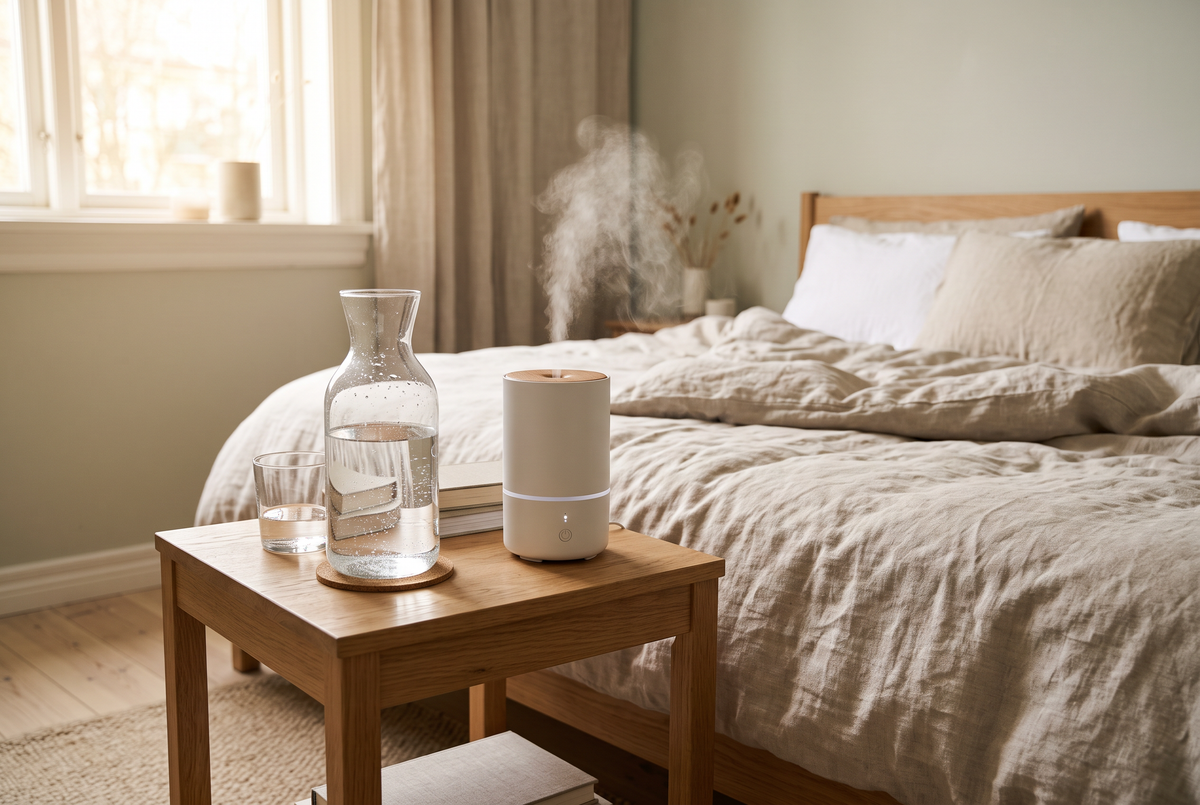
Rinse your nose morning and evening with isotonic saline solution (approx. 9 g salt per 1 liter of boiled water or ready-made nasal rinses). Keep the humidity in the bedroom at 40–60%, ventilate for 5–10 minutes with bursts of fresh air before sleeping, and if you suspect allergies, switch to bedding for allergy sufferers and an encasing. Only use decongestant nasal sprays for a short period (max. 5–7 days), otherwise, they can make the mucous membrane dependent.
Week 2: Consciously breathe through your nose during the day
Set a short reminder hourly: lips loosely closed, tongue relaxed on the roof of the mouth, breathing through the nose. Even during light exercise like walking or cycling, consistently breathe nasally. This trains the lip and tongue muscles.
Week 3: Adjust sleeping position
Promote side sleeping: a side sleeper pillow or a pillow behind your back prevents you from rolling onto your back. Your head should be positioned so that your cervical spine and thoracic spine form a straight line. A pillow that is too high pushes your chin to your chest and opens your mouth, while one that is too flat hyperextends your neck. Our pillow guide will help you choose.
Week 4: Test night aids
Now you can try nasal strips (to widen the nostrils), nasal dilators, or a gentle chin strap. Some people use special skin-friendly mouth tape; this should only be used if the nose is proven to be clear and there is no suspicion of sleep apnea. At the same time, keep a sleep diary to track your progress.
Common mistakes when trying to stop mouth breathing
The biggest mistake is to start with aids directly without checking the nose. Anyone who tapes their mouth shut with a blocked nose will have a restless night and give up in frustration. Second mistake: using decongestant nasal sprays for months. The mucous membrane gets used to it and swells more without the spray than before. Third mistake: underestimating the role of alcohol. Even two glasses of wine in the evening relax the throat muscles so much that the best intentions are useless.
Fourth mistake: ignoring overly dry room air. At 20–30% humidity, which is common in winter when the heating is on, the nasal mucous membranes swell, and the nose becomes blocked. A hygrometer for a few francs provides clarity. Fifth mistake: impatience. The change takes weeks, not days. And finally: anyone who snores loudly, has breathing pauses, or falls asleep during the day should not experiment further themselves, but should arrange for a sleep medicine examination.

Get CHF 25 discount
Subscribe to our newsletter and receive a one-time CHF 25 discount. ✓ 200 nights trial sleep ✓ 10 years warranty
Frequent questions about mouth breathing at night
Is mouth breathing at night dangerous?
Occasional mouth breathing, such as during a cold, is harmless. However, persistent mouth breathing increases the risk of snoring, dry mucous membranes, dental problems, and poorer sleep. In cases of breathing pauses or severe daytime fatigue, sleep apnea should be medically ruled out.
Does mouth tape help against mouth breathing?
Mouth tape can help maintain the habit of keeping the mouth closed if the nose is clear. It should only be used with skin-friendly tape, with proven clear nasal breathing, and without suspicion of sleep apnea. If in doubt, consult a doctor first.
How long does it take to stop mouth breathing?
With a clear nose, initial improvements often appear after two to four weeks of consistent training. If the nose is anatomically or allergically narrowed, this cause must first be treated.
Which sleeping position is best for mouth breathing?
Side sleeping. When lying on your back, the tongue and lower jaw fall backward, making it easier for the mouth to open. A side sleeper pillow or a pillow behind your back helps to maintain the side sleeping position.
Can dry indoor air promote mouth breathing?
Yes. At a humidity level below 40%, the nasal mucous membranes swell and the nose becomes narrower. Ideally, 40–60% relative humidity at 16–19 °C in the bedroom.
When should I see a doctor about mouth breathing?
If your nose is constantly blocked, if you snore loudly, have breathing pauses, get headaches in the morning, or are constantly tired during the day despite sufficient sleep. In these cases, an ENT examination and, if necessary, a sleep study are advisable.
This article is for general information and does not replace medical advice.








Leave a comment
This site is protected by hCaptcha and the hCaptcha Privacy Policy and Terms of Service apply.