
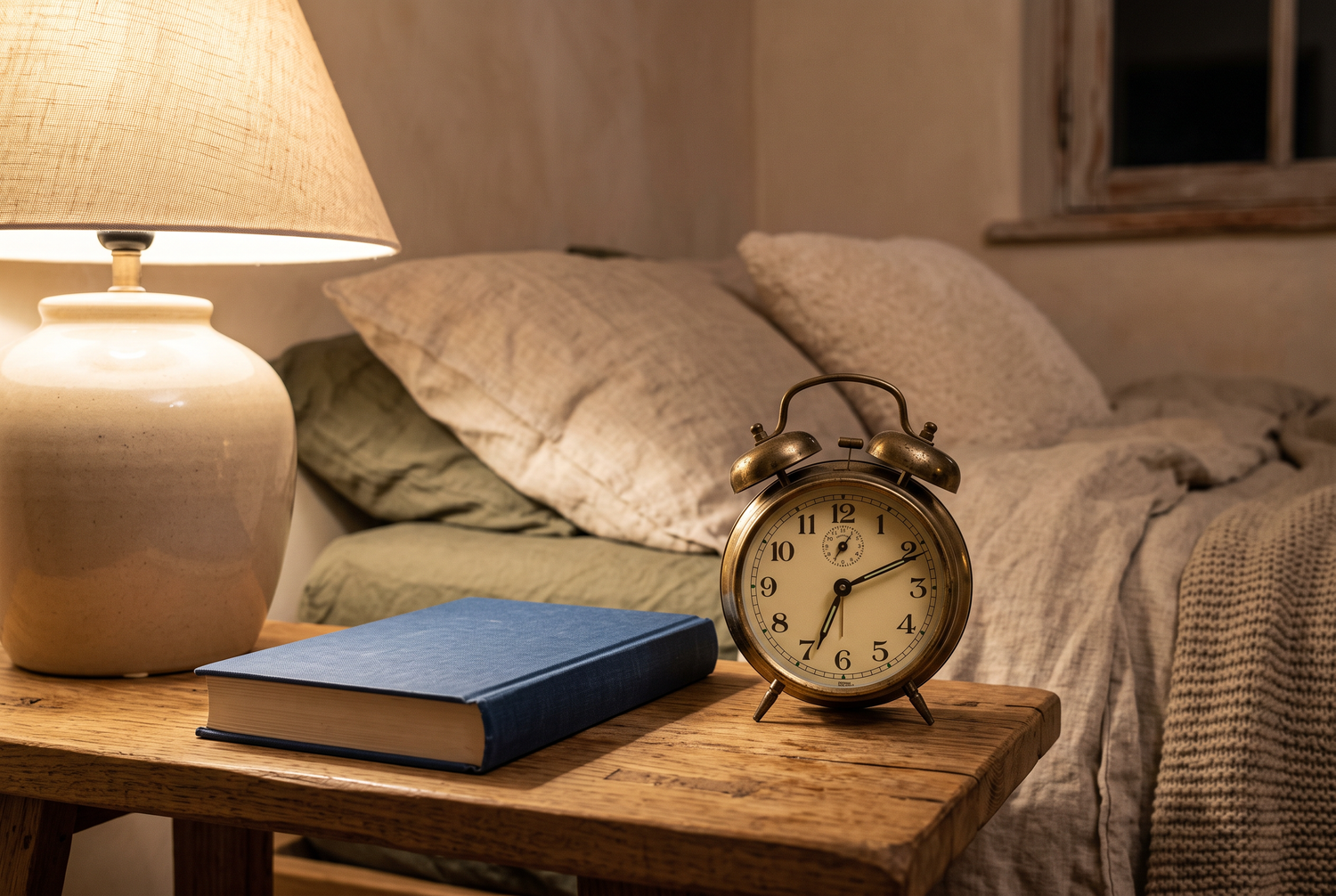
For most of us, our smartphone is the last thing we see at night and the first thing in the morning. Surveys show that about 80 percent of adults take their phone into the bedroom, and a large portion still scroll while in bed. At the same time, more and more people complain about difficulty falling asleep, restless nights, and the feeling of not being able to switch off in the morning, literally. The connection is no coincidence: the smartphone disturbs sleep through three mechanisms, of which the famous blue light is only the smallest. In this article, we will look at the effects in detail, debunk a few myths, and show a realistic 7-day plan for getting your phone out of the bedroom without feeling cut off. The effect on sleep onset latency and sleep quality is often noticeable after just one week.
The short answer: Yes, banning your phone from the bedroom is significantly beneficial for most people. It affects sleep in three ways: screen light delays melatonin secretion, unsettling content and constant availability activate the stress system, and nocturnal notifications fragment sleep. Those who put their device away 60 minutes before bedtime and charge it outside the bedroom overnight fall asleep faster and wake up less often on average. An analog alarm clock replaces the most common excuse.
- The smartphone disturbs sleep in three ways: light to the eye, mental activation through content, and nocturnal interruptions by notifications.
- Mental activation is the most significant factor: doomscrolling and emails shortly before falling asleep keep the stress system active, even with night mode.
- The mere presence of the phone on the bedside table lowers the inhibition threshold for nocturnal micro-checks.
- Recommendation: 60 minutes screen-free before bedtime, charging station in the hallway or living room, analog alarm clock in the bedroom.
- Night mode only reduces the blue component of light, not the awakening effect of the content.
Three ways your phone in the bedroom disturbs sleep
Firstly, light: The retina contains receptors that are particularly sensitive to short-wavelength blue light and directly influence the internal clock. Bright screen light in the evening can delay the secretion of the sleep hormone melatonin; details can be found in the article on Blue Light and Screens in the Evening. Secondly, activation: News, social media, and work emails are emotionally charged and keep heart rate and cortisol levels high; the brain receives the signal "stay awake, something is happening here." Thirdly, fragmentation: Every notification, every vibration, and every brief illumination can trigger micro-awakenings, even if you don't remember them in the morning. In total, sleep onset latency lengthens, sleep becomes shallower, and subjective recovery decreases. Studies with adolescents and adults consistently show: those who have their device in the bedroom sleep shorter and worse on average than people whose phone stays out.
The underestimated factor: mental activation instead of blue light
Blue light gets most of the attention, but recent research puts its share into perspective: the amount of light from a smartphone, at 40 to 80 lux on the eye, is significantly lower than, for example, a bright ceiling light, and accordingly, the pure melatonin delay is moderate. The greater leverage is the content. Anyone who reads an annoying work email at 11 p.m. or scrolls through disturbing news activates the sympathetic nervous system, heart rate and tension increase, and the merry-go-round of thoughts continues to spin long after the lights are out. This brooding is one of the most common sleep killers of all; more on this in the article on Stress and Brooding. Added to this is the reward mechanism: feeds are deliberately designed so that "just five more minutes" turn into half an hour, and bedtime shifts later evening after evening, a phenomenon that research calls bedtime procrastination. Night mode doesn't change this; it just makes the light warmer.

Nocturnal Micro-Checks: The Invisible Sleep Brake
If the phone is within reach, it will be used: surveys show that about one-third of adults check their device at least once per night, with significantly more among younger people. The problem is twofold. Firstly, looking at the display interrupts the sleep cycle exactly where it is, often in the middle of REM or light sleep phases, which are important for memory and emotional processing. Secondly, every nocturnal check trains the brain to reach for the device again during the next brief awakening; a harmless awakening that would normally be forgotten after seconds turns into a 20-minute waking phase with a bright display. Particularly insidious: checking the time. Anyone who looks at the clock at night and calculates, "only four more hours until the alarm," puts themselves under pressure and makes it even harder to fall back asleep. Sleep doctors therefore generally advise against looking at any clock at night, especially one that then offers Instagram. A phone outside the room makes all of this physically impossible, which is its real strength.
Excuses in a reality check
The most common reasons for keeping the phone by the bed, and what's really behind them:
| Excuse | Reality | Alternative |
|---|---|---|
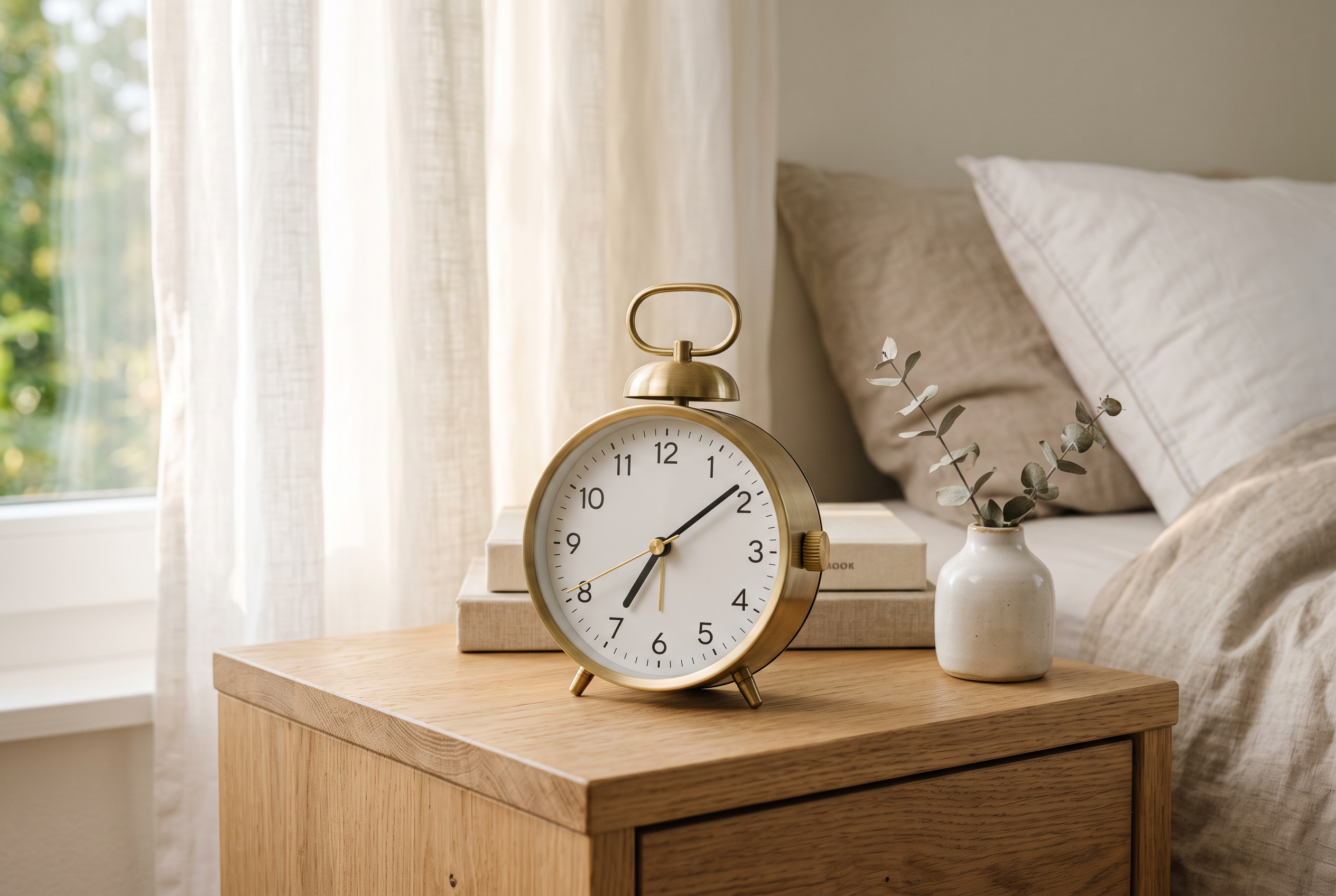
| "I need it as an alarm clock" | The most common gateway to nocturnal scrolling | Analog alarm clock or light alarm clock from approx. 20 francs |
| "I need to be reachable (emergency)" | Real emergencies are rare, accessibility is usually a habit | Do Not Disturb mode with exceptions for 2–3 emergency contacts, device in the hallway |
| "Scrolling relaxes me before falling asleep" | Feeds are more activating, bedtime shifts later | Book, audiobook, or podcast with sleep timer |
| "Night mode filters blue light" | It softens the light, not the unsettling content | 60 minutes screen break before bedtime |
| "I'm just checking the time" | Time checks increase nocturnal pressure and wake time | Don't look at the clock at all, the alarm will take care of waking up |
What changes when the phone stays out
The effect of a phone-free night is well-studied and occurs surprisingly quickly. Intervention studies, in which participants banned their smartphone from the bedroom for a week, consistently report shorter sleep onset latency, longer sleep duration, and better subjective sleep quality; many participants voluntarily wanted to maintain the new habit afterward. Three changes are particularly noticeable. Firstly, bedtime shifts earlier because the pull of the feed is absent, which alone gives many people 30 to 60 minutes more sleep. Secondly, falling asleep becomes calmer because the last impression of the day is a book, a conversation, or silence instead of a flood of stimuli; a regular evening routine is supportive. Thirdly, nights become calmer because micro-checks are eliminated and brief awakenings transition back to sleep on their own. Those who also have trouble falling asleep can find complementary techniques that don't involve screens in the guide on falling asleep faster.

Get CHF 25 Discount
Subscribe to our newsletter and receive a one-time CHF 25 discount. ✓ 200 nights trial sleep ✓ 10 years warranty
Practice: the 7-day plan for moving your phone out
Day 1: Get an analog alarm clock and set up the charging station outside the bedroom, in the hallway, kitchen, or living room. Day 2: Configure Do Not Disturb mode, with exceptions for two to three emergency contacts, so the safety argument is eliminated. Day 3 and 4: Introduce the 60-minute rule; one hour before bedtime, the phone goes to the charging station, with a book or audiobook available as an alternative. Expect a feeling of restlessness or "phantom grabs" towards the bedside table on these evenings; this is normal and subsides after a few days. Day 5: Adjust your morning routine; the phone is not looked at for the first time until after getting up, ideally after light and a glass of water. Day 6: Take stock, briefly note sleep duration and morning feeling. Day 7: Establish rules that apply to everyone in the household; for children and teenagers, parental example is more effective than any instruction. If you relapse, simply start over; the direction is what matters, not perfection, and the basics of good sleep hygiene further reinforce the effect.
Frequent questions about phones in the bedroom
Why shouldn't the phone be in the bedroom?
Because it disturbs in three ways: screen light delays the sleep hormone melatonin, unsettling content activates the stress system, and notifications and nocturnal checks fragment sleep. All three factors are eliminated outside the room.
Is night mode not enough?
No. Night mode only reduces the blue light component. The stronger effect comes from the content that keeps you awake and the pull of feeds that shift bedtime later, both of which remain unchanged with warmer light.
How long before bed should I put my phone away?
A 60-minute screen break before bedtime has proven effective. If you can't manage that, start with 30 minutes; for many people, this already noticeably shortens the time it takes to fall asleep.
What about emergencies if the phone is outside?
Do Not Disturb mode can be set up so that calls from two to three defined emergency contacts still ring. This way, you remain reachable for real emergencies without every message interrupting your sleep.
Is phone radiation in the bedroom dangerous?
According to current research, there is no evidence that the weak radiation from a smartphone directly harms sleep. The proven problems arise from light, content, and interruptions, not from radio waves.
Does it help to just put the phone in airplane mode?
Airplane mode stops notifications and is better than nothing. However, the temptation to scroll or check the time remains as long as the device is within reach. The most effective solution is to have the charging station outside the bedroom.
This article is for general information purposes only and does not replace medical advice.



Leave a comment
This site is protected by hCaptcha and the hCaptcha Privacy Policy and Terms of Service apply.