
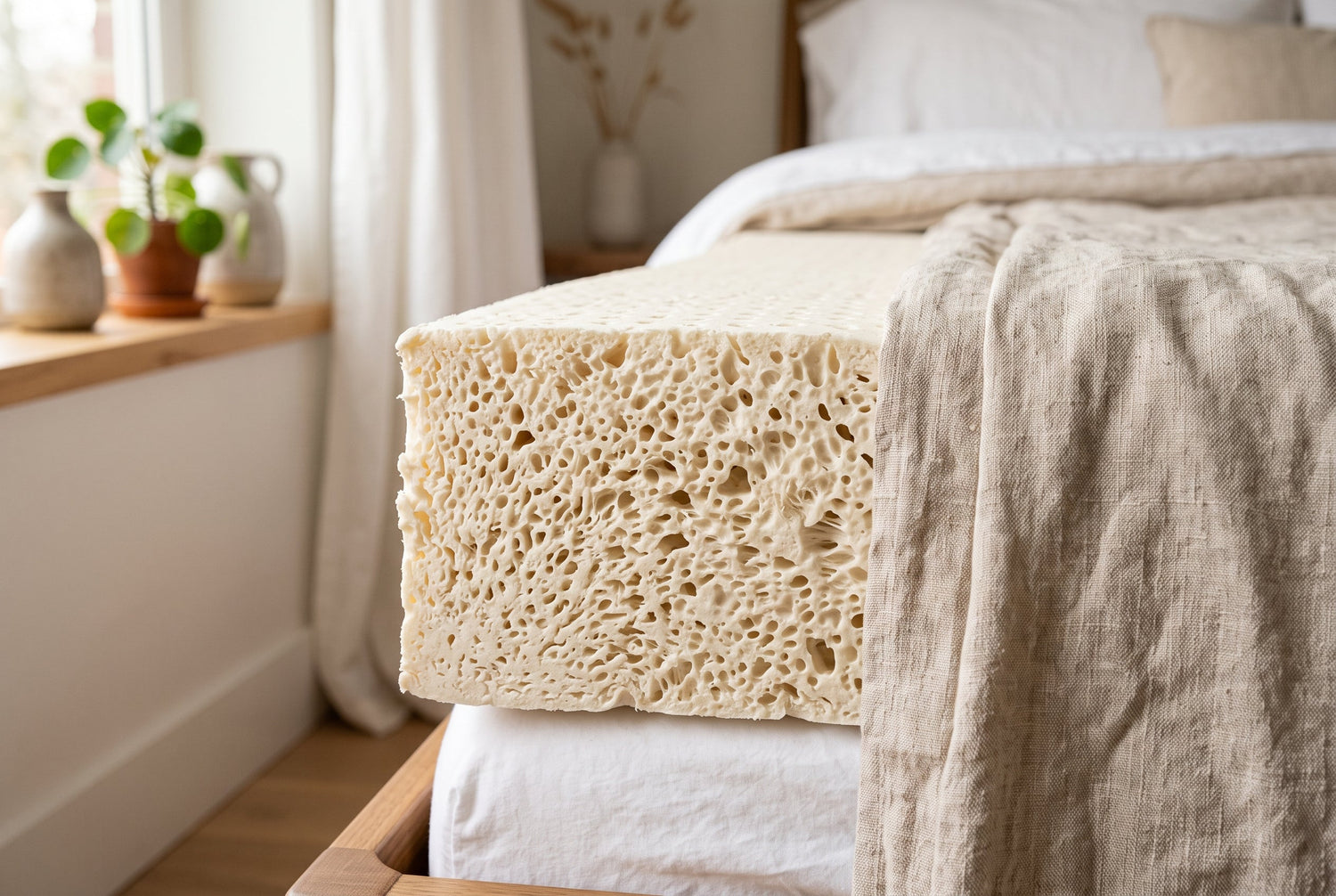
Anyone interested in a latex mattress will quickly come across two terms that sound similar but describe different products: natural latex and synthetic latex. Both are vulcanized into elastic mattress cores, both feel similar at first touch – yet they differ significantly in origin, point elasticity, durability, odor, and environmental footprint. It gets confusing because the trade uses terms like "latex mattress," "natural latex content," or "100% natural," which can hide very different mixing ratios. A mattress advertised as natural latex may contain significant synthetic components depending on the declaration. This article brings order to the terms: you will learn how both materials are produced, where the real differences lie, which seals provide clarity – and for whom which type of latex is worthwhile.
The short answer: Natural latex is obtained from the milky sap of the rubber tree, while synthetic latex is made from petroleum (styrene-butadiene rubber). Natural latex is more point-elastic, durable, and breathable, but noticeably more expensive and heavier. Synthetic latex is cheaper and more dimensionally stable in production, but it ages faster and feels less dynamic. Most latex mattresses on the market are blends – if you want real natural latex, look for declared contents of at least 85 percent and certificates like GOLS or QUL.
- "100% natural latex" is a strictly protected term: at least 95–100 percent natural rubber in the core. "Latex mattress" without any additions, however, may be predominantly synthetic.
- Natural latex offers the highest point elasticity of all common mattress materials and absorbs movements almost silently – ideal for side sleepers and restless sleepers.
- The lifespan of high-quality natural latex is 10 to 12 years; synthetic blends often show fatigue after just 6 to 8 years.
- Latex mattresses, at 20 to 40 kg (90x200 cm), are significantly heavier than foam mattresses – a real disadvantage when changing sheets and turning.
- Certificates like GOLS, QUL, or eco-INSTITUT verify natural content and freedom from harmful substances – mere marketing terms like "natural feeling" do not.
How is latex produced – and what's the difference?
Natural latex begins as the milky sap of the rubber tree (Hevea brasiliensis), tapped on plantations in Southeast Asia, Sri Lanka, and increasingly West Africa – one tree yields about 15 to 25 grams of latex milk per day, and a single mattress requires the daily harvest of around 300 to 500 trees over several weeks. The milk is frothed and vulcanized using the Dunlop or Talalay process: The traditional Dunlop process creates a denser, firmer foam; the more complex Talalay process, which uses vacuum and shock freezing, produces a more uniform, softer cell structure. Synthetic latex (SBR, styrene-butadiene rubber), on the other hand, is polymerized from petroleum derivatives. Chemically similar, but different in detail: natural latex molecular chains are longer and more uniform, resulting in higher elasticity and resilience. In practice, many manufacturers blend both – typical ratios are 20/80 to 60/40 natural to synthetic, because blends are cheaper and easier to foam with consistent results.
Feel and point elasticity compared
Latex is the most point-elastic mattress material available: it yields precisely where pressure occurs and continues to support elsewhere. Shoulders and hips sink in sufficiently, while the waist remains supported – important for a straight spine, especially for side sleepers. Natural latex enhances this effect with its high resilience: the mattress follows every movement almost without delay, without the "sinkhole" of sluggish foam cores. Synthetic latex feels similar but often seems a bit "dead": less bounce, slower recovery, and with cheaper qualities, a slightly rubbery, tough resistance. A second difference is temperature behavior: natural latex remains almost equally elastic at room temperatures from 10 to 30 °C, while some synthetic blends harden in the cold. Overall, latex is more temperature-neutral than viscoelastic foam, making it suitable for people who sweat easily at night. How latex compares to cold foam, innerspring, and co. is shown in the comprehensive mattress type comparison.
Durability, hygiene, and weight
In terms of durability, natural latex demonstrates its strengths: high-quality cores with densities of 65 to 95 kg/m³ last 10 to 12 years without significant sagging – more on when a change is due can be found in the article on the lifespan of a mattress. Synthetic-heavy blends often lose their resilience after just 6 to 8 years, noticeable by softening sleeping zones and indentations. In terms of hygiene, latex scores double points: the material is naturally antibacterial and offers dust mites little habitat, which makes latex mattresses popular with allergy sufferers. Good ventilation is still important: latex is denser than open-cell cold foam, so moisture evaporates more slowly – a slatted frame with sufficient spacing and regular airing of the bed are essential. The main practical disadvantage remains the weight: a natural latex mattress measuring 90x200 cm weighs 20 to 30 kg, and 160x200 cm quickly reaches 40 kg or more. Changing sheets, turning, and transporting thus become a two-person task.
| Criterion | Natural Latex | Synthetic Latex |
|---|---|---|
| Raw material | Milky sap of the rubber tree | Petroleum-based (SBR) |
| Point elasticity | Very high, dynamic resilience | High, but slower |
| Lifespan | 10–12 years | 6–8 years |
| Price (90x200 cm) | approx. CHF 800–2'000 | approx. CHF 300–800 |
| Weight | High (20–30 kg for 90x200) | Slightly lower |
| Environmental footprint | Renewable, but long transport routes; good with GOLS certification | Fossil raw materials, difficult to recycle |
| Typical odor | Sweetish-rubbery, dissipates slowly | Chemical, usually weaker |

Sustainability: How ecological is natural latex really?
Natural latex is considered the more sustainable material – rightly so, but with limitations. Positive aspects: Rubber is a renewable raw material, the trees bind CO₂ during their 25 to 30-year useful life, and pure natural latex is biodegradable. Critical aspects: Monoculture plantations can displace rainforest areas, and transport routes from Southeast Asia are long. Those who want to buy ecologically should look for the GOLS seal (Global Organic Latex Standard, at least 95 percent certified organic natural latex), the QUL certificate with strict pollutant and content tests, or test marks like eco-INSTITUT. Synthetic latex, on the other hand, is based on fossil raw materials and is difficult to recycle. However, the service life also counts for the overall balance: a mattress that lasts 12 years instead of 7 saves almost half a replacement mattress. What you should generally look for in environmentally friendly models can be found in the guide Recognizing a Sustainable Mattress and in the article on Oeko-Tex and Harmful Substances.
Honestly considered disadvantages: For whom latex is not ideal
As convincing as its elasticity is, latex has its limits. Its heavy weight makes handling and care difficult. The price for genuine natural latex is significantly higher than comparable foam mattresses. The typical inherent smell of new latex mattresses is harmless but can bother sensitive noses for weeks. People with a real latex allergy (Type I allergy to latex proteins) should be careful: although vulcanization greatly reduces the proteins and the cover separates skin and core, in case of doubt, the question should be clarified with a doctor. And finally, the climate: latex retains a bit more heat than open-pore cold foam – those who sweat a lot need a breathable cover and good bed ventilation. Modern adaptive foams like EvoPoreHRC, by the way, combine high point elasticity with lower weight and open-pore climate regulation – an alternative that bypasses the classic latex disadvantages.
Buying checklist: How to recognize good latex quality
First: read the declaration. Reputable providers state the exact natural latex content in percentages – "with natural latex" without a number is a warning sign. Second: check the density; good latex cores have a density of 65 to 95 kg/m³, below which durability suffers. Third: note the core height – at least 14 cm of pure latex core, total height from 18 cm, so that even heavier people do not sink through. Fourth: demand certificates (GOLS, QUL, eco-INSTITUT, LGA-tested for harmful substances). Fifth: check the cover – removable, washable at 60 °C, ideally quilted with climate fibers. Sixth: test lie – and not for 5 minutes in the store, but for weeks in your own bed, because the body needs time to adjust. Reputable online providers make this possible; what matters here is explained in the article Buying a mattress online and trial sleeping.
Get CHF 25 discount
Subscribe to our newsletter and receive a one-time CHF 25 discount. ✓ 200 nights trial sleep ✓ 10 years warranty

Frequently asked questions about natural latex mattresses
How do I recognize genuine natural latex?
By the declared percentage (at least 85, preferably 95–100 percent natural rubber content) and by certificates like GOLS or QUL, which independently verify the content. Terms like "latex mattress" or "with natural latex" without numbers say nothing about the actual content.
Is a natural latex mattress suitable for allergy sufferers?
For dust mite allergy sufferers, yes: latex offers mites little habitat and is naturally antibacterial. For a real latex allergy (Type I), caution is advised – although the protein load is low after vulcanization, suitability should be medically clarified.
How long does a natural latex mattress last?
High-quality natural latex cores with densities of 65 kg/m³ or more last 10 to 12 years. Synthetic-heavy blends usually show fatigue after 6 to 8 years. For hygienic reasons, a change is recommended at the latest after 10 years, regardless of the material.
Do you sleep warm or cold on latex?
Latex is more temperature-neutral than viscoelastic foam, but it retains slightly more heat than open-cell cold foam. With a breathable cover and a well-ventilated bed system, most people sleep comfortably on latex.
Why are natural latex mattresses so expensive?
Raw material extraction is complex: a mattress requires the latex milk of hundreds of trees over several weeks, plus energy-intensive vulcanization processes and long transport routes. Good natural latex mattresses therefore cost from about CHF 800, high-quality models up to CHF 2,000.
What is better: Dunlop or Talalay latex?
Neither is generally better. Dunlop latex is denser, firmer, and cheaper to produce – good for supportive base layers. Talalay latex has a more uniform, airier cell structure and is softer – pleasant as a comfort layer. Many good mattresses combine both processes.







Leave a comment
This site is protected by hCaptcha and the hCaptcha Privacy Policy and Terms of Service apply.