
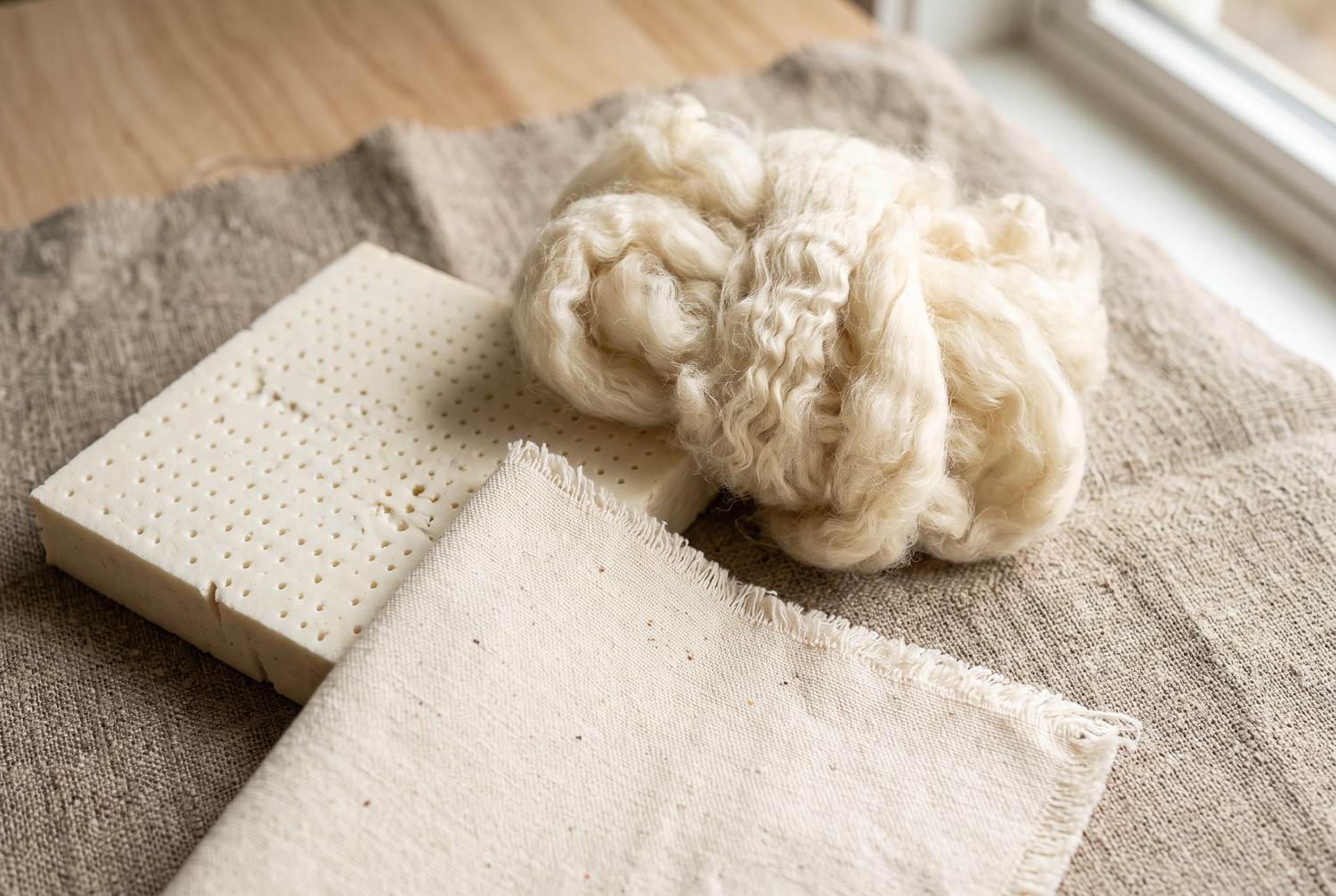
Around 50,000 tons of mattresses end up in landfills in Switzerland every year – most of them incinerated, because glued material mixtures are hardly recyclable. At the same time, more and more manufacturers are advertising with green promises: eco, organic, climate-neutral, vegan. For buyers, it is difficult to distinguish what has substance and what is mere greenwashing. The question is legitimate: a mattress is a large, material-intensive product that accompanies you for many years – its eco-balance is correspondingly significant. The good news: with a few clear criteria, a sustainable mattress can be reliably distinguished from one that is merely painted green. This guide shows what really matters: materials, certifications, production location, durability – and the often-forgotten question of what happens at the end of the mattress's life.
The short answer: You can recognize a sustainable mattress by four characteristics: independent certifications (at least OEKO-TEX Standard 100, preferably supplemented by GOTS or eco-INSTITUT), a long lifespan of 8 to 10 years thanks to high-quality materials with a density of RG 40 or higher, short transport routes due to European or Swiss production, and a well-thought-out end-of-life concept – such as single-grade materials, take-back programs, or refurbished second-life models. Durability is the biggest lever: a mattress that lasts twice as long halves its ecological footprint.
- Durability is the most important sustainability factor: 10 years of use instead of 5 halves material consumption and waste.
- Reliable certifications are OEKO-TEX Standard 100, GOTS, GOLS, and eco-INSTITUT – manufacturers' own fantasy labels are not proof.
- Natural material is not automatically more ecological: cultivation, processing, transport, and durability are crucial.
- Second-life and refurbished mattresses save up to 80 percent of the resources of a new purchase.
- Look for take-back or recycling offers from the manufacturer – disposal is part of the eco-balance.
Why lifespan is more important than material
The intuitive assumption is: natural latex and horsehair are sustainable, foam is not. Eco-balance research paints a more nuanced picture. The greatest environmental impact of a mattress occurs over its useful life: replacing a cheap mattress every 4 to 5 years means four times the production, packaging, transport, and disposal over 20 years – no matter how "natural" the material was. A high-quality mattress with a 10-year lifespan almost always performs better in the overall balance, even if its core consists of modern high-performance foam. The decisive factor for durability in foam is its density: from RG 40, the material retains its support over many years; below RG 30, sagging often begins after just 2 to 3 years. To estimate the remaining lifespan of your current mattress, read the article Lifespan of a Mattress. Key takeaway: the most sustainable product is the one you don't have to replace for the longest time.
Certifications: Which seals really say something
The jungle of seals is confusing, but some standards have established themselves as reliable. OEKO-TEX Standard 100 tests for over 100 harmful substances and is the minimum that any good mattress should meet – however, it is a harmful substance label, not an ecological one. GOTS (Global Organic Textile Standard) certifies textiles from controlled organic cultivation, including social standards in the supply chain; GOLS does the same for natural latex. The eco-INSTITUT label from Cologne is considered particularly strict regarding emissions and harmful substances. The Blue Angel also considers environmental aspects of production. Caution is advised with in-house seals: an "Eco-Logo" designed by the manufacturer itself without an independent testing body has no validity. If in doubt, check the certificate number on the certifier's website – reputable providers make this easy. More about harmful substances can be found in the guide OEKO-TEX and Harmful Substances in Mattresses.
Materials in the sustainability check
Natural latex scores with renewable raw materials and good durability, but has long transport routes from Southeast Asia and energy-intensive processing; furthermore, only certified organic cultivation (GOLS) is free from monoculture problems. Pocket springs consist predominantly of steel – highly recyclable, but energy-intensive in manufacturing. Classic cheap foams are petroleum-based and short-lived: the worst combination. Modern high-performance foams improve the balance through two levers: significantly longer durability and increasingly also raw materials from recycled or bio-based sources. Covers made of organic cotton, Tencel, or linen are skin-friendly and biodegradable. The construction is also important: layers that can be separated by type (core, cover, casing individually removable) can be recycled at the end of their life, whereas firmly glued material sandwiches are hardly recyclable. A well-thought-out design is thus a stronger sustainability signal than any single material – an overview of the construction types is provided by the Mattress Type Comparison.

Overview of sustainability criteria
The following table summarizes which characteristics distinguish a truly sustainable mattress – and which warning signs point to greenwashing.
| Criterion | Good sign | Warning sign |
|---|---|---|
| Certificates | OEKO-TEX, GOTS, GOLS, eco-INSTITUT | only in-house "Eco" logos |
| Lifespan | 8–10 years, 10-year warranty | 2-year warranty, RG below 30 |
| Production | Switzerland / Europe, short distances | unclear origin |
| Construction | layers separable by type | firmly glued material sandwich |
| End-of-life | Take-back, recycling, Second Life | no statement on disposal |
| Transparency | material list and test numbers open | vague terms like "climate-friendly" |
Second Life: the underestimated eco-option
A growing trend with significant leverage: professionally refurbished mattresses. This involves thoroughly inspecting and hygienically preparing returns from trial sleep programs – i.e., mattresses used for only a few weeks – and reselling them with a fresh cover. The ecological effect is considerable: up to 80 percent of resources are saved compared to a new purchase, and a fully functional product is spared incineration. It's important to distinguish this from a privately used mattress: Second-Life models from reputable providers undergo defined hygiene and quality checks, receive a new cover washed at 60 °C or a factory-new one, and come with a warranty – whereas with a private purchase, condition and hygiene are purely a matter of trust, as shown in the article Buying a Used Mattress. For both price-conscious and environmentally conscious buyers, Second Life is often the most rational choice: same technology, smaller footprint, lower price.
Common mistakes when buying a "green" mattress
Mistake one: being guided by the word "natural." Nature is not a protected term – even a mattress with 5 percent natural fiber content can call itself natural. Mistake two: not verifying certifications; every genuine test number can be looked up online with the certifier. Mistake three: ignoring durability and buying a short-lived eco-product that needs to be replaced after 4 years. Mistake four: ignoring the disposal question – ask before buying if the provider takes back old mattresses or recommends recycling partners; tips for correct disposal can be found in the guide Disposing of a Mattress. Mistake five: trading sustainability for ergonomics. A mattress on which you sleep poorly will be replaced – and end up in the trash. The sustainable choice is always also the ergonomically suitable one; therefore, use trial sleep offers, as described in the article Buying a Mattress Online with Trial Sleep.
Get CHF 25 discount
Subscribe to our newsletter and receive a one-time CHF 25 discount. ✓ 200 nights trial sleep ✓ 10-year warranty
Sustainable sleeping beyond the mattress
If you have chosen a sustainable mattress, you can extend the effect to the rest of the bedroom. Bed linen made of organic cotton or linen lasts 10 years or more with good care; washing at 60 °C is only necessary for allergy sufferers, otherwise 40 °C is sufficient – this saves around 40 percent energy per wash cycle. A mattress protector extends the life of the mattress by 2 to 3 years because it catches sweat and abrasion. Regularly rotating the mattress every 3 months distributes the load and prevents sagging. For bed frames, solid wood from European forestry is worthwhile – it outlasts several generations of mattresses; tips on this can be found in the article Sustainable Bedroom. And last but not least: a cool bedroom of 16 to 19 °C saves heating energy and at the same time improves sleep quality – sustainability and rest are not mutually exclusive, they reinforce each other.

- Ora Ultra Mattress is built for longevity: adaptive EvoPoreHRC premium memory foam that automatically adjusts to body and sleeping position, 10-year warranty and 200 nights trial sleep – a mattress for everyone that does not need to be replaced after a few years. Particularly resource-saving: The Ora Ultra Second Life gives inspected and hygienically prepared mattresses a second life – same adaptive technology, significantly smaller footprint.
Frequently asked questions about sustainable mattresses
Which certificate is most important for mattresses?
OEKO-TEX Standard 100 is the minimum and tests for harmful substances. For ecological requirements, GOTS (textiles), GOLS (natural latex), and the eco-INSTITUT label are more meaningful, as they also include cultivation and production.
Are natural latex mattresses automatically more sustainable than foam mattresses?
No. Natural latex is a renewable raw material, but it has long transport routes and energy-intensive processing. A durable high-performance foam from European production can perform better in the overall balance.
What is a Second-Life mattress?
A professionally refurbished mattress, usually a return from trial sleep programs. It is inspected, hygienically prepared, and sold with a fresh cover – this saves up to 80 percent of the resources of a new purchase.
How do I recognize greenwashing in mattresses?
By vague terms without evidence: "climate-friendly," "natural-like," or in-house eco-logos without an independent testing body. Reputable providers name specific certificates with verifiable numbers and disclose materials.
Can mattresses be recycled?
Partially. Mattresses that can be separated by type can be dismantled into core, cover, and steel and materially recycled. Firmly glued material mixtures, however, usually end up in incineration. Ask about take-back programs when buying.
Does a mattress protector really extend the lifespan?
Yes. A washable protector catches sweat, skin flakes, and abrasion, thus protecting the cover and core. In practice, this extends the useful life by about 2 to 3 years – a simple and inexpensive sustainability lever.








Leave a comment
This site is protected by hCaptcha and the hCaptcha Privacy Policy and Terms of Service apply.