
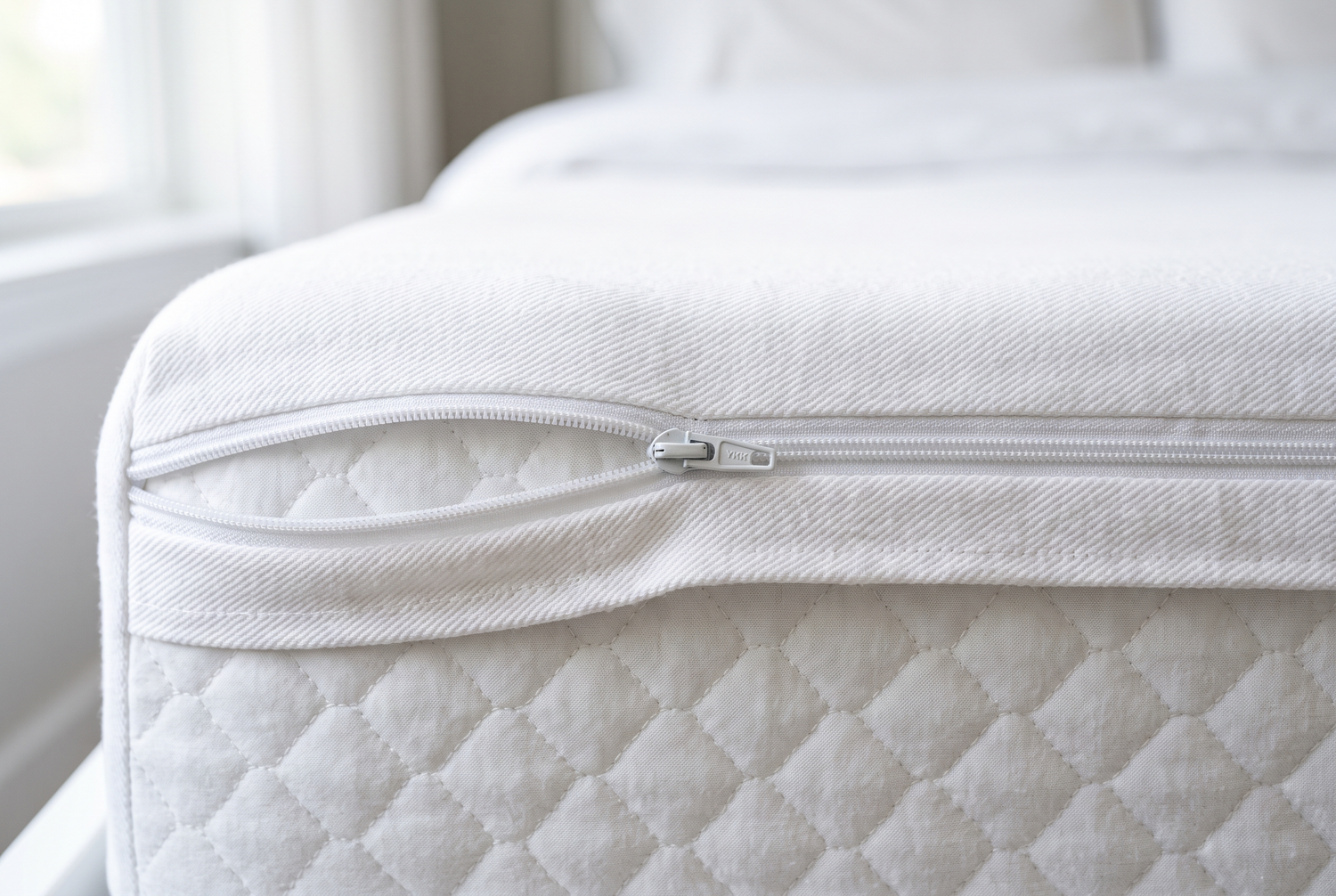
Dust mites live in every mattress – even new ones, even clean ones. This is not cause for concern initially, as these tiny arachnids are harmless as long as one doesn't react to their excrement. For the roughly ten percent of the Swiss population with a dust mite allergy, however, it's a different story: a stuffy nose in the morning, sneezing fits when making the bed, irritated eyes, and for some, asthmatic symptoms. Those affected want to reduce the number of mites in their bed as much as possible. The point is: a large part of popular advice is of little use, while a few measures can make a big difference.
The short answer: Dust mites cannot be completely eradicated, but their number can be significantly reduced. They feed on skin flakes and primarily need moisture: below 45 to 50 percent relative humidity, they dry out. The three most effective measures are a mite-proof mattress cover (encasing), bedding washed at at least 60 degrees every one to two weeks, and a dry, well-ventilated sleeping environment. Everything else – sun, cold, sprays – is at best supplementary. If an allergy is known, treatment should also be under medical supervision.
- It's not the mite itself, but its droppings that contain the allergy-triggering proteins.
- Mites need over 50% relative humidity – dry air is the most effective weapon.
- An encasing seals off the mattress and works faster than any cleaning.
- Wash bedding at 60 degrees; 40 degrees does not reliably kill mites.
Why mites love mattresses so much
A dust mite is about 0.1 to 0.5 millimeters in size and not visible to the naked eye. It feeds on shed skin flakes – and we lose about one to two grams of these per day, a significant portion of which in bed. In addition, an adult releases about 0.2 to 0.5 liters of fluid per night through skin and breath. Food plus moisture plus a constant 25 to 30 degrees directly under the duvet create ideal living conditions. Therefore, the mattress is the most mite-rich place in the home, followed by pillows, duvets, and upholstered furniture. The allergens are not the animals themselves, but proteins in their droppings. These particles dry out, disintegrate, and are stirred up when turning over in sleep or making the bed – which explains why symptoms primarily occur at night and in the morning.

What really helps – and what barely does
The ranking of measures is clearer than many guides suggest. In first place is the encasing: a mite-proof cover that completely encloses the mattress, pillows, and duvet, physically separating the allergens from you. It works immediately and independently of how many mites live in the mattress. In second place is the washing machine temperature: mites only reliably die at 60 degrees or higher; many survive at 40 degrees. In third place is the room climate. Keeping the relative humidity permanently below 50 percent deprives mites of their livelihood. In contrast, mite sprays with short-term effects, airing the mattress at an open window, or vacuuming without a HEPA filter (which tends to stir up allergens rather than remove them) do little to nothing.
| Measure | Effectiveness | Effort / Interval |
|---|---|---|
| Encasing for mattress, pillows, duvet | very high | once, wash every 2–3 months |
| Bed linen at 60 °C | high | every 1–2 weeks |
| Humidity below 50 % | high | daily shock ventilation |
| Vacuuming with HEPA filter | medium | 1–2 times per week |
| Mite sprays | low | short-term, no replacement |
Room climate as a decisive factor
Mites cannot drink water – they absorb moisture from the air. If the relative humidity drops below about 45 percent, they dry out within a few weeks. This happens naturally in well-ventilated Swiss homes in winter, which is why mite infestations are typically highest in late summer and autumn and lowest in late winter. Practically, this means: turning back the duvet in the morning instead of smoothing it immediately, so that the night's moisture can escape. Then, ventilate thoroughly twice a day for five to ten minutes. The bedroom temperature can comfortably be between 16 and 18 degrees. Be careful with humidifiers in the bedroom: while they improve dry mucous membranes, they create exactly the climate that mites need. Find out more in the articles on humidity in the bedroom and proper ventilation.
Properly caring for your mattress and bedding
The mattress itself cannot be washed, but it can be kept well under control. Vacuum the surface every two to three months with a device that has a HEPA filter – without this filter, you will blow the fine allergen particles back into the room. If the mattress cover is removable and washable, it should be put in the machine two to three times a year at the highest permitted temperature. Pillows and duvets made of synthetic fibers should be washed at 60 degrees two to four times a year; non-washable natural products are less suitable for allergy sufferers or absolutely require an encasing. And because mites spread throughout the entire mattress, regular rotation is worthwhile: it ensures even wear and promotes drying out. Practical instructions can be found under cleaning your mattress and mattress protectors and encasings.
If an allergy is confirmed
Typical signs of a dust mite allergy are symptoms that are strongest at night and in the first hours after waking up, significantly improve during holidays in dry climates or in the mountains, and occur year-round – in contrast to seasonal pollen allergies. The diagnosis is made by a medical professional with a skin test or blood test. In addition to allergen reduction in the bedroom, medication and, in suitable cases, specific immunotherapy are available. Important: anyone who develops wheezing, chest tightness, or coughing at night should definitely have this medically checked, as an untreated mite allergy can develop into asthma. Further information is provided in the article on allergy-friendly bedrooms.

Get CHF 25 discount
Subscribe to our newsletter and receive a one-time CHF 25 discount. ✓ 200 nights trial sleep ✓ 10-year warranty
Frequently asked questions about dust mites in mattresses
How many mites live in an average mattress?
Estimates range from several hundred thousand to several million creatures per mattress, depending on age, use, and room climate. The absolute number is less important for those affected than the amount of allergens actually inhaled.
Does putting the mattress in the sun help?
Only to a limited extent. UV light hardly penetrates the mattress, and the mites retreat to deeper layers. The real benefit lies in drying out: a thoroughly ventilated, dry mattress offers poorer living conditions.
Do I need to replace my mattress because of mites?
Not necessarily. A mite-proof encasing effectively seals off existing allergens. Replacement is sensible if the mattress is already saggy, damp, or older than about eight to ten years.
At what temperature do dust mites die?
Reliably at about 60 degrees in the washing machine. Washing at 40 degrees removes some allergens but does not reliably kill the mites. Alternatively, 24 hours in the freezer helps for small textiles.
Are natural materials like latex mite-proof?
No material is inherently mite-proof, as mites live on skin flakes and not on the mattress material. Crucial factors are a tightly woven cover, good moisture wicking, and regular care.
This article serves for general information and does not replace medical advice.








Leave a comment
This site is protected by hCaptcha and the hCaptcha Privacy Policy and Terms of Service apply.