
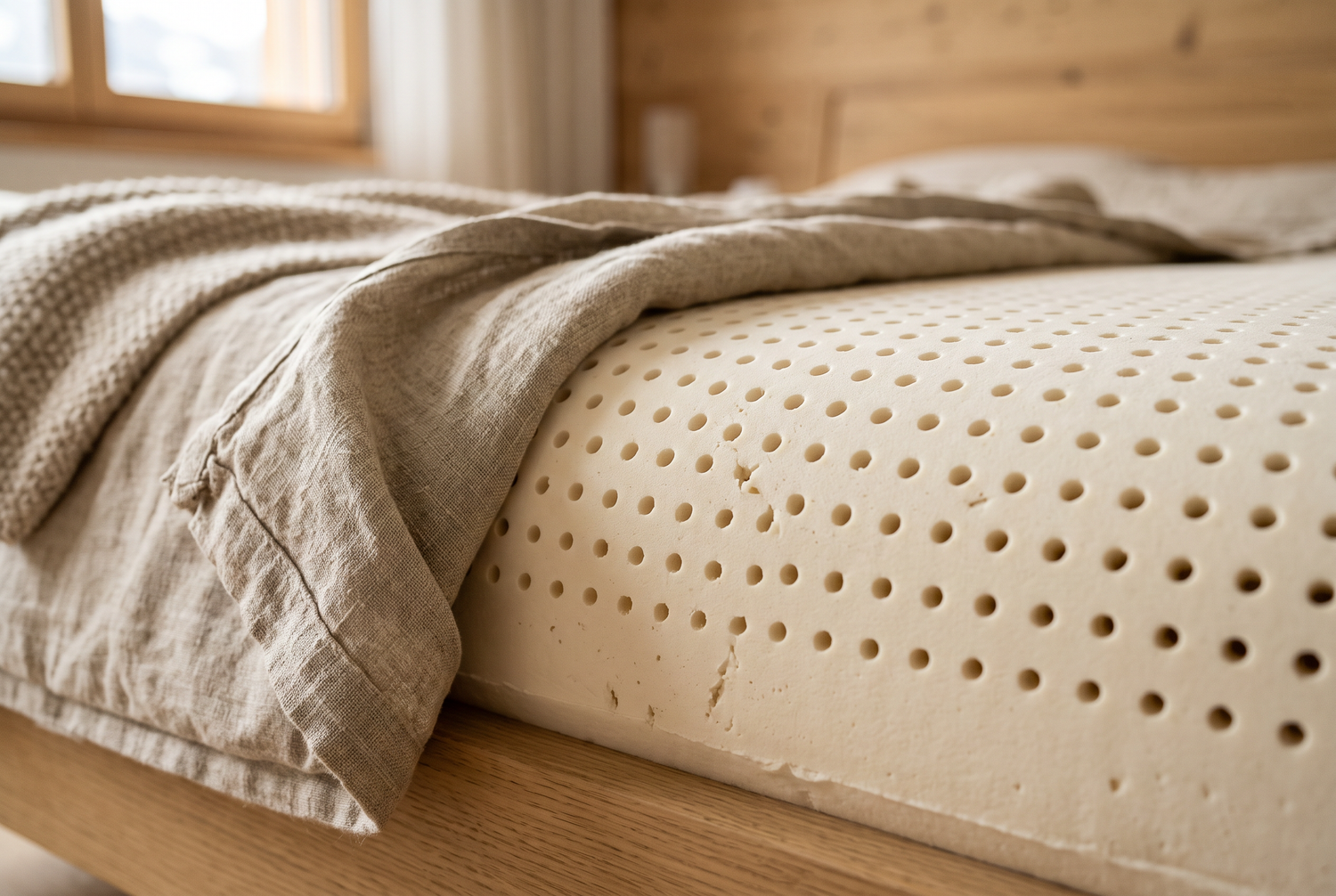
The latex mattress has a good reputation: durable, highly elastic, natural. If you ask for one at a specialist retailer, you'll usually get the most expensive recommendation in the room – and often the heaviest too. However, there's a world of difference between the marketing promise of "natural latex" and what's actually in the core. Many models sold as latex mattresses consist predominantly of synthetic rubber. This guide honestly assesses the construction: what latex can really do, where the disadvantages lie that are rarely mentioned in sales pitches, and for whom the surcharge is worthwhile.
The short answer: A latex mattress consists of vulcanized rubber – either natural latex from the rubber tree, synthetic petroleum-based latex, or a mixture. Its strengths are high point elasticity, very good durability of ten to fifteen years, and a mite-unfriendly, dense material. Its disadvantages are its enormous weight of 30 to 45 kilograms, a high price, and noticeable heat retention. Latex is very elastic – those seeking a quiet, body-conforming adaptation will find it more in adaptive memory foam.
- "Latex mattress" says nothing about the natural content – a core can only be called "natural latex" if it contains at least 85 percent natural rubber.
- Strengths: very high point elasticity, long lifespan (10–15 years), dense material offers little habitat for mites.
- Weaknesses: 30–45 kg weight, prices often from CHF 900, retains heat, absolutely requires a ventilated slatted frame.
- The characteristic pinholes in the core serve for ventilation and to control elasticity.
Natural latex, synthetic latex, and blended latex
Natural latex is extracted from the sap of the rubber tree, mainly in Southeast Asia. Synthetic latex is produced from petroleum derivatives and is cheaper, more consistent in quality, and slightly more dimensionally stable. In practice, blends dominate. The designation is not consistently protected – as a rule of thumb, a core should only be designated as natural latex if it contains at least 85 percent natural rubber. If the label only says "latex" or "with natural latex," the natural content is usually low. If in doubt, specifically ask about the percentage. There are two manufacturing processes: the Dunlop process yields denser, somewhat firmer latex, while the Talalay process, through additional vacuum, produces a lighter, airier, and more expensive material.

Advantages: Point elasticity and longevity
Latex is the most point-elastic of the common mattress materials. If you press into it with a finger, almost only the spot under your finger yields – the surrounding area remains largely stable. Applied to the body, this means: the shoulder can sink in without the entire upper body sliding along. This is particularly advantageous in the side sleeping position, as described in the article on mattresses for side sleepers. The second major advantage is durability: a good latex core retains its resilience for ten to fifteen years. Thirdly, the material is very dense, so dust mites find little living space – although the crucial mite barrier is the cover anyway. And fourthly, motion transfer is very low.
The disadvantages rarely mentioned in stores
Weight is the biggest everyday problem. A latex mattress measuring 160 by 200 centimeters can quickly weigh 40 kilograms. Turning it over is no longer a simple task but a two-person project – and moving it to the third floor without a lift is a real challenge. Secondly, latex retains heat more significantly than a spring core. Those who sweat at night will feel this. Thirdly, the price: you'll hardly find an honest latex mattress with a high natural content for under CHF 900, and the sky's the limit on the upper end. Fourthly, latex absolutely requires a well-ventilated slatted frame – on a solid bed base, moisture can accumulate and lead to mold. Fifthly: natural latex contains proteins that can be relevant for a genuine latex allergy; if you have a known allergy, you should consult a doctor.
Latex compared to spring core and foam
The following comparison shows where latex truly excels and where it does not.
| Criterion | Latex | Pocket spring | Adaptive memory foam |
|---|---|---|---|
| Point elasticity | very high | medium | very high |
| Weight (160x200) | 30–45 kg | 25–40 kg | 15–25 kg |
| Heat retention | retains heat | very cool | temperature-neutral to warm |
| Lifespan | 10–15 years | 7–10 years | 8–12 years |
| Price level | high | medium | medium to high |
Is latex really sustainable?
Natural latex is a renewable raw material – a rubber tree provides sap for about 25 years without being felled. That sounds convincing. However, an honest assessment also includes the long transport routes from Southeast Asia, the energy-intensive vulcanization process, and the fact that plantation farming changes ecosystems. Latex is also difficult to recycle at the end of its life because vulcanized rubber cannot be re-melted. The biggest ecological lever, however, remains the service life: a mattress that lasts twelve years instead of four saves more than any material label. Read more about this in the article on mattress recycling and sustainability.
Who a latex mattress is suitable for
Latex is useful for people who like a very precise, yet elastic lying feeling, who tend to be cold rather than sweat, who are not bothered by the weight, and who are willing to invest accordingly. It can also be a good choice for allergy households, provided there is no latex allergy. It is less suitable if you sweat heavily at night, if you want to handle the mattress alone, if your bed frame does not allow ventilation from below, or if you have a budget under CHF 800 – in this price range, you will get significantly more substance with other construction types. A systematic overview of all construction types can be found in the mattress type comparison, practical tips for testing in the article buying a mattress online and trying it out.

Get CHF 25 discount
Subscribe to the newsletter and receive a one-time CHF 25 discount. ✓ 200 nights trial sleep ✓ 10 years warranty
Frequently Asked Questions about Latex Mattresses
How do I recognize real natural latex?
Look for a specific percentage of natural rubber content in the product description. Only from around 85 percent is it usually referred to as natural latex. Phrases like "with natural latex" or "latex content" indicate a low natural content. Independent certifications like Oeko-Tex Standard 100 or eco-INSTITUT provide additional guidance on harmful substances and origin.
How heavy is a latex mattress?
A latex mattress measuring 90 by 200 centimeters weighs around 20 to 25 kilograms, while a model measuring 160 by 200 centimeters comes in at 30 to 45 kilograms. This is significantly more than with cold foam. Plan for a second person to help with turning, transporting, and changing covers, and check the load-bearing capacity of your slatted frame and bed frame beforehand.
Is a latex mattress suitable for house dust mite allergy sufferers?
The dense material offers little living space for mites, which is generally beneficial. However, the cover is crucial: it should be removable and washable at at least 60 degrees. For a diagnosed allergy, a mite-proof encasing is also recommended. If you have a known latex allergy, you should seek medical advice before purchasing, as natural latex can contain allergenic proteins.
Does a latex mattress get too warm in summer?
Latex retains body heat more than a spring core. In warm bedrooms, this can feel uncomfortable. The pinholes in the core improve air circulation, but they don't replace a ventilated slatted frame. If you generally sleep warm, you should lower the room temperature to 16 to 19 degrees and opt for lightweight bedding made of cotton or linen.
How long does a latex mattress last?
With good quality and proper care, ten to fifteen years is realistic – this is the longest lifespan among common construction types. A prerequisite is good ventilation from below to prevent moisture from accumulating. Here, too, the calendar age is not the deciding factor, but whether the mattress still provides support and you wake up refreshed.





Leave a comment
This site is protected by hCaptcha and the hCaptcha Privacy Policy and Terms of Service apply.