
Anyone coming home from a night shift at 7 AM is fighting their own biology: The body is ramping up, cortisol levels are rising, daylight signals activity – and precisely now, one is supposed to sleep. It's no wonder that shift workers on average get 1 to 4 hours less sleep per day than people with a normal rhythm. In Switzerland, around 17 percent of employed people work at least occasionally at night or in alternating shifts – in nursing, industry, logistics, gastronomy, and public transport. Chronic sleep deprivation after night shifts increases the risk of concentration errors, low moods, and in the long term, cardiovascular problems. This makes a well-thought-out daytime sleep strategy even more crucial. This guide shows step-by-step how to fall asleep faster, sleep longer, and start the next shift more rested after a night shift.
The short answer: After a night shift, you sleep best if you avoid bright light on your way home (sunglasses), go straight to a completely darkened, cool bedroom at home, and sleep preferably before 9 AM. A long sleep block of 5 to 6 hours in the morning or a split model has proven effective: 4 hours in the morning plus a 1 to 2-hour nap in the late afternoon before the next shift. Darkness, quiet, and a consistent routine are crucial.
- Daytime sleep is biologically easier if it starts early: Those who go to bed before 9 AM benefit from the still elevated melatonin levels and sleep on average 1 to 2 hours longer.
- Light is the strongest wake-up call: Sunglasses on the way home and a 100 percent darkened bedroom often make the difference between 4 and 7 hours of sleep.
- Caffeine has a half-life of 4 to 6 hours – last cup at least 4 hours before planned daytime sleep.
- The split-sleep model (4 hours in the morning plus a nap in the afternoon) is more suitable for many permanent night workers than a single long block.
- After the last night shift, a short transitional sleep of 2 to 3 hours plus early bedtime helps to quickly return to the daytime rhythm.
Why Sleeping After a Night Shift Is So Difficult
The human body follows an internal clock that is synchronized by light. In the morning, the activation hormone cortisol rises sharply, body temperature climbs, and bright daylight stops melatonin production – a perfect program for waking up, but the opposite of what night shift workers need now. Added to this is the environment: traffic noise, children's voices, postman, sunlight through the curtains. Studies show that daytime sleep is on average shorter and more fragmented than nighttime sleep – typically missing 1 to 4 hours. Although sleep pressure is high after a night without sleep, the circadian wake phase in the morning works against it. This is precisely why daytime sleep only works with conscious countermeasures: darkness, quiet, coolness, and timing. The article on the circadian rhythm explains in detail how strongly the internal clock dictates our sleep.
The Way Home Matters: Managing Light Strategically
You set the course for good daytime sleep already on your way home. Morning light with 10,000 to 20,000 lux is a massive wake-up signal that throttles melatonin production within minutes. Therefore, wear well-darkening sunglasses on your way home, even on cloudy days. Conversely, during the shift: Keep your workplace as bright as possible in the first half of the night – this supports wakefulness and slightly shifts the internal clock backward, which facilitates morning sleep. Once home, avoid bright overhead lighting and screens. A short, light breakfast (e.g., yogurt with oatmeal) is better than going to bed hungry; heavy, fatty meals, however, delay falling asleep by up to an hour. More basic information can be found in the guide Shift Work and Healthy Sleep.
Transforming the Bedroom into a Day-Night Zone
For daytime sleepers, the sleep environment is more important than for anyone else. Three factors count: darkness, silence, and temperature.
Darkness
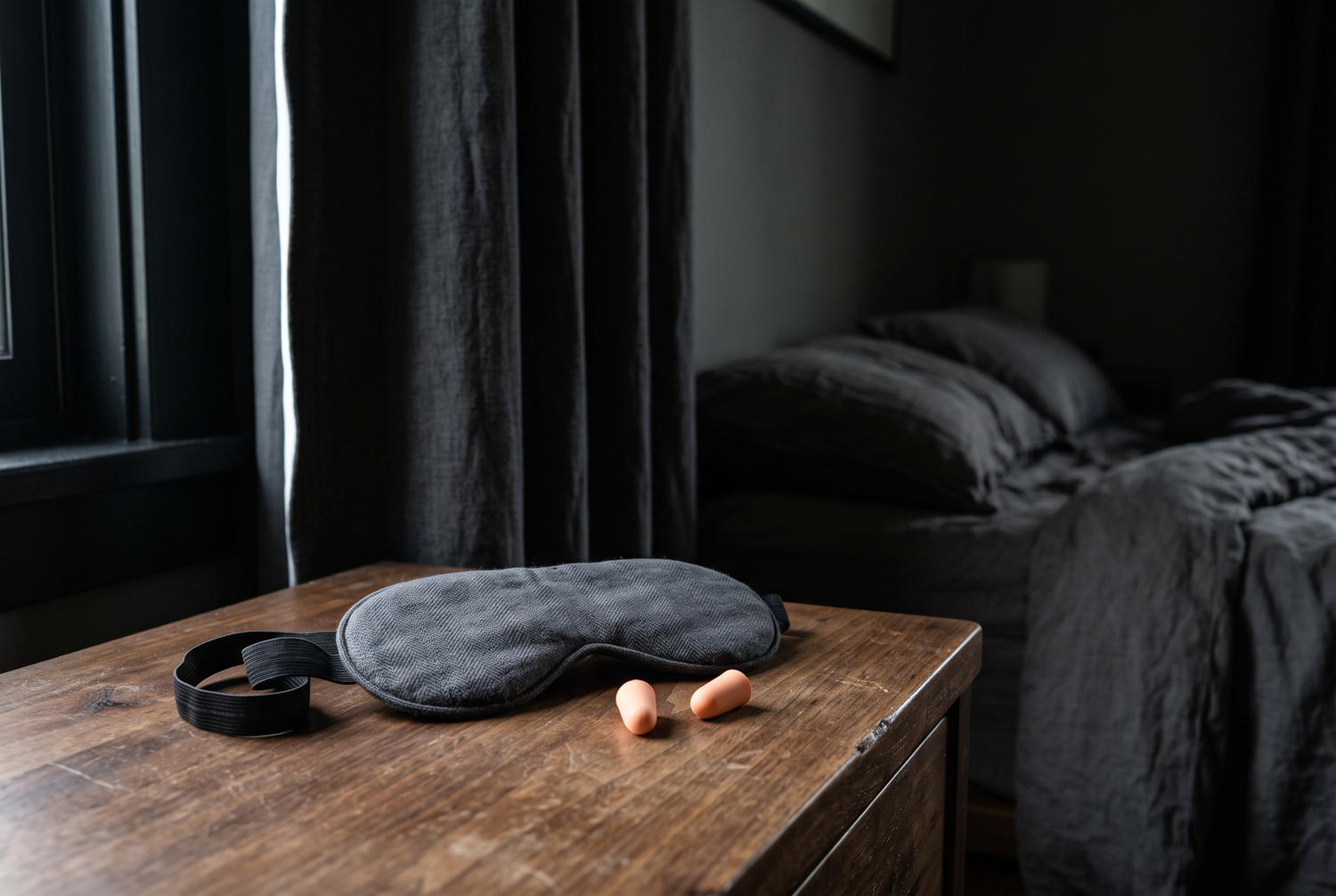
The goal is nearly 100 percent darkening. A blackout curtain with side guides or roller blinds with cassettes also block residual light at the edges. Additionally, a well-fitting sleep mask provides valuable service – especially when traveling or in summer when the sun shines until 9 PM.
Silence
Daytime noise can rarely be eliminated, but it can be muffled: Earplugs made of foam or silicone reduce noise by 20 to 35 decibels. A fan or a white noise app masks irregular sounds like slamming doors. Inform your household and neighbors about your sleeping times and consistently put your phone on silent – with exceptions only for emergencies.
Temperature
Even during the day, the ideal sleep temperature of 16 to 18 °C applies. In summer, early morning airing, closed blinds, and light bedding help, otherwise the heat quickly accumulates above 24 °C – and above this mark, sleep quality measurably decreases.
Timing: One Block or Split Sleep?
Two models have proven effective. Model 1, the long block: Sleep directly after returning home, ideally from about 8 AM to 2 PM. Advantage: continuous sleep with complete cycles. Disadvantage: The afternoon sleep pressure for the next night is missing, and many wake up on their own after 4 to 5 hours. Model 2, split sleep: 3.5 to 4.5 hours in the morning (e.g., 8 AM to 12 PM) plus a nap of 1 to 2 hours in the late afternoon or early evening (e.g., 5 PM to 7 PM), shortly before the next shift. This model suits many better for family life and demonstrably reduces fatigue in the second half of the night during the following shift. Important for both models: consistency. Those who sleep at different times every day further confuse the internal clock. The article How to Take a Power Nap Correctly shows how a short restorative sleep works properly.
| Model | Example Times | Advantages | Suitable For |
|---|---|---|---|
| Long Block | approx. 8 AM–2 PM | Continuous sleep cycles, simple routine | Quiet residential area, few daytime obligations |
| Split Sleep | approx. 8 AM–12 PM + 5 PM–7 PM | Fitter in the second half of the night, time for family in the afternoon | Permanent night shift, parents, restless environment |
| Transition Sleep after Last Shift | approx. 8 AM–10:30 AM, go to bed normally in the evening | Faster return to daytime rhythm | Alternating shifts, days off after night block |

Caffeine, Food, and Alcohol Around the Night Shift
Caffeine is both a tool and a trap for night shift workers. Used wisely, it helps at the beginning of the shift: 1 to 2 cups of coffee between 10 PM and 2 AM support wakefulness. After that, moderation is key, because caffeine has a half-life of 4 to 6 hours – an espresso at 5 AM still has half its effect at 9 AM and can shorten daytime sleep by 30 to 60 minutes. Rule of thumb: last caffeine intake at least 4 hours before planned bedtime. Details on this in the article Caffeine and Sleep. For food, the rhythm works well: main meal before the shift (approx. 6–7 PM), a light snack around 1 AM, a small breakfast after the shift. Heavy meals between 2 AM and 5 AM strain digestion, which runs on low at night, and promote heartburn during subsequent daytime sleep. Alcohol as a sleep aid is counterproductive: It speeds up falling asleep by a few minutes but fragments the second half of sleep and suppresses REM sleep.
The Switch Back: After the Last Night Shift
The trickiest moment of any night shift phase is the return to the daytime rhythm. Transitional sleep has proven effective: After the last night shift, sleep only for 2 to 3 hours – enough to relieve the worst sleep pressure, but short enough to be tired again in the evening. Get up no later than 11 AM, spend the afternoon actively and as much as possible outdoors in daylight, and go to bed at a normal time in the evening (10 to 11 PM). Most people are back in daytime mode after one to two days this way. Avoid sleeping for 8 hours until the afternoon after the last shift – this further shifts the rhythm and leads to a sleepless night before the first day off. Consistent sleep hygiene with fixed routines also accelerates the adjustment.
Common Mistakes After a Night Shift
Mistake 1: Running errands after the shift and not going to bed until 11 AM – the later sleep begins in the morning, the shorter and lighter the sleep. Mistake 2: Playing with your phone in bed and wasting sleep pressure; the bright display acts like a mini light therapy at the wrong time. Mistake 3: Skipping the alarm and waking up at some point – without structure, the rhythm disintegrates. Mistake 4: Energy drinks in the second half of the night; the sugar-caffeine mix takes a double toll. Mistake 5: Dozing on the sofa in an overheated, dimly lit living room instead of really sleeping in a cool, dark bedroom. Mistake 6: Staying completely in night mode on days off, even though the family is active during the day – this leads to chronic sleep deprivation on two fronts. Those who plan fixed sleep windows and involve their surroundings, however, reliably get 6 to 7 hours of daytime sleep.
Get CHF 25 Discount
Subscribe to our newsletter and get a one-time CHF 25 discount. ✓ 200 nights trial sleep ✓ 10 years warranty

Frequent Questions About Sleeping After a Night Shift
How long should one sleep after a night shift?
Ideally, 5 to 6 hours in the morning, supplemented by a nap of 1 to 2 hours in the late afternoon before the next shift. In total, shift workers should aim for 7 hours of sleep per 24 hours, even if these are divided.
Should I go to bed immediately after a night shift?
Yes, if possible within an hour of returning home. The earlier daytime sleep begins, the longer and deeper it will be, because melatonin levels are still elevated in the early morning. From about 10 AM, the internal clock increasingly works against falling asleep.
Why do I wake up after only 4 hours after a night shift?
This is the circadian wake phase: From late morning, the internal clock sends strong wake signals that override sleep pressure. Solutions include maximum darkening, earplugs, a cool room, and, if necessary, a second sleep block in the late afternoon.
How do I switch back to the daytime rhythm after the last night shift?
With a transitional sleep of only 2 to 3 hours in the morning, an active afternoon with plenty of daylight, and normal bedtime at 10 to 11 PM. This way, most people usually return to daytime mode within one to two days.
Is melatonin useful for shift workers?
Melatonin can facilitate daytime sleep in individual cases, but studies on shift work are mixed. Darkness, timing, and routine are more reliable. Intake should be discussed with a doctor, especially for regular use.
How much caffeine is okay during a night shift?
1 to 2 cups of coffee in the first half of the night (until about 2 AM) support wakefulness without significantly disrupting daytime sleep. No caffeine should be consumed 4 hours before planned bedtime, as its half-life is 4 to 6 hours.
This article is for general information and does not replace medical advice.








Leave a comment
This site is protected by hCaptcha and the hCaptcha Privacy Policy and Terms of Service apply.