
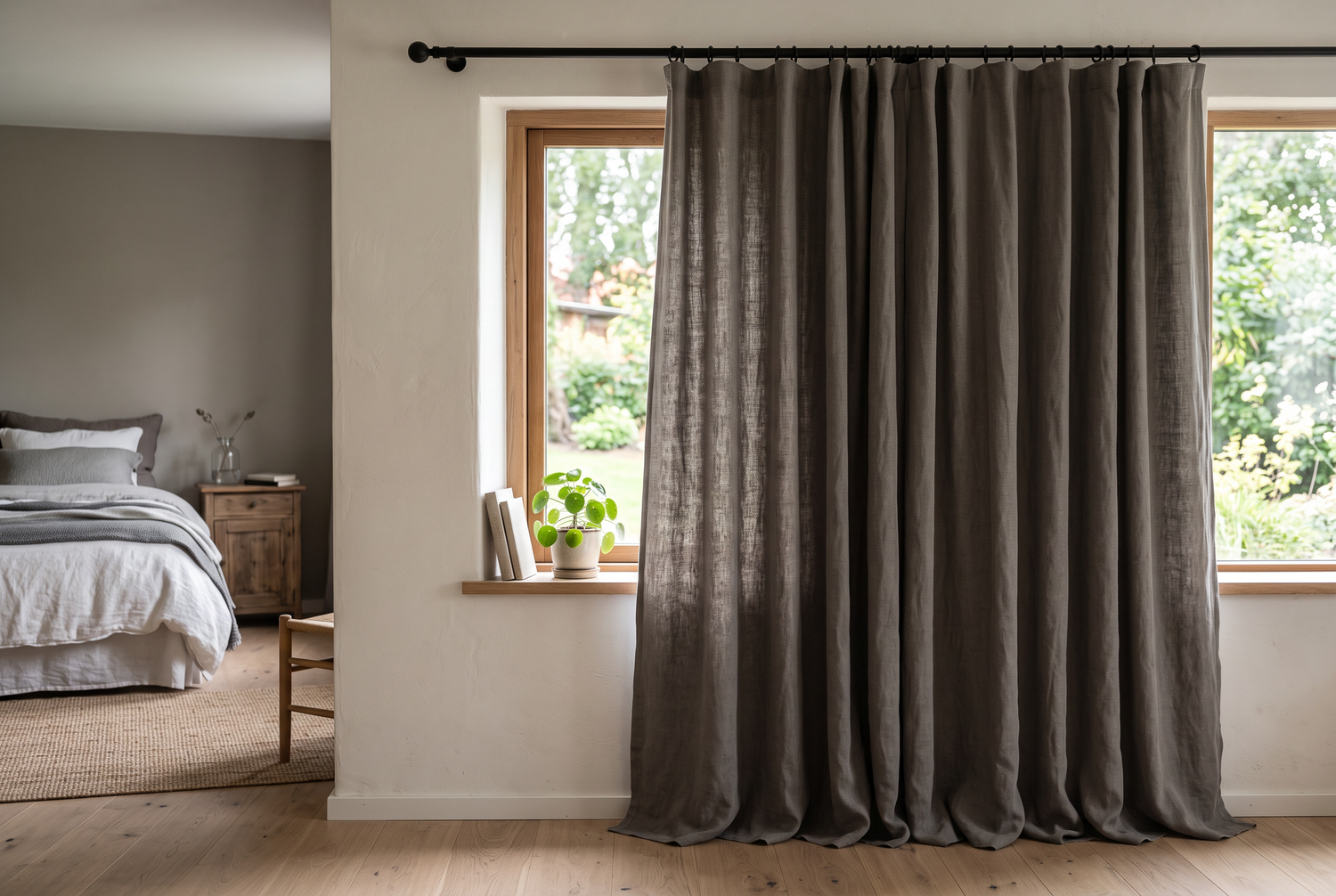
Streetlights, car headlights, the early summer sun at 5:30 AM: external light sources are among the most common and underestimated sleep disruptors. Even small amounts of light in the bedroom can suppress the release of the sleep hormone melatonin and make sleep shallower, as studies now clearly show. The most effective countermeasure is surprisingly unspectacular: the right curtain. But there are worlds of difference between a light decorative scarf, dimout fabric, and true blackout, and many bad purchases happen because terms get confused or the installation ignores the light gap at the edges. This guide explains the differences, provides concrete buying criteria with measurements and figures, and shows how to select and hang curtains so that the bedroom truly becomes dark, and incidentally, quieter and cozier.
The short answer: For restful sleep, you need at least a dimout curtain (darkens by about 85 to 99 percent), or a true blackout curtain with an opaque coating if there's street lighting directly outside your window or if you work shifts. Besides the fabric, installation is crucial: the rod should extend 20 to 30 cm beyond the window, and the curtain should reach the floor with double the fabric width, otherwise light will enter from the sides. The most reliable way to darken a room is a combination of a blackout roller blind on the window frame plus a decorative curtain in front of it.
- Even small amounts of light can impair melatonin production and sleep depth; darkness is a cornerstone of good sleep hygiene.
- Dimout fabrics darken by 85 to 99 percent and are sufficient for most residential areas; blackout fabrics with coating block light almost completely.
- Even the best fabric is useless without proper installation: a 20 to 30 cm overhang on the sides and floor-length curtains prevent light gaps.
- Heavy curtains also improve room acoustics and thermal insulation, a noticeable bonus on noisy streets and in old buildings.
- For travel and rented apartments, sleep masks, adhesive blinds, or mobile blackout solutions are flexible alternatives.
Why darkness is so important for sleep
The human body's internal clock primarily relies on light. As soon as it gets dark, the pineal gland begins to release melatonin, the hormone that primes the body for sleep. Light reaching the eyes, even through closed eyelids, slows down this process: studies show that even light intensities, such as those cast by a bright street lamp through a window, can measurably alter sleep architecture, leading to less deep sleep and more frequent brief awakenings. A widely noted study also found correlations between nocturnal light exposure in the bedroom and less favorable metabolic values. While such observational data should be interpreted cautiously, they underscore the general direction: the darker the bedroom, the better. As a rule of thumb, you should barely be able to see your own hand in front of your eyes. Blackout is particularly relevant for early risers in summer, when the sun in Switzerland rises before 6 AM, and for anyone who needs to sleep during the day. An overview of all blackout strategies can be found in the article Darkening your bedroom.
Curtain types compared: from decorative scarves to blackout
The terms are not standardized, but the differences are clear:
| Type | Darkening | Suitable for |
|---|---|---|
| Decorative scarf/linen curtain | approx. 30–60% | Appearance and privacy, not for darkening |
| Dimout curtain (densely woven) | approx. 85–99% | Normal residential areas, homely appearance |
| Blackout curtain (coated) | almost 100% | Streetlights, shift work, light-sensitive sleepers |
| Blackout roller blind in frame | approx. 95–100% (with guide rails) | Skylights, combination with decorative curtain |
| Blackout honeycomb pleated blind | approx. 90–99% | Rented apartments (clamp mounting), additional insulation |
For most bedrooms, the ideal combination is a roller blind or pleated blind directly on the window frame for darkening, with a floor-length curtain in front for coziness, sound absorption, and sealing the edges.

What matters when buying: dimensions, fabric, color
First, the width: calculate 2 to 2.5 times the window width in fabric so that the curtain hangs in beautiful folds and no light peeks through when it's closed. Second, the length: floor-length (up to 1 cm above the floor) darkens and insulates significantly better than hip-length models, which let light through under the hem. Third, the hanging: eyelets and concealed loops close more tightly at the top than classic ruched tapes with a large gap to the rod; a curtain track directly on the ceiling is the tightest. Fourth, the overhang: the rod should extend 20 to 30 cm beyond the window reveal on each side, so the fabric lies against the wall and blocks侧面 stray light. Fifth, the color: even dark blackout fabrics are available with a light, homely front; the coating is on the back, so you don't have to live in a dark cave to sleep in darkness. Light natural tones go well with a calm interior, as also recommended in the article on bedroom wall color. Sixth, care: coated fabrics should be washed on a delicate cycle at 30 degrees and not tumble dried, otherwise the coating will peel off.
The underestimated side effect: quieter and warmer sleep
Heavy, densely woven curtains noticeably improve room acoustics. They primarily absorb mid and high frequencies, room echo, and dampen noises that penetrate through window cracks; don't expect miracles against low-frequency traffic noise, but in combination with well-sealing windows, the difference is audible. For particularly noisy locations, there are special acoustic curtains with fabric weights starting at around 500 grams per square meter. The second bonus is thermal: floor-length curtains closed in front of the window create an insulating air cushion. In winter, this reduces cold radiation from old windows and the feeling of drafts; in summer, a closed, light-colored curtain on the outside during the day keeps some of the heat out, helping to maintain the recommended sleeping temperature of 16 to 19 degrees. More on this in the guide to ideal sleeping temperature. Honeycomb pleated blinds enhance the insulation effect with their air chambers. Combining blackout, acoustics, and insulation turns the window, the biggest weak point of the bedroom, into a well-protected area.
Common mistakes with blackout curtains
Mistake 1: Only looking at the fabric. A perfect blackout fabric with a 10 cm light gap on each side darkens worse than a dimout curtain with proper installation; the edges are decisive. Mistake 2: Mounting the rod too short and too low. Without a side overhang and with a large gap between the rod and the top edge of the fabric, a bright strip appears at the top, falling directly onto the pillow. Mistake 3: Choosing gathering tape with wide spacing, as this leaves light gaps at the top; eyelets, concealed loops, or ceiling tracks close more tightly. Mistake 4: Washing or ironing coated curtains at high temperatures, which destroys the blackout layer; a 30-degree gentle cycle is sufficient. Mistake 5: Accepting standard lengths even if the window isn't standard; shortening is easy, but curtains that are too short are wasted money. Mistake 6: Forgetting that complete darkness can make it difficult to get up. If you have trouble getting out of bed in the morning, combine blackout curtains with a wake-up light that simulates sunrise in the room.

Get CHF 25 discount
Subscribe to our newsletter and receive a one-time CHF 25 discount. ✓ 200 nights trial sleep ✓ 10 years warranty
Practice: measure, install, test
Step 1: Measure the window. The width of the reveal plus 20 to 30 cm overhang on each side gives the rod length. For curtain length, measure from the top of the rod to 1 cm above the floor. Step 2: Determine fabric quantity. Rod length multiplied by 2 to 2.5 gives the necessary fabric width; if using two panels, divide accordingly. Step 3: Choose mounting height. The closer to the ceiling, the tighter the curtain closes at the top and the taller the room appears. Step 4: For strong light incidence, additionally install a blackout roller blind or pleated blind directly in the window frame; for rented apartments, use clamp brackets without drilling. Step 5: The darkness test: Close everything during daylight and after 5 minutes of acclimatization, check where light still enters, usually at the sides and top, and seal specifically. For travel and holidays, a good sleep mask replaces the curtain, but at home, the spatial solution outperforms the mask in comfort and consistency.
Frequently asked questions about blackout curtains
What is the difference between dimout and blackout?
Dimout fabrics are very densely woven and darken by about 85 to 99 percent, but they appear cozy and allow some light to filter through. Blackout fabrics have an opaque coating and block light almost completely, ideal for street lights and shift work.
How dark does a bedroom need to be?
So dark that you can barely see your own hand in front of your eyes. Even small amounts of light can suppress melatonin production and make sleep shallower; complete darkness is the goal.
How wide should a blackout curtain be?
Calculate 2 to 2.5 times the window width in fabric and use a rod that extends 20 to 30 cm beyond the window on each side. This allows the curtain to hang in folds and also block stray light entering from the sides.
Do light curtains darken less effectively than dark ones?
Not necessarily. For coated blackout fabrics, the coating on the back provides the darkening, so the front can be light and homely. For uncoated fabrics, however, denser and darker fabrics will darken better.
What to do about skylights in the bedroom?
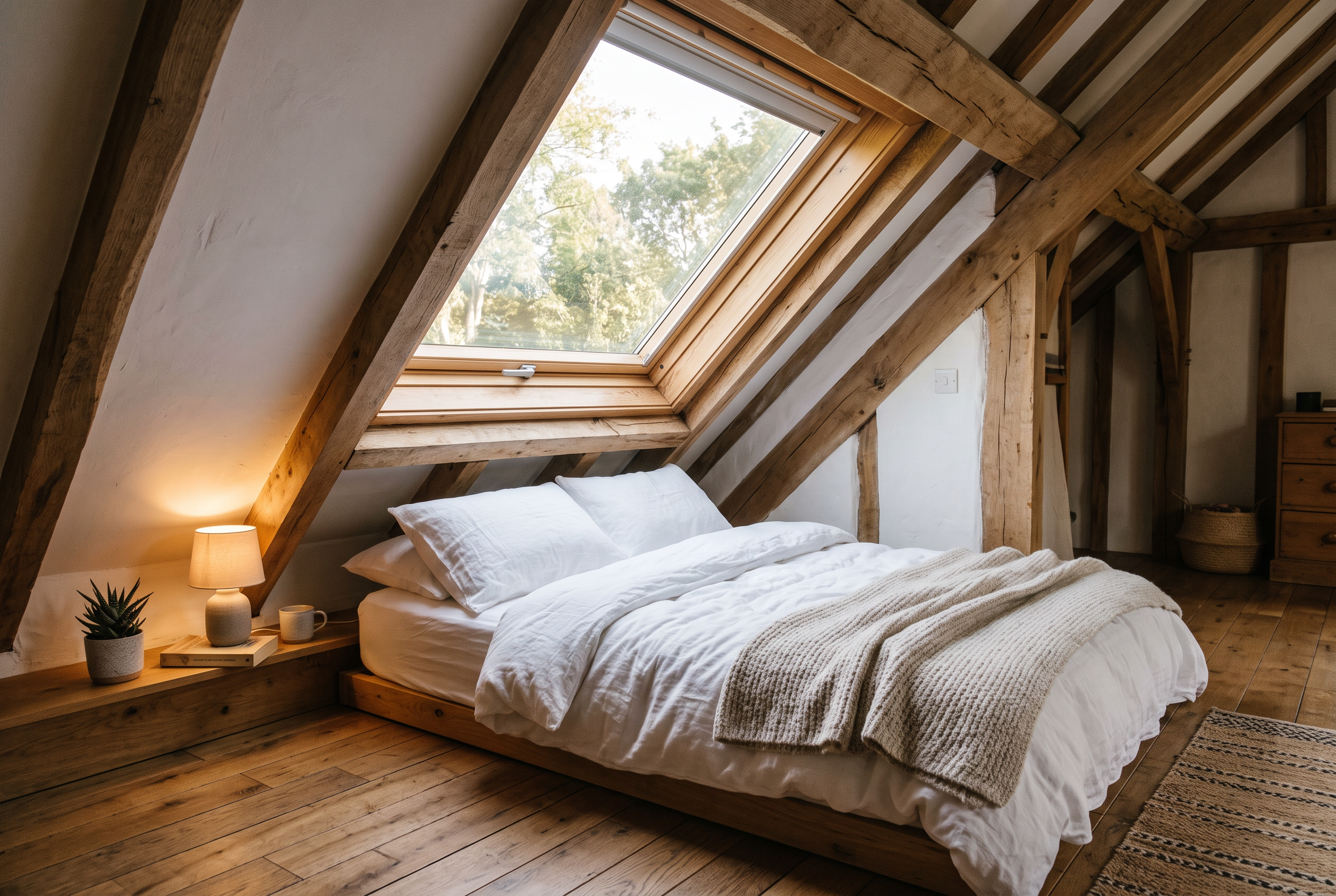
Custom-fit blackout roller blinds with side guide rails are the best solution here, as normal curtains would stand off from the sloped window. Many manufacturers offer blinds specifically for common skylight models.
Do blackout curtains also help against noise and cold?
Yes, to some extent: heavy, floor-length curtains dampen echo and high-frequency noises and form an insulating air cushion in front of the window. They are only of limited help against low-frequency traffic noise, where good sealing windows are more effective.








Leave a comment
This site is protected by hCaptcha and the hCaptcha Privacy Policy and Terms of Service apply.