
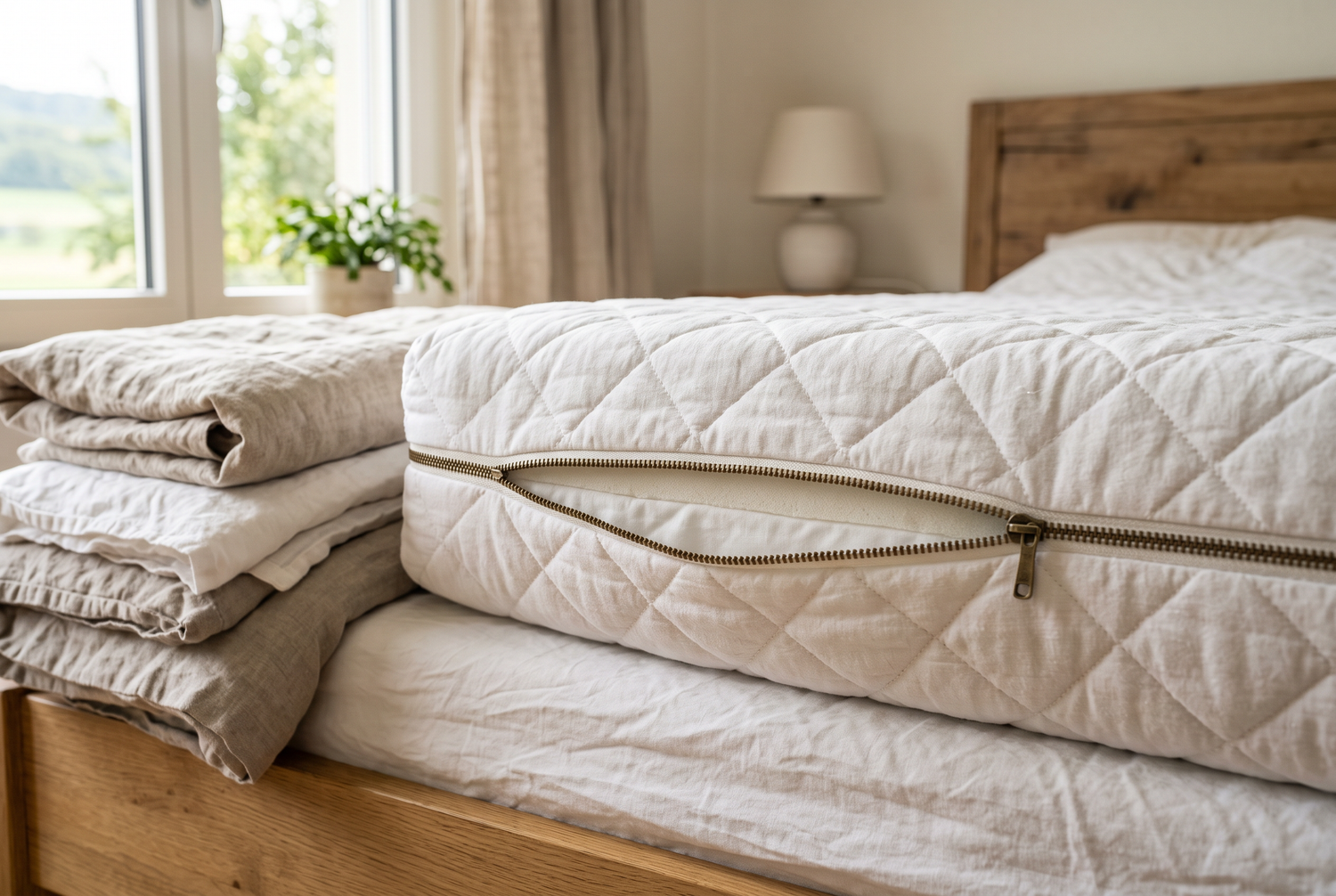
The mattress cover is the layer that takes the most abuse every night: sweat, skin flakes, skin oil, cosmetic residue, and dust accumulate there, even with a fitted sheet in between. An adult loses an average of 0.3 to 0.5 liters of fluid per night, significantly more in summer – and despite the sheet, some of it ends up in the cover. Nevertheless, in many households, the mattress cover is never washed or only every few years, often due to uncertainty: Can it even go in the washing machine? At what temperature? And what happens if it no longer fits afterward? This guide clarifies precisely these questions. You will learn about the different cover materials, how to correctly read the care label, what temperature is necessary for allergy sufferers, and how to avoid the dreaded shrinkage.
The short answer: Most removable mattress covers can be washed at 40 or 60 °C on a gentle cycle – the sewn-in care label is always decisive, not a rule of thumb. For normal households, two to three washes per year are sufficient; allergy sufferers and people who sweat heavily should wash every three months at 60 °C. Use a mild liquid detergent without fabric softener or bleach, spin at a maximum of 600 to 800 revolutions, and air dry the cover. Put it back on slightly damp, and it will conform exactly to the mattress as it dries.
- Always check the care label first – 40 °C and 60 °C are the most common specifications, some covers tolerate 95 °C.
- Guideline: 2–3 times a year, every 3 months for allergies, heavy sweating, or pets in bed.
- 60 °C is necessary to reliably kill dust mites – 40 °C cleans but does not kill.
- No fabric softener: It clogs climate fibers and noticeably reduces moisture absorption.
- Do not tumble dry unless the label permits it – otherwise, the cover will shrink and no longer fit.
What cover materials are available and how they differ
Not every mattress cover is constructed the same way. The classic double-jersey cover made of a polyester-cotton blend is robust, inexpensive, and usually washable at 60 °C. Tencel or Lyocell covers are made of cellulose fibers from wood, feel cool, and transport moisture particularly well – they usually tolerate 40 °C, sometimes 60 °C. Climate fiber or 3D mesh covers have an open spacer structure for ventilation; they are sensitive to high temperatures and fabric softener because the fibers can clump. Covers with silver ions or aloe vera treatment lose their functional layer if washed too hot. And medical encasing covers for dust mite allergy sufferers are deliberately designed to withstand 60 or even 95 °C because they must be hot washed regularly. A detail that many overlook: Some covers are quilted with a thin batting. This quilted layer takes significantly longer to dry than a smooth cover – plan for 24 instead of 8 hours. You can read more about protective layers in the article Mattress protectors and encasings.

The correct washing temperature – Table for reference
The temperature question is more important than it sounds: 40 °C cleans sweat and skin oil, but it does not kill dust mites – they survive the wash cycle and the damp laundry. Only at about 60 °C do mites die, and most of their allergens are flushed out. If you have to wash at 40 °C because the material requires it, you can use a special anti-mite detergent or put the cover in the freezer for 12 hours beforehand.
| Material | Typical Temperature | Spin Cycle | Special Feature |
|---|---|---|---|
| Double Jersey Polyester/Cotton | 60 °C | up to 800 rpm | robust, mostly washable as mite-proof |
| Tencel / Lyocell | 40–60 °C | up to 600 rpm | cooling, tends to wrinkle |
| Climate Fiber / 3D Mesh | 30–40 °C | up to 600 rpm | never use fabric softener, structure clumps |
| Cover with functional finish | 30–40 °C | up to 600 rpm | active ingredients dissolve with heat |
| Encasing for allergy sufferers | 60–95 °C | up to 1000 rpm | deliberately designed to be boil-proof |
How often should the mattress cover be washed?
For a normal household without allergies, two to three washes per year are sufficient – for example, during spring cleaning, after summer, and before the heating season. Those who sweat heavily, sleep in a warm bedroom, or suffer from night sweats should shorten the rhythm to every three months. For dust mite allergy sufferers, a quarterly rhythm at 60 °C is the standard recommended by allergological societies. For children who occasionally wet the bed, and after periods of illness with fever or gastrointestinal infection, you should wash immediately. If a pet regularly sleeps in the bed, the interval also shortens significantly – pet hair and salivary proteins are common allergens. Important for classification: The cover is only one part of the hygiene chain. The fitted sheet should be changed every one to two weeks, a mattress protector every one to two months. The article How often to change bed linen explains how these intervals interact.
Step-by-step: Removing and washing the cover
1. Find and open the zipper
Most covers have a circumferential zipper on three sides. Open it completely and unfold the cover like a book, instead of tugging it over the corners. For divided covers with two halves, remember which side was on top – many models have a summer and a winter side.
2. Pre-treat instead of scrubbing
Treat stains selectively with gall soap or an enzyme-based stain remover and let it work for 15 minutes. Do not rub vigorously, as this will drive the stain deeper into the fibers. For blood, use only cold water; warm water coagulates the protein and sets the stain.
3. Load correctly
A cover for 160×200 cm already fills a 7-kg machine well. Overloading leads to the laundry not being moved properly and detergent residues remaining in the fabric. For large covers from 180×200 cm, an 8-kg machine or a laundromat is the better choice.
4. Wash and spin
Measure liquid detergent rather sparingly – powder with bleach can damage functional fibers. Gentle cycle, maximum 600 to 800 revolutions. Too much spinning pulls the seams and permanently distorts quilted covers.
5. Dry and put on damp
Hang the cover flat over two lines or a clothes rack so that the weight is distributed. The best trick at the end: Put the cover back on the mattress slightly damp. It will then be easier to get over the corners and will dry to an exact fit.

Common mistakes when washing a mattress cover
Using fabric softener. It coats the fibers with a film that measurably impairs moisture absorption – precisely the quality for which a good cover was purchased. In climate fibers, the spacer structures also clump. Washing too hot. A 40-°C cover washed at 60 °C will shrink by several centimeters and will never fit over the core again. This is the most common irreversible damage. Putting it in the dryer. Even if the cover tolerates the washing temperature: dryer heat plus mechanical movement further shrinks the fabric. Only do this if the label explicitly shows the dryer symbol. Putting it back on wet and making the bed. A damp cover placed on a foam core, immediately covered with a sheet and duvet, is an invitation for mold. Putting it on damp is fine – but then let it air dry openly for several hours. Washing the foam core with it. A foam core should never go into the washing machine; it soaks up water, loses its structure, and practically never dries completely inside, which promotes mold. Washing only one half. For divided covers, this creates a visible color difference.
What to do if the cover is not removable?
Inexpensive roll-up mattresses and many spring core models have permanently sewn covers. In this case, only surface cleaning remains: vacuum with the upholstery attachment at medium suction power, treat stains selectively with little moisture and gall soap, then wipe with a clean, only slightly damp cloth and allow to dry thoroughly. Afterward, the mattress should air out for at least six hours with the window open. In this case, a washable mattress protector is mandatory – it takes over the function of the cover and goes into the machine every four to eight weeks. Detailed instructions for stain treatment can be found under Removing stains from a mattress and for basic cleaning under Cleaning a mattress. If you value hygiene when buying your next mattress, you should make a removable cover a basic requirement – it noticeably extends the usable life of the mattress, as the article Mattress lifespan shows.
Secure a CHF 25 discount
Subscribe to the newsletter and receive a one-time CHF 25 discount. ✓ 200 nights trial sleep ✓ 10-year warranty
Frequently asked questions about washing a mattress cover
At what temperature should I wash the mattress cover?
The care label is decisive. 40 or 60 degrees on a gentle cycle are common. For allergy sufferers, 60 degrees is important because only this temperature reliably kills dust mites. Never wash hotter than indicated, otherwise the cover will shrink and no longer fit over the core.
How often should you wash the mattress cover?
Two to three times a year is sufficient in a normal household. If you sweat heavily, suffer from a dust mite allergy, or have a pet in bed, you should wash every three months. After febrile infections or an accident, wash immediately.
Can the mattress cover go in the dryer?
Only if the care label explicitly shows the dryer symbol. The combination of heat and mechanical movement causes most covers to shrink further. Air drying flat over two lines and putting it back on the mattress slightly damp is safer.
Why doesn't the cover fit after washing?
In most cases, it was washed or dried too hot, causing the fabric to shrink. Sometimes the cover is just distorted and appears too small. Put it on slightly damp, stretching it evenly over the corners, and let it dry on the mattress – often it will fit again afterward.
Can I also wash the foam core of the mattress?
No. A foam core should never go into the washing machine. It soaks up water, loses its structure, and does not dry properly inside for weeks, which promotes mold growth. Only clean the core superficially and very sparingly with moisture.
What to do if the cover is not removable?
In that case, vacuum with the upholstery attachment, spot treat stains with little moisture, and ventilate thoroughly. In this situation, it is essential to use a washable mattress protector, which you wash every four to eight weeks at 60 degrees – it then takes over the protective function of the cover.








Leave a comment
This site is protected by hCaptcha and the hCaptcha Privacy Policy and Terms of Service apply.