Hardly any mattress material has changed sleeping comfort as much as viscoelastic foam – often also called memory foam. Originally developed for space travel, this pressure-relieving material is now found in high-quality mattresses, toppers, and pillows. But what exactly is behind the famous memory effect? How does classic viscoelastic foam differ from modern adaptive foams? And what should you look out for when buying? This guide explains the material from the ground up – understandable, honest, and without marketing jargon.
The short answer: Viscoelastic foam (memory foam) is a thermoelastic foam that reacts to body heat and pressure: it specifically yields at stressed points, precisely molds itself to the body's contours, and thus relieves shoulders, hips, and spine. Modern advancements such as EvoPoreHRC foam combine this pressure relief with high support and breathability – and automatically adapt to every body and sleeping position, without the need to choose a firmness level.
- Viscoelastic foam reacts thermoelastically: It becomes softer due to body heat and pressure and adapts precisely to the body's shape.
- The great advantage is pressure relief – ideal for sensitive shoulders and hips, as well as for side sleepers.
- Classic viscoelastic foam has weaknesses: Heat build-up and sluggish recovery make it difficult to turn over at night.
- Modern adaptive foams like EvoPoreHRC combine memory comfort with high support and air circulation – a firmness level no longer needs to be chosen.
What is viscoelastic foam? From space to the bedroom
Viscoelastic foam was developed in the 1960s on behalf of NASA to better cushion astronauts against the enormous acceleration forces during launch. The technical term is viscoelastic foam: viscous describes the material's slow-flowing behavior, elastic its ability to return to its original shape. If you press your hand into the foam, the imprint remains visible for a few seconds – hence the popular name memory foam.
In the mattress world, viscoelastic foam is practically never used as the sole core, as it lacks the necessary support. Instead, it usually forms a comfort layer over a supportive core of cold foam or high-quality PU foam. Our large mattress type comparison shows how the different constructions work in detail.
How does the memory effect work?
The secret lies in the cell structure. Viscoelastic foam has a very fine, open-cell structure whose stiffness is temperature-dependent. At room temperature, the material is relatively firm. As soon as body heat acts on it, the cell walls soften, and the foam slowly begins to yield under the pressure of the body. The result: The mattress precisely molds itself to the shoulders, hips, and lumbar region.
This precise adaptation has a measurable effect: the contact pressure is distributed over a larger area, and pressure points in the heavy body zones are reduced. This is precisely why memory foam is often recommended for tension, pressure sensitivity, and restless sleep – and is particularly popular with side sleepers, as our guide Mattress for Side Sleepers shows.

Classic Visco Foam vs. Modern Adaptive Foam
As impressive as the memory effect is, classic viscoelastic foam has inherent weaknesses. Because it reacts to heat, it also stores it: Many sleepers find pure visco mattresses too warm. And because the material returns to its original shape only slowly, turning over creates a feeling of sinking in, which some describe as "lying in a hollow." Modern adaptive foams of the latest generation were developed to address precisely these disadvantages.
| Feature | Classic Viscoelastic Foam | Modern Adaptive Foam (e.g., EvoPoreHRC) |
|---|---|---|
| Pressure Relief | Very good | Very good |
| Rebound Behavior | Sluggish, delayed | Fast – facilitates turning over |
| Temperature Behavior | Tends to accumulate heat | Open-pored, high air circulation |
| Support | Low, requires supportive core | High, actively supports the spine |
| Adaptation to Sleeping Position | Only via heat, slow | Automatically via zoned structure |
| Firmness Level Selection Needed? | Yes, depending on the model | No – one model adapts to all |
You can learn more about the basics of different foam types in our article Foam Mattresses at a Glance. And for those who overheat quickly at night, our guides on cool mattresses and the ideal sleeping temperature offer further tips.
Viscoelastic foam and firmness levels: an outdated concept
When buying a mattress, the question inevitably arises: H2, H3, or H4? What many don't know: Firmness levels are not standardized in Switzerland and the EU. An H3 from one manufacturer can feel like an H2 from another. The concept dates back to a time when foams were not yet able to adapt independently to different bodies – the customer had to make the adjustment themselves by choosing a firmness level. A detailed classification can be found in our article on firmness levels in mattresses.
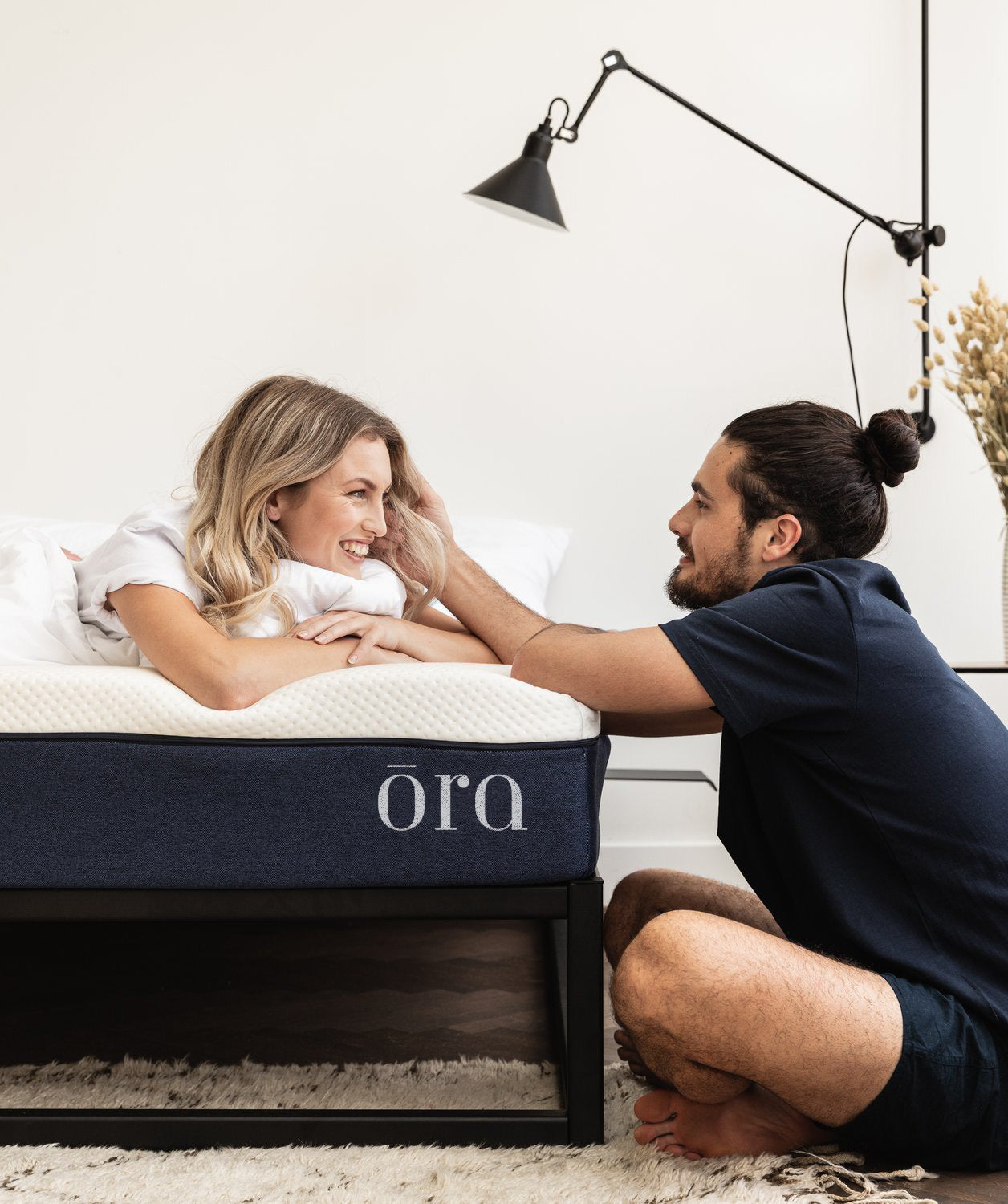
Highly developed adaptive foams make this choice unnecessary. The EvoPoreHRC Premium Memory Foam, as used in the Ora Ultra Mattress, reacts to weight, body shape, and sleeping position simultaneously: Light people sink gently, heavier people are supported more strongly, and when changing from a back to a side position, the material automatically readjusts. A mattress that works for everyone – instead of a guessing game with firmness levels.

Who is memory foam suitable for?
Memory foam in a modern, adaptive design is an excellent choice for most sleepers: for side sleepers whose shoulders and hips need to sink deep enough; for back sleepers who need even support for the lumbar spine; for couples with different body types who could never agree on a firmness level otherwise; and for anyone who is pressure-sensitive or wakes up with tension in the morning. If you want to upgrade your existing mattress first, you can start with a high-quality memory topper – more on this in our topper guide.
Important to know: Even the best foam ages. After eight to ten years, the rebound force of any material diminishes. We explain when a change is sensible in the article How often should you change your mattress? – and with proper mattress care, you can significantly extend its lifespan.
Get CHF 25 discount
Subscribe to the newsletter and receive a one-time CHF 25 discount. ✓ 200 nights trial sleep ✓ 10 years warranty
Frequently Asked Questions about Viscoelastic Foam and Memory Foam
What is the difference between viscoelastic foam and memory foam?
There is none: viscoelastic foam, memory foam, and "Gedächtnisschaum" (memory foam in German) all refer to the same material – a viscoelastic foam that reacts to pressure and body heat and adapts to the body's shape.
Is a memory foam mattress suitable for side sleepers?
Yes, especially so. Memory foam allows the shoulders and hips to sink in controllably, thereby keeping the spine straight when sleeping on your side. Modern adaptive foams like EvoPoreHRC also rebound quickly, making it easy to turn over.
Do you sweat on memory foam?
On classic viscoelastic foam, heat build-up can occur due to the dense cell structure. Modern open-pore foams of the latest generation, however, allow air and moisture to circulate well, providing a significantly drier, more comfortable sleeping climate.
What firmness level do I need for a viscoelastic foam mattress?
Firmness levels are not standardized and are unnecessary for modern adaptive foams: the material reacts independently to weight, body shape, and sleeping position. A high-quality adaptive mattress adapts automatically – eliminating the need to choose a firmness level.
How long does a memory foam mattress last?
High-quality memory foam with a high density lasts about 8 to 10 years with good care. After that, the rebound force diminishes, and the lying properties noticeably worsen – then a replacement is advisable.




Leave a comment
This site is protected by hCaptcha and the hCaptcha Privacy Policy and Terms of Service apply.