
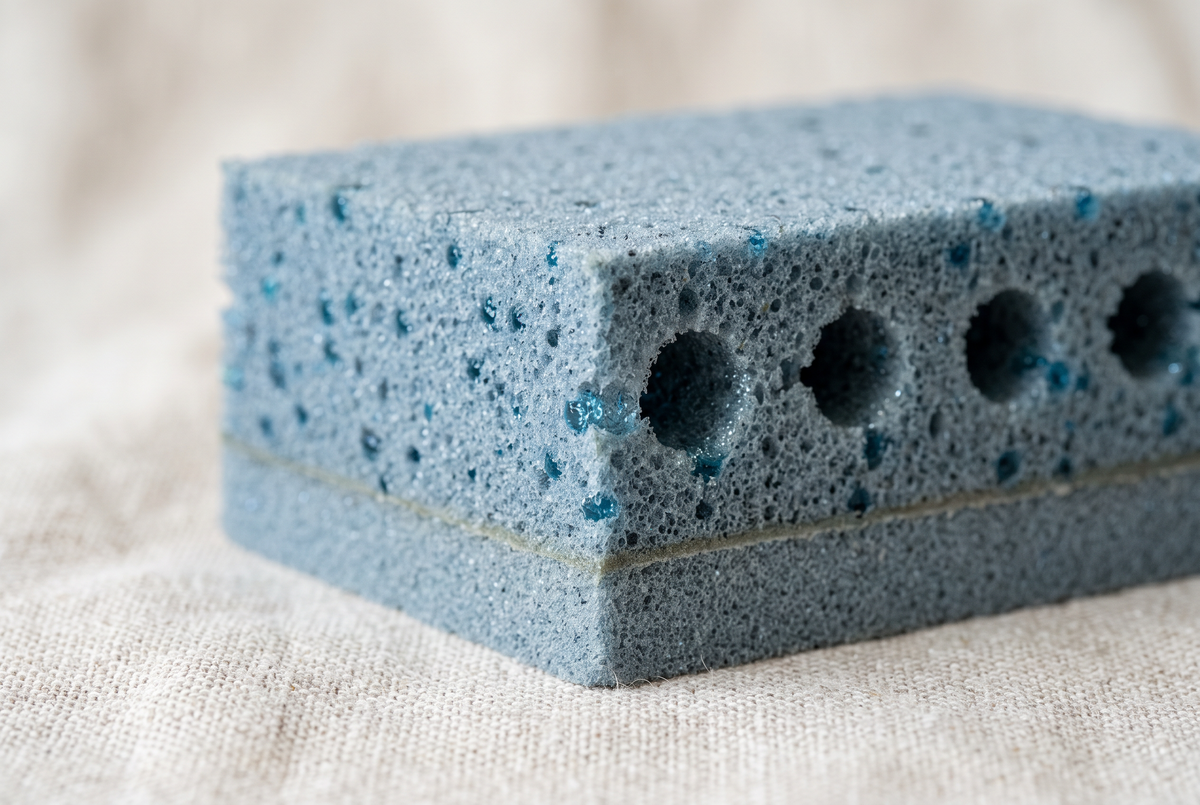
Gel foam sounds like a material that finally addresses sleeping hot: cooling, conforming, modern. Product descriptions often feature blue images, cooling channel graphics, and terms like "thermoregulation." What many don't know: gel foam is not a distinct material in the chemical sense, but a polyurethane foam to which gel-like additives have been mixed in or embedded. How strong the effect is depends entirely on the formulation, the proportion of these additives, and the construction of the mattress – and thus on factors rarely listed on the label. This article explains what gel foam can actually do, how it differs from cold foam and viscoelastic foam, and for whom the surcharge is worthwhile.
The short answer: Gel foam is a polyurethane foam with gel-like additives that reacts with greater point elasticity than classic cold foam and is less temperature-dependent than pure viscoelastic foam. It adapts quickly, returns promptly to its original shape, and feels cooler to the touch. The much-advertised cooling effect is real but limited: it primarily affects the initial contact, not the entire night. Crucial for the sleep climate are the open-cell structure of the core, the cover, and the room temperature. As a material, gel foam is good but not a magic bullet – quality and density matter more than the label.
- Gel foam is polyurethane foam with gel-like additives – not a standalone material.
- Advantage over viscoelastic foam: faster recovery, less temperature dependence.
- The cooling effect primarily concerns initial skin contact, not the entire night.
- Without density information, "gel foam" is not a promise of quality.
- The cover and room climate often influence the perceived temperature more than the core.
What gel foam is, technically
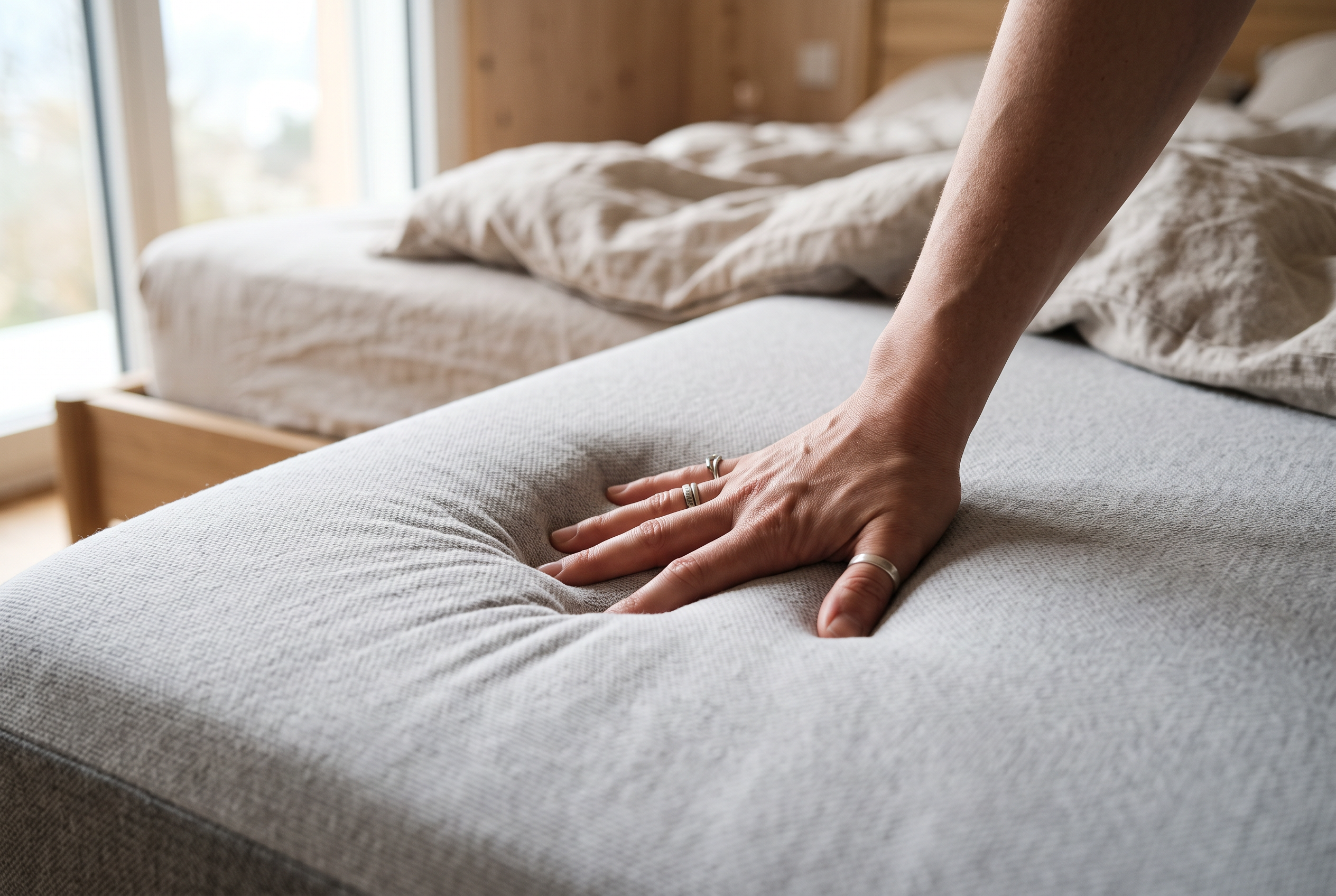
The base is a polyurethane foam, as used in cold foam and viscoelastic foam. The difference lies in additives: either gel-like particles are incorporated into the foam matrix, or the formulation is altered so that the foam exhibits gel-like deformation behavior. Some manufacturers also work with visible gel inserts or milled channels. The effect: the material deforms softer and more evenly than pure cold foam but returns to its original shape faster than classic viscoelastic foam. This combination is precisely where its true appeal lies. Pure viscoelastic foam reacts strongly to body heat – it feels firm in a cold bedroom, but significantly softer after twenty minutes of body contact. Many perceive this delay as sluggish, especially when changing positions. Gel foam dampens this temperature dependence. Our article on viscoelastic foam and memory foam also explains what this means for the sleeping sensation.
The cooling effect: what's true and what's exaggerated
Gel-like additives have higher thermal conductivity than pure foam. Therefore, the surface actually feels cooler upon initial skin contact – heat is conducted away from the contact point more quickly. This effect is measurable but time-limited. After about 20 to 40 minutes, the contact zone has reached equilibrium, and further heat dissipation depends on how well air and moisture are transported through the material and the cover. An adult releases approximately 0.3 to 0.5 liters of fluid per night; the crucial factor is whether this moisture is dissipated. Here, the open-cell structure of the foam significantly outweighs the material designation. An open-cell cold foam with a breathable cover can perform better climatically than a dense gel foam under a coated cover. Those primarily seeking relief from heat will find more effective levers in our article Sleeping in the Heat and under Cool Mattresses – most of which are external to the mattress.

Gel foam compared to other foams
| Property | Cold Foam | Viscoelastic Foam | Gel Foam |
|---|---|---|---|
| Point elasticity | Medium to good | Very good | Very good |
| Recovery behavior | Fast | Slow | Medium to fast |
| Temperature dependence | Low | High | Low to medium |
| Perceived surface temperature | Neutral | Rather warm | Cooler on contact |
| Weight | Medium | Higher | Higher |
| Price level | Low to medium | Medium | Medium to high |
How to distinguish good from bad gel foam
The term "gel foam" is not protected. A manufacturer can use it even if they add a small proportion of additives to a standard formulation – without significantly changing its properties. Therefore, it's better to check the hard facts. First, density: For daily use, the support core should have at least 40 kg/m³, preferably 50 or more. How this is calculated and classified is explained in the article Density explained. Second, layer thickness: Often, only a 2 to 4 cm thick gel foam overlay is installed over a simple core. This changes the sleeping sensation on the surface, not the support. Ask how thick the gel layer is and what the core underneath is made of. Third, open-cell structure: Only an open-cell structure allows moisture to pass through. Fourth, the cover: Washable at at least 40 degrees, preferably 60 degrees, and breathable. Fifth, overall weight: Very light gel foam mattresses are usually low-density, regardless of the name.
Common mistakes when buying a gel foam mattress
Reading color as a quality feature. Blue or turquoise colorations are purely aesthetic – color pigments say nothing about material properties. Concluding from "cooling" that it "solves my sweating problem." Night sweating often has other causes – room temperature, bedding, duvet filling, individual factors. For severe, recurring night sweats, a medical examination is advisable; see also Causes of night sweats. Mistaking a thin gel overlay for a gel foam mattress. Check the core construction. Ignoring the foundation. A too widely slatted base will cause any foam to sag; slats should be no more than 4 cm apart, see Slatted base and mattress. Judging too early. Even with gel foam, muscles need 14 to 30 nights to adapt. And the typical new odor after unpacking usually dissipates within 48 to 72 hours with good ventilation – more on this under Removing mattress odor.
Who gel foam is worthwhile for – and who it isn't
Gel foam excels where very precise body adaptation is required, without the sluggish sinking feeling of pure viscoelastic foam. This particularly concerns side sleepers with pronounced shoulder-waist ratios, people with pressure sensitivity on the shoulder or hip, and anyone who frequently changes position at night and doesn't want to fight against the mattress. The surcharge is less worthwhile if the main problem lies in the sleep climate: in that case, room temperature, bed linen material, and duvet choice will have a greater impact. Gel foam is also not automatically the right choice for individuals who prefer a very firm surface. And importantly: a well-made adaptive memory foam with high material density can achieve everything gel foam promises – precise adaptation, rapid recovery, good pressure distribution – without needing a special material designation. What matters most is how the mattress performs over weeks in your own bedroom, not what it's called in the store. Our comparison of mattress types provides a comprehensive overview.

Get CHF 25 discount
Subscribe to newsletter and receive a one-time CHF 25 discount. ✓ 200 nights trial sleep ✓ 10 years warranty
Frequently Asked Questions about Gel Foam Mattresses
What exactly is gel foam?
Gel foam is a polyurethane foam to which gel-like additives have been mixed in or embedded. It is not a standalone material, but a variant of known foam types. Its properties depend heavily on the specific formulation and the proportion of additives.
Does a gel foam mattress really cool?
Upon initial skin contact, the surface actually feels cooler because gel-like additives conduct heat away more quickly. This effect subsides after about 20 to 40 minutes. For the sleep climate throughout the night, open-cell structure, cover, and room temperature are more important.
What is better: gel foam or cold foam?
Gel foam is generally more point-elastic and adapts more precisely, while cold foam is often lighter, cheaper, and recovers very quickly. More important than the material type is the density of the support core – a high-quality cold foam outperforms cheap gel foam.
What density should gel foam have?
For daily use, the support core should have at least 40 kg/m³, preferably 50 kg/m³ or more. Make sure that the specification refers to the core and not just a thin top layer.
Is gel foam suitable for side sleepers?
Yes, gel foam is considered a good choice for side sleepers because it yields precisely, allowing the shoulder and hip to sink in while the waist remains supported. However, it is crucial that the core underneath provides sufficient support.
Does a new gel foam mattress smell?
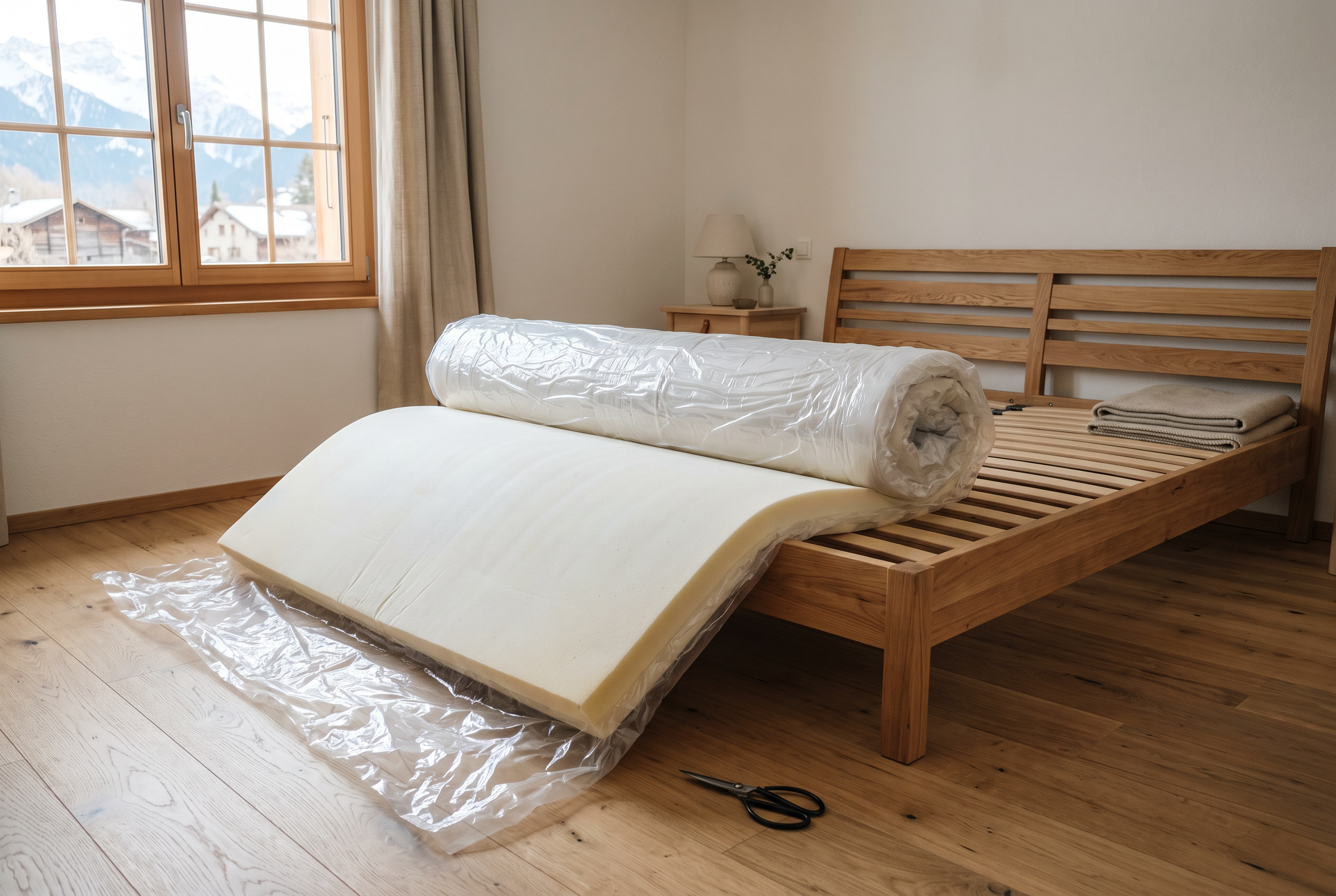
A slight new smell after unpacking is normal and usually dissipates within 48 to 72 hours with good ventilation. Leave the mattress uncovered during this time and ventilate the room several times a day.






Leave a comment
This site is protected by hCaptcha and the hCaptcha Privacy Policy and Terms of Service apply.