
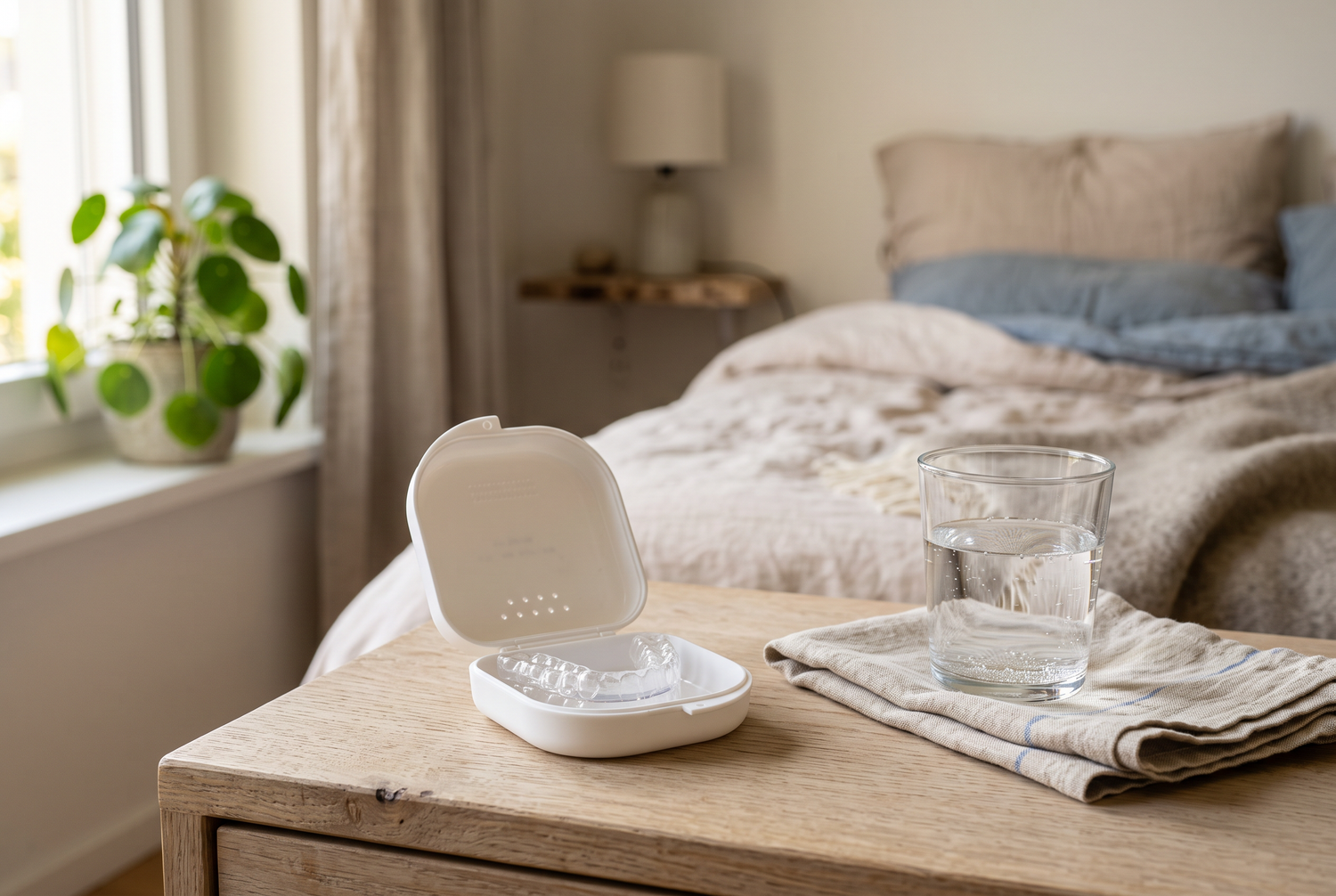
You wake up in the morning with a tense jaw, your temples throbbing, and your molars feel sensitive when you brush your teeth. Perhaps your partner heard a quiet, unpleasant grinding sound at night. Or your dentist noticed abraded chewing surfaces during your last check-up and mentioned the word "bruxism." Teeth grinding during sleep is astonishingly common: estimates from population studies suggest that about 8 to 16 percent of adults regularly grind or clench their teeth at night, with the proportion being even higher in children. The insidious thing about it is that those affected don't notice it themselves – the body does it during sleep, without conscious control. This article shows how to recognize bruxism, what is known about its causes today, and what measures actually help.
The short answer: Teeth grinding during sleep is not an illness in the strict sense, but an involuntary activity of the jaw muscles that is closely linked to stress, sleep quality, and brief nocturnal awakenings. Bruxism usually cannot be completely "untrained." An individually fitted bite splint reliably protects the teeth from abrasion, and relaxation techniques, a calm evening routine, and less caffeine and alcohol can noticeably reduce its frequency. It is important to have the teeth protected early, before substance loss becomes permanent.
- During sleep bruxism, forces of up to several hundred Newtons act on the teeth – significantly more than during normal chewing.
- Typical warning signs: morning jaw tension, temple headaches, sensitive tooth necks, flattened chewing surfaces.
- Stress, anxiety, smoking, alcohol, and caffeine are considered the most well-documented risk factors.
- A hard bite splint from the dental lab protects tooth substance; soft sports splints are unsuitable for this purpose.
- Relaxation techniques, warmth on the jaw, and a fixed evening routine demonstrably reduce muscle tension.
What actually happens during teeth grinding in sleep
Bruxism refers to a repeated activity of the masticatory muscles, manifested as grinding (lateral rubbing of the teeth) or clenching (static biting together). Experts clearly distinguish between awake bruxism and sleep bruxism because they have different mechanisms. During the day, many people unconsciously clench their teeth when concentrating or under tension – at the computer, in traffic jams, during sports. At night, however, the process is centrally controlled and occurs frequently in conjunction with so-called micro-arousals: brief, unconscious awakenings during which heart rate and muscle tone increase for a few seconds.
The forces are considerable. During normal chewing, depending on the food, about 70 to 150 Newtons act on the molars. During nocturnal clenching, significantly higher values can be reached briefly, and above all, the load lasts longer – sometimes several minutes of intense muscle activity accumulate over a night. Tooth enamel, with a hardness comparable to quartz, is very resistant, but not immune to years of lateral rubbing. This becomes visible as flattened cusps, fine cracks in the enamel, or wedge-shaped defects at the tooth neck.
How to recognize bruxism in yourself
Since you cannot observe yourself grinding, indirect signs are important. Most commonly, affected individuals report a stiff, tired jaw immediately after waking up, which improves over the course of the morning. Dull headaches in the temporal region are also typical, because the temporalis muscle is involved, as are earaches or a feeling of pressure in front of the ear, even though the ears themselves are healthy.
Further indications: your dentist finds wear facets, i.e., mirror-smooth surfaces that fit together exactly when you move your jaw sideways. Teeth react sensitively to cold and sweet because enamel has been lost. Impressions appear on the tongue margin, and a whitish line on the buccal mucosa at the level of the occlusal plane. Some people also notice that their mouth is harder to open wide in the morning or that it cracks when they yawn.
When medical clarification is useful
Seek dental help if pain lasts longer than two to three weeks, mouth opening is restricted (normal is about 40 to 55 mm between the incisal edges), teeth become loose or break. If loud snoring and breathing pauses are also present, sleep apnea should also be considered, as both frequently occur together.

The causes: Stress is at the top, but not alone
For a long time, a "wrong" bite position was considered the main cause. This idea is now considered outdated: minor deviations in the bite are found in almost all people and do not explain sleep bruxism. The connection with psychological stress is much better documented. Those who feel tense for weeks, worry a lot, or are under deadline pressure grind their teeth more frequently and intensely. The mechanism involves increased activity of the sympathetic nervous system, which does not completely shut down even at night.
In addition, substances play a role. Studies show that nicotine approximately doubles the risk, alcohol in the evening fragments sleep and increases the number of awakenings, and caffeine, with a half-life of about five to six hours, lasts longer than many people think – an espresso at 4 p.m. is still half in the body at midnight. Certain groups of medications, especially some SSRI-type antidepressants, are also suspected of promoting bruxism; however, this should never be changed without medical consultation. If you want to address your stress level, the article on stress and worrying as a sleep problem can help.
Bite splint: which type is suitable for what
The splint doesn't grind the problem away – it distributes the forces and sacrifices plastic instead of tooth enamel. That's precisely its purpose. The design is crucial, because there are worlds between a lab-made hard splint and a soft drugstore variant.
| Type | Properties | Suitable for |
|---|---|---|
| Hard adjustment splint (lab) | Firm plastic, individually ground, usually lasts 3–8 years | Standard for pronounced sleep bruxism |
| Soft vacuum-formed splint | Elastic, sometimes encourages "chewing," wears out quickly | Short-term bridging, sports protection |
| Thermoplastic splint from the drugstore | Self-adjusted, rarely fits exactly, pressure points possible | Emergency solution for a few weeks |
| Mandibular advancement splint | Pushes the lower jaw forward, opens the pharynx | Only with simultaneous snoring/apnea, after consultation |
Clean the splint with cold water and a soft brush without toothpaste – abrasives will scratch the plastic. Hot water will deform it. Store it dry and airy, not continuously in closed containers with residual moisture.
Common mistakes people make
Mistake 1: Having the bite adjusted by grinding. Prophylactically grinding down teeth to "correct" the bite is an irreversible procedure with weak evidence for sleep bruxism. Restraint is wise here.
Mistake 2: Wearing the splint only when experiencing symptoms. The protective effect comes from consistent nightly wear. Those who only use it when in pain are not protected on the nights when it would be necessary.
Mistake 3: Chewing gum as jaw training. Extensive gum chewing further fatigues already overworked muscles. Gentle stretching and warmth are more beneficial.
Mistake 4: Alcohol as a sleep aid. A glass of wine makes you sleepy, but it fragments the second half of the night and increases awakenings – precisely the trigger for grinding episodes. More on this in the article about alcohol and sleep quality.
Mistake 5: Excluding the sleep environment. If you frequently wake up at night due to a worn-out mattress or a room that is too warm, you produce more arousals – and thus more opportunities for grinding.
Practical section: Your evening routine against jaw pressure
This sequence takes about 15 minutes and can be easily added to existing rituals.
1. Warmth, 8–10 minutes. Place a warm, moist cloth (approx. 40 °C) on both cheeks in front of your ears. Warmth reduces muscle tone and improves blood circulation.
2. Gentle self-massage, 2 minutes. Feel for your jaw muscle with two fingers when you clench briefly. Release the bite and gently massage in circles – never painfully – over the hardened areas.
3. Stretching, 3 repetitions. Slowly open your mouth as wide as comfortable, hold for 10 seconds, and close it in a controlled manner. No jerking, no pain.
4. Practice tongue position. The relaxed resting position is: tongue tip on the palate behind the incisors, teeth slightly apart, lips closed. Rule of thumb: "Teeth apart, lips together." Set three reminders on your phone during the day.
5. Breathing, 5 minutes. Extended exhalation activates the parasympathetic nervous system. Specific instructions can be found under breathing exercises for better sleep.
6. Screen break. At least 45 minutes before turning off the lights – the combination of sensory overload and bright display keeps the arousal level high.
Why the sleep environment is also a factor
Sleep bruxism occurs frequently around awakenings. Anything that disturbs sleep depth therefore increases the probability. Three adjustments are particularly worthwhile: temperature, light, and lying comfort. The target range for the bedroom is 16 to 19 °C with 40 to 60 percent relative humidity; if it gets warmer than 22 °C, the number of nocturnal waking phases measurably increases. Details can be found in the article on ideal sleep temperature.
When it comes to lying comfort, it's less about "hard or soft" and more about pressure distribution. If your shoulders and hips cannot sink in sufficiently, you will change position more often at night, and every change in position is associated with a brief activation. A neck pillow of appropriate height – usually 10 to 14 cm in width for side sleepers, flatter for back sleepers – keeps the head and jaw in a neutral line and prevents the lower jaw from being shifted sideways for hours. The pillow guide goes into detail on this.

Botox, Biofeedback, and Medications: The State of Affairs
For botulinum toxin injections into the masticatory muscle, studies show a significant reduction in muscle strength and pain. The effect typically lasts three to six months, so it must be repeated, and potential side effects range from chewing weakness to changes in facial contour. It is an option for severe, therapy-resistant cases – not a first measure.
Biofeedback devices that measure muscle tone and respond with vibration or sound can temporarily reduce grinding activity. The data on long-term effectiveness is still thin, and some systems disturb sleep by creating additional awakenings. Medication approaches are individual decisions and should be managed by a doctor. The combination of a protective splint and stress reduction remains best documented – unspectacular, but effective.
Teeth grinding in children: usually harmless
In children between three and ten years old, nocturnal grinding is very common and in most cases disappears on its own, often in parallel with tooth replacement. As long as the permanent teeth are not visibly damaged and the child has no pain, observation is sufficient. Pay more attention to accompanying factors: a very late or irregular bedtime, exciting content in the evening, a stuffy nose with mouth breathing. Fixed routines and age-appropriate bedtimes for children often help more than any splint. In case of severe abrasion of permanent teeth or jaw pain, the pediatric dentist is the right point of contact.
Secure a CHF 25 discount
Subscribe to our newsletter and receive a one-time CHF 25 discount. ✓ 200 nights trial sleep ✓ 10-year warranty
Frequently asked questions about teeth grinding in sleep
How do I know if I grind my teeth at night?
The most reliable indicators are morning jaw tension, temple headaches shortly after waking, and sensitive teeth. Your dentist can also identify wear facets, wedge-shaped defects at the tooth neck, and tongue impressions. A partner's observation of a grinding sound is also informative.
Can teeth grinding be permanently cured?
A complete cure for sleep bruxism is usually not realistic, as the activity is centrally controlled. However, it is realistic to significantly reduce the frequency and intensity and effectively protect the teeth with a splint. Many affected individuals experience phases: In less stressful weeks, the symptoms almost completely disappear.
Which splint is the right one?
For nocturnal grinding, a hard, lab-made adjustment splint, fitted by the dentist, is considered the standard. Soft drugstore splints are at best suitable for short-term use, as they wear out quickly and can even stimulate the masticatory muscles further.
Does magnesium help against teeth grinding?
There is no convincing study evidence for magnesium in bruxism. A proven deficiency should, of course, be compensated for, but magnesium cannot currently be recommended as a targeted therapy against grinding. Relaxation techniques and good sleep hygiene have significantly better evidence.
Does the mattress affect teeth grinding?
Indirectly, yes. Grinding episodes frequently occur around brief nocturnal awakenings. A mattress that adequately relieves pressure on the shoulders and pelvis reduces unnecessary changes in position and thus the number of these arousals. A mattress alone does not eliminate bruxism but can significantly improve the overall conditions.
Is teeth grinding in children dangerous?
Generally not. In preschool and early school-aged children, grinding is very common and usually resolves on its own, often during tooth replacement. Parents should be attentive if permanent teeth are visibly abraded, the child complains of jaw pain, or additionally snores loudly.
This article is for general information purposes only and does not replace medical advice.









Leave a comment
This site is protected by hCaptcha and the hCaptcha Privacy Policy and Terms of Service apply.