
It's three in the morning, and you wake up because your hand feels like a foreign object: numb, tingling, as if ants are crawling inside. You shake it out, let it hang over the edge of the bed, and after two minutes, it gets better – until it happens again the next night. This exact pattern is the classic cardinal symptom of carpal tunnel syndrome, and it is estimated to affect about 3 to 5 percent of adults, with women significantly more often than men. Those who repeatedly wake up at night due to numb hands not only lose sleep but also risk permanent nerve damage in the long run. This article explains why the carpal tunnel causes particular problems at night, how to distinguish it from other causes, and what you can change starting tonight.
The short answer: In carpal tunnel syndrome, the median nerve (nervus medianus) is compressed in a narrow canal at the wrist. Pressure increases at night because many people sleep with their wrists sharply bent and additional tissue fluid accumulates in their hands. Numbness and tingling in the thumb, index, and middle fingers are typical, while the little finger remains unaffected. A neutrally positioned wrist splint for the night is the most effective self-measure and significantly improves symptoms in many affected individuals within two to four weeks.
- The carpal tunnel is only about 2 to 2.5 cm wide – it contains nine flexor tendons and one nerve.
- Cardinal symptom: nocturnal numbness of the thumb, index, and middle fingers; the little finger is typically not affected.
- When bent at 60 to 90 degrees, the pressure in the canal can increase many times over.
- A night splint in a neutral position (0 to 10 degrees extension) is the most important conservative measure.
- Persistent numbness during the day or muscle wasting at the thumb base is a warning sign – seek medical clarification promptly.
What the carpal tunnel is and why it becomes narrow at night
The carpal tunnel is a passage approximately two centimeters wide on the inside of the wrist. The floor is formed by the carpal bones, and the roof by a strong ligament, the flexor retinaculum. Nine flexor tendons for the fingers and thumb, as well as the median nerve, pass through it. Space is tight: if the synovial sheath lining of the tendons swells by just a few tenths of a millimeter, the pressure in the canal increases noticeably, and the nerve is the softest structure – it gives way first.
At night, several factors combine. First, hand posture: Many people sleep with their wrists sharply flexed or hyperextended, often with their hand under a pillow or under their cheek. Measurements show that pressure in the carpal tunnel is lowest in a neutral position and increases sharply with significant flexion or extension. Second, fluid distribution: When lying down, tissue fluid that collects in the legs due to gravity during the day redistributes more evenly throughout the body – including into the hands. Third, there is no movement at night, which otherwise acts like a pump for drainage.
Typical symptoms and how they develop
It almost always starts at night. Affected individuals wake up one to several times, their hand is numb or tingling; some describe a burning sensation or a dull pain that radiates into the forearm. The "shaking phenomenon" is characteristic: shaking, dangling, or letting the hand hang provides relief within minutes. This improvement with movement is a strong indicator of carpal tunnel syndrome.
Over time, the symptoms migrate to the day. Fine motor skills suffer: buttoning clothes, picking up a coin, turning a key become more difficult. Objects fall from the hand because feedback from the fingertips is lacking. In advanced stages, the thumb abductor muscle atrophies – visible as a flattening on the palm side under the thumb. This atrophy is a late and serious sign that requires prompt clarification, as nerve damage beyond a certain point can only partially reverse.
Two simple self-tests
Phalen's Test: Hold both backs of your hands together in front of your chest so that your wrists are bent at about 90 degrees. Stay like this for 60 seconds. If tingling or numbness occurs in the thumb to middle finger, the test is positive.
Hoffmann-Tinel Sign: Gently tap several times with a finger on the wrist crease. An electrifying sensation shooting into the fingers also suggests median nerve irritation. Both tests are indicators, not a diagnosis – confirmation is made via a neurological nerve conduction velocity measurement.

Not every numb hand is carpal tunnel
Before you commit to a diagnosis, it's worth looking at the alternatives. The distribution of numbness is the most important guide.
| Cause | Affected Fingers | Typical Indication |
|---|---|---|
| Carpal Tunnel Syndrome | Thumb, index, middle finger, half of ring finger | Worst at night, relief by shaking out hand |
| Cubital Tunnel Syndrome (Elbow) | Little finger and half of ring finger | Worsens with sharply bent elbow |
| Cervical Spine (Nerve Root) | Strip-like pattern over arm to fingers | Neck movement changes symptoms |
| Positional Pressure | Varying, whole hand or arm | Disappears completely after changing position |
| Polyneuropathy | Bilateral, often also affects feet | Gradual, stocking- or glove-like distribution |
If the entire arm goes numb and the discomfort completely disappears after changing position, an unfavorable sleeping position is more likely the cause – you can find more about this in the article on numbness in the arm when sleeping on your side.
Risk factors that can be influenced – and those that cannot
Factors that can be influenced primarily include strain patterns and metabolic factors. Repetitive hand movements involving force and vibration, for example in crafts or nursing, measurably increase the risk. Obesity also plays a role: Above a BMI of approximately 30, the incidence significantly increases, presumably due to increased fatty tissue in the canal and altered fluid balance. Untreated hypothyroidism and poorly managed diabetes are also factors that can be addressed medically.
Anatomy and certain life stages cannot be influenced. Some people simply have a narrower canal. During pregnancy, especially in the third trimester, carpal tunnel syndrome frequently occurs due to water retention – and in most cases resolves within a few months after birth. Symptoms also accumulate during menopause, presumably influenced by hormones.
The night splint: the most effective self-measure
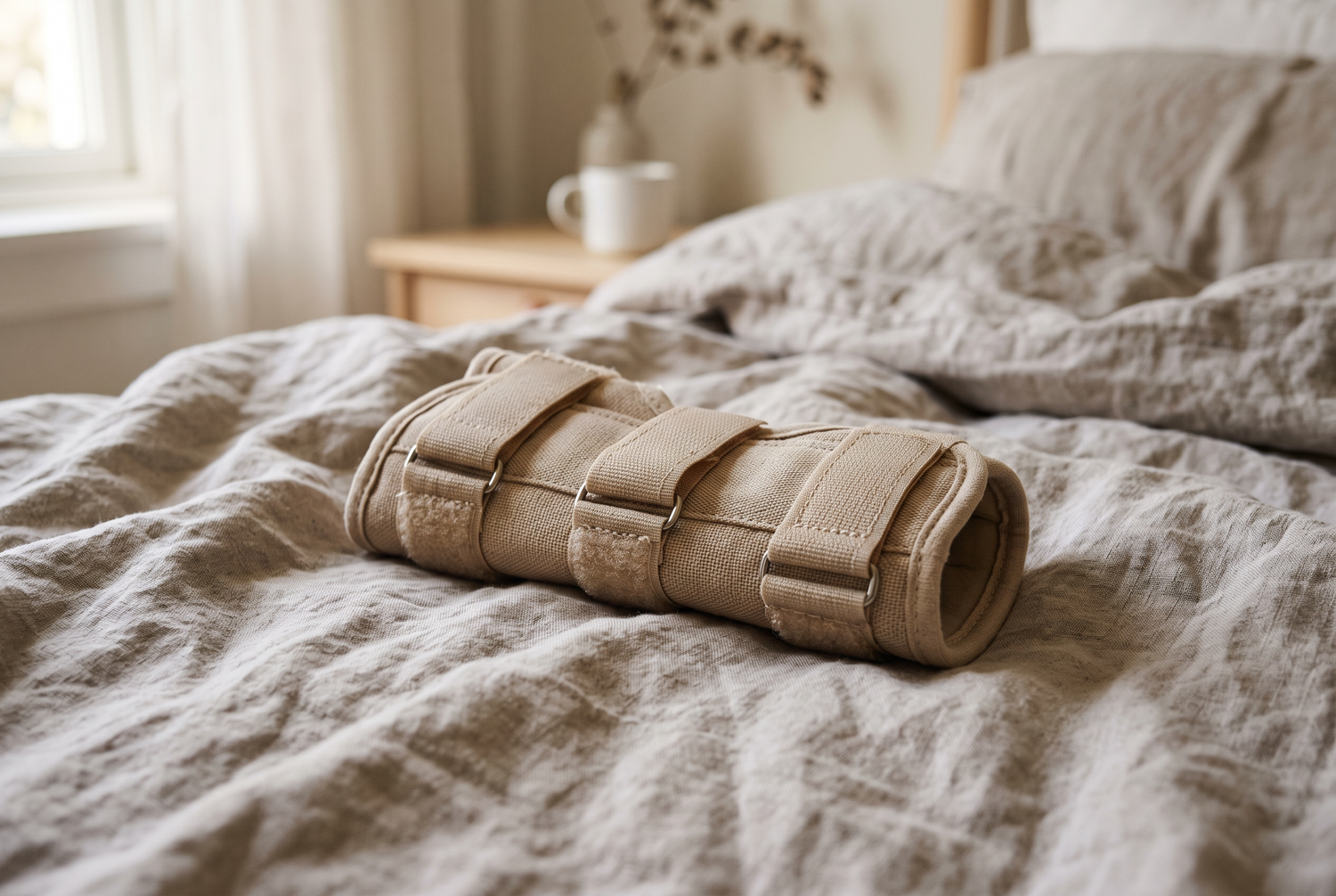
If one measure is well-documented, it's this one. A wrist splint keeps the joint in a neutral position at night – meaning largely straight, with a maximum of about 10 degrees extension. This is where the pressure in the carpal tunnel is lowest. Studies show that for mild to moderate carpal tunnel syndrome, consistent nightly wear for four to eight weeks leads to significant improvement in numbness and sleep quality.
What you should pay attention to: The splint must have a stable support on the palm side, it must not enclose the fingers (otherwise mobility is unnecessarily restricted), and it must not be so tight that it constricts – two fingers should still fit under the strap. Wear it every night, not just when symptoms occur. If both hands are affected, many people start with the worse side and add the second after one to two weeks. A common pitfall: After three good nights, the splint is put away – and the symptoms return. Expect at least six weeks of consistent use.
Common mistakes at night
Mistake 1: Pushing your hand under the pillow. This habit sharply bends the wrist and compresses the nerve for hours. Instead, rest your forearm relaxed beside your body or on a flat pillow.
Mistake 2: Lying on your arm. Your own upper body can easily weigh 20 to 30 kg in the side-lying support area – no arm is built for that. A body pillow in front of your chest gives your upper arm a place and prevents the lower arm from getting trapped under your torso.
Mistake 3: Clenching your fist. If you sleep tense, you keep your fingers bent, which thickens the flexor tendons in the canal. Relaxation exercises in the evening help twice over here.
Mistake 4: Sleeping too warm. Heat promotes swelling. A cool bedroom between 16 and 19 °C is also sensible from this perspective – see ideal sleeping temperature.
Mistake 5: Only looking at the hand. A stiff cervical spine or persistently tense shoulder muscles can promote nerve irritation along the entire arm. Looking at your neck and pillow height is worthwhile.
Practical guide: How to set up your bed and evening
Step 1 – Check pillow height. When lying on your side, your cervical spine should form a straight extension of your thoracic spine. For most side sleepers, this means a pillow height of about 10 to 14 cm, for back sleepers 6 to 10 cm. Details in the Pillow Guide.
Step 2 – Determine arm position. Side sleepers: lower arm extended forward instead of under the head, upper arm on a body pillow. Back sleepers: arms beside the body, palms up, small pillow under each forearm.
Step 3 – Mobilize for 10 minutes in the evening. Nerve gliding exercises: Extend arm sideways, palm forward, gently pull fingers back, while tilting head to the opposite side. 10 repetitions, slowly, without pain.
Step 4 – Cool instead of warm. For acute tingling, a cold gel pack on the wrist for 10 minutes helps better than heat, because it reduces swelling.
Step 5 – Keep an eye on salt and fluid. Very salty evening meals promote water retention. If you are prone to swelling, move your main salty meal to lunchtime.

When surgery is an option
Carpal tunnel release is one of the most common hand surgeries and is considered very reliable. It is considered when conservative measures do not provide sufficient relief after about three months, if numbness is constant, or if nerve conduction measurements show significant damage. With visible muscle wasting at the base of the thumb, there is usually not much longer to wait, as this damage becomes less reversible with increasing duration.
The procedure is performed under local anesthesia, openly or endoscopically, and typically takes 15 to 30 minutes. The nocturnal tingling improves for many affected individuals within the first few nights afterward, while strength and fine motor skills take several weeks to months. The decision should be made in consultation with a hand or neurosurgeon, ideally after a nerve conduction measurement. Important: This article does not replace such an evaluation.
The connection with sleeping comfort and sleep quality
Those who wake up repeatedly at night because of their hands primarily lose deep sleep in the first half of the night and REM sleep towards morning. This affects pain perception and regeneration – a self-reinforcing cycle. Therefore, it is worthwhile to look at the sleeping environment in addition to the splint.
A sleeping surface that allows the shoulder and pelvis to sink in sufficiently when lying on your side prevents you from pushing your arm under your head as a compensatory cushion. If the shoulder barely sinks in, the body seeks relief – usually in precisely the position that compresses the carpal tunnel. The number of nocturnal position changes also decreases when the pressure distribution is correct. More on this in the article on mattresses for side sleepers and the overview of sleep hygiene.
Get CHF 25 discount
Subscribe to newsletter and receive a one-time CHF 25 discount. ✓ 200 nights trial sleep ✓ 10 years warranty
Frequent questions about carpal tunnel at night
Why do hands fall asleep precisely at night?
At night, three factors combine: Many people sleep with their wrists sharply bent, which increases pressure in the carpal tunnel. When lying down, tissue fluid distributes more evenly and also accumulates in the hands. And there is no movement, which acts like a pump for drainage during the day. Therefore, symptoms are strongest between midnight and the early morning hours.
Which fingers are affected by carpal tunnel syndrome?
Typically the thumb, index finger, middle finger, and the thumb-side half of the ring finger. The little finger remains unaffected because it is supplied by a different nerve. If the little finger and ring finger are affected, it points more towards irritation of the ulnar nerve at the elbow, which requires different treatment.
How long do I need to wear the night splint?
Expect at least six to eight weeks of consistent nightly wear before evaluating the results. Many notice initial improvements after two to four weeks. Regularity is important: Those who only wear the splint when experiencing acute symptoms lose a large part of its effectiveness.
Does a different mattress help against numb hands?
Not directly, but indirectly. A sleeping surface that allows the shoulder and pelvis to sink in sufficiently prevents compensatory postures such as the hand under the head or lying on one's own arm. However, for actual carpal tunnel syndrome, it does not replace the splint or medical evaluation.
Can carpal tunnel syndrome resolve on its own?
Yes, this occurs – especially if a temporary cause is behind it, such as pregnancy or an unaccustomed physical strain over a few weeks. For long-standing symptoms with persistent numbness, spontaneous resolution is unlikely, and waiting can solidify nerve damage.
When should I seek medical help?
At the latest when numbness also persists during the day, hand strength decreases, objects frequently fall from the hand, or the thumb muscle atrophies visibly. Also, if symptoms disturb your sleep for weeks, an evaluation is advisable – a nerve conduction study reliably shows how severely the nerve is affected.
This article is for general information purposes only and does not replace medical advice.









Leave a comment
This site is protected by hCaptcha and the hCaptcha Privacy Policy and Terms of Service apply.