
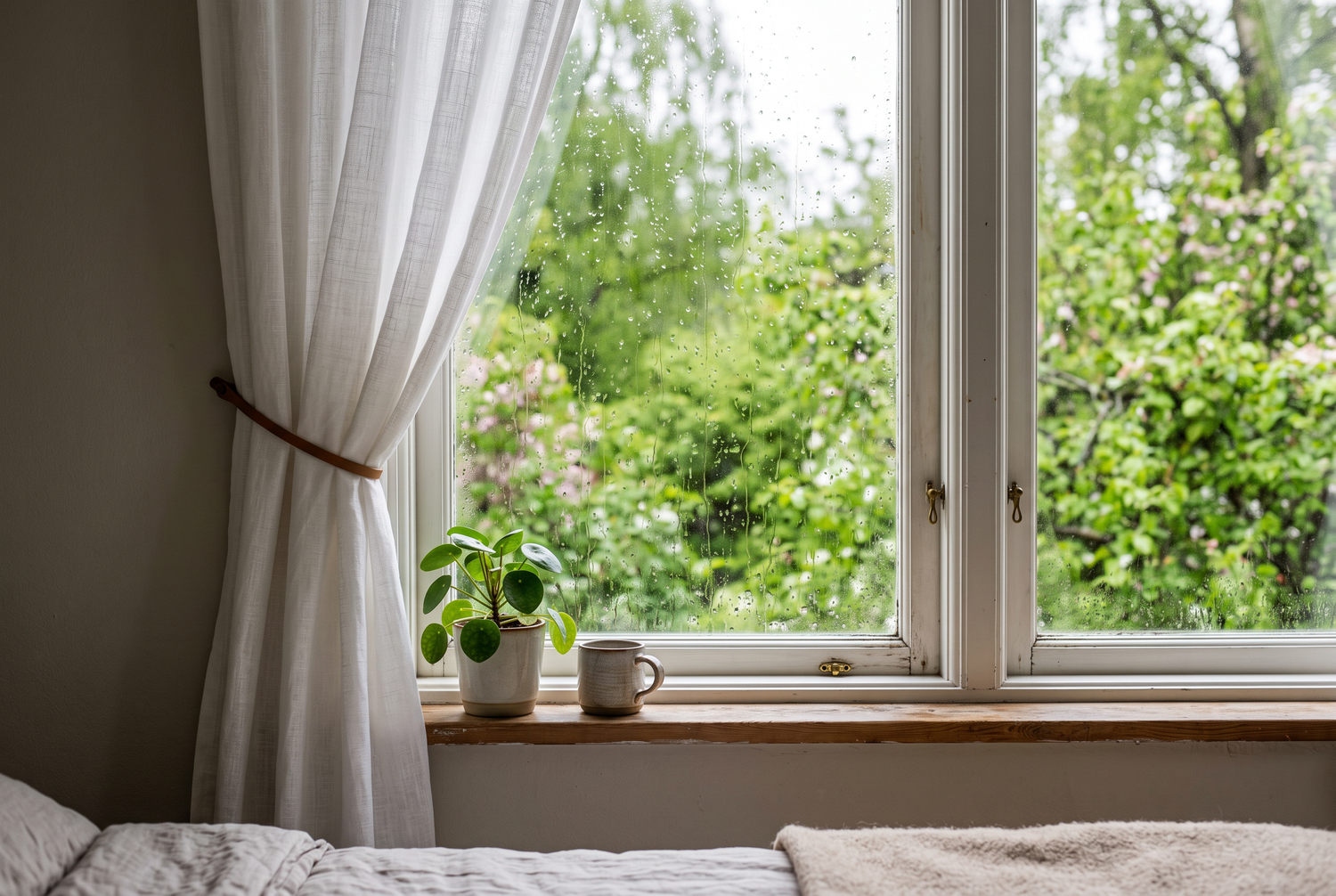
It's May, the night is mild, and you'd love to sleep with the window open. Instead, you're lying there with burning eyes and a nose that's alternately running and blocked, sneezing your way through half the night and waking up exhausted in the morning. Around 20 percent of the Swiss population suffers from hay fever, and the worst symptoms often occur at night and in the early morning hours. The reason lies partly in physiology, and partly simply in the fact that we spend seven to eight hours at a stretch in a room into which we have carried pollen during the day. This is precisely where the good news lies: the bedroom is the place where allergen exposure can be most effectively reduced. This article shows which measures actually make a difference.
The short answer: The most effective measures for pollen allergy in the bedroom are: showering and washing hair in the evening, taking off outdoor clothes outside the bedroom, properly timed ventilation, washing bedding more frequently and at 60 °C, and not drying laundry outdoors. A pollen screen on the window significantly reduces pollen entry, and a HEPA air purifier can further reduce residual exposure. In the city, pollen concentration is highest in the evening; in the countryside, it's highest in the morning – ventilation times should be adjusted accordingly.
- Hair is the biggest carrier of pollen into bed – washing it in the evening makes the biggest single difference.
- Ventilation times: in the city early morning (6–8 AM), in the countryside evening (7–12 PM).
- Pollen screens significantly reduce entry depending on the product and can usually be self-installed.
- Wash bedding weekly at 60 °C during the season, never dry it outside.
- If sleep remains disturbed despite all measures: discuss medical therapy, including hyposensitization, with a doctor.
Why symptoms are often worst at night
Three factors work together. Firstly, physiology: when lying down, the nasal turbinates swell more because gravity-dependent drainage is absent. A mucous membrane already irritated by the allergic reaction then swells completely. Secondly, the inflammatory reaction follows its own rhythm: after the initial pollen contact, an immediate reaction sets in, but four to twelve hours later, a late phase follows with renewed swelling. Those who were outdoors in the afternoon experience the second wave in the middle of the night.
Thirdly, the sheer duration of exposure. A bedroom where pollen has landed on hair, clothes, and bedding is a chamber where you breathe for seven to eight hours without interruption. Pollen is between about 10 and 100 micrometers in size, sinks slowly, and is stirred up again with every movement in bed.
The result is not just an uncomfortable feeling: studies show that allergic rhinitis measurably worsens sleep quality, with more awakenings, less deep sleep, and significantly more daytime fatigue. The impairment of performance is well documented – hay fever is not a trivial matter.
Measures sorted by effectiveness
| Measure | Effort | Expected benefit |
|---|---|---|
| Wash hair in the evening | Low | Very high – hair carries most pollen into bed |
| Remove outdoor clothes outside | Low | High |
| Dry laundry indoors | Low | High |
| Pollen screen on the window | Medium, one-time | High |
| Bedding weekly at 60 °C | Medium | Medium to high |
| HEPA air purifier | Medium, acquisition | Medium – as a supplement, not a replacement |
| Nasal rinse before sleep | Low | Medium |
| Reduce carpets and textiles | High, one-time | Medium |

Correct ventilation: timing beats duration
Completely avoiding ventilation is not an option – stale air, high humidity, and increased CO2 also worsen sleep. It's about finding the right time.
In the city, pollen concentration is typically lowest in the early morning, between about 6 and 8 AM. Pollen rises during the day with thermals and sinks back into the cities in the evening, which is why the load is higher there in the evening.
In the countryside, it's the opposite: pollen release primarily occurs in the morning, so the load is usually lowest between 7 and 12 PM.
Always good: immediately after a heavy rain. Rain washes pollen out of the air and significantly reduces the concentration. Be careful, however, during thunderstorms with strong winds: pollen grains can burst and break down into smaller, more deeply penetrating particles – a phenomenon known as thunderstorm asthma.
Practical: Shock ventilation for five to ten minutes with the window wide open completely exchanges the air, with minimal pollen exposure time. Leaving the window tilted for hours is exactly the opposite. You can find more information on this under proper ventilation.
Common mistakes during pollen season
Mistake 1: Showering in the morning instead of the evening. If you take the day's pollen into bed in your hair, you breathe it in all night long. An evening shower is the most effective single measure of all.
Mistake 2: Drying laundry outdoors. Bedding and pajamas act like pollen filters outdoors – with the result that you sleep in them. Consistently dry laundry indoors during the season.
Mistake 3: Leaving clothes in the bedroom. The day's jacket, sweater, and trousers belong in the hallway or another room, not draped over the chair next to the bed.
Mistake 4: Taking antihistamines only when itching starts. Many preparations work much better preventatively than acutely. Discuss the timing with your doctor or pharmacist – and note that older active ingredients can cause strong drowsiness, while modern ones hardly do.
Mistake 5: Placing the air purifier incorrectly. It should stand freely in the room, not behind a curtain or under a cabinet. Pay attention to the room size specification and a sufficiently quiet night mode – below 30 decibels, it won't disturb sleep.
Practical guide: The low-pollen evening routine
When you get home: Leave shoes and jacket in the entryway. Do not sit on the bed with outdoor clothes – this single habit carries a surprising amount of pollen.
One hour before bedtime: Shower and wash hair. If you don't want to wash your hair daily, you can at least rinse it thoroughly or use a daily-changed cloth over the pillow.
30 minutes before: Nasal rinse with isotonic saline solution. It flushes pollen from the nose before the late reaction sets in. Details on application can be found in the article about stuffy nose at night.
Before going to bed: Briefly air the room if the time of day is appropriate, then close the window. Keep the bedroom door closed so that no pollen from the rest of the living space flows in.
Weekly: Wash bedding at 60 °C. Pillows and duvets every three to six months, depending on care instructions. Mop the floor instead of sweeping dry – sweeping stirs up particles.
Seasonally: Install pollen screens before the start of your season. They can usually be attached with Velcro and removed in the autumn. Filter effectiveness and air permeability are a compromise – read the product information.

Bed and textiles: what matters
Pollen settles everywhere, but especially on textiles. Therefore, the less fabric in the bedroom, the easier the control. Heavy curtains, long-pile carpets, and decorative pillows are pollen reservoirs during the season. Washable, light curtains and a smooth floor are easier to maintain.
When it comes to bedding, washability at 60 °C is key. Cotton and linen easily meet this. Cover fabrics with a tightly woven structure absorb fewer particles than open-pored ones. An encasing, i.e., an allergen-proof cover for mattresses, pillows, and duvets, is particularly useful for house dust mite allergies – for pure pollen allergy, it brings less benefit but does no harm. More on this can be found under mattress protectors and encasing and in the article about bedding for allergy sufferers.
The mattress itself also plays a role – especially regarding whether its cover is removable and washable. A cover that can be machine-washed at 60 °C makes seasonal cleaning significantly easier. How to approach this in general is shown in the article on washing mattress covers.
When medical treatment comes into play
Environmental measures reduce exposure, but they don't eliminate the allergy. If your sleep remains disturbed for weeks despite consistent implementation, a medical evaluation is advisable. A prick test or blood test clarifies which pollens are relevant – this is the basis for everything else.
Available are modern antihistamines that cause little drowsiness, as well as corticosteroid nasal sprays that work locally and have a favorable risk-benefit ratio when used correctly. The only causal treatment is hyposensitization over three years, either as an injection or as a tablet or drops under the tongue. It is time-consuming but can significantly reduce symptoms in the long term and prevent the so-called "escalator phenomenon" to allergic asthma.
Pay particular attention to warning signs of lower airway involvement: coughing at night, shortness of breath during exertion, wheezing breath sounds, or a tight feeling in the chest. These symptoms should be medically clarified – further information can be found in the article on sleep environment for asthma.
Get CHF 25 discount
Subscribe to our newsletter and receive a one-time CHF 25 discount. ✓ 200 nights trial sleep ✓ 10-year warranty
Frequently Asked Questions about Pollen Allergy and the Bedroom
When should I ventilate with a pollen allergy?
In the city, early in the morning between 6 and 8 AM; in the countryside, in the evening between 7 and 12 PM. The reason: pollen rises during the day with thermals and sinks back into cities in the evening. A good opportunity is always directly after heavy rain, as it washes the air clean.
What helps most against pollen in the bedroom?
Showering and washing your hair in the evening. Hair is the biggest carrier of pollen into bed, and if you go to bed with unwashed hair, you breathe in pollen all night. After that: remove outdoor clothing outside the bedroom and do not dry laundry outdoors.
Does an air purifier help?
As a supplement, yes. A device with a HEPA filter can significantly reduce particulate matter in the room if it stands freely and is designed for the room size. However, it does not replace basic measures like showering and changing clothes, but comes after. Look for a quiet night mode below about 30 decibels.
How often should I change bedding during pollen season?
Weekly, washed at 60 °C. Those who are severely affected can at least change the pillowcase every two to three days, as most pollen from hair ends up there. Consistently dry laundry indoors during the season.
Do pollen screens on windows really help?
Yes, they significantly reduce pollen entry when ventilating. The compromise lies in air permeability: the finer the fabric, the better the filtering effect and the lower the air exchange. The screens can usually be self-installed with Velcro and removed in the autumn.
Why are my symptoms worse at night than during the day?
When lying down, the nasal mucous membranes swell more because gravity-dependent drainage is absent. Additionally, the immediate allergic reaction is followed four to twelve hours later by a late phase with renewed swelling – those who were outside in the afternoon experience it in the middle of the night.
This article is for general information purposes only and does not replace medical advice.





Leave a comment
This site is protected by hCaptcha and the hCaptcha Privacy Policy and Terms of Service apply.