
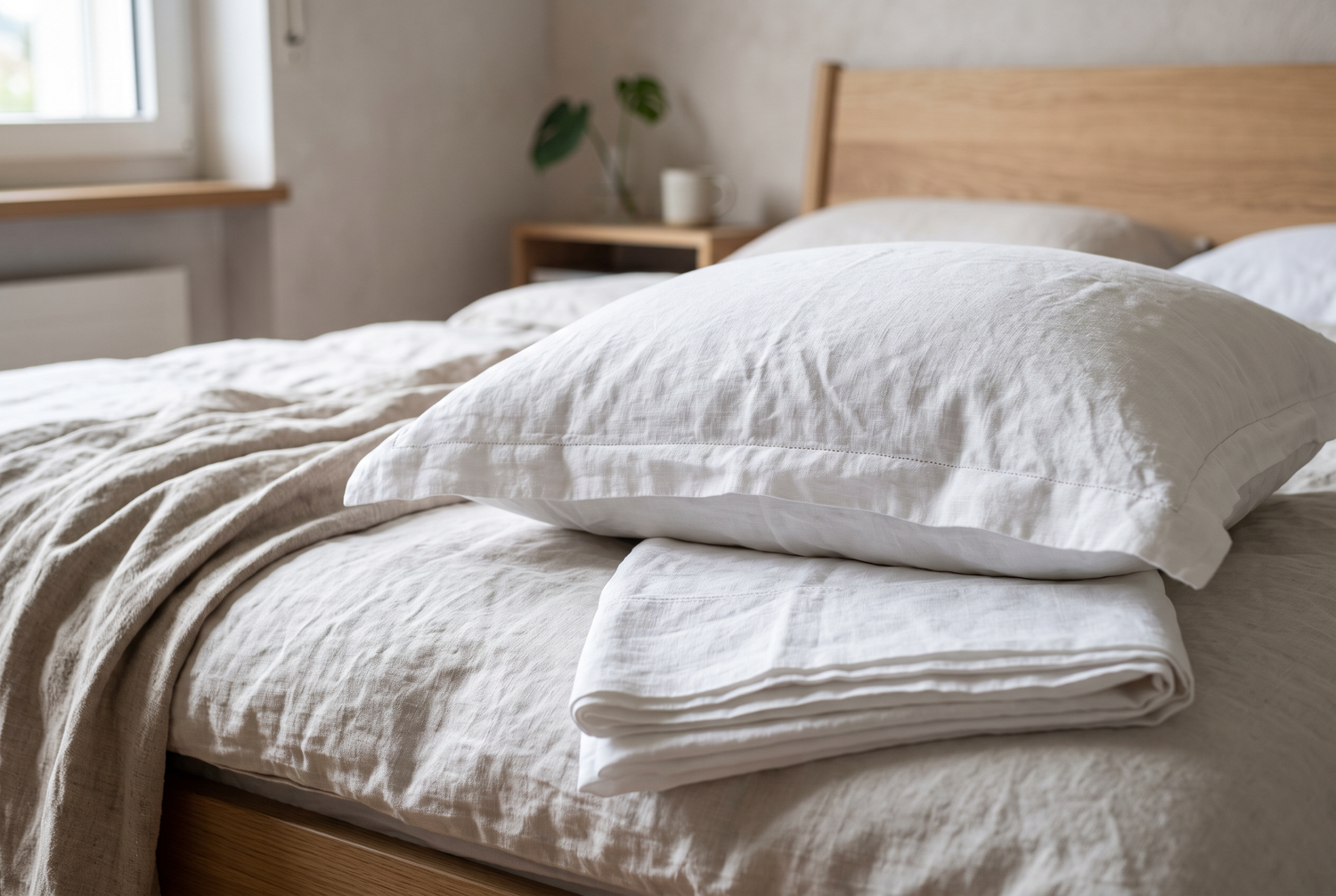
You wake up, turn your head to the side – and it aches. A stiff neck in the morning is one of the most common reasons why people feel tired even after a sufficiently long night's sleep. Often, the cause is sought in the stress of the previous day, but it lies much closer: in the seven to eight hours your head rested on the pillow. The cervical spine is the most mobile and at the same time most sensitive section of the spine, and it tolerates unfavorable positioning much worse than the lower back. The good news: In most cases, the problem can be significantly improved with a few targeted adjustments to the sleeping environment.
The short answer: A stiff neck in the morning usually occurs because the cervical spine is bent or hyperextended for hours. The most common triggers are a pillow that is too high or too flat, a mattress that does not allow the shoulders and pelvis to sink in sufficiently, and sleeping on your stomach with your head turned permanently. Additionally, stress and nocturnal teeth grinding can further tense the neck and jaw muscles. If pillow height, sleeping surface, and sleeping position are well-matched, symptoms disappear for many sufferers within a few weeks. If the pain lasts longer than four weeks or radiates into the arm and hand, the cause should be medically investigated.
- The goal is a straight line from the back of the head over the neck to the thoracic spine – in every sleeping position.
- Side sleepers need a higher pillow (around 10–14 cm), back sleepers a flatter one (around 6–10 cm).
- Sleeping on your stomach rotates the head by up to 90 degrees and is the least favorable position for the neck.
- A sleeping surface that is too firm does not allow the shoulder to sink in and tilts the neck upwards.
Why the neck aches particularly in the morning
During the day, we constantly change our posture – not so during sleep. An adult moves 20 to 40 times per night, but often remains in the same position for 20 to 60 minutes between these changes. If the cervical spine is bent sideways or hyperextended backward, the small neck muscles constantly work against gravity. They statically resist until they tire and react with an increased basic tone – which is exactly what we feel as stiffness in the morning. In addition, the intervertebral discs of the cervical spine absorb fluid at night and swell slightly. This makes an already irritated structure more sensitive in the morning than in the evening. Those who also breathe shallowly and with an open mouth reflexively hyperextend their head to keep the airways clear – a mechanism many know from neck pain caused by the wrong mattress.

Sleeping position: the biggest lever
Each sleeping position places different demands on head support. The same principle always applies: the cervical spine should form a natural extension of the thoracic spine, without sideways bending or hyperextension. In the side-lying position, the pillow must fill the gap between the ear and the shoulder – more for broad shoulders, less for narrow ones. In the back-lying position, this distance is significantly smaller, so the pillow can be flatter. The stomach-lying position is problematic: because the head must be turned to the side for breathing, the cervical spine rotates for hours close to its end position. If you cannot give it up, you should at least sleep without a pillow or with a very flat model and place a pillow under the pelvis to relieve the lumbar spine.
| Position | Recommended pillow height | Typical mistake |
|---|---|---|
| Side position | approx. 10–14 cm, supportive | Pillow too flat, head tilts down |
| Back position | approx. 6–10 cm, softer | Pillow too high, chin on chest |
| Stomach position | 0–5 cm or no pillow | Normal pillow, neck hyperextended |
| Combination sleepers | adaptable model, approx. 8–12 cm | Pillow optimized for only one position |
Pillow and mattress always work together
A common misconception: those who have neck pain in the morning buy a new pillow – and are surprised that little changes. Pillow and sleeping surface form a system. If the shoulder does not sink in enough in the side-lying position because the mattress is too firm, the head is pushed upwards relative to the spine. Even the best pillow can no longer correct this, as it only further widens the gap. Conversely: if the shoulder sinks in too deeply because the sleeping surface provides no support in the shoulder area, the neck bends downwards. The rule of thumb is therefore: first check the sleeping surface, then adjust the pillow. A good test is to have a second person observe from the front – the spine should form a straight horizontal line in the side-lying position. More on this in the pillow guide and for mattresses for side sleepers.
Stress, teeth grinding and drafts
Not every morning tension comes from the bed. Psychological tension measurably increases the resting tone of the shoulder and neck muscles – and this increased tone partially persists during sleep. Those who are still mentally caught up in their workday in the evening literally take the tension to bed with them. The same applies to nocturnal teeth grinding: the chewing muscle is closely connected to the neck muscles via fascial connections, which is why bruxism often occurs together with neck and temple pain. Drafts also play a role – a direct airflow from a window or fan directed at the neck can reflexively tense the muscles. Relaxation techniques such as progressive muscle relaxation address precisely this issue and noticeably reduce muscle tone before falling asleep. Those who ruminate in the evening will find concrete techniques in the article on stress and rumination.
What helps immediately in the morning
Acute warmth usually helps better than cold, as it promotes blood circulation in the tense muscles. A warm shower directed at the neck for two to three minutes, or a grain pillow for 15 minutes, often relieves stiffness faster than stretching in a cold state. This is followed by slow, controlled movements: gently turn the head ten times left and right, then tilt the ear towards the shoulder and hold for 20 seconds each – without pulling and without jerky movements. It is important to involve the shoulder girdle: ten slow shoulder circles backwards activate the muscles that relieve the neck. Those who sit in front of a screen all day should repeat this sequence briefly every two hours, otherwise the tension will return by evening.
When you should seek medical advice
An occasional morning stiffness that resolves within an hour is harmless. You should pay attention if pain radiates into the arm or even into the fingers, if numbness, tingling, or loss of strength occurs, if the symptoms persist for more than four to six weeks despite adjusting the pillow and mattress, or if dizziness, vision problems, or fever occur. Such signs can indicate nerve root irritation or another treatable cause and require medical evaluation. Persistent morning headaches combined with neck stiffness and daytime fatigue are also a reason to consider nocturnal breathing cessations – more on this under recognizing sleep apnea.

Secure CHF 25 discount
Subscribe to our newsletter and receive a one-time CHF 25 discount. ✓ 200 nights trial sleep ✓ 10 years warranty
Frequently asked questions about morning neck stiffness
Which pillow is best for neck stiffness?
It's not the design that's crucial, but the height: it must precisely fill the gap between your ear and the mattress in your preferred sleeping position. Side sleepers usually need 10 to 14 centimeters, back sleepers 6 to 10 centimeters. A pillow that only supports the head and not the neck is usually too small.
Can a mattress that is too firm cause neck pain?
Yes. If the shoulder cannot sink in in the side-lying position, the cervical spine is bent sideways upwards. This strains the neck muscles for hours. A sleeping surface that adapts to the body contour usually solves this problem more reliably than a new pillow alone.
How long does it take for the neck to get used to a new pillow?
Expect one to three weeks. During this time, the muscles adjust to the new position, which can feel unusual at first. If there's no improvement after four weeks or if the symptoms worsen, the height is probably not right.
Does warmth or cold help with morning neck stiffness?
For pure muscle tension without signs of inflammation, warmth usually helps better because it promotes blood circulation and reduces muscle tone. Cold is more useful for acute, inflammatory pain or pain occurring after an injury. When in doubt, what feels comfortable is usually right.
Is sleeping without a pillow better for the neck?
Only for stomach sleepers and some back sleepers with a very flat shoulder area. Side sleepers without a pillow bend the cervical spine sharply downwards, which tends to increase tension. The straight line between the head and spine is always decisive.
This article is for general information and does not replace medical advice.










Leave a comment
This site is protected by hCaptcha and the hCaptcha Privacy Policy and Terms of Service apply.