
During the day, it was somewhat manageable, but as soon as you lie down, your nose clogs up. First one side, then the other after turning over. You breathe through your mouth, your throat dries out, and eventually, you lie wide awake, annoyed by a problem that is essentially harmless. A blocked nose at night has surprisingly significant consequences: it leads to mouth breathing, intensifies snoring, dries out the mucous membranes, and causes awakenings that fragment sleep. Those with chronically obstructed nasal breathing sleep measurably worse – regardless of sleep duration. This article explains why the nose blocks when lying down, what helps immediately at night, and what preventive measures are effective.
The short answer: When lying down, gravity-assisted drainage is lost, blood accumulates in the erectile tissue of the nasal turbinates, and the mucous membrane swells. Additionally, a natural nasal cycle alternates narrowing the sides every few hours – this is more noticeable when lying down. The quickest relief comes from a nasal rinse with isotonic saline solution, elevating the upper body by 15 to 30 degrees, and maintaining humidity at 40 to 60 percent. Decongestant nasal sprays provide immediate relief but should not be used for more than about a week due to the risk of dependency.
- When lying down, the nasal turbinates swell because venous return is less efficient without gravity.
- The natural nasal cycle switches the dominant side every 2 to 6 hours – completely normal.
- Nasal irrigation with isotonic saline solution is the most effective measure without side effects.
- Decongestant sprays: maximum 5 to 7 days, otherwise there is a risk of dependency with permanent swelling.
- Target values in the bedroom: 16 to 19 °C with 40 to 60 percent relative humidity.
Why the nose blocks when lying down
The nasal turbinates are not rigid structures but tissues equipped with erectile tissue – similar to a sponge with a dense venous plexus. Their task is to warm, humidify, and filter the inhaled air. To do this, they must be able to dynamically adjust their blood flow.
When standing and sitting, gravity aids the downward flow of blood. When lying down, this effect is absent, blood remains longer in the erectile tissues, and the mucous membrane thickens. In healthy people, this is barely noticeable. However, if the mucous membrane is already irritated – by infection, allergy, or dry air – this additional millimeter can make the difference between "manageable" and "completely blocked."
In addition, there is the nasal cycle. In most people, one side of the nose is always more congested and therefore narrower, while the other is clearer. Dominance switches every two to six hours. During the day, this goes unnoticed because both sides together allow sufficient air to pass through. At night, with an already swollen mucous membrane, the switch becomes clearly noticeable – hence the familiar pattern "I turn over, and the other side closes up."
The most common causes at a glance
| Cause | Typical indication | First approach |
|---|---|---|
| Common cold | Acute, with sore throat or cough, improves after 7–10 days | Rinse, humidify, patience |
| Allergy (pollen, dust mites) | Itching, sneezing fits, seasonal or strongest in the morning | Allergen reduction, medical therapy |
| Dry indoor air | Winter, heating season, crusts in the nose | Raise humidity to 40–60% |
| Deviated septum | Permanently one side significantly narrower | ENT consultation |
| Polyps | Bilateral, loss of smell, insidious | ENT consultation |
| Rebound after nasal spray | Spray works for shorter periods, nose blocked without spray | Controlled withdrawal, medically supervised |
| Reflux | Heartburn at night, hoarseness, clearing throat in the morning | Avoid late meals, elevate upper body |

Immediate relief: What works at night
1. Nasal rinse with isotonic saline solution. The most effective measure without side effects. It flushes out secretions, allergens, and crusts and moistens the mucous membrane. Use a nasal irrigator with body-temperature water (about 35 °C) and the amount of salt specified on the package – homemade salt water in the wrong concentration will sting. Hypertonic solutions (higher salt content) have a stronger decongestant effect in the short term but are more irritating.
2. Elevate the upper body. 15 to 30 degrees is sufficient. Important: elevate the entire upper body, not just the head with a stack of pillows – otherwise, your neck will bend. An adjustable bed or a wedge pillow solves this neatly; alternatively, place planks under the bed legs at the head end.
3. Moist warmth. A warm, moist cloth on the bridge of the nose and cheeks for five minutes loosens secretions and has a relaxing effect. Inhaling with steam is also possible – with caution due to the risk of scalding, and without essential oils for small children.
4. Drink. Sufficient fluid keeps secretions thin. A glass of lukewarm water or herbal tea before sleep, but not too much to avoid nocturnal bathroom trips.
5. Use side sleeping. If one side is clearer, lie on your side with that side facing up – the lower side is more likely to swell due to gravity.
Common mistakes
Mistake 1: Continuous use of decongestant nasal spray. Probably the most consequential mistake. Xylometazoline and related active ingredients work reliably, but after about five to seven days, dependency sets in: the mucous membrane swells more strongly after the effect wears off than before. This creates a cycle that can only be broken with medical supervision.
Mistake 2: Stacking too many pillows. This kinks the neck and further narrows the throat. It is better to recline the entire upper body.
Mistake 3: Humidifier without a hygrometer. Too much humidity is also a problem: above 60 percent, the risk of mold increases significantly. A simple hygrometer for a few francs provides clarity – more under Humidity in the bedroom.
Mistake 4: Overlooking the allergy. Anyone who has a blocked nose at night all year round and sneezes in the morning should consider dust mites – see Dust mites in the mattress.
Mistake 5: Alcohol as a sleep aid. Alcohol dilates blood vessels and increases mucous membrane swelling. Those who drink in the evening more often have a blocked nose.
Prevention: Furnishing the bedroom
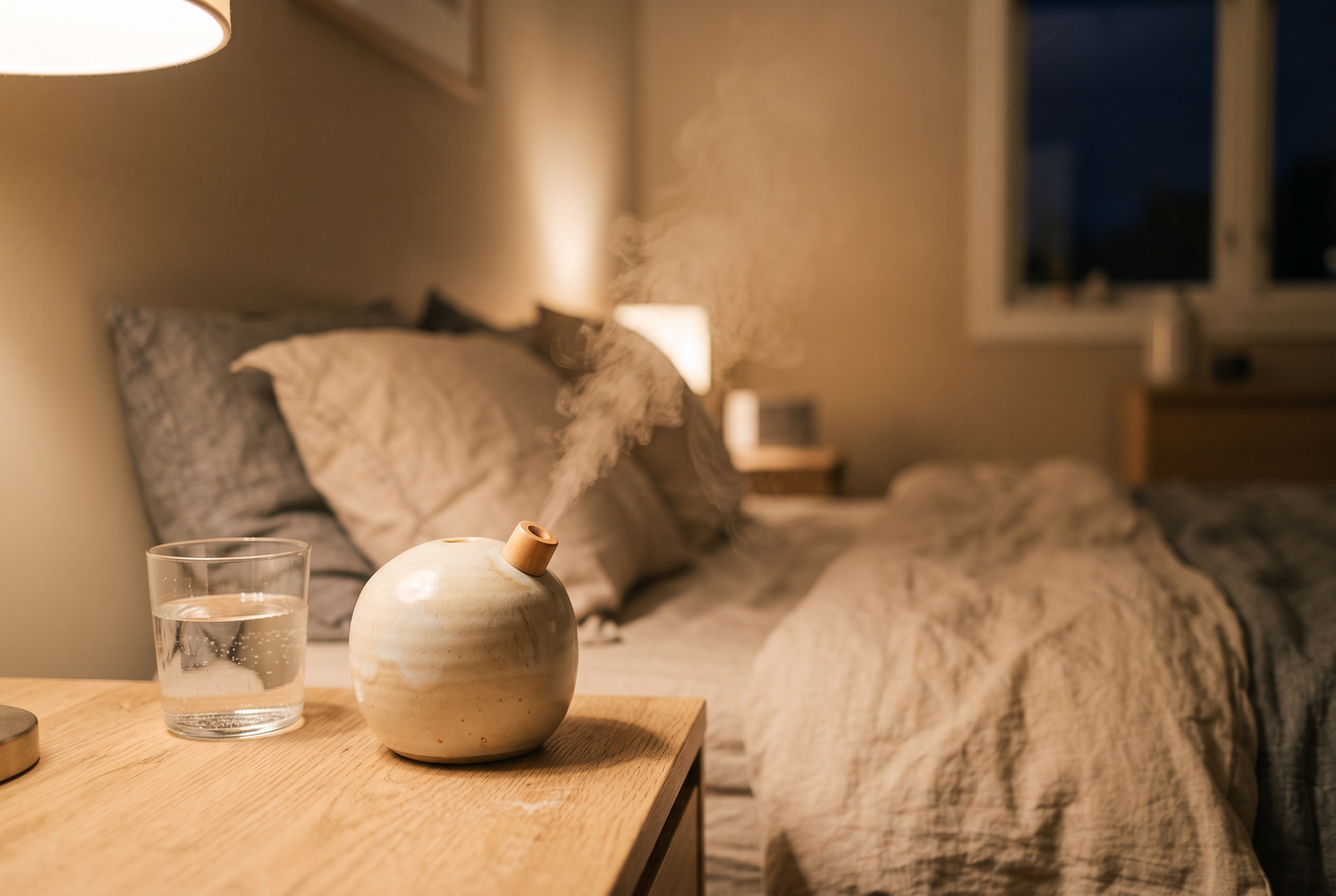
Measure and control humidity. Target range 40 to 60 percent. In winter with heating, it often drops below 30 percent, which dries out the mucous membrane. A humidifier helps but must be cleaned regularly – otherwise, it becomes a breeding ground for germs. Even a shallow bowl of water on the radiator or drying laundry in the room measurably improves values.
Maintain temperature. 16 to 19 °C is the target range. Rooms that are too warm also dry out additionally – see ideal sleeping temperature.
Ventilate correctly. Twice daily, ventilate thoroughly for five to ten minutes to exchange the air without cooling down the walls. Continuous tilting is inefficient and promotes moisture problems on cold surfaces – details under proper ventilation.
Reduce dust. Smooth surfaces, fewer textiles in the bedroom, wash bedding every one to two weeks at 60 °C. This helps against dust mite allergens as well as non-specific irritation.
Nasal care as a routine. A rinse morning and evening, in the heating season additionally sea salt nasal spray or a nasal oil, keeps the mucous membrane functional. Unlike decongestant sprays, these products can be used long-term without harm.

Why mouth breathing is a problem in itself
When the nose is blocked, you breathe through your mouth – which works but has disadvantages. The nose warms the air to body temperature, humidifies it to near complete saturation, and filters particles. The mouth can do none of this. The result: dry mucous membranes in the throat, hoarseness in the morning, a furry feeling on the tongue, and an increased risk of cavities because the protective saliva film dries out.
In addition: mouth breathing promotes snoring because the lower jaw sinks backward and the base of the tongue narrows the pharynx. Therefore, those who breathe through their mouth due to a blocked nose often snore louder. Conversely, snoring significantly improves for many people once nasal breathing is clear again. If you regularly wake up with a dry mouth after the night, you can find further approaches under Anti-snoring aids.
When medical clarification is advisable
A cold-related blocked nose improves within seven to ten days. If the blockage lasts longer than three to four weeks or recurs repeatedly, it should be examined by an ENT doctor. These constellations also indicate a need for clarification: only one side permanently blocked (suspected deviated septum), loss of smell for weeks (suspected polyps), unilateral bloody discharge, facial pain or pressure over the sinuses with fever.
If an allergy is suspected, a prick test or blood test clarifies which allergens are relevant. This is the basis for targeted therapy – for example, with a corticosteroid nasal spray, which unlike decongestant sprays can also be used long-term, or with hyposensitization. Those who are affected at night mainly during pollen season can find practical measures in the article about the pollen-free bedroom.
Get CHF 25 discount
Subscribe to newsletter and receive a one-time CHF 25 discount. ✓ 200 nights trial sleep ✓ 10 years warranty
Frequently asked questions about blocked nose at night
Why is the nose more blocked at night than during the day?
When lying down, gravity-assisted drainage is lost, blood remains longer in the erectile tissue of the nasal turbinates, and the mucous membrane swells. Additionally, a natural nasal cycle alternates the dominant side every two to six hours – which becomes very noticeable at night with an already irritated mucous membrane.
What immediately helps with a blocked nose in bed?
A nasal rinse with isotonic saline solution at about 35 °C, then elevate the entire upper body by 15 to 30 degrees. Additionally, a warm, moist cloth on the bridge of the nose and cheeks for five minutes helps. If one side is clearer, lie on your side with that side facing up.
How long can I use decongestant nasal spray?
A maximum of five to seven days at a time. After that, there is a risk of dependency: the mucous membrane swells more strongly after the effect wears off than before, creating a cycle. Sea salt sprays and nasal oils, however, are safe for continuous use.
What is the correct humidity in the bedroom?
40 to 60 percent relative humidity at 16 to 19 °C. Below 30 percent, the nasal mucous membrane dries out and becomes more susceptible to swelling and infections; above 60 percent, the risk of mold increases. An inexpensive hygrometer reliably shows your current levels.
Can a blocked nose cause snoring?
Yes. When the nose is blocked, mouth breathing is adopted. This causes the lower jaw to sink backward, the base of the tongue to narrow the pharynx, and snoring noises to increase. For many people, snoring significantly improves once nasal breathing is clear again.
When should I see an ENT doctor?
If the blockage lasts longer than three to four weeks or recurs repeatedly, if only one side is permanently blocked, with loss of smell for weeks, with unilateral bloody discharge, or with facial pain and fever. Suspicion of an allergy is also a good reason for clarification.
This article is for general information purposes only and does not replace medical advice.









Leave a comment
This site is protected by hCaptcha and the hCaptcha Privacy Policy and Terms of Service apply.