
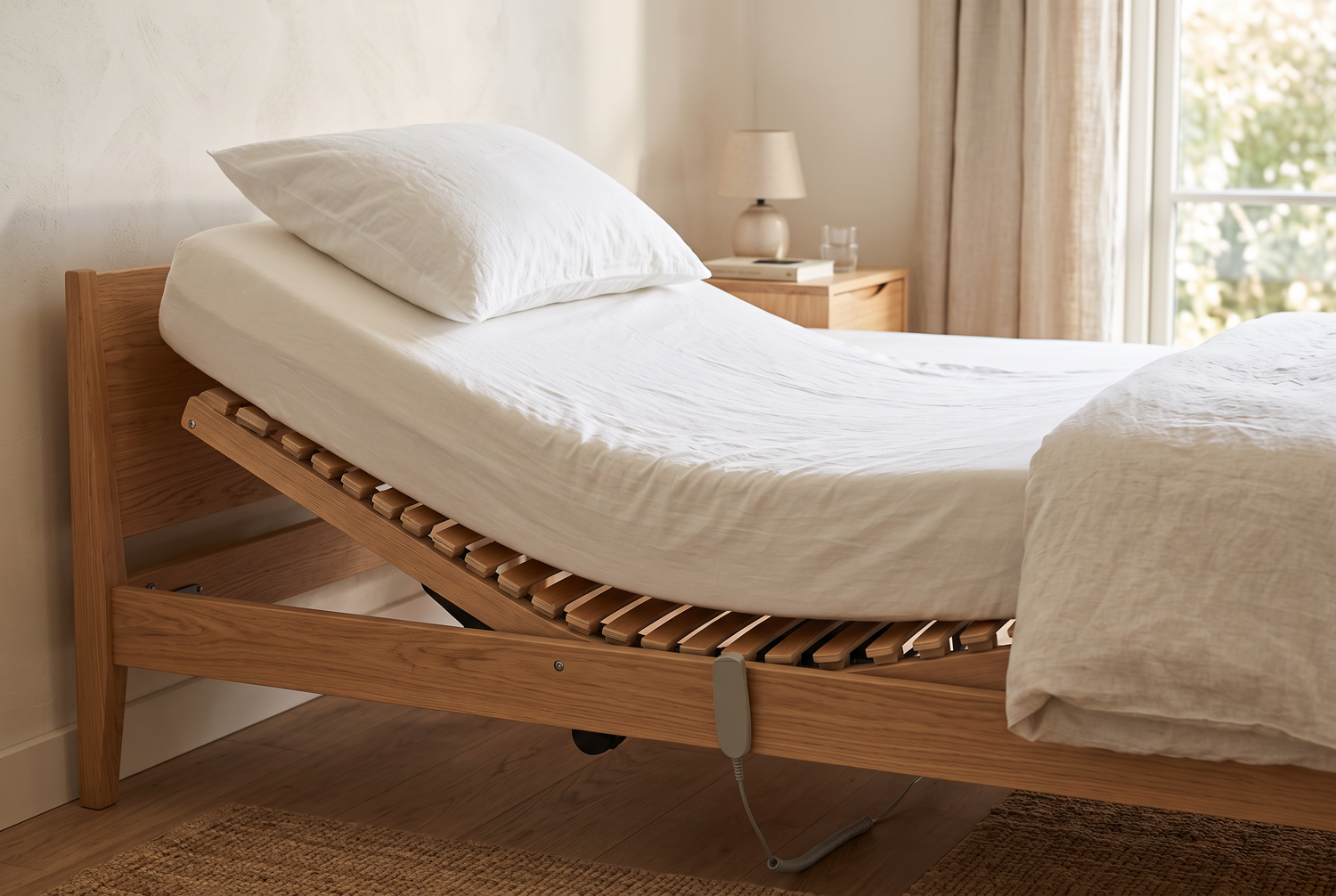
An electrically adjustable bed was long considered an aid for care situations. Today, it is found in more and more normal bedrooms – even for people without health limitations. The reason is simple: those who read, watch TV, or work on a laptop in the evening prefer to sit propped up rather than with three stacked pillows. In addition, there are specific health applications where a slight elevation of the upper body demonstrably helps. At the same time, a motorized frame costs significantly more than a rigid slatted frame, requires electricity, and restricts mattress choice. This guide realistically assesses the benefits and effort – so you can decide if the investment is worthwhile for your situation.
The short answer: An electrically adjustable bed is particularly beneficial for nocturnal reflux, light snoring, swollen legs, or difficulty getting up from a flat position. A headrest elevation of 15 to 30 degrees is sufficient for most of these effects. The benefit as a comfort feature for reading and watching TV is also real. However, those who sleep flat without problems and have none of the aforementioned complaints primarily gain convenience – not a medical necessity. Important: The mattress must be flexible enough to follow the adjustment without kinking.
- 15 to 30 degrees of headrest elevation is sufficient for most health effects.
- Clear benefits for nocturnal reflux, light snoring, and swollen legs.
- Power consumption is low – typically under 5 kWh per year with normal use.
- Only flexible mattresses are suitable; rigid innerspring models kink or get damaged.
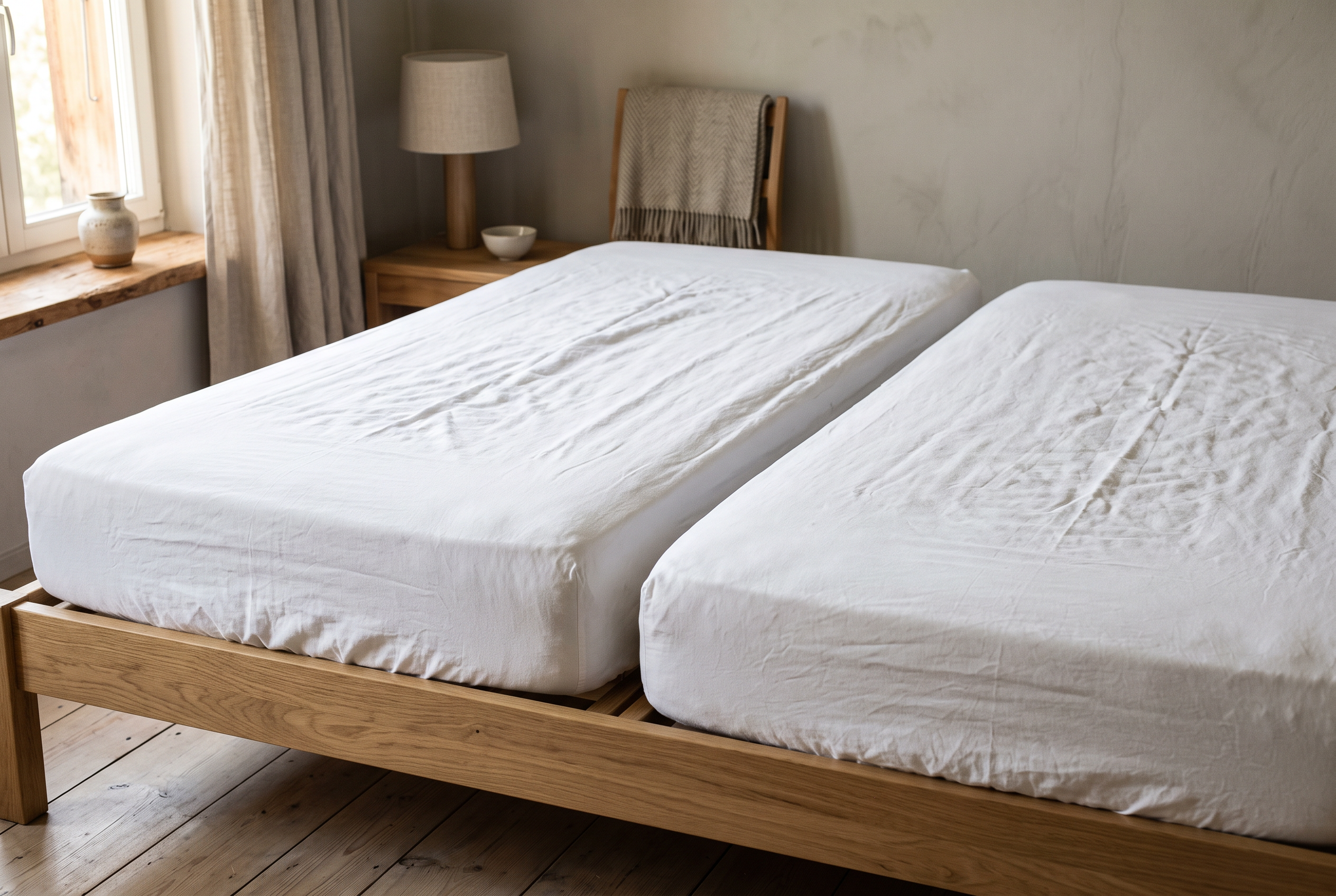
- In a double bed, each side needs its own mattress if independent adjustment is desired.
How an adjustable bed works technically
A motorized frame is essentially a slatted frame with movable segments. Two adjustment areas are common: head and back section, and foot section with thigh and calf segments. They are driven by electric motors, controlled via a wired remote control or app. High-quality models offer memory positions, a zero-gravity function, and emergency lowering in case of power failure.
Adjustment angles typically range from 60 to 70 degrees for the head section and 30 to 45 degrees for the foot section. For sleeping, these maximum values are irrelevant – they are for sitting. At night, 15 to 30 degrees is the practically relevant range. When purchasing, make sure the head section can be adjusted finely and not just in coarse steps.
An often overlooked detail: the load capacity. Motorized frames are usually designed for 120 to 150 kg per sleeping surface, including the mattress. Those who are heavier or use a very heavy mattress should specifically look for reinforced models. You can find basic information on the topic under electric slatted frame.
When adjustment truly helps
Nocturnal Reflux
With nighttime heartburn, stomach contents flow back into the esophagus. Elevating the upper body uses gravity to make this more difficult. Even 15 to 20 degrees often show results in practice. It is important that the entire upper body is elevated and not just the head – otherwise, the abdominal area can kink and pressure may even increase. A motorized frame achieves this better than any stack of pillows. More on this under heartburn and reflux at night.
Light Snoring
When lying on your back, the tongue falls backward and narrows the throat. A slight elevation of the upper body counteracts this. For simple snoring without breathing pauses, this can noticeably help. If sleep apnea is suspected – i.e., nocturnal breathing pauses with pronounced daytime fatigue – bed adjustment does not replace medical clarification. Information on this under recognizing sleep apnea.
Swollen Legs and Venous Complaints
Elevating the foot section by 10 to 20 cm supports venous return and can reduce evening swelling. An elevation starting from the thigh, not just the feet, is useful – otherwise, a kink can occur in the back of the knee. For existing venous or heart conditions, you should discuss the positioning with your doctor.
Getting Up and Mobility
Those who have difficulty sitting up from a flat position – after operations, with osteoarthritis, or in old age – benefit significantly. The bed brings the upper body into an almost sitting position, from which getting up requires significantly less effort. In combination with an appropriate bed height of 45 to 55 cm, this often makes the difference between independent and dependent.

Which mattress suits a motorized frame
This is where many purchases fail. A mattress on an adjustable frame must bend multiple times a day without being damaged and without forming a hard edge at the bending points. Point-elastic foams can do this very well: they follow the contour evenly and fully return to their original shape.
Classic innerspring mattresses, however, are problematic. The continuous innerspring is designed for a flat surface. If it is permanently bent, springs can deform permanently, connections can break, and a noticeable edge forms at the bending point. Some manufacturers explicitly offer adjustable-suitable innerspring models with integrated flex zones – without this indication, you should not risk it.
| Mattress Type | Suitability for Motorized Frames | Note |
|---|---|---|
| Memory/Visco Foam | Very good | Follows contour without edge formation |
| Cold Foam | Good | Slightly stiffer with high core height |
| Latex | Good | Heavy – check frame load capacity |
| Pocket Spring | Only with approval | Requires manufacturer's flex zones |
| Bonnell Spring | Unsuitable | Permanent deformation, risk of breakage |
Practical tip: Also pay attention to the mattress height. Very high models over 25 cm bend less well and unnecessarily raise the sitting position. 18 to 24 cm is a good range. Further details can be found in the guide to mattresses for adjustable slatted frames.
Cost, electricity, and everyday usability
A simple motorized frame measuring 90 × 200 cm starts at around CHF 500 to 800. High-quality models with two motors, memory positions, and emergency lowering cost between CHF 1200 and 2500 per sleeping surface. For a double bed with independent adjustment, this price doubles accordingly.
Electricity consumption is surprisingly low. The motors only run during adjustment – typically a few minutes per day. Assuming a power consumption of around 100 to 200 watts and five minutes of daily use, this results in less than 5 kWh per year. More relevant is the standby consumption of the power supply; look for models with standby under 0.5 watts or disconnect the bed from the power supply during longer absences.
Regarding noise: Good motors operate at around 40 to 50 dB – comparable to a quiet refrigerator. Cheaper models can be significantly louder, which is particularly disturbing if your partner is already asleep. If possible, listen to the noise before purchasing.
Common mistakes with adjustable beds
Mistake 1: Adjusting too steeply. Many set the headrest to 45 degrees or more. This is too much for sleeping – the body slides down during the night and the spine becomes compressed. 15 to 30 degrees is the sensible range.
Mistake 2: Only raising the headrest. Without a slight footrest elevation, you slowly slide downhill. A minimal elevation of the thigh area by 5 to 10 degrees stabilizes the position.
Mistake 3: Using an unsuitable mattress. The most expensive mistake. A bent innerspring mattress will be permanently deformed after a few months – and the warranty usually does not apply in this case.
Mistake 4: A continuous mattress in a double bed. If both sides are to be adjusted independently, each side needs its own mattress. A continuous one would tense transversely and bulge when lifted on one side.
Mistake 5: Ignoring cable routing. Motor cables must be routed in such a way that they cannot be pinched or pulled during adjustment. Check this after assembly in all end positions.

How to find your setting
Step 1 – Define your goal. Is it about reflux, snoring, legs, or comfort? Each goal has a different ideal position. Reflux: upper body 15–20 degrees. Legs: foot section 10–20 cm. Reading: headrest 40–60 degrees.
Step 2 – Start small. Begin with 10 degrees and increase over a week. The body needs time to adapt to the changed pressure distribution.
Step 3 – Check for sliding. Do you wake up lower than when you fell asleep? Then the headrest is too steep or the foot section is too flat.
Step 4 – Adjust pillows. With the headrest elevated, you often need a flatter pillow than before, otherwise the neck will be overstretched. Our pillow guide offers orientation.
Step 5 – Review after two weeks. Are the symptoms improving? If not, the cause is probably different – in which case, medical clarification is worthwhile instead of further adjustment attempts.
Get CHF 25 discount
Subscribe to our newsletter and receive a one-time CHF 25 discount. ✓ 200 nights trial sleep ✓ 10-year warranty
Frequently asked questions about adjustable beds
How much should the headrest be elevated for sleeping?
For sleeping, 15 to 30 degrees is the sensible range. Steeper settings cause the body to slide down during the night and compress the spine. Larger angles are only suitable for sitting, reading, or watching TV.
Does an adjustable bed help with snoring?
For simple snoring without breathing pauses, a slight elevation of the upper body can noticeably help because the throat remains more open. If sleep apnea with nocturnal breathing pauses and pronounced daytime fatigue is suspected, this does not replace medical clarification.
Which mattress is suitable for a motorized frame?
Point-elastic foams such as memory or cold foam are very suitable because they follow the contour and fully return to their original shape. Bonnell spring is unsuitable. Pocket spring only if the manufacturer explicitly approves the model for adjustable frames.
How high is the power consumption of an adjustable bed?
Very low. The motors only run during adjustment, usually a few minutes per day. With normal use, this results in less than 5 kWh per year. More relevant is the standby consumption of the power supply – look for values below 0.5 watts.
Do I need two mattresses in a double bed?
If both sides are to be adjusted independently, yes. A continuous mattress would tense transversely and bulge when lifted on one side. However, for synchronously adjusted frames, a continuous mattress is possible, provided it is sufficiently flexible.
Can I use a motorized frame in an existing bed frame?
Mostly yes, provided the frame has a circumferential support frame and the internal dimensions fit. Make sure there is enough space under the frame for the motors and that the cables cannot be pinched.
This article is for general information and does not replace medical advice.








Leave a comment
This site is protected by hCaptcha and the hCaptcha Privacy Policy and Terms of Service apply.