
The market for anti-snoring aids is large and confusing: nasal strips, nasal dilators, chin straps, sprays, specially shaped pillows, vests with back padding, apps that wake you up with vibrations, and dental splints from the internet. The advertising promises all sound similar, prices range from five to several hundred Swiss francs – and their effectiveness differs significantly. Around 40 percent of men and 20 percent of women in middle age snore regularly, meaning a corresponding number of people resort to these products, often after sleepless nights for their partner. This article categorizes common aids by their mechanism of action and evidence, and shows where you should start first.
The short answer: There is no single anti-snoring aid that works for everyone – because the causes are varied. Mandibular advancement devices (for pharyngeal narrowing), positional therapy (for snoring predominantly in supine position), and weight reduction are the best-proven methods. Nasal strips and nasal dilators only reliably help if the nose is indeed the bottleneck. Sprays, chin straps, and most special pillows have limited data supporting their effectiveness. Before any purchase, it should be clarified whether obstructive sleep apnea is behind the snoring – in which case these aids are not the right solution.
- First, clarify: simple snoring or sleep apnea? Pauses in breathing change everything.
- The mandibular advancement device is the most studied aid – but only effective when custom-fitted by a dentist.
- For snoring predominantly in the supine position, positional therapy often reduces intensity by half.
- Even a 5 to 10 percent weight reduction can noticeably reduce snoring.
- Alcohol in the evening reliably exacerbates snoring – the cheapest lever of all.
Why the cause determines the solution
Snoring occurs when air flows through a narrowed upper airway, causing soft tissue to vibrate – usually the soft palate and uvula, sometimes the base of the tongue or pharyngeal walls. However, the narrowing can be located in very different places, and this is precisely what determines which aid is useful.
If the narrowing is in the nose – for example, due to a septal deviation, chronically swollen nasal turbinates, or an allergy – then nasal strips, dilators, and treating the underlying cause can help. If it's in the throat, because the lower jaw falls back during sleep and the base of the tongue blocks the airway, you need a measure that keeps the jaw forward. And if snoring only occurs when lying on your back, positioning is key.
The simplest self-test: record your sleep using an app over several nights. Does snoring only occur during certain phases? Does your partner report that it stops as soon as you turn onto your side? You can find basic information about the phenomenon in the article on Snoring: Causes and What Helps.
Aids compared
| Aid | Mechanism of action | Evidence | Suitable for |
|---|---|---|---|
| Mandibular advancement device | Holds the lower jaw 5–10 mm forward, opening the throat | Good | Throat narrowing, also mild apnea (after clarification) |
| Positional therapy (vest, back pillow) | Prevents supine sleeping | Good for positional snoring | Snoring only or predominantly on the back |
| Nasal strips / Nasal dilators | Mechanically widens the nasal vestibule | Mixed, good for nasal narrowing | Narrow nasal entrance, cold |
| Throat sprays and oils | Aimed at making tissue "smoother" | Weak | Possibly short-term, not for continuous use |
| Chin strap | Keeps the mouth closed | Weak, partly counterproductive | Only for pure mouth breathing, never for apnea |
| Anti-snoring pillows | Changes head and neck angle | Thin, very product-dependent | Unfavorable neck posture, worth a try |
| CPAP therapy | Keeps airways open with positive pressure | Very good | Moderate to severe sleep apnea |

First clarify: harmless snoring or sleep apnea?
This step is more important than any product choice. With simple snoring, tissue vibrates, but breathing remains continuous. In obstructive sleep apnea, the airway repeatedly collapses completely or partially; pauses in breathing occur for ten seconds or more, followed by an arousal and often a loud snort.
Warning signs that suggest apnea: observed breathing pauses, loud snoring with sudden interruptions, morning headaches, pronounced daytime sleepiness despite sufficient time in bed, night sweats, frequent urination at night, and a neck circumference over approximately 43 cm in men or 40 cm in women. If several of these apply, it should be investigated – outpatient screening devices make this uncomplicated today. Details in the article Recognizing Sleep Apnea.
Why this is so important: A chin strap or a spray that dampens the noise without eliminating breathing pauses removes the warning signal and leaves the underlying problem unresolved. Untreated sleep apnea significantly increases the risk of high blood pressure and cardiovascular diseases.
The three most effective levers in detail
1. Positional Therapy
For many people, snoring occurs exclusively or predominantly when lying on their back, because in this position the lower jaw and the base of the tongue sink backwards due to gravity. The classic solution is the "tennis ball trick": a ball or a firm pillow sewn into the back of the pajamas. More modern options include vests with padding or small sensors that vibrate gently when you lie on your back. Studies show significant reductions in position-dependent snoring. Prerequisite: You must be able to lie comfortably on your side – if your shoulder cannot sink in there, you will unconsciously turn back.
2. Mandibular Advancement Device
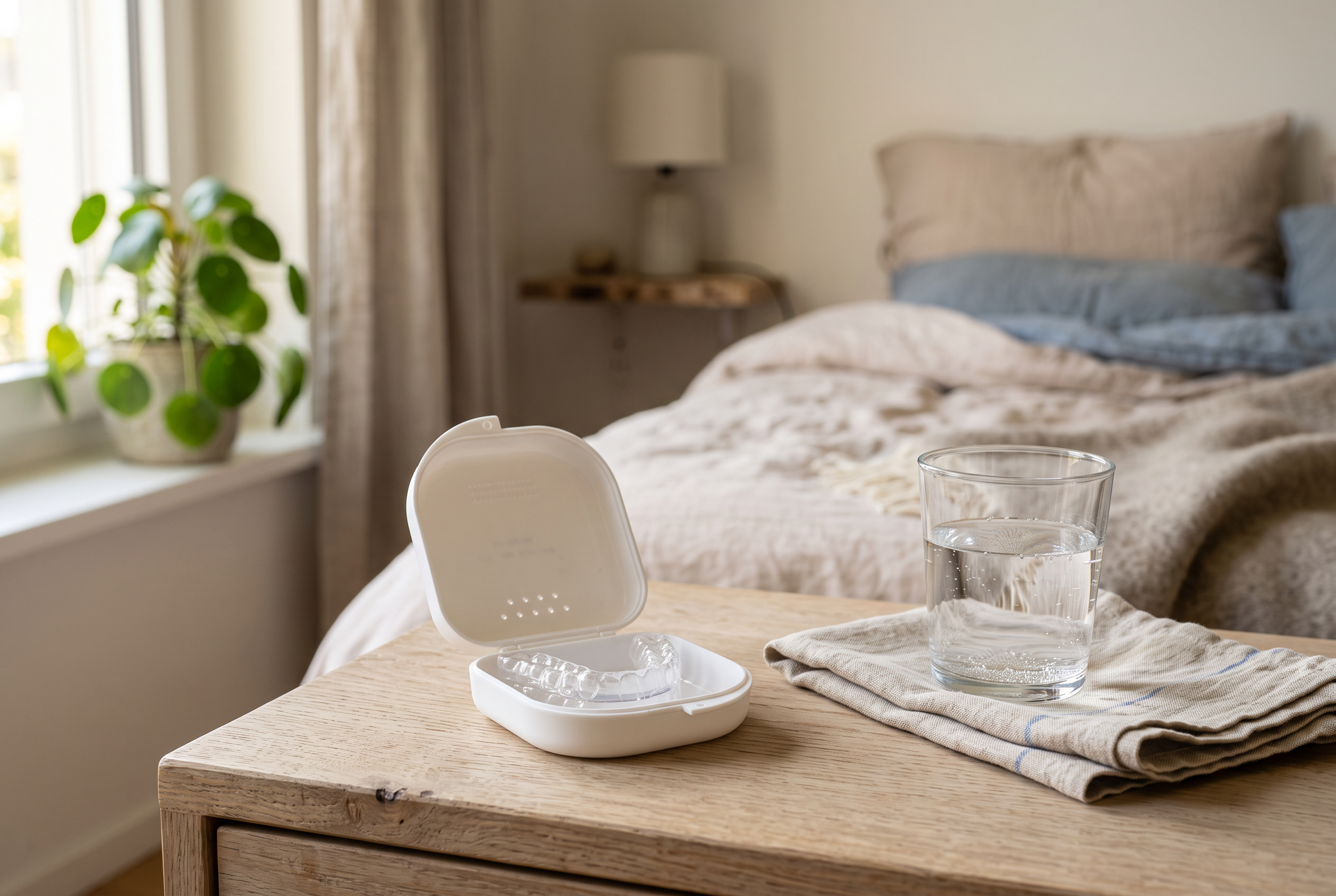
It consists of two splints for the upper and lower jaw, which are connected and typically hold the lower jaw 5 to 10 mm forward. This opens the throat behind the base of the tongue. Important: Only a dental-fitted splint is effective. Self-adjusting variants from the internet are often ill-fitting, can shift teeth, and cause temporomandibular joint problems. Prerequisites are sufficiently healthy teeth and a pain-free temporomandibular joint – if you grind your teeth at night, you should mention this beforehand.
3. Weight and Alcohol
Fat tissue in the neck area narrows the airway. Studies show that even a reduction of 5 to 10 percent of body weight can noticeably improve snoring and the apnea index. Alcohol, in turn, directly relaxes the pharyngeal muscles and reliably exacerbates snoring – those who abstain for three hours before sleep often notice a difference on the very first night. More on this under Alcohol and Sleep Quality.
Common mistakes when buying anti-snoring aids
Mistake 1: Buying without clarifying the cause. Using a nasal strip when the narrowing is in the throat wastes money and time. First understand, then buy.
Mistake 2: Dental splints from the internet. The price difference to custom-made dental devices is significant, but so is the risk of malocclusions and temporomandibular joint problems. This saving can turn out to be expensive.
Mistake 3: The chin strap if apnea is suspected. Forcing the mouth closed when the nose is blocked or breathing pauses exist can worsen the situation.
Mistake 4: Trying only one remedy and giving up. Snoring is often multifactorial. A combination of side sleeping, alcohol abstinence, and treated nasal breathing usually works better than any single remedy.
Mistake 5: Ignoring the sleep environment. Dry heating air irritates mucous membranes and increases swelling. A relative humidity of 40 to 60 percent is also advisable from this perspective – see Humidity in the Bedroom.
Practical Guide: Your Four-Week Plan
Week 1 – Observe. Record four to five nights with a recording app. Note alcohol intake, exercise times, meal times, and how you fell asleep. Goal: recognize patterns.
Week 2 – The free levers. No alcohol after 7 PM, last large meal three hours before sleep, bedroom temperature 16 to 19 °C, fixed bedtimes. Continue recording and comparing.
Week 3 – Test positioning. If recordings show snoring predominantly on your back: encourage side sleeping. A body pillow behind your back and one between your knees makes side sleeping more stable and comfortable.
Week 4 – Check your nose. For chronically obstructed nasal breathing, an ENT check-up is advisable. Short-term relief can be found with a nasal rinse using isotonic saline solution; decongestant nasal sprays should not be used for longer than about one week due to the risk of habituation. If the cause is allergic, it's worth looking at an allergy-friendly bedroom.
After that: If snoring continues to be bothersome or if signs of apnea persist, the next step is a medical examination – not the purchase of the next product.

What the sleep environment can contribute
The side sleeping position is the best position for many snorers – but only if it is also comfortable. If the shoulder cannot sink in, pressure builds up, and the body unconsciously turns back onto its back during sleep. This puts any positional therapy at a disadvantage. A surface with good pressure distribution is therefore an often overlooked prerequisite for being able to maintain the side position at all.
The pillow height also counts. A pillow that is too high kinks the neck and can further narrow the throat, while one that is too flat causes the head to tilt backwards. As a guide, 10 to 14 cm is usually recommended for side sleepers, and 6 to 10 cm for back sleepers – more in the Pillow Guide. A slight elevation of the upper body by about 10 to 15 degrees, as enabled by an adjustable bed, can noticeably reduce snoring for some people.
Get CHF 25 discount
Subscribe to newsletter and receive a one-time CHF 25 discount. ✓ 200 nights trial sleep ✓ 10 years warranty
Frequently asked questions about anti-snoring aids
Which anti-snoring aid is most effective?
That depends on the cause. For snoring predominantly in the supine position, positional therapy is most effective; for a narrowed throat, a custom-fitted mandibular advancement device by a dentist. If the bottleneck is in the nose, nasal strips or treatment of the underlying cause can help. There is no universally best solution.
Do nasal strips help against snoring?
Only reliably if the nasal entrance is indeed the bottleneck – for example, due to cold-related swelling or narrow nostrils. If the sound originates from the soft palate or base of the tongue, a nasal strip will have little effect. A trial period of one week will quickly show if it works for you.
Are dental splints from the internet an alternative?
This is not advisable. Self-adjusting splints often fit inaccurately, can shift teeth, and cause temporomandibular joint problems. A custom-made mandibular advancement device by a dentist costs more, but is tailored to your anatomy and regularly checked.
What does the tennis ball trick do?
It prevents lying on your back by making it uncomfortable. For position-dependent snoring, it is a surprisingly effective and practically free measure. The prerequisite is that side sleeping is comfortable – otherwise, you will still turn back.
When should I have snoring medically evaluated?
If you observe breathing pauses, loud snoring with sudden interruptions, pronounced daytime sleepiness despite sufficient time in bed, morning headaches, or night sweats. These signs indicate obstructive sleep apnea, which is treated differently from simple snoring.
Can a different mattress reduce snoring?
Indirectly. A mattress that allows for comfortable side sleeping makes positional therapy sustainable – and side sleeping is one of the most effective measures. A slight elevation of the upper body can also help. However, for sleep apnea, this does not replace medical therapy.
This article serves as general information and does not replace medical advice.









Leave a comment
This site is protected by hCaptcha and the hCaptcha Privacy Policy and Terms of Service apply.