
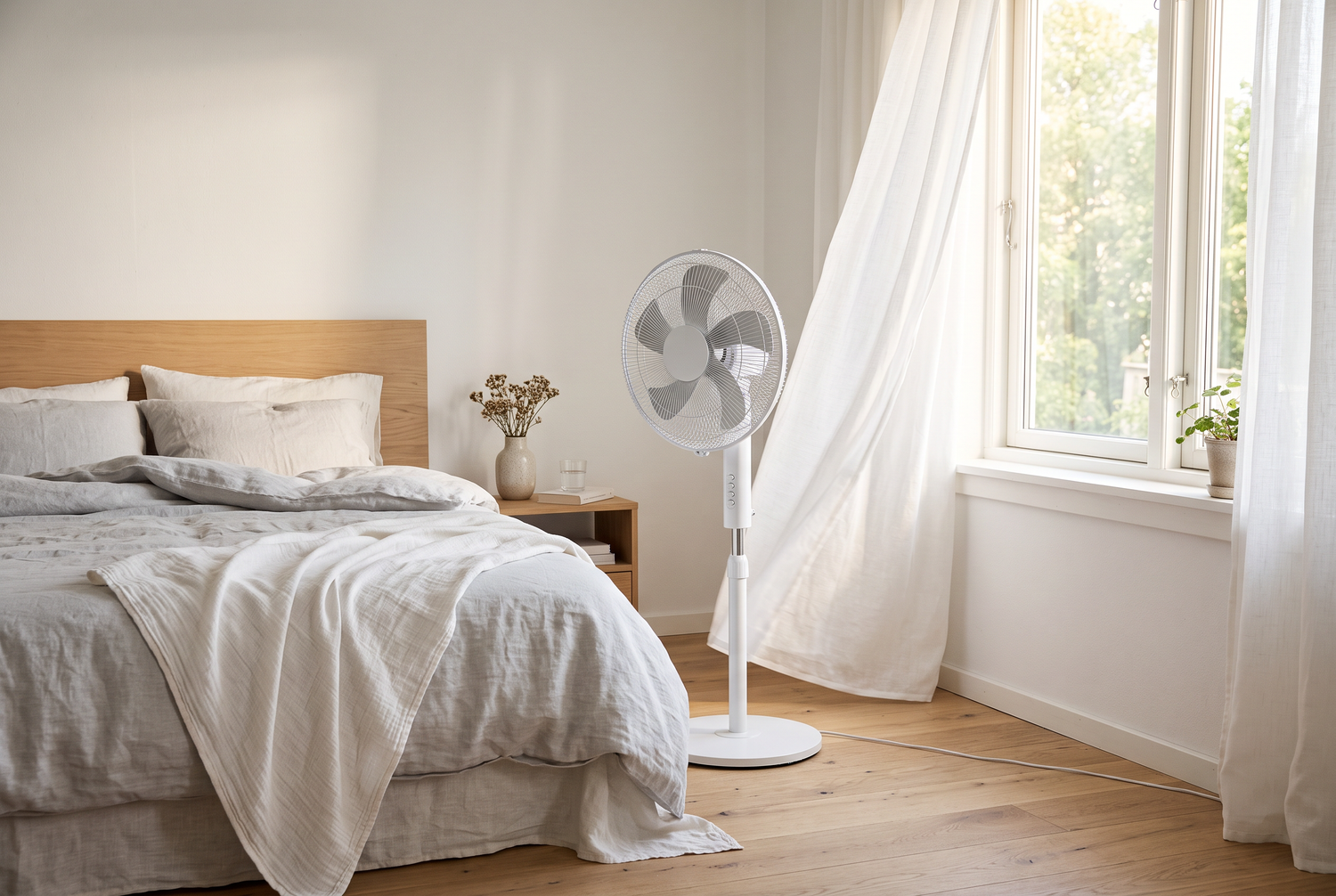
As soon as the bedroom thermometer climbs above 24 degrees Celsius, fan season begins in many Swiss households, and with it, the discussion: some swear by the cooling draft and the steady hum, while others warn of stiff necks, dry eyes, and colds. What's true? A brief preview: For most people, a fan is a sensible, inexpensive, and energy-saving aid on hot nights if used correctly, and that's often where the problem lies. Drafts directed straight at the head, full power, and a dusty rotor can indeed turn the helper into a nuisance. In this article, we clarify how a fan works physically, what it can and cannot do, who should be cautious, and what settings will help you get through the night cool and symptom-free.
The short answer: Yes, sleeping with a fan at night is harmless for healthy people and often the best simple solution in hot weather. Correct use is important: do not direct the airflow directly and continuously at your head and neck; instead, use it indirectly or in oscillation mode, maintain a distance of at least 2 meters, and choose a low setting. Those prone to dry eyes, allergies, or neck tension should use a timer and indirect airflow. A fan does not lower the room temperature but reduces the perceived temperature by 2 to 4 degrees, at electricity costs of only a few cents per night.
- A fan doesn't cool the air, but the body: the airflow improves the evaporation of sweat and lowers the perceived temperature by 2 to 4 degrees.
- Health risks are low: drafts do not cause colds, but they can contribute to muscle tension and dry out mucous membranes.
- Proper placement: at least 2 meters away, in oscillation mode or directed at a wall, low setting, timer for the second half of the night.
- The steady hum acts like white noise for many and masks disturbing sounds.
- At 20 to 60 watts, a fan uses only a fraction of the electricity of an air conditioner per night, costing around 5 to 15 cents.
How a fan actually cools
First, the most common misconception: a fan does not lower the room temperature; on the contrary, its motor even emits a minimal amount of heat. Nevertheless, the draft feels cool, and two mechanisms are responsible for this. First, convection: moving air carries away the warm layer of air directly above the skin and replaces it with cooler room air. Second, and more importantly, evaporative cooling: the airflow accelerates the evaporation of sweat, and evaporation extracts heat from the skin, the same effect that makes wet skin feel cold in the wind. Together, this lowers the perceived temperature by about 2 to 4 degrees, and even more with noticeable air movement. This leads to an important limitation: in extreme heat above about 35 degrees room temperature and simultaneously high humidity, evaporation works less effectively, so the fan provides little benefit; however, Swiss bedrooms rarely reach such temperatures. For a typical summer night with 24 to 30 degrees in the room, the effect is significant, and it helps the body exactly where it matters for sleep: the core body temperature must be able to drop by about 0.5 to 1 degree to fall asleep, more on this in the article on the ideal sleeping temperature.
The advantages: cooling, noise, air circulation
Besides its cooling effect, a fan brings two side effects that many users might not name as the primary reason, but which are real. Firstly, the sound: the steady, broadband hum acts like natural white noise, raises the ambient noise level in the room, and masks individual disturbing noises like street noise or snoring from the next room; the principle is explained in the article on white noise. Studies with sleep apps and surveys show that many people subjectively fall asleep and stay asleep better with constant background noise, especially in urban areas. Secondly, air circulation: in rooms that have heated up during the day, warm air accumulates under the ceiling and near the bed; a fan mixes the layers and accelerates cooling during the night, especially effective in combination with cross-ventilation: if it is placed by an open window at night and blows cool outside air in or warm inside air out, the actual room temperature drops faster. How to combine this technique with shading and ventilation routines is shown in the guide Cooling the bedroom in summer.

The possible disadvantages honestly considered
The common concern that drafts cause colds is unfounded; colds are caused by viruses, not by cold air. Nevertheless, three points deserve attention. Firstly, muscle tension: constant cold drafts on the neck and shoulders can reduce local blood circulation to the muscles and, in sensitive individuals, promote tension; the classic "stiff neck" after a night with a fan is usually exactly that, more on causes and remedies in the article on neck tension in the morning. Secondly, dry mucous membranes: the constant airflow also accelerates evaporation from the eyes, nose, and mouth; those who sleep with their mouth open or wear contact lenses are more likely to wake up with a dry throat or burning eyes. Thirdly, dust and allergens: a fan stirs up dust, pollen, and dust mite allergens from the floor, relevant for allergy sufferers; regular vacuuming, cleaning the rotor blades, and choosing low-pollen ventilation times alleviate the problem; additional tips are offered in the article on a low-pollen bedroom. All three points can largely be avoided with indirect airflow, oscillation mode, and a timer.
Fan types compared
| Type | Noise level (low setting) | Strengths in the bedroom |
|---|---|---|
| Pedestal fan | approx. 35–50 dB | Plenty of air, adjustable height, oscillation mode |
| Tower fan | approx. 40–55 dB | Slim, wide air distribution, often with timer |
| Ceiling fan | approx. 30–45 dB | Indirect, wide-area air movement, very quiet models |
| Desk/USB fan | approx. 30–45 dB | Affordable, portable, for spot cooling |
For bedrooms, it's worth checking the manufacturer's decibel rating at the lowest setting: values around 35 decibels correspond to a soft whisper and do not disturb most sleepers; models with DC motors are clearly advantageous here.
Fan or air conditioning: what makes more sense?
Air conditioning is the only solution that genuinely lowers the room temperature, and during heatwaves with tropical nights above 20 degrees Celsius outdoor temperature, this can be a real benefit. The price for this is high: a split unit requires permits and installation, monoblock units are often louder than any fan at 50 to 65 decibels, and electricity consumption is 10 to 30 times that of a fan, at 500 to 1000 watts. Specifically: a 40-watt fan consumes 0.32 kilowatt-hours in 8 hours, which is about 8 to 10 cents per night. An 800-watt monoblock uses about 6.4 kilowatt-hours, costing over 1.50 francs, quickly amounting to 50 to 100 francs difference per month in summer. Therefore, for most Swiss summer nights, a combination of consistent shading during the day, cross-ventilation in the cool morning hours, a light summer duvet, and a fan is sufficient. Air conditioning remains the solution for attic apartments and extended heat periods. If poor sleep is primarily due to sweating, you should also check your mattress and bedding; breathable materials make a greater difference than many expect. Tips on this can be found in the article Sleeping in hot weather.

Get CHF 25 discount
Subscribe to our newsletter and receive a one-time CHF 25 discount. ✓ 200 nights trial sleep ✓ 10 years warranty
Practical advice: setting up your fan correctly
Position: Place the device at least 2 meters from the bed and do not direct the airflow directly at your head and upper body. Two proven methods: oscillation mode, where the airflow briefly sweeps over your body every few seconds, or indirect airflow, where the fan blows against a wall or across the room, so only the general air movement reaches the bed. Setting: Start low; even a slight breeze is enough for evaporative cooling. Full power provides little additional cooling but more noise and dryness. Timer: Your body temperature naturally drops in the second half of the night, so a timer for 2 to 4 hours is often sufficient and protects mucous membranes and your electricity bill; if you let it run all night, place a thin cloth over your shoulders and neck. Hygiene: Wipe the rotor blades and grille weekly, otherwise the device will distribute dust in the room. Window combination: In the cooler hours after midnight, place it by an open window to draw in cool air. During the day, keep the window closed and shaded.
Frequently Asked Questions about Fans at Night
Is it unhealthy to sleep with a fan at night?
Not for healthy people. Drafts do not cause colds; dry mucous membranes and muscle tension from direct, continuous drafts are possible. These effects can largely be avoided by maintaining distance, using oscillation mode, and a low setting.
Does a fan cool the bedroom?
No, it does not lower the room temperature, but it reduces the perceived temperature by 2 to 4 degrees by accelerating the evaporation of sweat. Only with an open window can it additionally draw cool outside air into the room.
Can a fan cause a stiff neck?
It's possible: constant cold drafts on the neck and shoulders can reduce muscle blood flow and promote tension in sensitive individuals. Therefore, do not direct the airflow directly at the head area or use the oscillation mode.
How much electricity does a fan consume per night?
Typical devices consume 20 to 60 watts. At 40 watts and 8 hours of operation, that's 0.32 kilowatt-hours, or about 8 to 10 cents per night, a fraction of what an air conditioner consumes.
Is a fan suitable for allergy sufferers?
With limitations: it can stir up dust, pollen, and dust mite allergens. Allergy sufferers should regularly clean floors and rotor blades, ventilate indirectly during pollen season, and choose low-pollen ventilation times.
Which fan is the quietest for the bedroom?
Models with DC motors, large rotor blades, and low rotation speed, often pedestal or ceiling fans with specifications around 30 to 35 decibels at the lowest setting. This corresponds to a soft whisper and is perceived by most as a pleasant hum.
This article is for general information and does not replace medical advice.








Leave a comment
This site is protected by hCaptcha and the hCaptcha Privacy Policy and Terms of Service apply.