
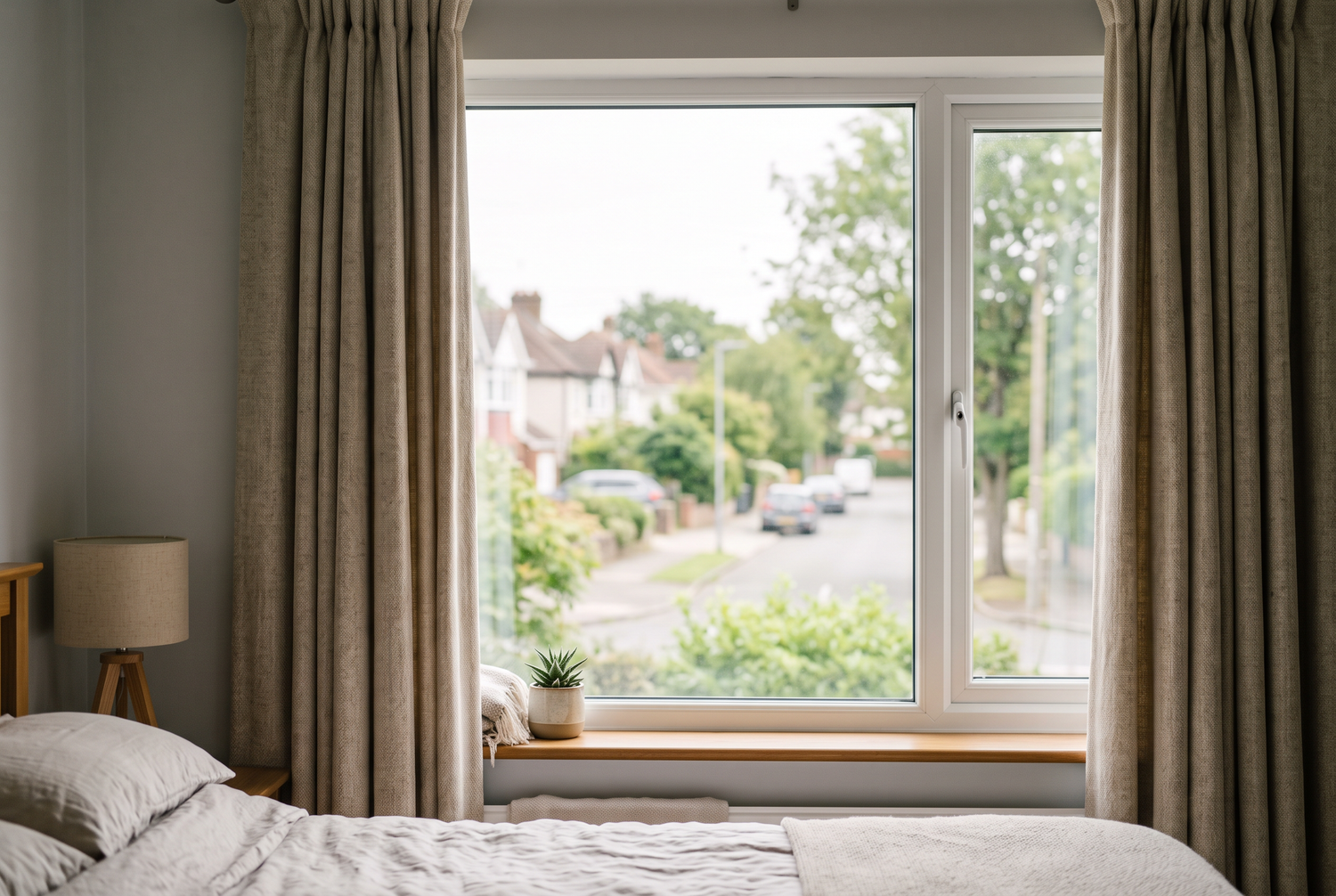
Anyone living on a busy street knows the pattern: it finally gets quiet around midnight, rush hour traffic starts at five, and in between, a single motorcycle jolts you awake from deep sleep. Road noise is by far the biggest source of noise in Switzerland: according to the Federal Office for the Environment, about one in seven people during the day and about one in eight at night are exposed to harmful or annoying traffic noise at their place of residence. The insidious thing: even those who believe they have gotten used to the noise still show arousal reactions, increased heart rate, and less deep sleep in the sleep lab. The good news is that almost any living situation can be significantly improved with a combination of structural, textile, and acoustic measures, often without major investment. This article categorizes the measures by effect and effort, from window seals for a few francs to soundproof windows.
The short answer: The most effective chain against road noise during sleep is window, room, ear: first, tight or soundproofed windows (new seals often already provide 3 to 5 decibels, soundproof windows 10 to 15), second, a sound-absorbing room furnished with heavy curtains, carpet, and a full wardrobe wall facing the noise, third, earplugs or constant background noise that covers individual noise peaks. If possible, move the bedroom to the side facing away from the street; this is the most effective single measure of all.
- The WHO recommends that for restful sleep at night, outdoor noise should ideally be below 40 decibels; individual noise peaks are more disruptive than a steady level.
- The body subjectively gets used to noise, but still reacts with arousal and stress hormones; "I don't hear it anymore" is deceptive.
- Windows are the main entry point: renew seals, avoid gap ventilation, and install soundproof windows of class 3 to 4 if necessary.
- Textiles work: heavy curtains, carpet, and a full wardrobe on the street-facing wall significantly reduce reverberation and indoor noise levels.
- Earplugs (20 to 35 decibels of attenuation) and white noise are the fastest and cheapest immediate solutions.
What noise does to the body at night
Hearing knows no sleep mode; it monitors the environment all night long. Sounds from about 33 to 40 decibels in the bedroom can trigger arousal reactions, often so brief that one does not remember them in the morning, but the sleep architecture still suffers: less deep sleep, more light sleep, more frequent changes. Particularly disturbing are not constant levels, but events—the single motorcycle, the door, the night bus—because the brain evaluates sudden changes as a potential danger and briefly switches to alarm. This causes heart rate and blood pressure to rise measurably, even without conscious awakening. Long-term studies link sustained nocturnal traffic noise to increased risks for high blood pressure and cardiovascular diseases; the WHO classifies noise as a significant health risk accordingly. Important for understanding: subjective habituation does not mean physiological habituation. Anyone who has slept on a main road for years and often wakes up exhausted in the morning should take noise seriously as a possible cause, even if they no longer consciously perceive it.
Step 1: Analyze noise sources and entry paths
Before you invest, a quick analysis is worthwhile. Lie in bed in the evening and listen carefully: Does the noise primarily come through the window, through the wall, or over the floor? In most cases, the window is the main entry point, because even a simple brick wall insulates with 45 to 50 decibels far better than an old window with 25 to 30. A simple test: Hold your ear to the closed window sash and then to the wall next to it; the difference is usually clear. Also check the seals by clamping a sheet of paper and closing the sash: If it can be pulled out, the seal is worn out. Also note when the noise is disturbing: Continuous traffic noise requires different measures (insulation, masking) than individual nocturnal peaks (earplugs, changing window sides). And ask the systemic question: Is there a quieter room in the apartment on the courtyard side? Moving the bedroom costs nothing and often brings 10 to 20 decibels, more than any window.

Step 2: Upgrade the window
Window measures, ordered by effort: New silicone or EPDM sealing strips cost a few francs per meter, can be installed by yourself in an hour, and often provide 3 to 5 decibels of improvement with worn seals, which is not quite a halving of perceived loudness subjectively, but clearly audible. Second: give up tilt ventilation. A tilted window reduces sound insulation to almost zero; it's better to ventilate thoroughly before going to bed and keep the window closed overnight, as described in the article proper ventilation. Third: For single glazing or very old insulating glass, it's worth looking at soundproof windows. They are divided into classes; Class 3 insulates about 35 to 39 decibels, Class 4 about 40 to 44. Compared to an old window, an improvement of 10 to 15 decibels is realistic, which is perceived as roughly a halving to quartering of the perceived loudness. Tenants should ask their administration; in heavily polluted streets, there are sometimes cantonal funding programs for soundproof windows. Fourth, the compromise solution for fresh air fans: sound-insulated ventilators that draw air through the wall while the window remains closed.
Step 3: Furnish the room to absorb sound
Once inside, noise can be further mitigated. Hard, empty rooms act like echo chambers, making every sound louder and sharper. Textile surfaces dampen: a large carpet, heavy floor-length curtains, a padded headboard, and pictures with acoustic fleece noticeably reduce reverberation; how to choose curtains with blackout and insulating properties is shown in the curtain guide. The most effective furniture trick: Place a large, full wardrobe against the wall facing the noise source, be it the street or noisy neighbors; the additional mass acts like a secondary wall and dampens low-frequency sound that textiles alone cannot achieve. The bed position also matters: the further the bed is from the window, the lower the noise level at the ear; in a 4-meter-deep room, this can make a difference of 3 to 6 decibels. A side effect of textile upgrades: the room feels warmer and cozier, which further aids falling asleep.
Step 4: Masking and earplugs as an immediate solution
If structural measures are not sufficient or not possible, two proven immediate solutions remain. First, masking: a constant, broadband background noise, white or pink noise, a quiet fan, raises the basic level and makes individual noise peaks less prominent; the brain no longer registers the sudden change as an alarm. Studies show mixed, but predominantly positive effects in noisy environments; a moderate volume of about 40 to 50 decibels is important, details in the article on white noise. Second, earplugs: foam earplugs, when inserted correctly, attenuate 25 to 35 decibels and are inexpensive; wax and silicone earplugs are often more comfortable for side sleepers with 20 to 27 decibels of attenuation, and custom-made otoplastics combine comfort with targeted attenuation. With all variants, you can generally still hear the alarm clock. Which type of earplug suits which ear and how to use earplugs hygienically can be found in the guide Sleep Mask and Earplugs.
Measures at a glance: effect and cost
| Measure | Typical Effect | Effort/Cost |
|---|---|---|
| Move bedroom to courtyard side | 10–20 dB less at the ear | Free, just rearranging |
| Renew window seals | 3–5 dB with worn seals | Low, DIY |
| Heavy curtains, carpet, wardrobe wall | Noticeably less reverberation and peaks | Medium, cozy side effect |
| Soundproof windows Class 3–4 | 10–15 dB compared to old windows | High, partly cantonal funding |
| Earplugs | 20–35 dB attenuation directly at the ear | Very low, immediately effective |
| White noise/fan | Masks noise peaks | Low, immediately effective |

Get a CHF 25 discount
Subscribe to our newsletter and receive a one-time CHF 25 discount. ✓ 200 nights trial sleep ✓ 10-year warranty
Common mistakes when dealing with nocturnal noise
Mistake 1: Sleeping with a tilted window and complaining about noise; the tilted position renders any glazing ineffective; it's better to ventilate thoroughly before sleeping and close the window. Mistake 2: Relying on habituation. The stress system continues to react, even if consciousness blocks out the noise; chronic fatigue despite "sufficient" sleep is a warning sign. Mistake 3: Incorrectly inserting earplugs. Foam plugs must be rolled, inserted deeply, and held while expanding, otherwise half of the 35 decibels of attenuation is lost. Mistake 4: Using music or podcasts as continuous background noise. Changing content activates the brain; only uniform noise is suitable for masking. Mistake 5: Reaching for the clock when waking up at night due to noise and getting annoyed about the lost time; this keeps you awake more than the noise itself; it's better to lie still and slow down your breathing. Mistake 6: Implementing only a single measure and giving up. Noise protection works as a chain; only the combination of a tight window, a muffled room, and an ear solution brings decisive peace in difficult situations.
Frequently asked questions about road noise and sleep
How loud can it be in the bedroom at night?
For restful sleep, the indoor noise level should ideally be below about 30 decibels; arousal reactions are possible from about 33 to 40 decibels. The WHO recommends outdoor noise levels below 40 decibels in front of the window at night.
Do you get used to road noise?
Only subjectively. Consciousness blocks out familiar noise, but the body and brain continue to react with brief arousal reactions, increased heart rate, and stress hormone surges. Persistent nocturnal noise therefore remains a health risk.
What helps most against road noise in the bedroom?
The most effective single measure is moving to a room on the side facing away from the street. This is followed by tight or soundproof windows, a textile-dampened room, and as immediate solutions, earplugs or white noise.
Do heavy curtains help against traffic noise?
They noticeably dampen reverberation and mid-to-high frequencies, making the room quieter, but they are only of limited effect against low-frequency traffic hum. The combination with tight windows and a wardrobe wall facing the noise provides the most benefit.
Can I oversleep my alarm with earplugs in?
Generally not: Earplugs attenuate 20 to 35 decibels, and an alarm clock near the bed is significantly louder and will penetrate. If you are unsure, test it with a trial alarm on the weekend or use a vibrating alarm clock.
Is sleeping with white noise healthy?
At a moderate volume of about 40 to 50 decibels, it is considered harmless and can effectively mask noise peaks. However, it should not be set louder than necessary, and those who sleep well without it do not need it.
This article is for general information purposes only and does not replace medical advice.






Leave a comment
This site is protected by hCaptcha and the hCaptcha Privacy Policy and Terms of Service apply.