
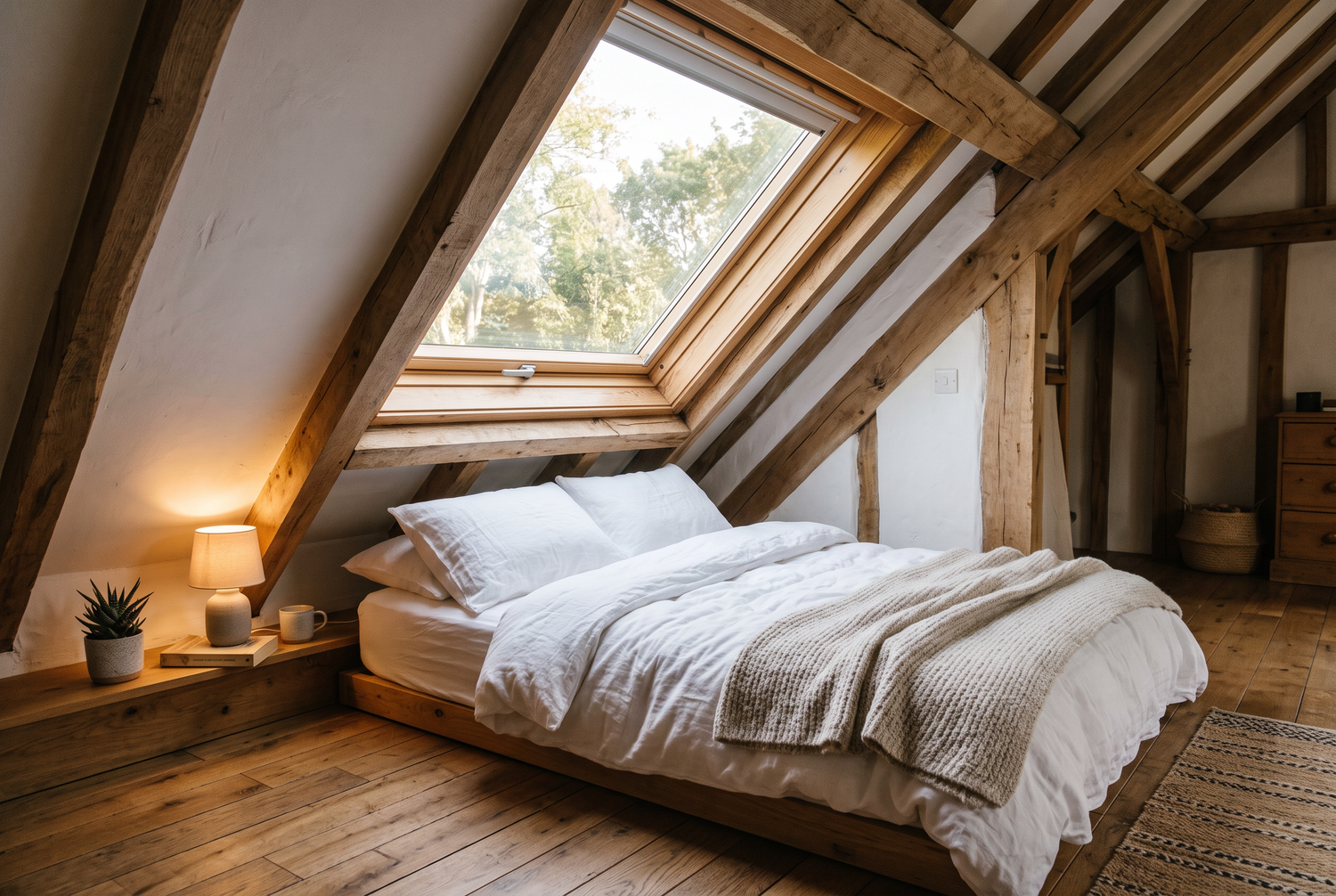
Bedrooms under the roof have two faces: In photos, with visible beams, skylights, and sloped walls, they look cozy like a mountain hut; in everyday life, their residents struggle with bumped heads, lack of storage, summer heat, and the eternal question of where the bed even fits. Yet, the sloped ceiling is not a disadvantage but a planning task: By assigning the low zones to the bed and storage and keeping the high zones clear for movement, you can transform the seemingly difficult room into a bedroom with more coziness than any standard rectangular room. In this guide, we systematically go through the planning, from bed position to custom furniture and climate, to lighting and colors, with concrete measurements, so that the theory also works under your roof.
The short answer: Place the bed with the headboard under the slope, ensuring at least 70 to 80 cm of clear height above the mattress edge at the head end for upright sitting, and keep the areas with full room height clear for wardrobes and movement. Use the knee wall for storage with low chests of drawers or built-in cabinets. Against summer heat, external shading on the skylight and nightly cross-ventilation help; against darkness, bright colors and several warm light sources are effective. This way, the slope transforms from an obstacle into the coziest corner of the room.
- Rule of thumb for bed position: at the head end, at least 70 to 80 cm of clear height above the mattress, allowing for upright sitting and reading.
- Zone distribution by height: below 1 m knee wall for storage, 1 to 1.8 m for bed and chests of drawers, above 1.8 m for wardrobe and walkways.
- Attic rooms heat up the most in summer; external shading on the skylight is up to three times more effective than internal blinds.
- Bright colors, continuous wall-ceiling tones, and several warm light sources make low rooms appear larger.
- Custom furniture and low sideboards utilize the knee wall; tall standard wardrobes belong on the gable wall.
Understanding the space: dividing zones by height
The key to an attic slope is dividing the floor plan by usable height instead of area. Measure three lines and mentally mark them on the floor: Where is the room lower than approximately 1 meter (pure storage space), where is it between 1 and 1.8 meters (sitting and lying zone), and where is it higher than 1.8 meters (standing and movement zone)? This map dictates the entire furnishing. The most common planning mistake is placing the bed in the high zone: The bed does not need standing height, but the wardrobe and the path to the door certainly do. If the slope is on the long side of the room, the bed moves with its headboard under the slope, and the gable wall or the high wall accommodates the wardrobe. A second consideration is the knee wall height, i.e., the vertical wall under the slope: From about 60 to 80 cm knee wall, the bed can be comfortably placed against it without the slope hanging directly over one's face. If you are building new, ideally plan the knee wall in the sleeping area with this height from the start.
The bed position: head under the slope, but correctly
Sleeping under a sloped ceiling feels cozy for most people, as long as two measurements are right. First, the sitting height: There should be at least 70 to 80 cm of space above the top edge of the mattress at the head end, so you can sit upright, read, and get up in the morning without ducking your head; with a mattress height of about 25 cm and usual bed height, this means the slope should still have about 1.3 to 1.5 meters of room height at the headboard. Second, the getting-up side: At least one side of the bed needs standing height or at least 1.8 meters along its entire length, otherwise every nightly getting up becomes a head-bumping lottery. Couples therefore usually place the bed parallel to the slope with access from the high side, or across with the headboard at the knee wall. If the bed is under a skylight, remember to consider blackout and that it can be noisy when it rains, but you'll be rewarded with a starry sky. Regarding bed height itself under the slope: lower is better; a low bed frame creates valuable centimeters of headroom. What matters for choosing the right height is explained in the guide to ideal bed height.

Storage space: the knee wall is your friend
Attic rooms are considered to have little storage space, yet the storage space is right before your eyes, just low. The zone below 1 meter height, where no one wants to stand or lie, is perfect for drawer chests, lowboards, and rolling boxes; when fitted with custom-made built-in wardrobes that follow the roof pitch, bedding, suitcases, and seasonal clothing disappear completely. If you don't want to invest in custom furniture, a cheaper combination works: low standard chests of drawers (60 to 80 cm high) along the knee wall, with the slope above remaining free for pictures or a light strip. Open shelves in the slope itself are tricky; they collect visible dust and make the room appear cluttered, while closed fronts look calmer. The high area on the gable wall accommodates the wardrobe; if the width is insufficient, two narrow, tall wardrobes to the left and right of the door are often a better solution than a deep wardrobe that eats up floor space. And under the bed? A bed box or flat boxes are legitimate in an attic room; every cubic meter counts here, as long as the mattress remains well ventilated.
Climate under the roof: managing heat and cold
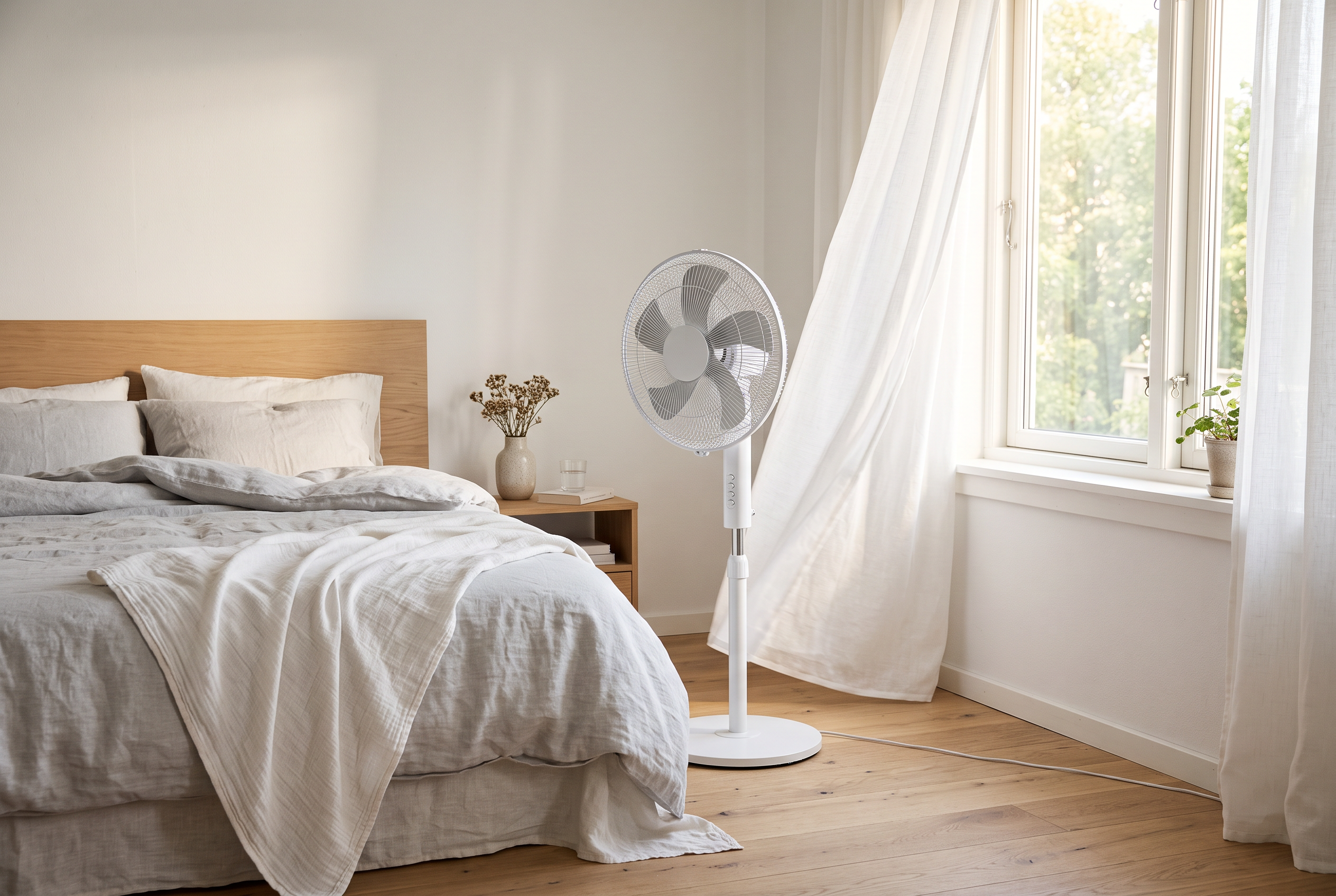
No room in the house reacts more strongly to the weather than the attic: in summer, poorly insulated attic rooms heat up to 30 degrees Celsius and more, in winter they cool down faster than any other room. For sleep, summer heat is the bigger problem, because body temperature must be able to drop for falling asleep; ideal room temperatures are 16 to 19 degrees Celsius, as described in the article on ideal sleeping temperature. The hierarchy of measures: external shading first; a heat protection roller shutter or awning on the outside of the skylight blocks radiation before it reaches the glass, and is thus significantly more effective than any internal blind. Next, the ventilation strategy: close windows and shade during the day, cross-ventilate at night and early morning, ideally with a skylight above and a facade window below; the chimney effect draws warm air out. The basics are explained in the article proper ventilation. Additionally, a fan, light summer bedding, and all the tricks from the guide cooling the bedroom in summer help. In winter, the opposite applies: check slopes and knee walls for drafts, because leaky connections make themselves felt as cold air drafts directly above the bed.
Knee wall height and usage at a glance
| Room height in the zone | Sensible use | Better avoid |
|---|---|---|
| below 1.0 m | Built-in storage, chests of drawers, boxes | Bed position with slope directly over face |
| 1.0–1.4 m | Headboard of the bed, bench, reading nook | Wardrobe, mirror, workspace |
| 1.4–1.8 m | Complete bed, low shelves, chests of drawers | Main walkways |
| above 1.8 m | Wardrobe, door, walkways, dressing area | Obstruct with storage |
Light and colors: optically opening up the space
Attic rooms often have small windows and many intricate surfaces that cast shadows, making lighting planning more crucial than in a standard room. Rule number one: Paint walls, slopes, and ceiling in the same light tone; this optically dissolves the edges and makes the room appear higher; contrasting slopes visually cut up small rooms. Warm white and natural tones or very light, muted nuances are suitable. More on the effect of individual tones can be found in the article on bedroom wall colors. Rule number two: several small, warm light sources instead of a single ceiling light, which rarely fits under the slope anyway; wall lights on the gable wall, an LED light strip along the knee wall, and dimmable bedside lamps, all in warm white 2700 Kelvin, are proven solutions. Rule number three: don't forget skylight blackout. Skylights act like roof windows and allow summer light to fall directly onto the bed from 5:30 AM; custom-fit blackout blinds with side guide rails provide a remedy. The selection criteria are explained in the curtain and blackout guide.

Get CHF 25 discount
Subscribe to the newsletter and receive a one-time CHF 25 discount. ✓ 200 nights trial sleep ✓ 10 years warranty
Common mistakes in attic bedrooms
Mistake 1: Placing the bed in the highest room zone and squeezing the wardrobe under the slope – it should be the exact opposite. Mistake 2: Not measuring the headroom at the head end; anyone who ducks their head every morning will unconsciously develop an aversion to their own bed; 70 to 80 cm above the mattress is the minimum. Mistake 3: Placing a high box spring or storage bed under the slope; every centimeter of bed height reduces headroom. Flat bed frames are advantageous under slopes, and what matters for choosing one is explained in the guide Choosing a bed frame. Mistake 4: Ignoring summer heat and only darkening indoors; without external shading, the attic room remains an oven. Mistake 5: Dark colors on the slopes; they visually push the room down; dark accents, if any, belong on the vertical gable wall. Mistake 6: Choosing mattresses and bedding as in a normal room; temperatures fluctuate more strongly under the roof, so breathable, climate-regulating materials pay off twice as much here.
Frequently asked questions about bedrooms with sloped ceilings
What's the best way to place a bed in a room with a sloped ceiling?
With the headboard under the slope or against the knee wall, ensuring at least 70 to 80 cm of clear height above the mattress at the head end. At least one side of the bed should be comfortably accessible along its entire length.
How high does the knee wall need to be for a bed?
From about 60 to 80 cm knee wall height, a bed can be comfortably placed without the slope hanging directly over one's face. Ultimately, the sitting height above the mattress at the head end is decisive.
Is sleeping under a sloped ceiling unhealthy?
No, there are no health concerns; many even find the niche cozy. Important factors are sufficient headroom, good room ventilation, and a tolerable summer climate under the roof.
What can I do about heat in an attic bedroom?
External shading on the skylight first, as it's significantly more effective than internal blinds. Additionally, keep windows closed during the day, cross-ventilate at night and early morning, and use a fan and light bedding for extra help.
What colors are suitable for rooms with sloped ceilings?
Light, warm tones, consistently applied to walls, slopes, and ceilings. Uniform colors visually dissolve room edges and make low rooms appear taller; dark accents, if any, belong on the vertical gable wall.
Where should the wardrobe go in an attic room?
Against the gable wall or a wall zone with over 1.8 m height. The knee wall under the slope should instead be used for storage with low chests of drawers or custom-built cabinets.








Leave a comment
This site is protected by hCaptcha and the hCaptcha Privacy Policy and Terms of Service apply.